
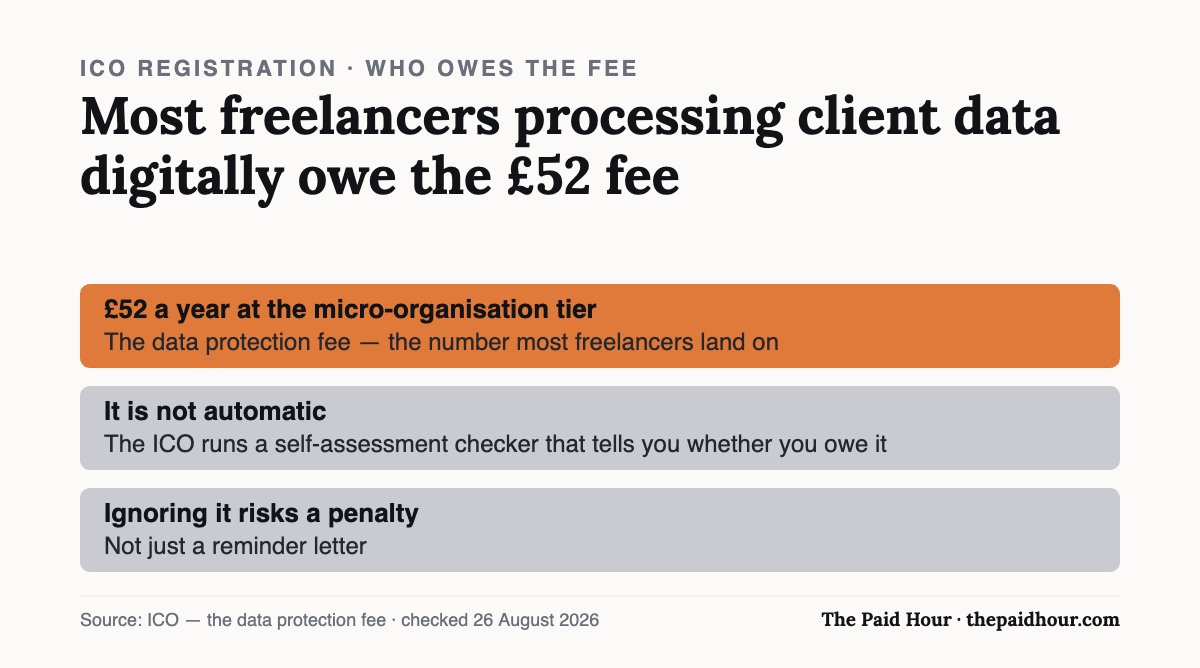
The short version: Registering with the ICO is not automatic for the self-employed, but most freelancers processing client data digitally owe the data protection fee, for micro organisations it is currently £52 a year. The ICO runs a self-assessment checker; ignoring the fee risks a penalty, not just a reminder.
ICO registration self-employed status doesn’t automatically require, but most freelancers processing personal data digitally do need to pay the fee. “GDPR” can feel like something only big companies worry about. It isn’t. Under the Data Protection (Charges and Information) Regulations 2018, most organisations (including sole traders), that process personal information have to pay an annual data protection fee to the Information Commissioner’s Office (ICO), separate from registering for Self Assessment or VAT (ico.org.uk). Miss it and the ICO can fine you. Here’s what applies to a one-person freelance business.
Do I need to register with the ICO?
Probably yes, unless your processing falls entirely within a specific exempt category. The ICO’s rule of thumb: if you hold or process personal data electronically (client names, email addresses, phone numbers, even a CRM or invoicing spreadsheet with contact details), you’re likely a “data controller” and need to pay the fee, unless an exemption applies (ico.org.uk).
This catches more freelancers than you’d expect. A designer with a client list in Notion, a copywriter using Mailchimp, a VA storing contact details in Google Sheets, all of that is “automated processing of personal data” in the ICO’s terms.
ICO registration exemptions, do I qualify?
The ICO exempts organisations whose processing is only for one or more of these specific purposes (ico.org.uk):
- Staff administration (your own employee/HR records)
- Advertising, marketing and public relations (for your own business)
- Accounts and records (statutory accounting and financial record-keeping)
- Not-for-profit purposes
- Personal, family or household affairs
- Maintaining a public register
- Judicial functions
- Non-automated processing (paper-only, no computer involved)
- Elected/prospective representatives (a niche category rather than relevant to most freelancers)
The catch is the word “only.” The accounts-and-records exemption, for example, covers keeping your own financial records, it does not cover holding client contact details for project delivery, invoicing clients through software, or running an email list. Most freelancers who use client data for actual client work, not just their own bookkeeping, fall outside these exemptions and need to pay. Even if you are exempt, you still have to follow the rest of UK GDPR (lawful basis, security, data subject rights), the exemption is only from the fee (ico.org.uk).
If you’re not sure, don’t guess: the ICO’s own self-assessment tool at ico.org.uk/fee-checker takes about 10 minutes and gives you a personalised answer on whether you owe the fee and which tier applies (ico.org.uk).
How much is the data protection fee for ICO registration?
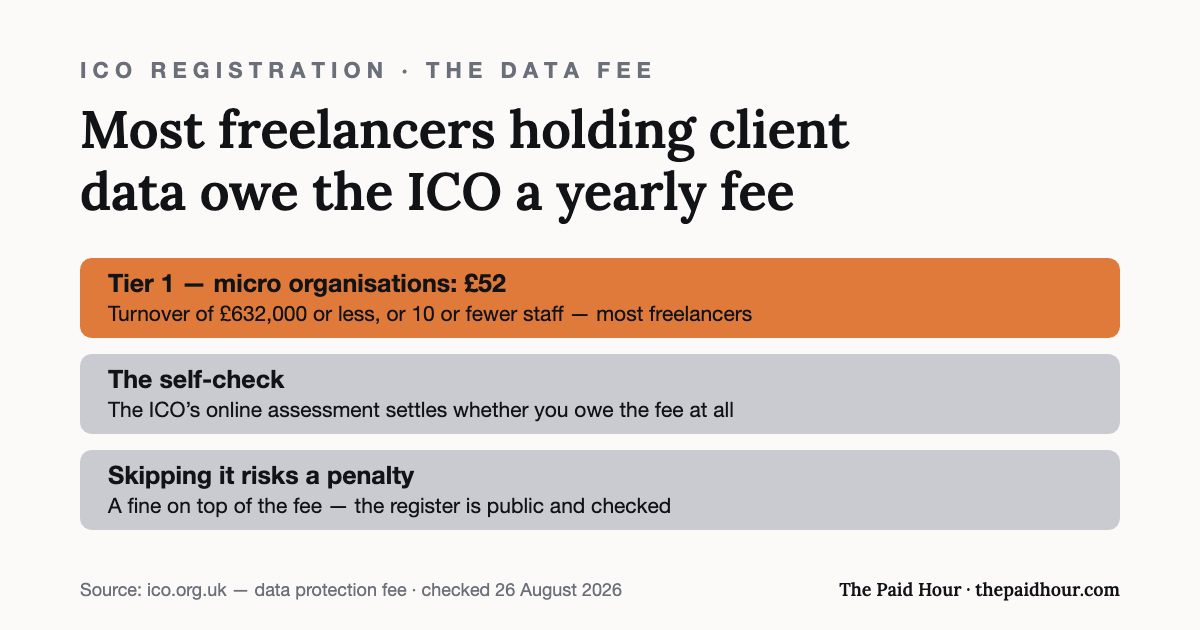
If you do need to pay, most sole traders fall into Tier 1 (micro organisations), currently £52 a year, which applies if your turnover is no more than £632,000 and you have no more than 10 staff: comfortably covering the vast majority of freelancers (ico.org.uk).
The full fee structure:
| Tier | Who it’s for | Fee |
|---|---|---|
| Tier 1 | Micro organisations (turnover ≤£632,000 or ≤10 staff) | £52 |
| Tier 2 | Small/medium organisations (turnover ≤£36m or ≤250 staff) | £78 |
| Tier 3 | Large organisations (above those thresholds) | £3,763 |
Charities and small occupational pension schemes pay the Tier 1 rate regardless of size. There’s a £5 discount if you pay by Direct Debit (ico.org.uk). Registration is annual, you renew each year rather than a one-off payment.
What happens if I skip ICO registration?
The ICO can issue a fixed penalty notice. Its published fixed penalty for a Tier 1 (micro) organisation failing to pay is £400, rising to £600 for Tier 2 and £4,000 for Tier 3. The ICO says it reserves the right to increase any of these up to the statutory maximum of £4,350, for example where a controller doesn’t cooperate or provide the information needed to assess what they owe (ico.org.uk). In other words, a £52-a-year fee turns into a penalty many times that size if the ICO catches you not paying, and this is separate from any wider UK GDPR enforcement action for actual data breaches, which can be far higher.
How do I complete ICO registration and pay?
The process is straightforward and entirely online:
- Go to ico.org.uk/fee and choose “first time payment” if you’ve never registered.
- Not sure if you need to? Run the self-assessment tool first at ico.org.uk/fee-checker.
- The application takes roughly 15 minutes: you’ll answer questions about your business size, turnover, and what data you process (ico.org.uk).
- Pay online (card or Direct Debit: Direct Debit gets you the £5 discount).
- Set a reminder to renew annually: the fee doesn’t roll over automatically like some subscriptions.
If you’re already registered and just need to renew, go to the same ico.org.uk/fee page and select “renew” instead.
So do you need to register, or not?
If you use client contact details in an invoicing tool, CRM, or email list as a freelancer, assume you need to register unless you can clearly tick one of the ICO’s exemption boxes, and if in doubt, use their self-assessment tool instead of guessing. At £52 a year for most sole traders, it’s cheap insurance against a £400+ fixed penalty. That’s the short version of ICO registration self-employed rules — check if you qualify for an exemption before assuming you don’t need to register.
This connects directly to two things every freelancer already does: putting client details on invoices (see What a UK Invoice Must Include) and choosing accounting software that stores that same client data (see Best Accounting Software for UK Freelancers), both are exactly the kind of processing that can trigger the fee requirement.
Flagged for the record: fee amounts, penalty amounts, and the exemption list are all set by the ICO and can change, this post reflects what ico.org.uk stated in August 2026. Always check ico.org.uk/fee or run the self-assessment tool for your current, individual position rather than relying on this post alone. This is general information, not legal advice.
Correction, 26 August 2026: the summary box at the top of this guide gave the ICO tier-1 data protection fee as £40. The correct figure, sourced in the article itself, is £52. The box, the chart and the checked-date line were corrected. See the corrections log.
Paying the fee is one duty; reporting a breach within 72 hours is the other, and no insurance policy removes it. There is more on both, and on the £25,000 of cover bundled with Cyber Essentials, in cyber insurance for freelancers.
Sources
- ICO, Data protection fee self-assessment
- ICO: Guide to the data protection fee (tiers and amounts)
- ICO, Exemptions from the data protection fee
- ICO. Fixed penalties for failure to pay the data protection charge
- ICO, Data protection fee: what you need to do
Reviewed 26 August 2026; fee amounts are as published on ico.org.uk (linked above), confirm there before paying. The tier-1 fee and thresholds are as published by the ICO and linked above.
Insurance sized to a guess?
Protect the Business: Legal, IP & Insurance 2026/27. Eight modules and five working sheets built around a complete annotated freelance contract, with a negotiation note under every clause.
- Registering a trade mark yourself: searching, classes, fees and the opposition period
- UK GDPR without a consultant: the ICO fee tiers, a privacy notice, and the 72-hour breach plan
- An insurance sizing calculator by work type, and the client clauses never to sign as they stand, with the redline for each
You own the copyright in what you make until you assign it in writing. Most clients assume the opposite, and most freelance contracts are silent on it.
Buying more than one? All ten 2026/27 courses for £107, against £328 at full price.