
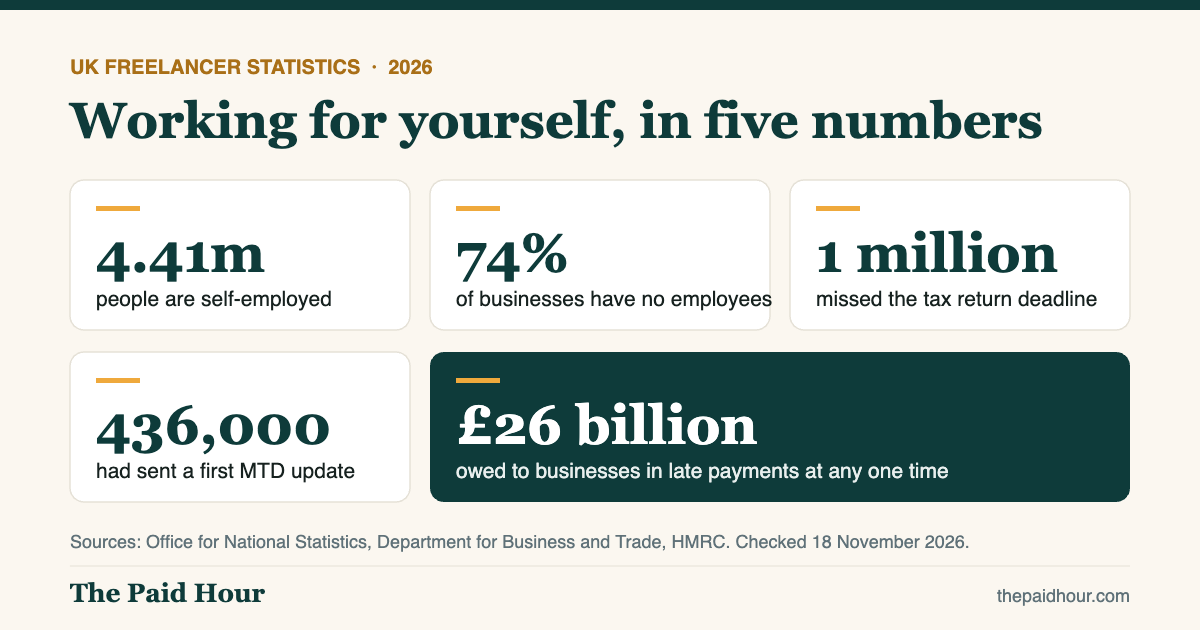
Three in four UK businesses have nobody on the payroll. About a million people missed the last tax return deadline. And at any given moment, businesses are waiting on £26 billion in payments that should already have arrived.
This page collects the official figures on working for yourself in the UK. Every number comes from the Office for National Statistics, HMRC or a government department, and each one links to its source so you can check it.
In short
- 4.41 million people in the UK are self-employed (July to September 2026).
- 74% of private sector businesses have no employees.
- 11.49 million Self Assessment returns arrived on time in January 2026. About 1 million did not.
- 436,000 people had sent their first Making Tax Digital update, out of about 864,000 expected.
- £26 billion is owed to UK businesses in late payments at any one time.
How many people are self-employed in the UK?
4.41 million people were self-employed in the UK in July to September 2026, according to the Office for National Statistics Labour Force Survey (released 17 November 2026).
That is 28,000 more than a year earlier, when the figure was 4.38 million. It is still 509,000 below January to March 2020, when 4.92 million people worked for themselves.
| Period | Self-employed people |
|---|---|
| January to March 2020 | 4.92 million |
| July to September 2025 | 4.38 million |
| July to September 2026 | 4.41 million |
These are survey estimates, so small movements from one quarter to the next should be read with care.
How many UK businesses have no employees?
The UK had 5.59 million private sector businesses at the start of 2026. Of those, 4.12 million (74%) had no employees at all. The figures come from the Department for Business and Trade’s Business population estimates 2026, published on 5 November 2026.
| Measure (start of 2026) | Figure |
|---|---|
| Private sector businesses | 5,586,835 |
| Businesses with no employees | 4,115,175 (74%) |
| Sole proprietorships | 3.1 million (55%) |
| Sole proprietorships with no employees | 2.9 million |
| Companies | 2.2 million (39%) |
| Ordinary partnerships | 343,000 (6%) |
| Change in all businesses since 2025 | Down 104,000 (1.8%) |
| Change in businesses with no employees | Down 157,000 (3.7%) |
So the fall in the last year came from one-person businesses. The number of businesses that employ staff went up over the same period.
Self Assessment: who filed and who missed the deadline?
HMRC expected just over 12 million tax returns for the 2024 to 2025 tax year. By the 31 January 2026 deadline it had received 11.49 million, and it estimated that 1 million people missed it. These are HMRC’s own figures, published on 3 February 2026 and described by HMRC as indicative.
| Self Assessment, 31 January 2026 deadline | Figure |
|---|---|
| Returns expected | 12,029,168 |
| Returns received by the deadline | 11,489,825 |
| Filed online | 97.25% |
| Filed on paper | 316,000 |
| Filed on deadline day | 475,722 |
| Filed in the final hour (23:00 to 23:59) | 27,456 |
| Busiest hour (17:00 to 17:59) | 32,982 |
| Estimated to have missed the deadline | 1 million |
Missing the deadline brings an automatic £100 penalty, even when no tax is owed. The dates for the next return are in our guide to the Self Assessment deadlines for 2027.
Making Tax Digital: the first year in numbers
Since 6 April 2026, sole traders and landlords with qualifying income above £50,000 have had to keep digital records and send HMRC a quarterly update. HMRC put the number of people in scope at about 864,000.
The first quarterly deadline was 7 August 2026. On 12 August, HMRC said that more than 436,000 people had sent their first update and more than 570,000 had signed up.
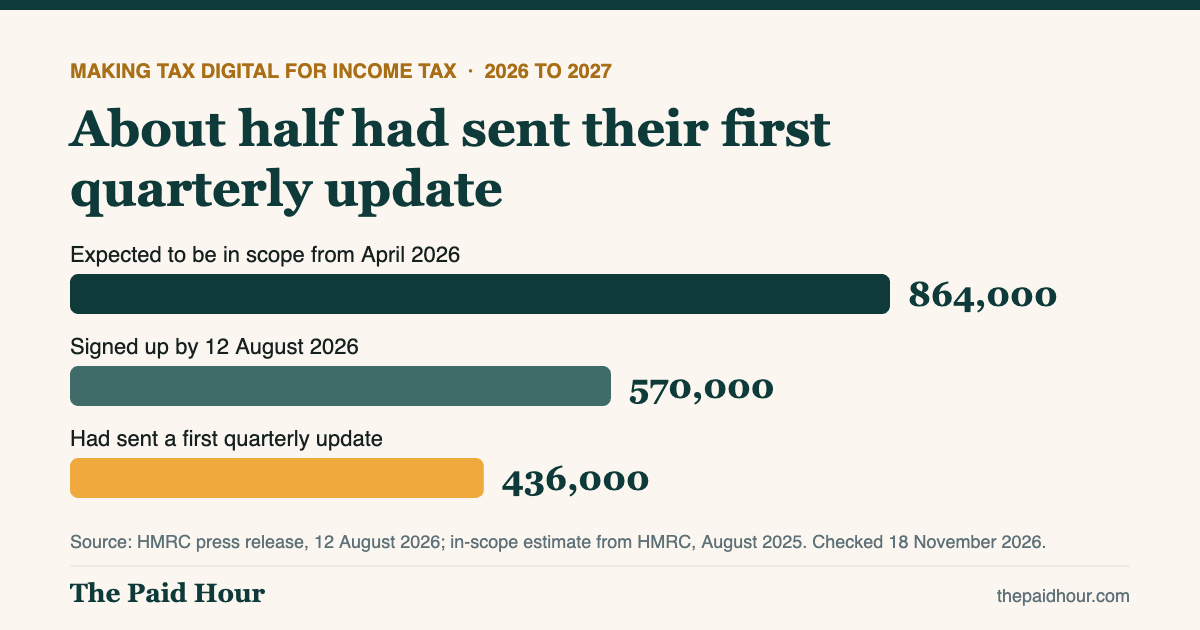
By our calculation, that means about half of those expected had sent an update (436,000 of 864,000), and about two thirds had signed up (570,000 of 864,000).
- HMRC is not issuing penalty points for late quarterly updates in the 2026 to 2027 tax year. They start from 6 April 2027.
- The income threshold falls to £30,000 from April 2027 and £20,000 from April 2028.
If the next step affects you, read what the £30,000 threshold means from April 2027 or start with our plain guide to Making Tax Digital for sole traders.
Late payment: how much are UK businesses owed?
Government research published in July 2025 found that UK businesses are owed an estimated £26 billion in late payments at any given time. The study was carried out for the Department for Business and Trade and the Small Business Commissioner. Its headline findings are below.
| Late payment in the UK | Figure |
|---|---|
| Owed in late payments at any given time | £26 billion |
| Average owed per affected business | £17,000 |
| Businesses affected each year | Over 1.5 million (28%) |
| Time spent chasing, per affected business | 86 hours a year |
| Cost to the UK economy | Almost £11 billion a year |
| Businesses that close because of late payment | 14,000 a year, or 38 a day |
The law already gives you a remedy. Statutory interest on a late business payment is 8 percentage points above the Bank of England base rate, using the base rate in force on the 30 June or 31 December before the payment became late. The base rate was 3.75% on 30 June 2026, so the statutory rate is 11.75% for payments that become late between 1 July and 31 December 2026.
The Bank of England raised its rate to 4% on 5 November 2026. If that still stands on 31 December, the statutory rate for January to June 2027 will be 12%. Our guide to late payment interest for freelancers shows how to charge it.
What the numbers say if you work for yourself
- Working alone is the normal shape of a UK business. Three in four have no staff. You are not the exception.
- Missing 31 January is common, and it costs money. About one filer in twelve missed the last deadline. Filing a few weeks early removes the risk.
- Digital tax reporting is moving down the income scale. If your qualifying income is above £30,000, the rules reach you in April 2027.
- Being paid late is widespread, and you have rights. More than a quarter of businesses are affected each year.
To see what you are likely to owe for this tax year, use our free UK tax calculator.
Using these figures
You are welcome to quote any figure on this page in an article, essay, report or presentation. Please link to this page as your source, and check the original source before you publish. We update the page when each source releases new data.
Suggested citation: The Paid Hour, UK Freelancer Statistics 2026, thepaidhour.com/uk-freelancer-statistics/
Sources
- Office for National Statistics: Self-employed, UK, Labour Force Survey (series MGRQ)
- Department for Business and Trade: Business population estimates for the UK and regions 2026
- HMRC: 11.48 million beat the Self Assessment deadline
- HMRC: 436,000 sole traders and landlords make their tax digital
- HMRC: 864,000 sole traders and landlords face new tax rules in two months
- Department for Business and Trade: Late payments research, impact on the UK economy
- legislation.gov.uk: Late Payment of Commercial Debts (Rate of Interest) (No. 3) Order 2002
- Bank of England: Bank Rate
Figures checked 18 November 2026. This page is general information, not tax or financial advice.