
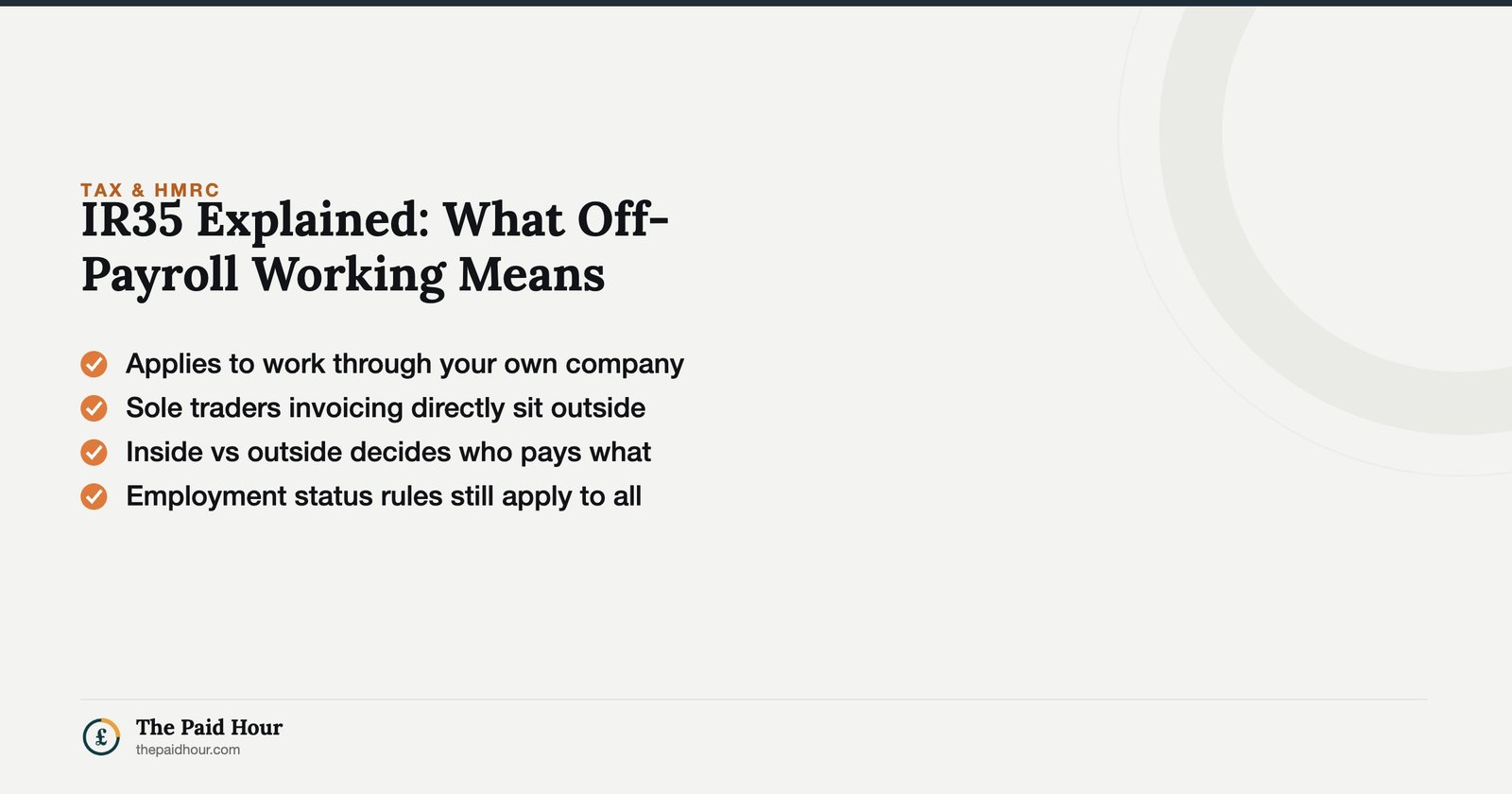
What matters here: IR35 only applies when you work through your own limited company, a sole trader invoicing directly is outside the regime entirely, though employment status rules still apply. If a client engages you via an intermediary, inside-vs-outside decides who pays employment taxes. Most readers of this site are not caught.
Table of Contents
IR35 explained simply: it decides whether a client treats you as employed or self-employed for tax purposes. “IR35” has to be one of the most Googled, and most misunderstood, terms in UK freelancing. Plenty of sole traders worry it applies to them. For most people reading this site, it doesn’t. Here’s what’s actually going on under the hood.
IR35 Explained: What It Actually Is
IR35 (the “off-payroll working rules,” formally Chapter 10 of ITEPA 2003), exists to stop people doing what’s effectively an employee’s job while being taxed like a business, by routing the work through a limited company or partnership instead of sitting on the payroll directly.
Where IR35 applies to an engagement, the contractor pays broadly the same Income Tax and National Insurance an employee would pay for that same work, even though they’re still technically self-employed via their own company. That’s IR35 explained at its simplest: same work, taxed like employment, once the rules bite.
Who it applies to
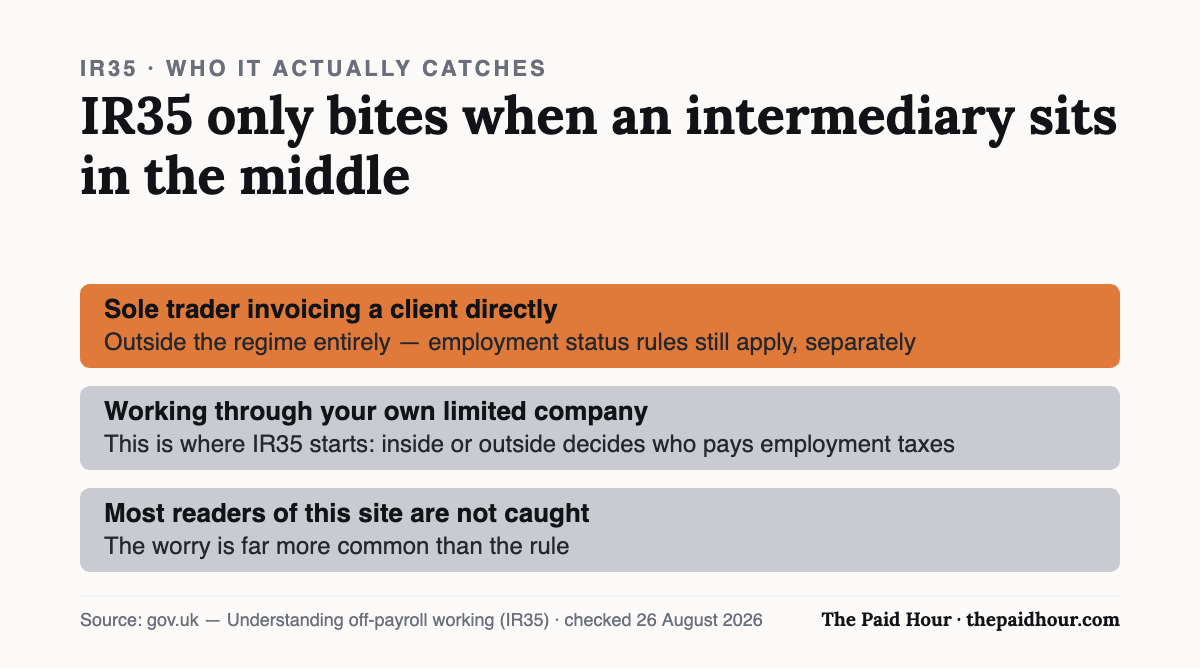
This is the part worth underlining twice: IR35 only bites if you supply your services through an intermediary, a personal service company (PSC) or a partnership. Invoice clients directly as a sole trader, with no limited company sitting in between, and IR35 simply doesn’t apply to you. (Source: gov.uk, Understanding off-payroll working)
So if you’re a straightforward sole trader freelancer, IR35 itself isn’t really your problem. What can still catch sole traders out is a separate, older idea: employment status. HMRC can look at how you work with a client: never mind what you call yourself on paper, and decide the relationship looks a lot more like employment than self-employment. If HMRC decides you’ve been misclassified, it can affect your Self Assessment obligations too, not just IR35 status.
Red flags include fixed hours set by the client, no right to send someone else to do the work in your place (no “substitution”), the client providing all your equipment, and effectively having one client who treats you like staff. None of this belongs exclusively to IR35 — it’s the same test HMRC has always used to sort employees from the self-employed.
Inside vs. outside IR35, the short version
- Outside IR35: the engagement is business-to-business. The contractor manages their own tax through their company, same as always.
- Inside IR35: the engagement looks like employment. Since reforms in 2017 (public sector) and 2021 (medium/large private sector), it’s the client rather than the contractor, who decides status, and the fee-payer in the chain deducts PAYE tax and NI before paying the contractor’s company.
Small private-sector clients are exempt from making this determination, in that case, the contractor’s own company still has to self-assess status, exactly as it did before 2021. Getting IR35 explained correctly for your own setup usually comes down to that one client-size distinction.
What’s changing in 2026
One confirmed change: from 6 April 2026, new PAYE rules make agencies and end-clients liable for unpaid PAYE tax when a labour supply chain includes an umbrella company that fails to pay it correctly (source: gov.uk. PAYE rules for labour supply chains including umbrella companies from 6 April 2026). This is aimed at cleaning up non-compliant umbrella arrangements rather than sole traders directly, but if you ever work through an agency or umbrella company as part of a contract, it’s worth knowing the rules around you are tightening.
There’s also been talk of updated small-company size thresholds affecting which clients count as “small”, and therefore exempt from making IR35 determinations, from April 2026. At the time of writing, gov.uk’s own off-payroll guidance page hasn’t yet been updated to reflect a confirmed new threshold, so if this matters to your specific contracting situation, check the current gov.uk off-payroll working for clients guidance directly instead of relying on any number quoted elsewhere.
The practical takeaway
Invoice as a sole trader with no limited company? You can mostly file this under “background knowledge” and move on. Operate through a limited company and take on contracts that look and feel like employment? Worth understanding your status on each engagement, not just assuming self-employment is automatic because that’s what your invoice happens to say.
This is general guidance rather than personalised tax advice. Always check gov.uk or speak to an accountant for your specific situation.
Common questions about IR35
Does IR35 apply to a sole trader?
No. The rules only bite when services are supplied through an intermediary, a personal service company or a partnership. Invoice a client directly as a sole trader, with nothing sitting in between, and IR35 does not apply to you at all. Employment status is still tested, but that is a separate question with separate consequences.
Who decides whether an engagement is inside or outside IR35?
Since the 2017 public-sector and 2021 private-sector reforms, the client decides, not the contractor, and the fee-payer in the chain deducts PAYE and National Insurance before the money reaches the contractor’s company. Small private-sector clients are exempt from making that determination, and in that case the contractor’s own company still has to.
What makes an engagement look inside IR35?
Fixed hours set by the client, no right to send a substitute, the client supplying all the equipment, and effectively one client treating you like staff. None of that is unique to the off-payroll rules, it is the same employment status test HMRC has always used to separate employees from the self-employed.
Know your status before the client decides it?
IR35 & Contractor Operating Guide 2026/27. Eight modules and four working sheets covering status, evidence, umbrella companies after April 2026, and the rate maths on both sides of the line.
- The small-client test, the Status Determination Statement, and the client-led disagreement process
- CEST walked through where it is weakest, and how to keep evidence of the run
- An outside-to-inside rate converter, an umbrella payslip checker, and the contract red-flag checklist
For medium and large clients the client decides your status. Most contractors do not know which side of that line their client sits on until the determination lands.
Buying more than one? All ten 2026/27 courses for £107, against £328 at full price.
Sources
- gov.uk: Understanding off-payroll working (IR35)
- gov.uk, Off-payroll working for clients
- gov.uk. PAYE rules for umbrella-company supply chains (April 2026)
Reviewed 26 August 2026, the off-payroll rules are as published in HMRC’s guidance linked below. This is general information about how the rules work, not tax advice. The links above go to the primary sources; for your own circumstances, speak to an accountant or contact HMRC directly.