
Checked 29 October 2026 against HMRC’s Budget 2026 documents. From 6 April 2027, landlord tax on rental profit rises to 24% (basic), 44% (higher) and 49% (additional) in England, Wales and Northern Ireland. That is 4 points more than today and 2 points more than the rise already planned. Landlords who own through a limited company are not affected by these rates.
Landlord tax in 2027 is going up twice. A rise to 22%, 42% and 47% was already law from Budget 2025. Then the Budget on 28 October 2026 added two more points. So from 6 April 2027, you pay 24%, 44% or 49% on rental profit instead of 20%, 40% or 45%.
Your salary and trading profit stay on the normal rates. Only property income gets the new, higher rates. For every other change, see Budget 2026 winners and losers. This guide shows what changes, how much more you pay, who is affected and five legal ways to soften the hit.
Table of Contents
Landlord tax 2027 at a glance
| Band | 2026/27 (now) | Already planned for 2027/28 | From 6 April 2027 (Budget 2026) |
|---|---|---|---|
| Basic rate | 20% | 22% | 24% |
| Higher rate | 40% | 42% | 44% |
| Additional rate | 45% | 47% | 49% |

Who pays the new landlord tax 2027 rates
- Individual landlords who own rental property in their own name, alone or jointly.
- Landlords in partnerships who receive a share of rental profit.
- Sole traders with a buy-to-let on the side: your trading profit stays at normal rates, your rent goes on the new rates.
The rates apply in England, Wales and Northern Ireland. The Scottish and Welsh governments have the power to set their own property income rates, so check with your devolved government if you pay Scottish or Welsh income tax. Companies that hold property pay corporation tax at 19% or 25%, and the Budget did not change those rates.
How much more landlord tax will you pay?
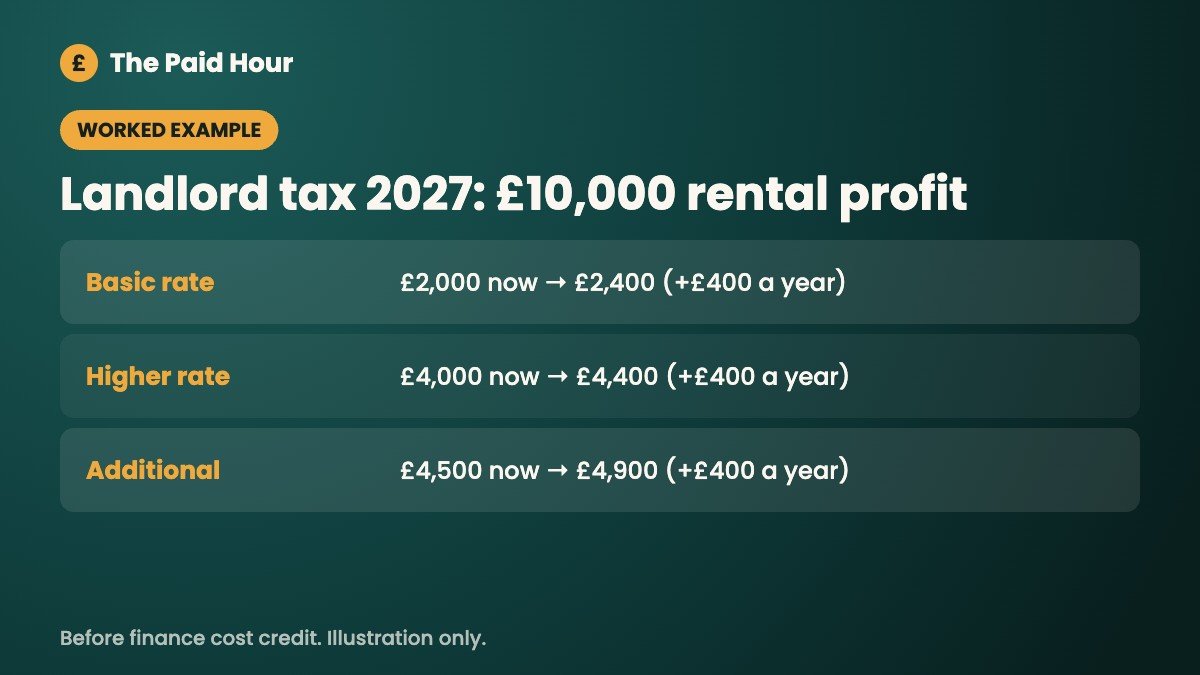
The simple rule: every £1,000 of rental profit costs you £40 more a year than today, whatever your band. That is because each band rises by 4 points between 2026/27 and 2027/28.
| Rental profit | Basic rate now (20%) | 2027/28 (24%) | Higher rate now (40%) | 2027/28 (44%) |
|---|---|---|---|---|
| £5,000 | £1,000 | £1,200 | £2,000 | £2,200 |
| £10,000 | £2,000 | £2,400 | £4,000 | £4,400 |
| £20,000 | £4,000 | £4,800 | £8,000 | £8,800 |
What happens to mortgage interest relief?
You cannot deduct mortgage interest from rental profit like other costs. Instead you get a tax credit on your finance costs. Today that credit is 20%. The Treasury’s Budget 2026 costings say the credit will stay in line with the property basic rate, so it is expected to rise to 24% from 6 April 2027. It becomes law once the Finance Bill passes.
Why it matters: a basic-rate landlord pays 24% and gets 24% back, so the interest is fully relieved. A higher-rate landlord pays 44% but still gets only 24% back. Big mortgages hurt most at the higher rate. We will update this guide when the Finance Bill is published.
Landlord tax 2027 calculator
England, Wales and Northern Ireland. Ignores the personal allowance taper above £100,000 and the property allowance. Illustration only, not personal tax advice.
Landlord tax 2027: three worked examples
Aisha, nurse with one flat
Aisha earns £34,000 and makes £8,000 of rental profit before £2,000 of mortgage interest. All her rent sits in the basic band. Her tax on rent rises from £1,600 to £1,920, a jump of £320. Her finance cost credit of £400 rises to £480 at the expected 24%. Overall she pays about £240 more a year.
Tom, sole trader with two buy-to-lets
Tom makes £48,000 from his plumbing business and £15,000 from rent, with £6,000 of mortgage interest. Most of his rent falls into the higher band. He pays about £600 more a year on the same rent from April 2027. His £6,000 credit rises from £1,200 to £1,440 at 24%, so the net rise is about £360. He still gets only 24% back on interest he is taxed on at 44%, so every rate rise hurts.
Priya and Sam, joint owners
Priya and Sam own a house together and split the £16,000 profit 50:50. Priya is a basic-rate taxpayer and Sam pays higher rate. Each pays £320 more a year on their £8,000 share. Because they are married, a different split could help. If it reflects how they really own the property and they tell HMRC with form 17, it could move more profit into Priya’s basic band.
5 ways to reduce your landlord tax 2027 bill

- Claim every allowable expense. Letting agent fees, repairs, insurance, ground rent, service charges, accountancy, travel to the property and replacing furnishings in a furnished let all reduce taxable profit. At 44%, every £100 you forget costs you £44.
- Check how you own the property. Married couples and civil partners who own jointly are taxed 50:50 by default. If you really own it in unequal shares, form 17 can move income to the lower earner.
- Use pension contributions. Paying into a personal pension extends your basic rate band. That can pull rental profit out of the 44% band and back into 24%.
- Plan the timing of big costs. A repair you were going to do anyway saves 4 points more tax in 2027/28 than in 2026/27. Improvements are capital costs, not repairs, so check which is which.
- Get advice before you incorporate. A limited company pays corporation tax, not the new rates. But moving property into a company can trigger Capital Gains Tax and Stamp Duty Land Tax, and mortgages cost more. It only suits some landlords.
Good landlord insurance is an allowable expense too. If you are renewing, compare cover with Simply Business. Affiliate link: we may earn a commission at no cost to you.
Landlord tax 2027 and Making Tax Digital
From 6 April 2027, landlords and sole traders join Making Tax Digital for Income Tax if their qualifying income was over £30,000 in 2025/26. For landlords, qualifying income means gross rent before expenses, not profit. So a landlord with £32,000 of rent and £20,000 of costs is still in. Each property business needs its own quarterly update. Check whether the £30,000 rule catches you.
You will need software HMRC recognises. FreeAgent is free with a NatWest, RBS, Ulster Bank or Mettle business account, and it handles property income. Remember that each income stream needs its own FreeAgent account. Affiliate link: we may earn a commission at no cost to you.
What has not changed for landlords
- The £1,000 property allowance. If your gross rent is £1,000 or less, it is still tax-free. Budget 2026 raised the trading allowance, not the property allowance.
- Corporation tax rates for property companies: 19% and 25%.
- The personal allowance of £12,570, frozen until April 2031.
- The basic rate band. The 44% rate still starts at £50,270 of total income.
Budget update, 28 October 2026: the trading allowance rises from £1,000 to £3,000 from 6 April 2027, and the Self Assessment reporting threshold for trading income moves to £3,000 with it. For the 2026/27 tax year the £1,000 limit still applies. GOV.UK policy paper.
Landlord tax 2027 timeline
| Date | What happens |
|---|---|
| Saturday 7 November 2026 | MTD quarterly update 2 for landlords already in MTD |
| 31 January 2027 | Self Assessment for 2025/26 at today’s rates |
| 6 April 2027 | Property rates 24%, 44%, 49% · MTD at £30,000 of qualifying income |
| 31 January 2028 | Final declaration for 2026/27, the last year at 20%, 40%, 45% |
| 31 January 2029 | First return taxed at the new property rates (2027/28) |
What landlords should do before April 2027
- Run your 2027/28 numbers through the calculator above.
- Raise your tax pot. Save 24% or 44% of rental profit, not 20% or 40%.
- Book repairs and replacements you already need, while costs still save tax at today’s rates.
- Check whether gross rent plus trading income pushes you over £30,000 for MTD.
- If you are thinking about a company, take advice early. The costs of moving can outweigh the savings.
Should you sell, raise rents or hold?
The landlord tax 2027 rise is real, but it is rarely a reason on its own to sell. On £10,000 of rental profit it costs about £400 a year. Selling can cost far more in Capital Gains Tax, agent fees and lost future rent. Run the numbers before you act.
Raising rents is not always an option either. You need to follow the notice rules for your tenancy, and the market sets a ceiling. Many landlords will absorb part of the rise and look for savings in costs instead. Reviewing your mortgage deal, insurance and agent fees often finds more than the tax rise takes.
If you hold, the most useful step is simple: put more aside. A landlord who saves 24% or 44% of rental profit from April 2027 will never meet a tax bill they cannot pay. Use our guide on how much to save for tax to set the right amount for your income.
Landlord tax 2027 for higher-rate landlords
Higher-rate landlords feel the landlord tax 2027 change most, for two reasons. First, they jump from 40% to 44% on rental profit. Second, if the finance cost credit stays below their tax rate, every pound of mortgage interest costs them more in tax than it saves. A landlord on 44% who gets a 24% credit still loses 20p in tax on every £1 of mortgage interest.
That is why pension contributions matter so much here. A £5,000 personal pension payment can move £6,250 of income from the higher band into the basic band, once basic-rate tax relief is added. For a landlord on 44%, that is £1,250 of tax saved on the rent, on top of the pension itself.
Frequently asked questions
What is the landlord tax rate from April 2027?
From 6 April 2027, individual landlords in England, Wales and Northern Ireland pay 24% (basic), 44% (higher) or 49% (additional) on rental profit.
Does the landlord tax 2027 rise apply to limited companies?
No. Companies that own property pay corporation tax at 19% or 25%. The new property income rates apply to individuals and partnerships.
Will mortgage interest relief go up to 24%?
Yes, that is the plan. The credit is 20% today. The Treasury’s Budget 2026 costings say it stays in line with the property basic rate, so it is expected to be 24% from 6 April 2027, once the Finance Bill passes.
Do landlords in Scotland pay the new property rates?
The rates set by Budget 2026 apply in England, Wales and Northern Ireland. Scotland and Wales can set their own property income rates.
How much more landlord tax will I pay from 2027?
About £40 more for every £1,000 of rental profit compared with today, before any change to the finance cost credit.
How we checked this landlord tax 2027 guide
We took the rates from HMRC’s overview of tax legislation and rates, published with the Budget on 28 October 2026. The finance cost credit position comes from the Treasury’s Budget 2026 policy costings. We will update this page when the Finance Bill is published. This is general information, not personal tax advice.
Sources
- HMRC, Budget 2026 overview of tax legislation and rates (section 1.2)
- HM Treasury, Budget 2026
- Propertymark, Budget 2026 raises landlord taxes
- GOV.UK, Declaration of beneficial interests in joint property (form 17)
Filing it yourself this year?
HMRC Tax & Expense Mastery 2026/27. Nine modules and eleven working templates that take a UK freelancer from “do I even need to register” to a correct return, with MTD quarters built in.
- Fifteen expense categories, with the trap inside each one (training, clothing, meals, the seven-year pre-trading rule)
- Home and vehicle: flat rate against actual cost, with the £312 break-even worked out and the mileage lock-in rule
- The year-one payments-on-account cash shock, and the routine that stops it landing twice
HMRC does not send a list of what you forgot to claim. Most freelancers leave several hundred pounds of legitimate expenses on the table every single year, and the return still gets filed.
Buying more than one? The Complete Freelancer System, all five for £87, against £193 bought separately.