
Checked 29 October 2026 against the Budget documents on GOV.UK. Winners: side hustlers (trading allowance £3,000 from April 2027), drivers (55p mileage made permanent, 35p over 10,000 miles), self-employed fathers (parental pay from 2029), cash savers (ISA allowance kept at £20,000). Losers: landlords and savers outside an ISA (24%, 44%, 49% from April 2027), and owners selling a business (BADR limit halved to £500,000). Income tax, National Insurance and VAT rates did not change.
The Budget 2026 winners and losers list for the self-employed is shorter than the headlines made it look. Chancellor John Healey kept income tax, National Insurance and VAT rates where they were on 28 October 2026. What moved were the allowances around the edges, and those edges decide who quietly gains and who quietly pays.
This guide sorts every Budget measure that touches sole traders, freelancers, landlords and small company owners into three piles. Who wins, who loses, and what is mixed. Each one has the date it starts, a worked example and what to do about it. There is a quick checker near the end so you can see which pile you are in.
Table of Contents
Budget 2026 winners and losers at a glance
| Who | Verdict | What changed | Starts |
|---|---|---|---|
| Side hustlers and micro-traders | Winner | Trading allowance and reporting threshold up from £1,000 to £3,000 | 6 April 2027 |
| People who drive for work | Winner | 55p per mile for the first 10,000 miles made permanent; 35p (from 25p) above that | Now / 6 April 2027 |
| Self-employed fathers and partners | Winner | Parental pay for the first time: two weeks, up to £194 a week | Not yet confirmed (reported as April 2029) |
| Cash savers | Winner | Planned cut to the cash ISA allowance reversed; stays £20,000 | 6 April 2027 |
| Founders of high-growth companies | Winner | New Capital Gains Tax Founders’ Relief | 6 April 2027 |
| Landlords | Loser | Property income tax 24%, 44%, 49% | 6 April 2027 |
| Savers outside an ISA | Loser | Savings income tax 24%, 44%, 49% | 6 April 2027 |
| Owners selling a business | Loser | Business Asset Disposal Relief lifetime limit cut from £1m to £500,000 | 6 April 2027 |
| Employers with staff on minimum wage | Loser | National Living Wage and minimum wage up 3.9% | 1 April 2027 |
| Online sellers above £90,000 | Mixed | Marketplaces collect the VAT | October 2027 |
| Anyone paying payments on account | Mixed | Smaller, more regular payments | April 2029 |

If you only read one line of the Budget 2026 winners and losers list: HMRC taxes your trading profit exactly as before. The winners gain through allowances. The losers lose through tax on rent, interest and business sales.
Winner 1: side hustlers get a £3,000 trading allowance
The trading allowance triples from £1,000 to £3,000 from 6 April 2027. HMRC is also raising the Self Assessment reporting threshold for trading income to £3,000 at the same time. So if your gross takings from small trading stay at £3,000 or less, you will not pay tax on them and you will not need to report them.
On any list of Budget 2026 winners and losers, this is the biggest win for small earners. It covers a lot of people. The weekend dog walker, the tutor with three students, the crafter on Etsy, the designer who takes a couple of jobs a year. It is the first rise since the allowance started in 2017.
| Gross takings | Tax year 2026/27 (limit £1,000) | From 2027/28 (limit £3,000) |
|---|---|---|
| £900 | Tax-free, nothing to report | Tax-free, nothing to report |
| £2,400 | Register; tax on £1,400 (or on profit if your costs are higher) | Tax-free, nothing to report |
| £3,000 | Register; tax on £2,000 | Tax-free, nothing to report |
| £6,000 with £500 of costs | Register; tax on £5,000 | Register; tax on £3,000 |
Two warnings. First, the test uses gross income, not profit, so someone reselling stock can cross £3,000 while making very little. Second, it does not start this tax year. Keep declaring side income above £1,000 for 2026/27. Our trading allowance guide covers who cannot use it, including income from your own company or your employer.
Keep side income in its own account so the £3,000 line is easy to see. A free business account such as Tide does that in minutes. Affiliate link: we may earn a commission at no cost to you.
Winner 2: drivers keep 55p a mile, and get 35p over 10,000
In May 2026 the approved mileage rate for cars and vans rose from 45p to 55p a mile for the first 10,000 business miles, backdated to 6 April 2026. Most people expected it to be temporary. The Budget made it permanent and added a second rise. Miles above 10,000 go from 25p to 35p from 6 April 2027.
| Business miles a year | Old rates (45p / 25p) | From 2027/28 (55p / 35p) | Extra deduction |
|---|---|---|---|
| 6,000 | £2,700 | £3,300 | £600 |
| 10,000 | £4,500 | £5,500 | £1,000 |
| 15,000 | £5,750 | £7,250 | £1,500 |
| 20,000 | £7,000 | £9,000 | £2,000 |
For a basic-rate sole trader paying 20% income tax and 6% Class 4 National Insurance, £1,500 of extra deduction is worth about £390 a year. Mobile hairdressers, carers, cleaners, tradespeople and delivery drivers are among the clearest Budget 2026 winners and losers: they gain most. You still need a mileage log with dates, journeys and miles. See the mileage allowance guide for what HMRC expects, and mileage vs capital allowances if you are deciding how to claim a new car.
Winner 3: parental pay for self-employed fathers and partners
For the first time, self-employed fathers and partners will be able to get parental pay. The full start date and rules are still to come, and FreeAgent’s Budget summary reports April 2029. The government expects around 150,000 more parents a year to qualify, for two weeks of pay worth up to £194 a week. Until now, self-employed mothers could claim Maternity Allowance but partners had no equivalent.
Winner 4: cash savers keep the full £20,000 ISA
Not every Budget 2026 story for savers is bad. The government had planned to cut the cash ISA allowance for people under 65. The Budget reversed it, so the cash ISA allowance stays at £20,000 from 6 April 2027. That matters more than it sounds, because tax on savings interest outside an ISA is rising (see the losers below). If you keep your tax pot in savings, an ISA is now the cleaner home for it.
Winner 5: founders get a new Capital Gains Tax relief
A new Founders’ Relief gives a lower Capital Gains Tax rate on qualifying disposals of shares in high-growth companies from 6 April 2027. Coverage of the Budget reports the rate as 10% with a £10 million lifetime limit. It targets founders and significant early investors, not at most sole traders, and a technical consultation runs until 30 November 2026.
Loser 1: landlords pay 24%, 44% and 49% on rent
Tax on property income was already due to rise to 22%, 42% and 47% from April 2027. The Budget adds two more points. So from 6 April 2027 the property rates are 24% basic, 44% higher and 49% additional in England, Wales and Northern Ireland.
| Rental profit | Basic rate today (20%) | From 2027/28 (24%) | Extra tax a year |
|---|---|---|---|
| £6,000 | £1,200 | £1,440 | £240 |
| £10,000 | £2,000 | £2,400 | £400 |
| £15,000 | £3,000 | £3,600 | £600 |
In the Budget 2026 winners and losers split, landlords sit firmly on the losing side. A sole trader who also lets a flat will now pay more tax on each pound of rent than on each pound of trading profit. If you are a landlord in Making Tax Digital, remember the property business needs its own quarterly update.
Loser 2: savers outside an ISA
Landlords are not alone. The same new rates apply to savings income across the whole UK: 24%, 44% and 49% from 6 April 2027. Interest inside your personal savings allowance is still tax-free. But a big tax pot earning interest in an ordinary account will cost more. Move what you can into the £20,000 cash ISA.
Loser 3: owners selling a business
For the Budget 2026 self-employed owner thinking about an exit, this is the sting. Business Asset Disposal Relief lets you pay a lower Capital Gains Tax rate on selling all or part of a business. The lifetime limit falls from £1 million to £500,000 for disposals on or after 6 April 2027. You pay the main rate on gains above the limit. If a sale is close, timing now matters, so speak to an accountant before April.
Loser 4: small employers
For Budget 2026 self-employed business owners with staff, the National Living Wage and National Minimum Wage rise by 3.9% from 1 April 2027. Good news for staff, but a cost for a café, salon or trades business paying hourly wages. Build it into your prices for next spring now.
Mixed: online sellers, MTD and how you pay tax
Online marketplaces will collect VAT from October 2027
Marketplaces will collect VAT on sales by UK VAT-registered businesses, and by other UK sellers above £90,000 of annual sales on a platform. The rules leave out personal sales and second-hand goods. Clearing out a wardrobe does not count. If you buy to resell, you are trading. Our side hustle tax guide explains the line.
Making Tax Digital carries on, with a softer start
For the Budget 2026 self-employed reader in MTD, there is no delay. MTD for Income Tax extends to people with qualifying income over £30,000 from April 2027 and over £20,000 from April 2028. The Budget also extended the penalty easement: if you join MTD in April 2027, you get no late-submission points on your 2027/28 quarterly updates. If you joined in April 2026, your easement ends on 5 April 2027 and points apply from your first 2027/28 update. Updates are still compulsory. If you are in now, update two is due on Saturday 7 November 2026. Check whether the £30,000 rule catches you.
You need software HMRC recognises. FreeAgent is free with a NatWest, RBS, Ulster Bank or Mettle business account and handles quarterly updates and the final declaration. Affiliate link: we may earn a commission at no cost to you.
Smaller, more regular tax payments from 2029
From April 2029, people who make payments on account will make more regular payments during the year instead of two large ones. HMRC says it will automate the payments, and people with enough PAYE income can choose to pay through their tax code. Nothing changes before then. How payments on account work today.
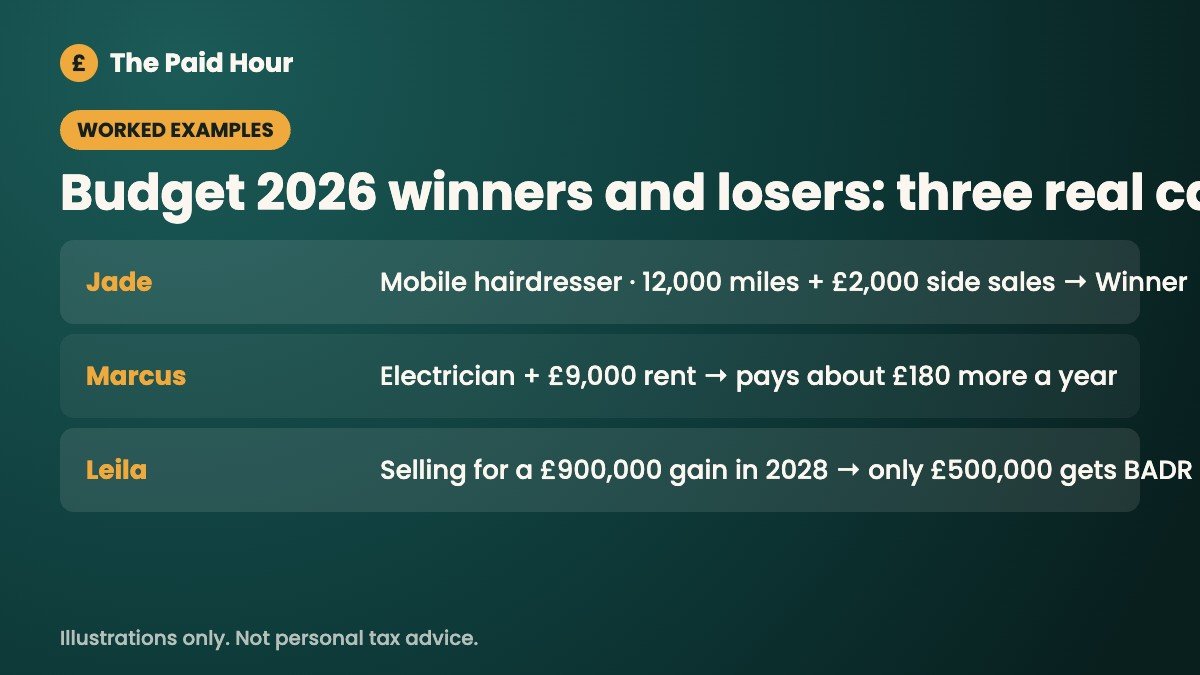
Three self-employed people, three Budget results
Jade, mobile hairdresser
Here is how the Budget 2026 self-employed changes land for three real-world cases. Jade drives 12,000 business miles a year. From 2027/28 her mileage deduction rises by £200 on the miles above 10,000 (2,000 miles at 10p more), on top of keeping 55p for the first 10,000. She also sells hair accessories online for about £2,000 a year, which becomes tax-free and report-free under the £3,000 allowance. Winner.
Marcus, electrician and landlord
Marcus earns £30,000 from his trade and £9,000 of rental profit, so he is a basic-rate taxpayer. HMRC taxes his trade as before. From April 2027 he pays 24% on his rent, about £180 a year more than the 22% already planned and £360 more than today’s 20%. Loser on the property side.
Leila, agency owner planning to sell
Leila hopes to sell her limited company for a £900,000 gain in 2028. Under the old £1 million limit, all of it would have qualified for Business Asset Disposal Relief. From 6 April 2027 only £500,000 does, and he pays the main rate on the rest. Loser, unless she sells before April 2027.
What did not change
- Income tax rates, Class 4 National Insurance and VAT rates.
- Dividend tax rates: 10.75%, 35.75% and 39.35%.
- The personal allowance (£12,570) and higher rate threshold (£50,270), frozen until April 2031.
- The Self Assessment deadline of 31 January.
Frozen thresholds are the hidden cost that no Budget 2026 winners and losers table shows. They are a tax rise by stealth. Each time you raise your prices, HMRC taxes more of your profit, and more of it at 40%. If you are close to £50,270 or £100,000 of income, pension contributions are still the simplest way to bring taxable profit down.
Are you a Budget 2026 winner or loser? Quick checker
Tick everything that applies to you
General guide only. Not personal tax advice.
Now you know where you sit among the Budget 2026 winners and losers. Want your own pound figure for the trading allowance and mileage changes? Use the calculator in Autumn Budget 2026 for the self-employed.
What to do before April 2027

- In MTD already? Send update two before Saturday 7 November.
- Earned over £30,000 from self-employment and property in 2025/26? Choose MTD software this winter.
- Side income near £3,000? Keep records for 2026/27; the new limit only applies from 2027/28.
- Drive for work? Keep a mileage log now so 2027/28 claims are easy.
- Landlord? Rework your 2027/28 tax pot at 24% or 44%.
- Selling a business? Check timing against the 6 April 2027 BADR change.
- Big savings? Use your £20,000 cash ISA allowance.
Frequently asked questions
Who are the Budget 2026 winners for the self-employed?
Side hustlers (trading allowance up to £3,000 from April 2027), people who drive for work (55p mileage made permanent and 35p over 10,000 miles from April 2027), self-employed fathers and partners (two weeks of parental pay, start date to be confirmed) and cash savers (ISA allowance kept at £20,000).
Who loses from Budget 2026?
The main Budget 2026 winners and losers on the losing side are landlords and savers outside an ISA, who face 24%, 44% and 49% tax rates on property and savings income from 6 April 2027, owners selling a business, whose BADR lifetime limit falls to £500,000, and employers facing a 3.9% minimum wage rise.
Did Budget 2026 raise income tax or National Insurance for sole traders?
No. Income tax, Class 4 National Insurance and VAT rates are unchanged. Thresholds stay frozen until April 2031.
When does the £3,000 trading allowance start?
6 April 2027. For the 2026/27 tax year the trading allowance is still £1,000.
Did Budget 2026 change Making Tax Digital?
MTD goes ahead at £30,000 from April 2027 and £20,000 from April 2028. April 2027 joiners get no late-submission points on 2027/28 quarterly updates. April 2026 joiners do, from 6 April 2027. Either way, the updates are still required.
How we checked this Budget 2026 winners and losers list
Every figure on this page comes from the documents HM Treasury and HMRC published on 28 October 2026. The Budget report, the overview of tax legislation and rates, and the policy costings. Where a detail is only in press coverage, such as the Founders’ Relief rate, we say so. Where a rule is still being designed, such as how often payments will be taken from 2029, we label it as not yet decided rather than guessing.
Budget 2026 winners and losers can also shift as the details firm up. Budget announcements can change between Budget day and the Finance Act. We re-check this page when the Finance Bill 2026-27 is published and when HMRC releases guidance. And the date at the top shows the last check. If you spot something that looks wrong, tell us through the contact page and we will look at it the same week.
This Budget 2026 winners and losers guide is general information for UK sole traders, freelancers, landlords and small company owners, not personal tax advice. Your own position depends on all your income, where you live in the UK and which reliefs you already claim. For anything with a large amount riding on it, such as selling a business or changing how you take income, speak to a qualified accountant before 6 April 2027.
Sources
- HM Treasury, Budget 2026 (28 October 2026)
- HMRC, Budget 2026 overview of tax legislation and rates
- HMRC, Increasing the trading allowance
- HM Treasury, Budget 2026 policy costings
Filing it yourself this year?
HMRC Tax & Expense Mastery 2026/27. Nine modules and eleven working templates that take a UK freelancer from “do I even need to register” to a correct return, with MTD quarters built in.
- Fifteen expense categories, with the trap inside each one (training, clothing, meals, the seven-year pre-trading rule)
- Home and vehicle: flat rate against actual cost, with the £312 break-even worked out and the mileage lock-in rule
- The year-one payments-on-account cash shock, and the routine that stops it landing twice
HMRC does not send a list of what you forgot to claim. Most freelancers leave several hundred pounds of legitimate expenses on the table every single year, and the return still gets filed.
Buying more than one? The Complete Freelancer System, all five for £87, against £193 bought separately.