
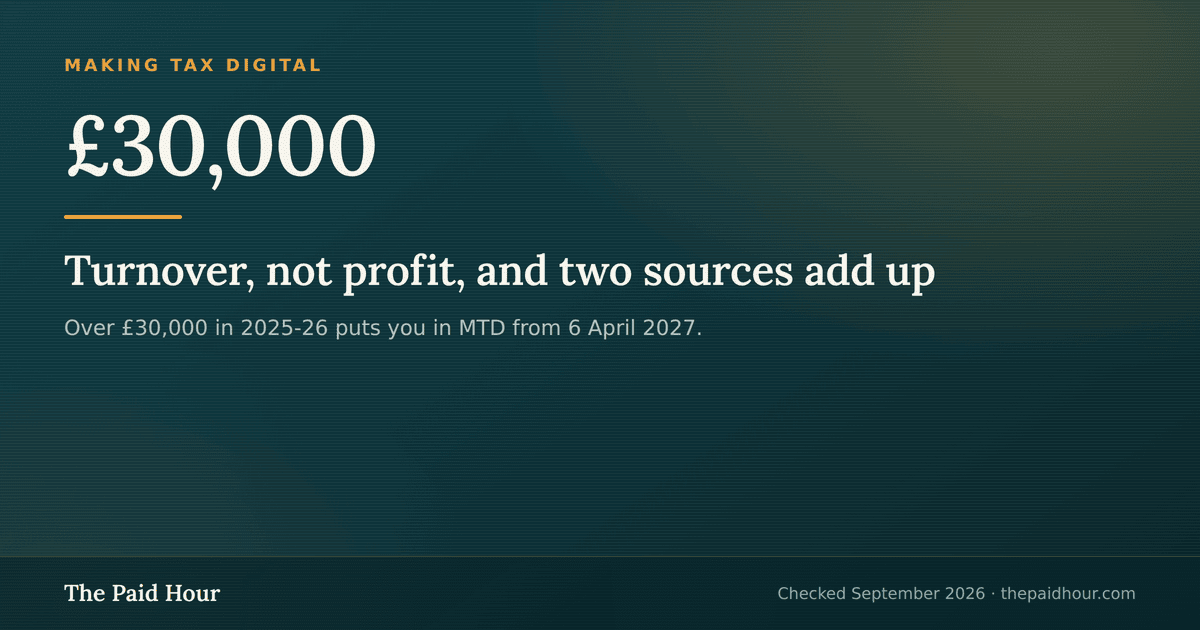
If your combined self-employment and property income before expenses was over £30,000 in the 2025 to 2026 tax year, you must use Making Tax Digital for Income Tax from 6 April 2027. HMRC reads that figure off the return you file by 31 January 2027. The test is turnover, not profit, and two income sources add together. GOV.UK, checked 12 September 2026.
The MTD £30,000 threshold for 2027 catches people who are certain it does not apply to them, on a number they have never had to think about. Not profit. Gross income before a single expense comes off, self-employment and property added together.
Table of Contents
The £30,000 is turnover, and it adds two things together
HMRC calls it qualifying income and defines it in one sentence: “Qualifying income is your total income from self-employment and property. This is the amount before expenses (also known as turnover).”
Two consequences, both of them bite. A sole trader turning over £34,000 with £9,000 of costs makes £25,000 profit and is still in. Someone with £18,000 of freelance work and £14,000 of rent is in on £32,000, though neither source alone goes near the line. HMRC’s own example adds £25,000 of rent to £27,000 of self-employment and gets £52,000.
The return you file this January decides it
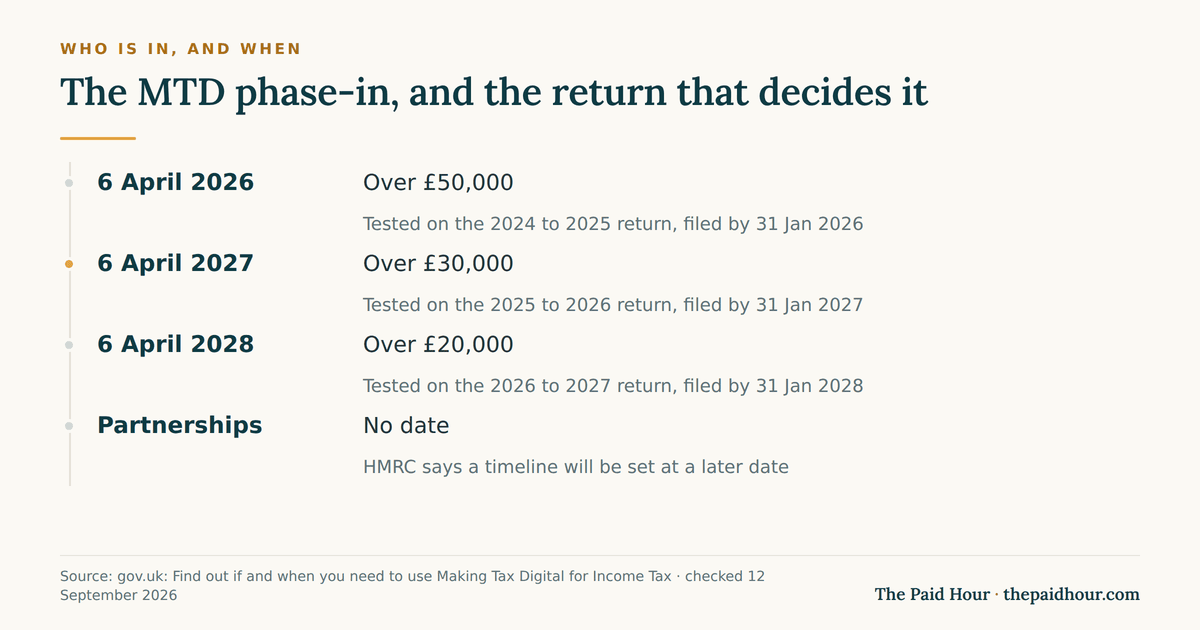
Each start date is tested against the tax year that ended two years earlier, the last return HMRC holds in time to act on.
| Qualifying income | Tax year HMRC tests | Return filed by | MTD starts |
|---|---|---|---|
| Over £50,000 | 2024 to 2025 | 31 January 2026 | 6 April 2026 |
| Over £30,000 | 2025 to 2026 | 31 January 2027 | 6 April 2027 |
| Over £20,000 | 2026 to 2027 | 31 January 2028 | 6 April 2028 |
So the 2025 to 2026 return in your drafts is the one that puts you in or leaves you out. Fill in the turnover box, add any property income, and you have the answer months before HMRC writes. Our page on the deadlines already running for the £50,000 group shows the shape of it.
HMRC does not wait for you to volunteer. Its guidance says that from September 2026 it began signing up people who needed MTD for 2026 to 2027 and had not done it themselves. No equivalent wording exists yet for the £30,000 group. I would expect the same around September 2027, but that is my read, not a commitment.
What counts as qualifying income, and what does not
| Counts towards the £30,000 | Does not count |
|---|---|
| Self-employment turnover, before expenses | Employment income taxed through PAYE |
| UK property income, before expenses | Your share of profit from a partnership |
| Your share of jointly owned property income | Dividends, including from your own company |
| Foreign property income, if you are UK tax resident | State Pension and private pensions |
| VAT, if you include it in your turnover figure | Income from REITs and PAIFs |
| Bare trust and interest in possession trust income paid directly to you | Transition profits from basis period reform |
| UK land transactions treated as trade profits, where the income continues | One-off UK land transactions, and qualifying care relief |
Three of those matter more than the rest. A full-time employee with a £9,000 side business stays out, because PAYE income is ignored. Partners are out for now, HMRC saying only that a timeline will follow “at a later date”. And transition profit from basis period reform is excluded, which matters if it inflated your 2023 to 2024 figures.
Priya: £19,400 of design work and £13,200 of rent
Priya is a freelance designer with a flat she lets. In 2025 to 2026 she invoiced £19,400 and took £13,200 in rent, with £4,300 of design costs and £1,800 of letting costs.
Qualifying income is £19,400 plus £13,200, so £32,600. Over by £2,600, and in from 6 April 2027. Her taxable profit is £32,600 less £6,100, so £26,500, and that figure has no bearing on the test at all. She files a return showing £26,500 and assumes she is safely under £30,000. She is not.
Two income sources also means two sets of quarterly updates, one for the design work and one for the property.
TikTok Shop and online sellers: count your sales, not your payout
If you sell on TikTok Shop, Etsy or eBay, the platform takes its fees before it pays you. So the money that reaches your bank is smaller than your sales. For the £30,000 test, HMRC counts your sales before fees and other costs. It does not count the payout.
Example (made-up figures). In the 2025 to 2026 tax year Mr K sold £18,000 on TikTok Shop and £13,000 on Etsy. After platform fees, about £27,500 reached his bank. He thinks he is under £30,000. He is not. His qualifying income is £18,000 plus £13,000, so £31,000. He must use Making Tax Digital from 6 April 2027.
To check your own number, add up the sales reports from every platform for 6 April 2025 to 5 April 2026. Do not use your bank statement. Platform fees are still a business cost, so they lower your profit and your tax. They just do not lower your qualifying income.
Platforms also send your sales figures to HMRC each year. See does TikTok Shop report sellers to HMRC.
Source: GOV.UK, Work out your qualifying income for Making Tax Digital for Income Tax. Checked 17 November 2026.
What actually changes on 6 April 2027
Digital records. Each transaction needs the amount, the date, and the category. Retailers can record daily gross takings instead of every sale. A quarter’s records must exist before you send that update or before its deadline, whichever is first. HMRC does not require you to photograph receipts, though scanning them into the software keeps record and evidence together.
Quarterly updates. Four a year, per income source, sent from the software. They are cumulative, which catches people out: HMRC says each one covers from the start of the tax year to the end of that update period, rather than only the three months gone. A mistake in quarter one is corrected by quarter two instead of amended. An empty quarter still gets an update.

Standard periods run 6 April to 5 July, 5 October, 5 January and 5 April, with deadlines of 7 August, 7 November, 7 February and 7 May. Books running to 31 March can use calendar quarters, selected per income source in the software before the first update goes in.
The final bit. A final declaration replaces the tax return, due 31 January after the tax year ends. For 2027 to 2028 that is 31 January 2029, tax payable the same day. Quarterly updates are not payments, and payments on account do not change.
What it costs a year
HMRC does not provide the software. You buy it. Prices below came off each provider’s own UK pricing page on 12 September 2026.
| Plan | Monthly, ex VAT | A year, ex VAT | A year, inc VAT at 20% | The catch |
|---|---|---|---|---|
| FreeAgent, free route | £0 | £0 | £0 | Needs a NatWest, RBS, Ulster Bank or Mettle account with at least one transaction a month |
| FreeAgent Landlord | £10 | £120 | £144 | Property income only |
| Xero Ignite | £18 | £216 | £259.20 | 20 invoices and 10 bills a month, then you move up to Grow at £39 |
| FreeAgent Sole Trader, monthly | £19 | £228 | £273.60 | 50% off for the first six months, then full price |
| FreeAgent Sole Trader, paid annually | Billed £190 a year | £190 | £228 | £38 a year cheaper than monthly, paid up front |
Priya needs one plan covering a trade and a property, so the landlord plan is out and the free route turns on her bank. Call it £0 to £273.60 a year. Check any product against the list of HMRC-recognised MTD software before paying, and if your books live in a spreadsheet, bridging software is still allowed.
Exemptions, and the £20,000 line
Some exemptions are automatic. Qualifying income of £20,000 or less is the main one. Others cover people with no National Insurance number before the tax year starts, non-resident companies, trustees, personal representatives of someone who has died, and Lloyd’s members filing SA103L. Ministers of religion on SA102M, and anyone getting Married Couple’s Allowance or Blind Person’s Allowance, stay exempt beyond April 2027.
The digitally excluded route has to be applied for. HMRC lists three grounds: age, health or disability stops you using a computer, tablet or smartphone; you are a practising member of a religious society whose beliefs are incompatible with digital communications; or your location means no internet access at home or at your business.
It also lists what it will not accept: always having filed on paper, being unfamiliar with software, keeping few digital records, or finding setup inconvenient.
Four points and £200
Late submission moves to points. One point per missed quarterly update or return deadline, a threshold of four, a £200 penalty when you reach it, then £200 for every miss after. Four quarters in a year is exactly the threshold. One break: the Budget on 28 October 2026 confirmed that if you join in April 2027, late quarterly updates for 2027/28 earn no points. Your 2027/28 tax return still does, and points for late updates start in 2028/29.
Late payment is separate. For 2027 to 2028 onwards: nothing for 15 days, then 4% of the tax outstanding at day 15, another 4% of what is outstanding at day 30, and from day 31 a charge at an annual rate of 10%. Late payment interest runs on top at 7.75%, set at Bank Rate plus 4 percentage points since 6 April 2025.
Price it on Priya. She sends all four 2027/28 updates late and pays a £3,400 bill 40 days late. The updates cost her no points in her first year, but the late payment still costs £136 at day 15, £136 at day 30, £9.32 for ten days at the 10% rate and £28.88 of interest. Total £310.20, against software costing at most £273.60. Do the same in 2028/29 and the four late updates add £200. The points system covers appeals and how points expire.
MTD £30,000 questions
Is the £30,000 MTD threshold based on profit or turnover?
Turnover. Qualifying income is income from self-employment and property before expenses, so £34,000 of sales and £25,000 of profit is in.
Do I have to sign up before April 2027?
You can sign up early on GOV.UK if you have filed a return in the last two years, and a practice year is not a bad idea. Otherwise sign up once the 2025 to 2026 return is done.
What if my income drops below £30,000 after I have started?
You stay in. GOV.UK treats £20,000 or less as the automatic exemption, so a small fall below £30,000 does not release you.
What to do, in order
- Add your 2025 to 2026 self-employment turnover to gross property income, before expenses. Over £30,000 and 6 April 2027 is your date.
- File the 2025 to 2026 return by 31 January 2027 and keep the turnover figure where you can find it.
- Check whether your bank gives you FreeAgent free before paying for anything. That one is worth £273.60 a year.
- Pick software that covers every income source you have, the property as well as the trade, and check it on HMRC’s software finder first.
- Sign up voluntarily for a practice run, or apply for an exemption now if one of the three digitally excluded grounds really applies.
- Put 7 August 2027 in the calendar. It will not feel urgent until about 5 August.
If you would rather be handed the setup, the Digital Bookkeeping System course takes the records side from spreadsheet to compliant, and our overview of Making Tax Digital for sole traders covers the rest of the regime.
Sources
- GOV.UK: Find out if and when you need to use Making Tax Digital for Income Tax
- GOV.UK: Work out your qualifying income for Making Tax Digital for Income Tax
- GOV.UK: Sign up for Making Tax Digital for Income Tax
- GOV.UK: Check what to do if HMRC has signed you up for Making Tax Digital for Income Tax
- GOV.UK: Send quarterly updates
- GOV.UK: Create digital records
- GOV.UK: Find out if you can get an exemption from Making Tax Digital for Income Tax
- GOV.UK: Penalties for Making Tax Digital for Income Tax
- GOV.UK: HMRC interest rates for late and early payments
- GOV.UK: Find software that works with Making Tax Digital for Income Tax
- FreeAgent: Pricing
- Xero: UK pricing plans
Figures checked against GOV.UK, FreeAgent and Xero on 12 September 2026. This is general information, not financial or tax advice.
MTD quarters coming and the books are a shoebox?
Digital Bookkeeping System (MTD-ready) 2026/27. Seven modules and a seven-sheet toolkit, built around a category-to-tax-box mapping table that makes your quarterly updates fill themselves.
- A software decision sheet costed over three years, split by turnover, VAT status and phone-or-desktop
- The chart of categories mapped to the Self Assessment and MTD boxes, and the three categories never to auto-categorise
- Weekly and month-end cards, an MTD quarter-close checklist, and an export-and-archive index so their cloud is never your only copy
Software is priced monthly, excluding VAT, and you will hold the subscription for years. Pick on the wrong number and the difference over three years is more than every course on this site combined.
Buying more than one? All ten 2026/27 courses for £107, against £293 bought separately.