
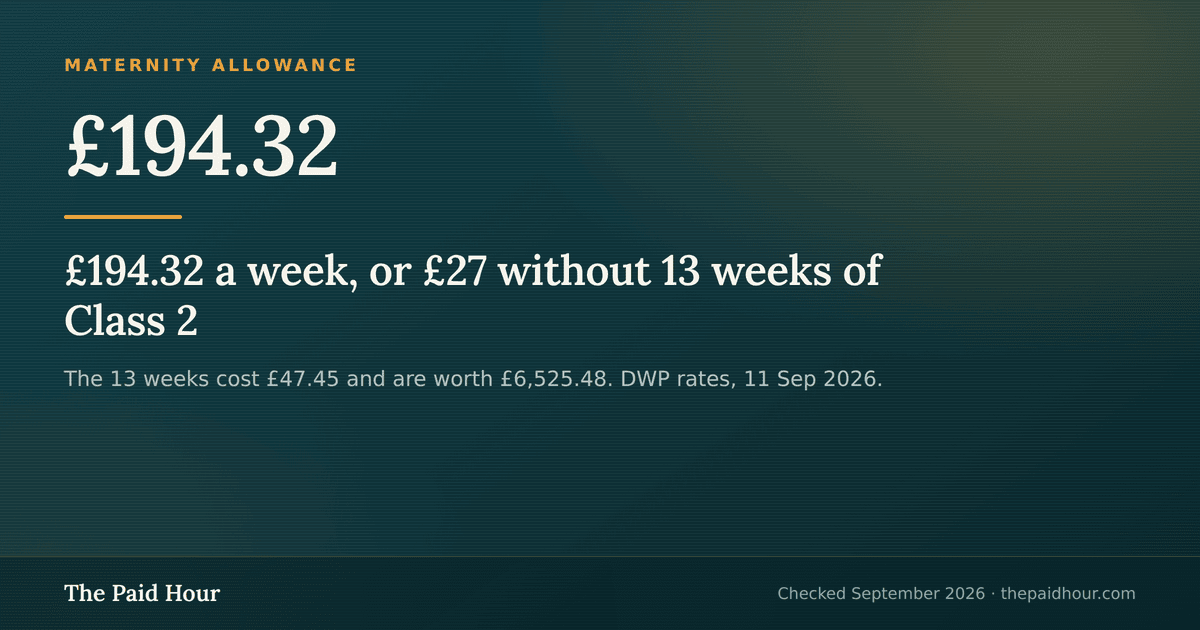
Self-employed Maternity Allowance is £194.32 a week for up to 39 weeks in 2026/27 (DWP benefit rates, checked 11 September 2026). You need 26 weeks registered with HMRC in the 66 weeks before your due week, plus Class 2 National Insurance for 13 of those weeks. Without the Class 2, you get £27 a week. Claim on form MA1 from 26 weeks pregnant.
The gap between the two rates is £167.32 a week. Over 39 weeks that’s £6,525.48, and the thing that decides which side of it you land on is 13 weeks of Class 2 National Insurance at £3.65 a week. That’s £47.45. Maternity allowance self employed claims go wrong at exactly this point, because Class 2 stopped being compulsory in April 2024 and a lot of sole traders have never paid a penny of it, or don’t know whether HMRC has “treated” it as paid for them. This guide sets out the rule, the arithmetic, and a dated timeline for a baby due 1 March 2027.
Contents
Two rates, £167.32 a week apart
GOV.UK gives the self-employed figure as “between £27 to £194.32 a week for up to 39 weeks”. That range hides a cliff. You get the standard £194.32 if, in the 66 weeks before the week your baby is due, you were registered with HMRC as self-employed for at least 26 weeks and paid (or are treated as having paid) Class 2 National Insurance for at least 13 weeks. Fewer than 13 weeks of Class 2 and DWP scales the payment down by the number of weeks you have. None at all and it’s £27.
Here is what that looks like across a full claim.
| Maternity Allowance, self-employed, 2026/27 | Weekly | × 39 weeks |
|---|---|---|
| Standard rate (13+ weeks of Class 2 in the test period) | £194.32 | £7,578.48 |
| Reduced rate (no Class 2 in the test period) | £27.00 | £1,053.00 |
| Difference | £167.32 | £6,525.48 |
| Cost of 13 weeks of voluntary Class 2 at £3.65 | £3.65 | £47.45 |
| Net gain from paying the 13 weeks | £6,478.03 |
Employed claimants get £194.32 or 90% of average weekly earnings, whichever is lower. There’s no 90% test for the self-employed. It’s the flat £194.32 or a Class 2-based fraction of it, which is why your actual profit level matters far less than your National Insurance record does.
Class 2 went voluntary in April 2024. This is the trap
Since 6 April 2024 nobody is liable to pay Class 2. If your profits for a tax year are at or above the Small Profits Threshold (£7,105 for 2026/27, £6,845 for 2025/26), HMRC treats Class 2 as paid for that year to protect your benefit record. If your profits are below it, you can pay voluntarily, and the box for that sits inside your Self Assessment return. HMRC’s National Insurance Manual (NIM75001) confirms that for Maternity Allowance no distinction is made between Class 2 paid because of a liability and Class 2 paid voluntarily. Both count. Treated-as-paid counts too.
The catch is timing. Profits for a tax year can’t be established until the year has ended and the return is filed, so HMRC’s record of your Class 2 weeks only updates when you file. A woman whose baby is due in March 2027 has a test period that runs from late November 2025.
About 19 of those weeks sit in the 2025/26 tax year and the rest in 2026/27, a year whose return can’t even be filed until 6 April 2027. If her 2025/26 return isn’t in when DWP checks, or her 2025/26 profits were below £6,845 and she didn’t tick voluntary Class 2, the record shows zero weeks. DWP pays £27.
There is a repair mechanism, and it’s worth knowing exactly how it works. When you claim, DWP tells HMRC. GOV.UK says HMRC “will contact you if you’ve paid less than 13 weeks of Class 2 National Insurance” and will “tell you how many additional contributions you need to get the maximum amount”.
NIM75002 puts it more bluntly: HMRC sends a bill for the required number of weeks, whether you pay it is your decision, and HMRC will not pursue it. You pay, the contributions are linked to your claim, and your payments are increased and backdated. GOV.UK warns this “can take several weeks”, and that you may get £27 in the meantime.
One more line from the manual that most guides miss: if you pay the Class 2 to secure the standard rate and your profits for that year later turn out to be at or above the Small Profits Threshold, the Class 2 you paid is refunded. So there’s no scenario where paying it costs you more than £47.45, and plenty where it costs you nothing. Our guide to voluntary Class 2 National Insurance in 2026/27 covers the State Pension side of the same decision.
Self-employed Maternity Allowance: the 26-in-66 test period
The test period is the 66 weeks before the week your baby is due. Not the birth date. The due date on your MAT B1 certificate, and DWP doesn’t move it if the baby comes early or late. Weeks run Sunday to Saturday, so the period ends on the Saturday before your due week and starts 66 weeks before that Sunday.
Within those 66 weeks you need 26 weeks registered as self-employed with HMRC. They don’t have to be consecutive, and periods of employment or unemployment in between don’t disqualify you. What matters is the registration date, which is why the MA1 notes say that if you “do not register, or register late, you may lose some or all of your entitlement”. If you’ve been trading without telling HMRC, registering as a sole trader now starts the clock. There’s a separate late registration penalty risk on top, so do it properly.
Two edge cases. If you’re employed and self-employed at the same time and your employer won’t pay Statutory Maternity Pay, you can claim MA on the employed route instead, which needs 13 weeks earning £30 or more; DWP will want your 13 highest-earning payslips from the test period. And if you do unpaid work in your spouse or civil partner’s business rather than trading yourself, there’s a £27-a-week, 14-week version, conditional on your partner paying Class 2 for the same 26 weeks.
A dated timeline for a baby due 1 March 2027
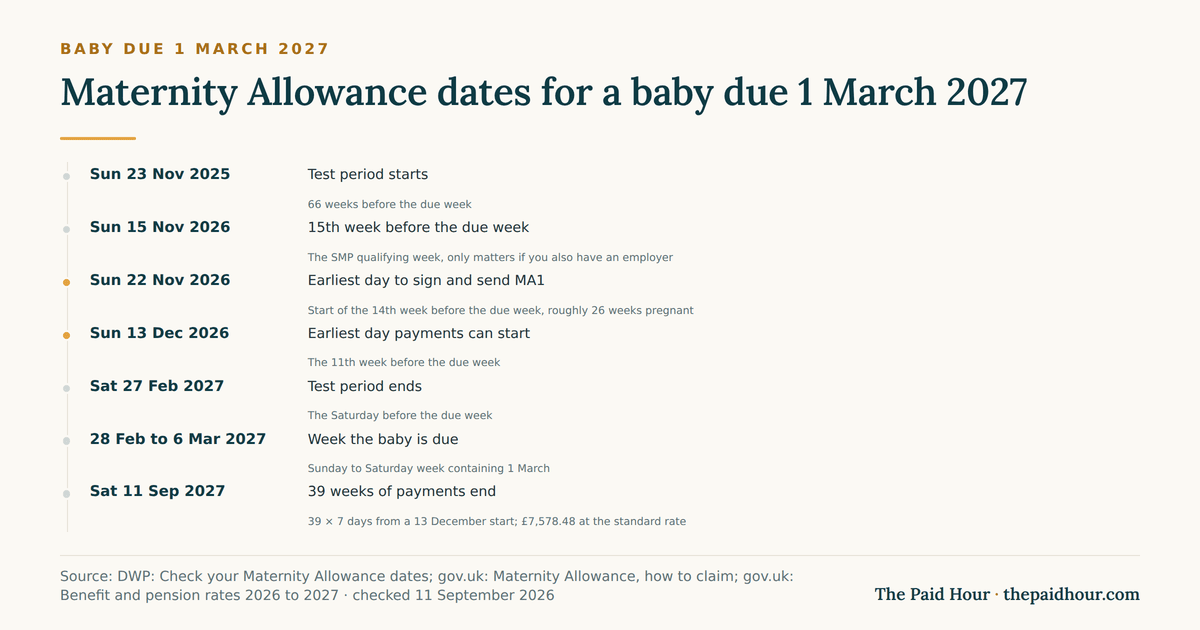
Take a self-employed dog groomer, registered with HMRC since April 2025, profits of £6,000 in 2025/26, baby due Monday 1 March 2027. I ran that date through DWP’s own Test Period calculator on 11 September 2026 (the printed table booklet only runs to December 2026, so a March 2027 due date isn’t in it). These are the dates it gave, plus the start and end dates that follow from the GOV.UK rules.
| Event | Date | Rule |
|---|---|---|
| Test period starts | Sunday 23 November 2025 | 66 weeks before the due week |
| 15th week before the due week starts | Sunday 15 November 2026 | The SMP qualifying week, if you also have an employer |
| Earliest day to sign and send MA1 | Sunday 22 November 2026 | Start of the 14th week before the due week, roughly 26 weeks pregnant |
| Earliest day payments can start | Sunday 13 December 2026 | The 11th week before the due week |
| Test period ends | Saturday 27 February 2027 | The Saturday before the due week |
| Week the baby is due | 28 February to 6 March 2027 | Sunday to Saturday week containing 1 March |
| Latest possible start | Day after the birth | Payments must begin by then |
| 39 weeks end (if started 13 December) | Saturday 11 September 2027 | 39 × 7 days from the start |
Now the money. Her 2025/26 profits of £6,000 are below that year’s £6,845 threshold, so nothing is treated as paid. Suppose she never ticked the voluntary box. She sends MA1 on 22 November 2026 asking for payments from 13 December. DWP finds no Class 2 weeks and awards £27. HMRC then writes with a bill for 13 weeks, £47.45 at the 2026/27 rate (a little less if the weeks HMRC picks fall in 2025/26, when Class 2 was £3.50).
She pays it. Her award moves to £194.32 and the difference is backdated to 13 December. Over 39 weeks she collects £7,578.48 instead of £1,053, a gain of £6,525.48 for an outlay of £47.45, and if her 2026/27 profits end up at £7,105 or more she gets the £47.45 back too.
Change one fact. Say her 2025/26 profits were £9,000. Then Class 2 is treated as paid for the whole of 2025/26, including the 19 test-period weeks from 23 November 2025 to 5 April 2026. That’s more than 13. The only job is to file the 2025/26 return before she claims, so HMRC’s record already shows it when DWP asks. File in October or early November 2026 and she should get £194.32 from the first payment with no £27 stage and no bill.
Claiming on form MA1: what to send and when you hear back
There’s no online claim. The MA1 is a PDF you either print and fill in by hand or complete on a desktop and print. The notes are explicit that it won’t work on a phone or tablet and won’t save in Mac Preview or in Acrobat older than version XI; use a proper PDF reader. If you can’t print, GOV.UK has an order-a-form link and DWP posts one. Don’t sign or date it before your claim-from date (22 November 2026 in the example above), because an early signature delays the claim.
Send with it your original MAT B1 certificate, which your midwife or doctor can issue from the 20th week of pregnancy. If the baby has already arrived, add proof of birth. Employed claimants add payslips; self-employed claimants don’t, because DWP checks your Class 2 record with HMRC directly. Originals only, or copies certified at a Jobcentre Plus office. Keep a photocopy of the MAT B1 before it goes in the post.
GOV.UK says you should get a decision within 20 working days. Payment is every 2 or 4 weeks, in arrears, into a bank, building society or credit union account. To get the full amount, claim within 3 months of the date you want MA to start; claim later than that and you lose weeks. The helpline is 0800 169 0283, Monday to Friday, 10am to 3pm, and the postal address for anything after the claim is DWP Maternity Allowance, Mail Handling Site A, Wolverhampton WV98 2GL.
Tax, Self Assessment and the 10 keeping-in-touch days
Maternity Allowance is tax-free. GOV.UK’s Income Tax page lists it under state benefits you do not pay tax on, alongside Child Benefit and Universal Credit. It doesn’t go on your tax return as income, it doesn’t use up your Personal Allowance, and it isn’t profit for Class 4 purposes. If you want to see what your trading profit alone produces once you’re back at work, the free UK tax calculator does the 2026/27 sums.
What doesn’t stop is Self Assessment itself. You’re still registered, still trading for HMRC’s purposes, and the return for the year you’re on leave is still due by 31 January. Your profits will be lower, which may pull you under the Small Profits Threshold; if they do, the voluntary Class 2 box on that return is the cheap way to keep the year counting for the State Pension. You also get Class 1 National Insurance credits automatically for the weeks you receive MA. Check your State Pension forecast a few months after the claim ends to make sure they’ve landed.
Universal Credit is the exception to the “nothing changes” story. UC is reduced by an amount equal to your MA, pound for pound, so if you’re on both, report the MA award on your UC account the day it starts.
On working: you can do up to 10 days of work during the 39-week Maternity Allowance Period without losing any of it. These are keeping-in-touch days and they apply to the self-employed as well as employees. Any part of a day counts as a day. Go past 10 and you lose MA for the extra days, and you must report every day you work, by phone or post, before or as it happens.
The 14-week spouse’s-business version has no keeping-in-touch days at all. Sending a few invoices, answering a client’s email and finishing a job that overran all count as work, so decide in advance which 10 days are worth spending. Self-employed sick pay works on similar “prove it, report it” lines, and the two are worth reading together if pregnancy-related illness is in the picture.
The bigger risk during those 39 weeks isn’t losing a day of MA. It’s the business itself: clients drifting, a retainer lapsing, an insurance policy renewing on autopilot, nobody chasing the invoice you sent in week 38 of pregnancy. Our Protect the Business course is built around exactly that gap, keeping a sole trader business intact while you’re not in it.
People also ask
How much is Maternity Allowance for self-employed in 2026?
£194.32 a week for up to 39 weeks at the 2026/27 standard rate, provided you have 26 weeks registered with HMRC and 13 weeks of Class 2 National Insurance in the 66-week test period. With no Class 2 it’s £27 a week. Both figures are on GOV.UK and were checked on 11 September 2026.
Do I have to pay Class 2 National Insurance to get Maternity Allowance?
Only if you want the standard rate. Class 2 has been voluntary since April 2024, but 13 weeks of it (paid, voluntary or treated as paid because your profits reached the Small Profits Threshold) is the condition for £194.32 rather than £27. If your record is short, HMRC bills you for the missing weeks after you claim, at £3.65 a week for 2026/27.
Is Maternity Allowance taxable if I’m self-employed?
No. GOV.UK lists Maternity Allowance among tax-free state benefits, so it doesn’t go on your Self Assessment return and doesn’t count towards Income Tax or Class 4. It does reduce Universal Credit pound for pound.
Step by step, in order
- Put your due date into DWP’s Check your Maternity Allowance dates service and write down the test period start, the claim-from date and the 15th-week date.
- Check your National Insurance record in your personal tax account for the tax years inside the test period. If a year shows no Class 2 and profits were under the threshold, that’s the year to fix.
- File the most recent tax return you can before you claim, and tick voluntary Class 2 on it if profits were below the Small Profits Threshold. It’s £3.65 a week and the return is how HMRC learns about it.
- Ask your midwife for the MAT B1 at your 20-week appointment, photocopy it, and keep the original for the MA1 envelope.
- Fill in MA1 on a desktop PDF reader, sign it on or after your claim-from date, and post it with the MAT B1 the same week.
- If HMRC writes with a Class 2 bill after you claim, pay it straight away and diary a follow-up with the helpline if the higher rate hasn’t appeared within 6 weeks.
Sources
- GOV.UK: Maternity Allowance (overview)
- GOV.UK: Maternity Allowance, what you’ll get
- GOV.UK: Maternity Allowance, eligibility
- GOV.UK: Maternity Allowance, how to claim
- GOV.UK: Maternity Allowance, report a change of circumstances (keeping in touch days)
- GOV.UK: Maternity Allowance claim form MA1 and notes
- DWP: Check your Maternity Allowance dates (Test Period calculator)
- GOV.UK: Benefit and pension rates 2026 to 2027
- GOV.UK: Self-employed National Insurance rates
- GOV.UK: Rates and allowances, National Insurance contributions
- GOV.UK: Voluntary National Insurance
- HMRC National Insurance Manual NIM75001: Class 2 and Maternity Allowance, background
- HMRC National Insurance Manual NIM75002: ability to pay Class 2 before the due date
- GOV.UK: Income Tax, tax-free and taxable state benefits
Figures checked against GOV.UK, the DWP benefit and pension rates 2026/27, the MA1 claim notes and HMRC’s National Insurance Manual on 11 September 2026. This is general information, not financial or tax advice.
Insurance sized to a guess?
Protect the Business: Legal, IP & Insurance 2026/27. Eight modules and five working sheets built around a complete annotated freelance contract, with a negotiation note under every clause.
- Registering a trade mark yourself: searching, classes, fees and the opposition period
- UK GDPR without a consultant: the ICO fee tiers, a privacy notice, and the 72-hour breach plan
- An insurance sizing calculator by work type, and the client clauses never to sign as they stand, with the redline for each
You own the copyright in what you make until you assign it in writing. Most clients assume the opposite, and most freelance contracts are silent on it.
Buying more than one? All ten 2026/27 courses for £107, against £293 bought separately.