
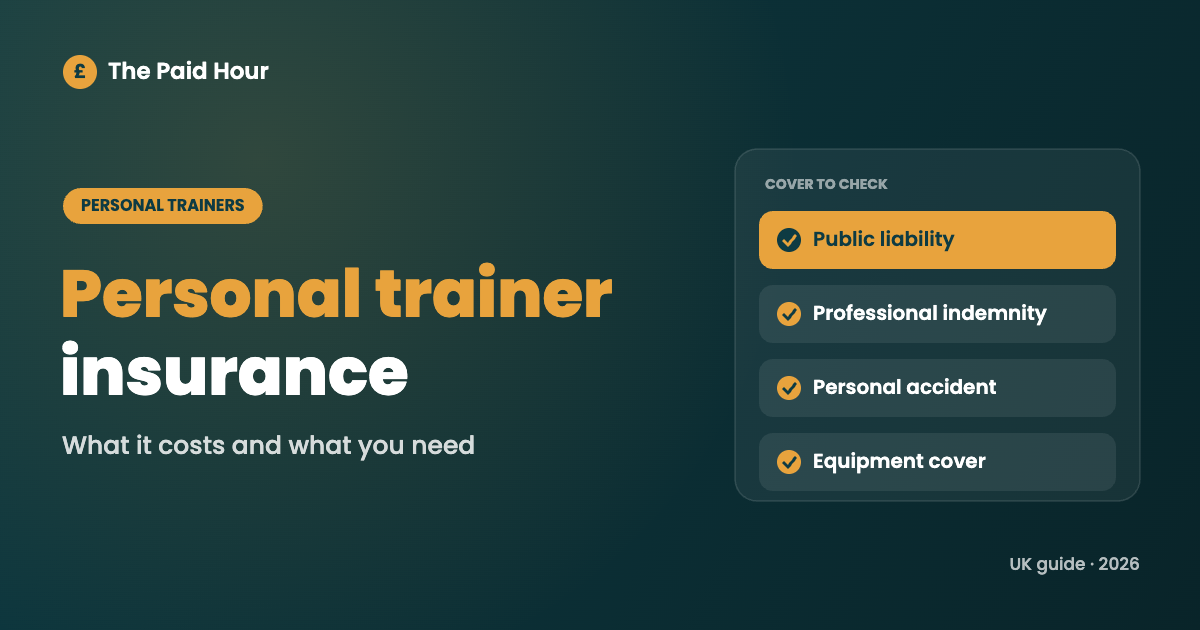
Short answer: Personal trainer insurance should match your work, contracts and risks. The examples below describe individual businesses, not a typical premium or the right cover limit for you. Request a quotation for your own activities.
This guide separates injury claims, professional advice, equipment and your own accident cover. Use the comparison checklist to ask an insurer about your work and gym contracts before buying.
How much personal trainers pay for insurance in 2026
These are real published quotes from Simply Business, which insures 4,500 personal trainers, plus its own data on what the cheapest tenth pay. Where you train, how long you have been qualified and the limit a gym asks for all move the number, but these examples do not establish the going rate.
| Profile | Cover | Price |
|---|---|---|
| Cheapest 10% of personal trainers, Jan–Jun 2026 | Public liability up to £2m | £60.54 a year or less |
| Newly self-employed PT, gym and clients’ homes, 4–5 years’ experience, sole trader, South Derbyshire | Public liability £1m | £74.85 a year (£6.24 a month) |
| PT limited company hiring a studio, professional sportspeople, 1 employee, Rushcliffe | Public liability £10m, employers’ liability £10m | £693.88 a year (£57.82 a month) |
The two examples have different businesses and cover limits, so their price difference cannot isolate the cost of each cover. The broker’s £30,995 average is based on only three successful claims: it does not establish a typical loss or the limit you need.
A client injury claim, step by step
Illustrative scenario: a client is injured during a training session and seeks compensation. Whether the policy pays depends on liability, insured activities, exclusions, conditions and the facts. A public-liability label does not guarantee payment of every injury claim.
What a personal trainer’s policy has to include
- Public liability. A client pulls a muscle on a lift you cued, drops a plate on another member, or trips over your kit. Gyms require £1m minimum; some chains ask for £2m or £5m.
- Professional indemnity. A programme or nutrition advice that a client says caused injury or loss. Increasingly bundled with PL for trainers; worth having if you write plans or give dietary advice.
- Personal accident. Pays you a lump sum or weekly amount if you are injured and cannot train clients. The one cover that protects your own income rather than someone else’s claim.
- Equipment cover. Kettlebells, bands, a portable rig in the car. Only worth it if replacing it would stop you working.
- Employers’ liability. Check employee status, legal requirements and exemptions with your insurer and GOV.UK.
Which gyms and clients will ask for your certificate
Ask each gym you work with for its written insurance requirements, including covers, limits and any certificate checks. Sports centres, council leisure facilities and outdoor bootcamp sites often want £5 million and may ask for the council to be named. Online-only coaches are rarely asked, but the first time a client claims is not the moment to find out.
Compare cover before comparing prices
Request quotations for the same activities, limits, excesses and exclusions, and compare full annual costs including any instalment charges. Published examples describe individual businesses, not a market average or your own premium. Tax relief depends on your circumstances. The earlier estimator was removed because its multipliers were not supported by an insurer’s rating model.
For personal-training cover, specify online and in-person sessions, group sizes, locations, equipment and any nutrition advice. Ask whether your qualifications and activities meet the policy conditions, and compare gym or venue requirements with the quoted limits.
Four checks before you pay for PT cover
- Check the gym’s minimum limit and buy that limit, not the cheapest.
- Ask whether the policy covers you outdoors and in clients’ homes, not just on gym premises.
- Check each quoted excess and the loss you could absorb yourself; compare the same cover and conditions.
- Declare nutrition advice if you give it. Undeclared, a claim about diet can be refused.
- Keep the certificate on your phone. Gym managers ask on the day.
Set it to how you coach. Simply Business compares personal trainer quotes from several insurers in about seven minutes and shows the excess beside each price. Get a personal trainer insurance quote. We may earn a small commission if you buy, at no cost to you; it does not change the price you pay.
Taking on new PT clients each month?
Protect the Business: Legal, IP & Insurance 2026/27. Eight modules and five working sheets built around a complete annotated freelance contract, with a negotiation note under every clause.
- Registering a trade mark yourself: searching, classes, fees and the opposition period
- UK GDPR without a consultant: the ICO fee tiers, a privacy notice, and the 72-hour breach plan
- An insurance sizing calculator by work type, and the client clauses never to sign as they stand, with the redline for each
You own the copyright in what you make until you assign it in writing. Most clients assume the opposite, and most freelance contracts are silent on it.
Buying more than one? All ten 2026/27 courses for £107, against £293 bought separately.
Questions personal trainers ask about insurance
How much is personal trainer insurance in the UK?
These examples are not a typical-price range. Compare quotations for the same activities, limits, excesses and exclusions, including any instalment charges.
Do personal trainers legally need insurance?
No law requires it unless you employ someone, when employers’ liability becomes compulsory. In practice every commercial gym requires public liability before you can train clients on its floor.
What insurance do I need to be a self-employed PT?
Public liability at the limit your gym requires, usually £1m–£5m. Professional indemnity if you write programmes or give nutrition advice. Personal accident if you want your own income protected. Employers’ liability only if you pay other trainers.
Is PT insurance tax deductible?
Business insurance can be an allowable expense. Tax savings depend on taxable profit, applicable rates and eligibility; there is no fixed after-tax premium for everyone.
Does public liability cover online coaching?
It covers injury or damage you cause; online, that risk is small. For online coaching the relevant cover is professional indemnity, which responds if a client says your programme or advice caused harm or loss.
Sources
- Simply Business, personal trainer insurance – example quotes, cheapest-10% price and claims data, 2026
- MoneySuperMarket, self-employed business insurance – average public liability £78.27, quotes Jul–Sep 2026
- GOV.UK, expenses if you’re self-employed – insurance as an allowable expense
Insurance by trade
- Cleaners
- Personal trainers
- Hairdressers and barbers
- Photographers
- Contractors, trade and IT
- Gardeners and landscapers
- Tutors
- Dog walkers