
In short: Public liability pays out when your work hurts someone or damages their property. Professional indemnity pays out when your work, advice or a mistake costs a client money. They cover different risks, so one never replaces the other. Neither is required by law for a sole trader. Employers’ liability is the only one of the three that is compulsory, and only once you take on staff.
People search “is professional indemnity the same as public liability” because insurers sell them side by side and the names sound alike. They are not the same. The easiest way to tell them apart is to ask one question: did someone get hurt or did something get broken, or did someone lose money because of your work?
Public liability vs professional indemnity: the difference in one table
| Public liability | Professional indemnity | |
|---|---|---|
| What it pays for | Injury to a member of the public, or damage to their property | A client’s financial loss caused by your advice, service or a mistake |
| Who claims | Anyone affected by your work: a customer, a passer-by, a venue | Your client |
| The trigger | Something physical happened | Something went wrong with the work itself |
| Legal requirement | None for sole traders | None, unless your regulator requires it |
| Typical limits | £1m to £10m | £50,000 to £5m |
| Cover basis | Usually occurrence: the policy live when the incident happened | Usually claims-made: the policy live when the claim arrives |
The Association of British Insurers describes the three liability covers the same way: public liability for claims from the public, professional indemnity for loss caused by your services or advice, and employers’ liability for staff. The typical limits above come from Simply Business’s own public liability and professional indemnity pages.
Five real-life claims, and which policy pays
Theory is easy to nod along to. These everyday cases make it stick.
| What happened | Which cover |
|---|---|
| A client trips over your camera bag at a wedding and breaks a wrist | Public liability |
| You knock a client’s laptop off the desk while fixing their Wi-Fi | Public liability |
| A bug in the website you built takes the client’s shop offline for three days and they lose sales | Professional indemnity |
| Your bookkeeping error means the client pays an HMRC penalty | Professional indemnity |
| Your part-time assistant hurts their back lifting kit | Employers’ liability (not public liability) |
Notice the last one. Public liability does not cover your own staff. If you employ anyone, even part time, you need employers’ liability insurance by law. We cover that separately in employers’ liability for the self-employed.
Which one do you need? It depends on your work
This is our reading of where each job’s biggest risk usually sits. It is a starting point, not a quote. Your own contracts and clients may ask for more.
| Your work | Main risk | Usually needs |
|---|---|---|
| Cleaner, gardener, dog walker | You are in other people’s homes and spaces | Public liability |
| Electrician, plumber, decorator | Damage or injury on site | Public liability; add PI if you design or advise |
| Web developer, designer, copywriter | Your work fails or misses the brief | Professional indemnity |
| Consultant, coach, bookkeeper | Clients act on your advice | Professional indemnity |
| Photographer, events, tutor at clients’ venues | Both: people around you, and the work itself | Both |
| Market trader, pop-up seller | The public near your stall | Public liability |
A good rule: if you visit clients, work in public or have customers come to you, you want public liability. If clients pay you for know-how, advice or creative work, you want professional indemnity. Plenty of freelancers tick both boxes.
Is either one a legal requirement?
No law makes a sole trader buy public liability or professional indemnity. The ABI lists employers’ liability as the only compulsory one, and only when you have employees. Get that wrong and the fine is up to £2,500 for every day you are not properly insured, according to gov.uk. Cover must be at least £5 million, and you do not need it if the only people you employ are close family.
There are two common ways you end up needing the others anyway:
- Your regulator. Some professions must hold professional indemnity. Solicitors need at least £2 million under the SRA indemnity rules. Architects need at least £250,000 under ARB guidance.
- Your client. Councils, agencies, venues and bigger companies often refuse to sign you up without a certificate. The contract will name the cover and the minimum amount. Read it before you buy, so you buy the right limit once.
The trap most people miss: claims-made cover
Public liability usually works on an occurrence basis. If the accident happened while your policy was live, you are covered, even if the claim turns up years later.
Professional indemnity usually works the other way, on a claims-made basis. The policy that pays is the one live when the client complains, not when you did the work. So if you cancel PI the day you stop freelancing, and a former client claims next year, you may have nothing. That is why regulated professions demand run-off cover: solicitors and architects must keep it for six years after they stop. If you close down or switch to employment, ask your insurer about run-off before you cancel.
How much does each cost in 2026?
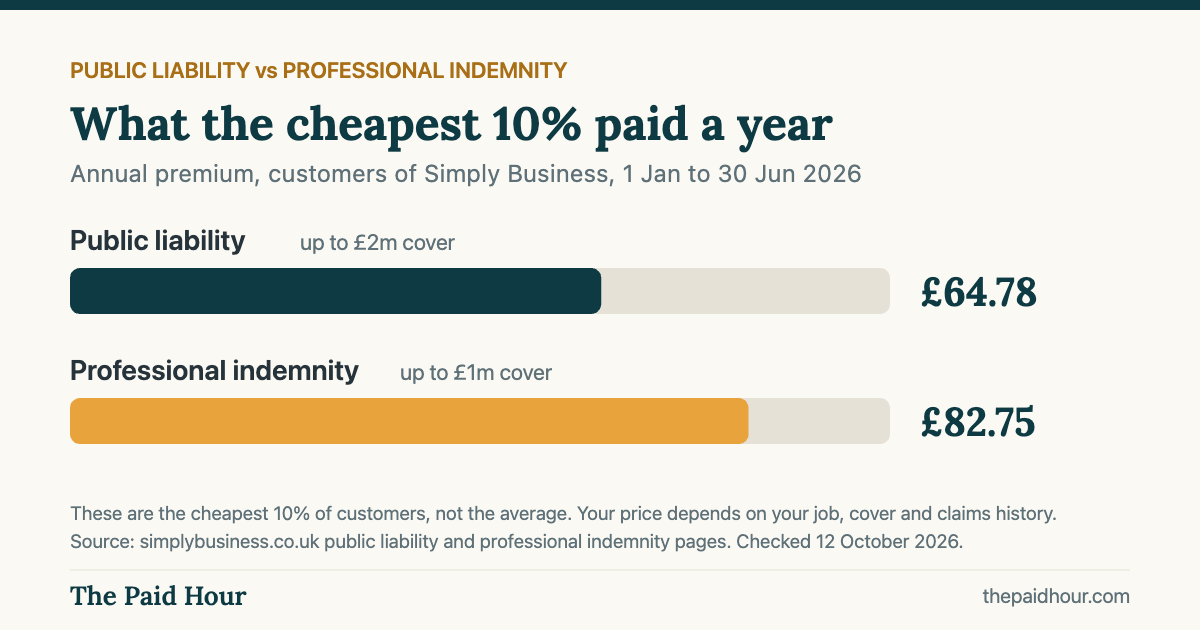
Both are cheaper than most people expect. Simply Business says the cheapest 10% of its customers paid £64.78 a year or less for public liability up to £2 million, and £82.75 a year or less for professional indemnity up to £1 million, between January and June 2026. Those are the low end, not the average.
Its own example quotes give a fairer picture: a sole trader domestic cleaner was quoted £69.29 a year for £1 million of public liability, and a sole trader software developer £96.60 a year for £250,000 of professional indemnity. Prices move every day, so treat these as a guide. For what pushes a public liability price up, see how much public liability insurance costs.
One useful extra: business insurance premiums count as an allowable expense. HMRC lists insurance under financial costs you can claim, so the real cost after tax is lower.
Can you buy both in one policy?
Yes. Most UK business insurers let you add public liability, professional indemnity, employers’ liability and tools cover to one policy with one renewal date. If you need two of them, a combined quote is usually simpler than two separate policies, and you only have one certificate to send clients. Just check each section has the limit your contracts ask for.
Quick answers
Is professional indemnity the same as public liability?
No. Public liability covers injury and property damage. Professional indemnity covers financial loss from your work or advice.
Is professional liability the same as professional indemnity?
In the UK the two names are generally used for the same type of cover. “Professional liability” is the more common term in the US. Always read what the policy wording actually covers.
Do I need public liability if I work from home?
If clients never visit and you never visit them, the risk is low. If anyone comes to your home for business, or you go to theirs, it is worth having.
Does public liability cover my own injuries?
No. It covers other people. Cover for yourself is personal accident or income protection insurance.
Read next
- Self-employed business insurance: what you actually need
- Professional indemnity insurance for sole traders
- Public liability insurance for the self-employed
- Cyber insurance for freelancers
Still unsure which one your work needs? Premierline is a UK business insurance broker. A short chat should tell you whether you need one policy or both, with a quote for each.
Sources
- ABI: Liability insurance
- gov.uk: Employers’ liability insurance
- Simply Business: Public liability insurance (prices and limits)
- Simply Business: Professional indemnity insurance (prices and limits)
- SRA: Indemnity insurance rules
- ARB: Professional indemnity insurance guidance (PDF)
- gov.uk: Expenses if you’re self-employed, legal and financial costs
Checked 12 October 2026. Insurance prices change daily and only your own policy wording binds the insurer. This is general information rather than insurance advice: The Paid Hour is not authorised or regulated by the Financial Conduct Authority and does not arrange insurance. For cover suited to your situation, speak to an FCA-authorised broker.