
What matters here: Public liability insurance cost UK sole traders pay is higher than the “£5.40 a month” headline suggests. The “from £5.40 a month” headline is the cheapest tenth of customers, it is an annual price divided by twelve, and it excludes what paying monthly adds. Simply Business puts that figure at £64.78 a year or less for the cheapest 10%; AXA quotes £63 a year on the same basis. Real published examples sit around £86 to £100 a year. After the tax deduction a sole trader on the basic rate feels about three quarters of it.
How Much Does Public Liability Insurance Cost in the UK?
Public liability insurance cost UK figures typically run from about £86 to £100 a year for a sole trader with standard cover, or roughly £7 to £9 a month once you divide the annual premium by twelve rather than the sub-£6 headline figure the ads lead with. The average public liability insurance sole trader premium sits in this £86–£100 a year band once you strip out the cheapest-10% marketing price, and if you are asking how much is public liability insurance per month UK insurers charge, budget nearer £8 a month than £5.40. If you have not yet worked out whether you need this cover at all, read Public Liability Insurance: Do the Self-Employed Need It? before you buy on price alone.
Every quote page leads with a number under six pounds. Nobody pays six pounds and walks away, and the reason is in the footnote rather than the headline.
Public liability insurance cost is one of those figures where the advertised price and the paid price are related but not the same thing. Here is the gap, using the insurers’ own published numbers instead of anybody’s estimate.
What the advertised public liability price actually is
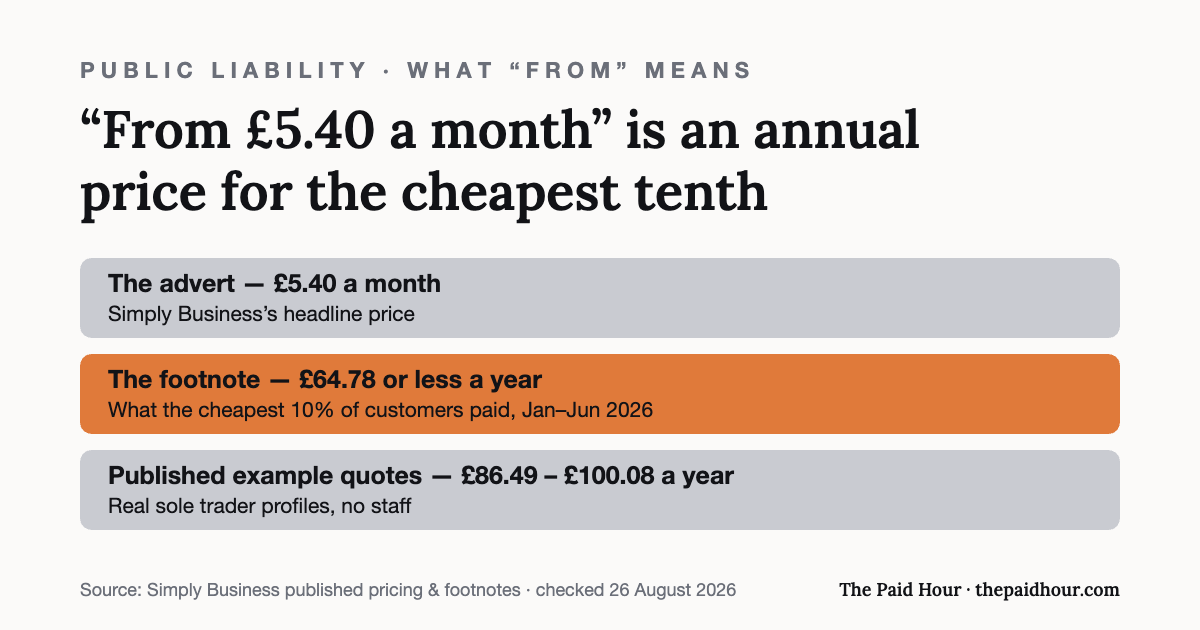
Simply Business advertises public liability from £5.40 a month. Its own small print says what that means: “The price is for up to £2 million of public liability insurance – 10% of customers paid £64.78 or less annually between 1st Jan – 30th Jun 2026. Equivalent to £5.40 a month (and excludes the extra costs for paying monthly).”
Three things are buried in that sentence.
- It is the cheapest 10% of customers. Nine in ten paid more.
- It is an annual figure divided by twelve. Nobody is charged £5.40 a month.
- Paying monthly costs extra on top, and the footnote says so outright.
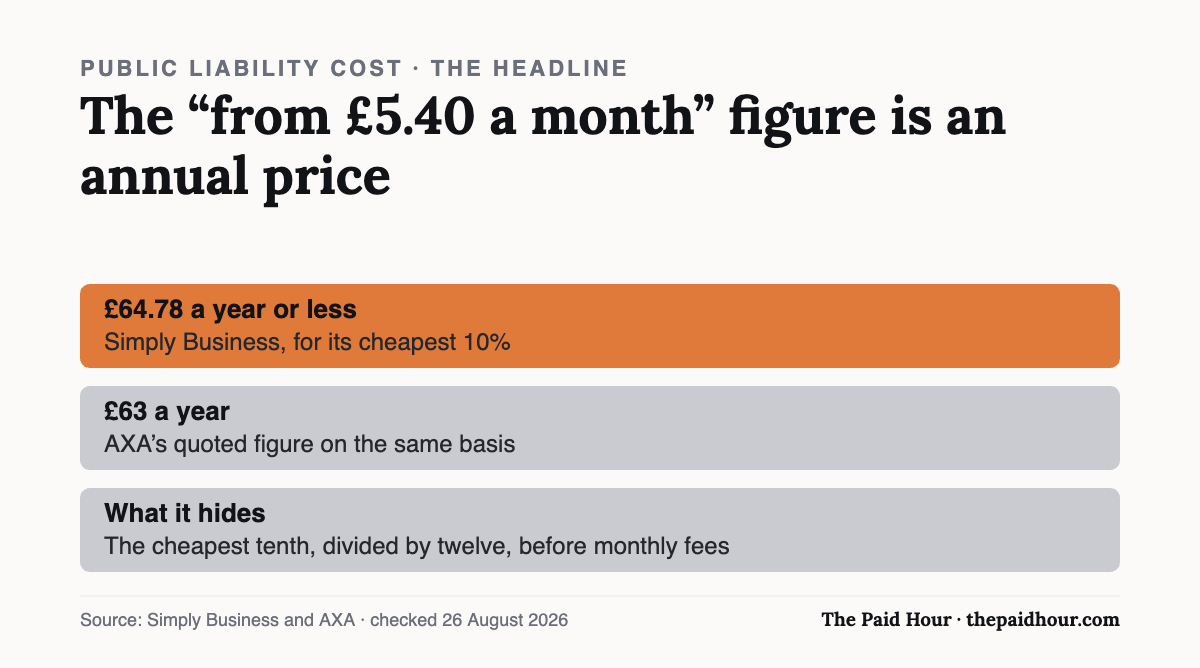
AXA does the same arithmetic slightly differently and lands in the same place: “public liability insurance costs AXA customers prices from £6 per month, or £63 per year”, where the £6 is what “10% of our customers paid from £6 for ten months between April and June 2026 after an initial deposit”.
Ten months, after a deposit. It is not a lie and it is not a twelfth of anything.
What people pay for public liability
Two examples Simply Business publishes on its own quote page, which are more use than any average because they name the trade and the town:
| Who | Cover included | Price as published |
|---|---|---|
| Domestic cleaner, Manchester. Sole trader, no employees, under a year in business, residential properties only. | £1,000,000 public liability | £7.21/month (£86.49/year) |
| Barber, Edinburgh. Sole trader, no employees, 2–3 years in, rents a chair rather than owning the shop. | £1,000,000 public liability plus £1,000 tools cover | £11.46/month (£100.08/year) |
Now do the multiplication on the second row. £11.46 twelve times is £137.52 rather than £100.08. On the first row the two figures line up exactly; on the second they do not. Whatever sits behind that, it is a reminder to ask which basis a quote is on before you compare it with anything, because the footnote on the same page is explicit that the headline rate “excludes the extra costs for paying monthly”.
These are the provider’s own illustrative quotes instead of an independent survey. Read them as the shape of the market for a sole trader with no staff, which is what most people asking this question are.
What moves a public liability premium
AXA lists six factors: occupation, where you work, the level of cover, how many employees you have, turnover, and the excess you accept.
Occupation does most of the work. A consultant sitting in a spare room and a roofer are not in the same conversation, and no amount of shopping around closes that gap, it is the risk, not the marketing. The two levers you actually control are the excess, which cuts the premium in exchange for pain later, and the level of cover, which is usually not yours to choose at all.
£1 million or £2 million?
The market has already answered this. Simply Business says “85% of customers have a £1 million limit and 15% £2 million”.
So £1 million is the default, and the people on £2 million are mostly there because a contract told them to be. Cover runs up to £10 million at the top end, and that is construction and managed sites rather than a freelancer with a laptop. Read the client contract before you pick the number, whoever is asking for the certificate decides it rather than you.
The price after tax, which is the one that matters
Business insurance is an allowable expense. HMRC’s example of one is this exact policy: “You can claim for any insurance policy for your business, for example public liability insurance.”
For a sole trader whose profits sit in the basic rate band, the marginal relief is 20% Income Tax plus 6% Class 4 National Insurance: 26p in the pound. So the cleaner’s £86.49 policy has a real cost of about £64, and AXA’s £63 lands nearer £47.
That is arithmetic from the published rates, not a figure HMRC prints anywhere, and it only works if you are claiming the expense. Plenty of people pay the premium and then never put it on the return, which is the most expensive way to buy insurance there is. It belongs with the rest of your allowable expenses.
Before you buy public liability on price
At £60 to £150 a year, the difference between the cheapest quote and the third cheapest is the price of a takeaway. The difference between the right cover and the wrong cover is the claim.
Check the excess, check whether tools and equipment are in or out, and check the limit against what your contract demands. Then buy annually if you can find the cash, because the monthly convenience is the one cost on this list you can remove entirely.
Signing client contracts as they arrive?
Protect the Business: Legal, IP & Insurance 2026/27. Eight modules and five working sheets built around a complete annotated freelance contract, with a negotiation note under every clause.
- Registering a trade mark yourself: searching, classes, fees and the opposition period
- UK GDPR without a consultant: the ICO fee tiers, a privacy notice, and the 72-hour breach plan
- An insurance sizing calculator by work type, and the client clauses never to sign as they stand, with the redline for each
You own the copyright in what you make until you assign it in writing. Most clients assume the opposite, and most freelance contracts are silent on it.
Buying more than one? All ten 2026/27 courses for £107, against £328 at full price.
Sources
- Simply Business. Public liability insurance, published pricing and example quotes
- AXA, How much does public liability insurance cost?
- gov.uk: Expenses if you’re self-employed: legal and financial costs
- gov.uk — Self-employed National Insurance rates
The £5.40 headline and its footnote were re-checked against Simply Business’s own pricing page on 26 August 2026.
Prices checked on the providers’ own pages on 25 August 2026 and they change, Simply Business figures cover 1 January to 30 June 2026, AXA’s April to June 2026. This is general information, not insurance advice: The Paid Hour is not authorised or regulated by the Financial Conduct Authority, does not arrange or recommend insurance, and earns nothing from any insurer named here. For cover suited to your situation, speak to an FCA-authorised broker. The tax points are general information rather than tax advice.
Read next
- Public Liability Insurance: Do the Self-Employed Need It?
- Simply Business for Sole Traders: Not an Insurer
- Self-Employed Insurance UK: What Freelancers Actually Need
What public liability insurance costs: common questions
How much is public liability insurance for the self-employed?
Simply Business puts it at £64.78 a year or less for its cheapest 10% of customers, and AXA quotes £63 a year on the same basis. Published real-world examples sit closer to £86–£100 a year. Treat anything advertised as a “from” price as the bottom tenth of the market, not the middle.
What is the average cost of public liability insurance in the UK?
There is no honest single average, and the headline figures are not one. Every widely quoted number is a cheapest-decile price, which is why the quote you get back is usually higher than the number that brought you to the page.
How much does public liability insurance cost per month?
The “from £5.40 a month” style of headline is an annual price divided by twelve, quoted for the cheapest tenth of customers. Actually paying monthly is a credit arrangement and costs more over the year than paying once.
What makes a public liability premium go up?
Trade and risk class first — a scaffolder and a copywriter are not in the same market — then turnover, the level of cover, and claims history. Two sole traders can pay very different prices for identical cover.
Is public liability insurance tax deductible?
Yes. It is an allowable business expense and HMRC names insurance directly, so it comes off your taxable profit. A basic-rate sole trader therefore feels roughly three quarters of the sticker price.