
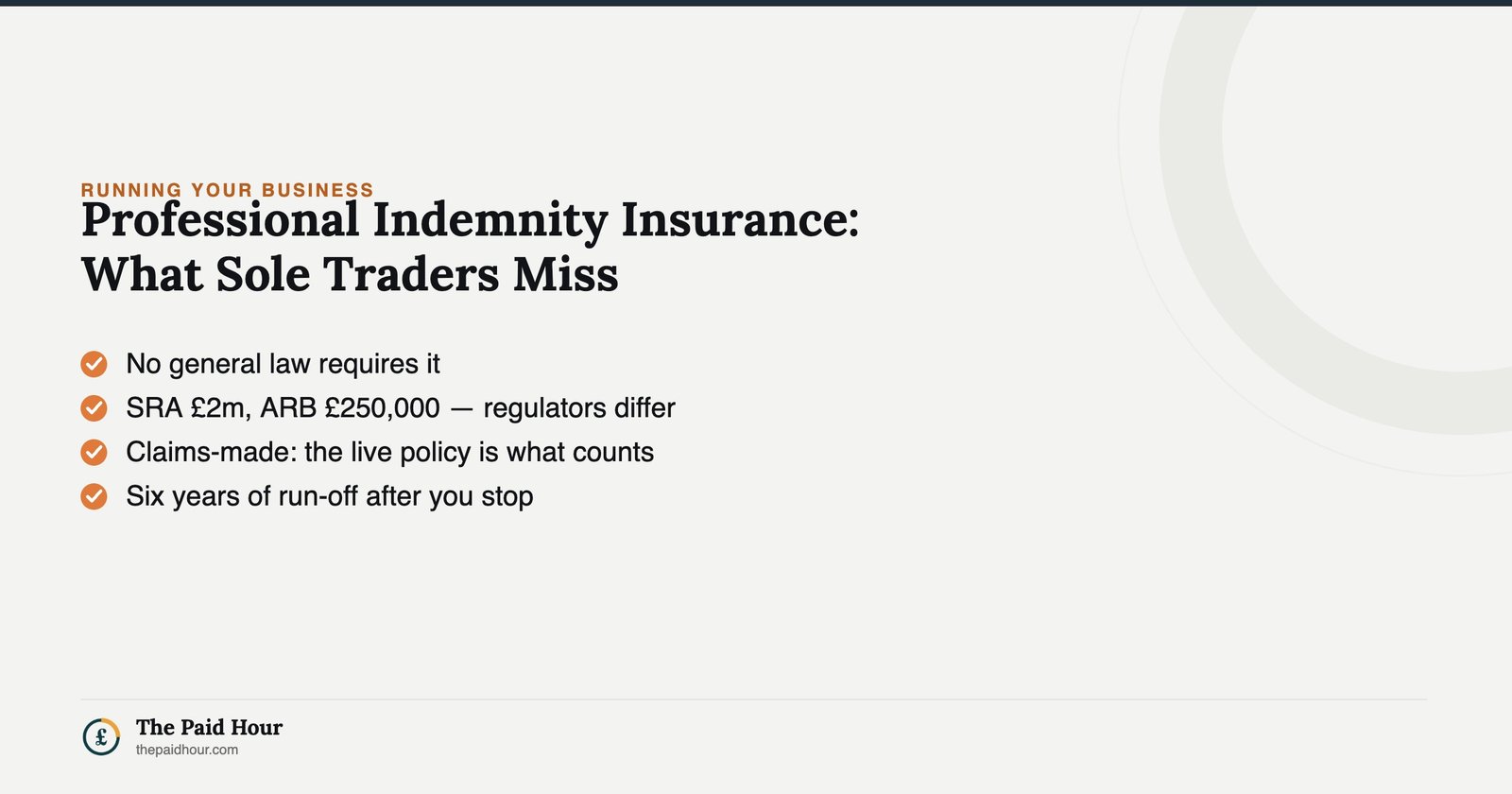
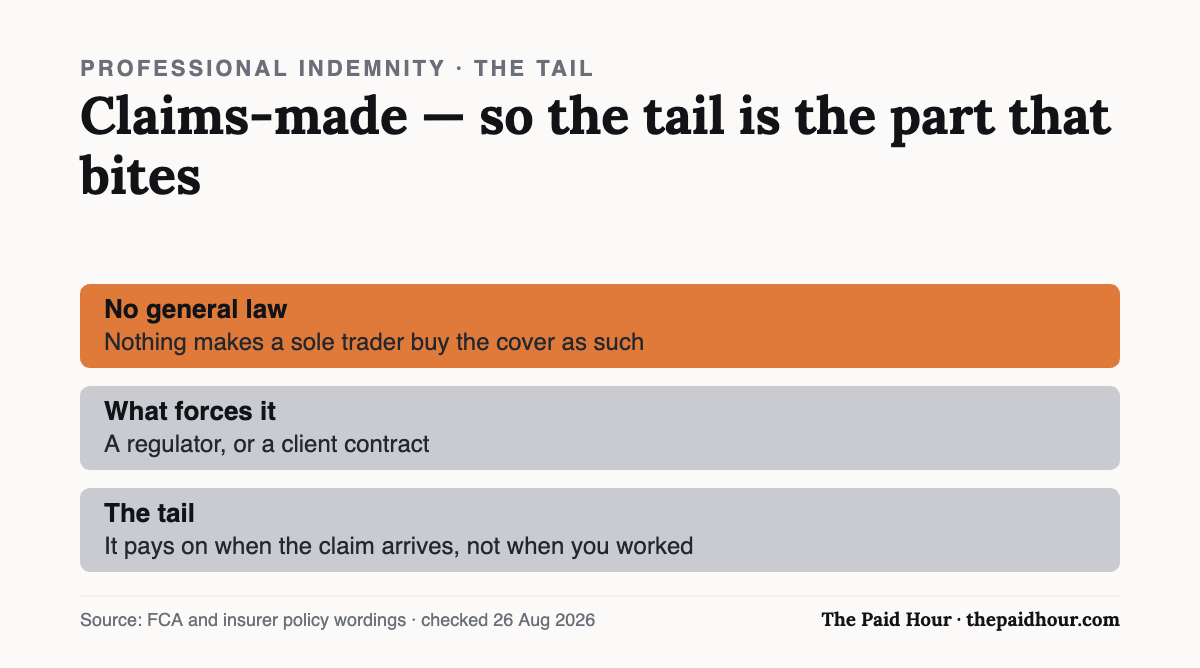
Straight answer: No general law makes a sole trader buy professional indemnity insurance. Two things can still force it: a regulator, if your profession has one, and a client contract, which is most people’s real answer. The part nobody mentions is the tail, cover works on a claims-made basis, so the policy that matters is the one live when the claim arrives. Solicitors and architects are both required to hold six years of run-off cover after they stop.
Professional Indemnity vs Public Liability Insurance UK: Quick Comparison
| Professional Indemnity Insurance | Public Liability Insurance | |
|---|---|---|
| What it covers | Financial loss from bad advice, errors, or negligent work | Injury or property damage to a third party |
| Who it protects | Your clients, against your mistakes | Members of the public and their property |
| Legal requirement? | Only if your regulator or professional body mandates it | No general legal requirement for the self-employed |
| Cover basis | Claims-made (the live policy when the claim arrives) | Usually occurrence-based |
| Typical buyers | Consultants, designers, developers, accountants | Trades, market traders, anyone visiting client sites |
| Run-off cover needed? | Yes — commonly 6 years after you stop trading | No |
In short: professional indemnity insurance covers financial loss caused by your advice or work, while public liability insurance covers physical injury or property damage to someone else. Weighing professional indemnity vs public liability insurance UK sole traders usually find the answer comes down to what they sell. Advice and work product point to professional indemnity, physical presence around clients and the public points to public liability, and some businesses need both.
Professional indemnity is the policy for when the work itself is the problem. Not a trip hazard rather than a broken window. The report that was wrong, the design that did not work, the advice a client acted on and lost money.
For most freelancers it is the only liability cover that matches anything they do. It is also the one with a sting in it, and the sting arrives years after you have stopped.
Does a sole trader need professional indemnity insurance?
Three answers, and only one of them applies to you.
- Your regulator requires it. Then it is not optional and the minimum is already decided.
- Your client contract requires it. Then it is optional in law and compulsory in practice, which amounts to the same thing when the invoice depends on it.
- Neither. Then it is a judgement about how much of your own money you are prepared to put behind your own work.
What does not exist is a statute saying every self-employed person must hold it. The only insurance UK law imposes on a small business is employers’ liability, and only once you employ someone, which is covered separately.
If your profession is regulated, the number is set for you
Regulators do not agree with each other, and the spread is wider than most people expect.
| Regulator | Minimum cover | Run-off after you stop |
|---|---|---|
| SRA (solicitors) | £2 million; £3 million for a relevant recognised or licensed body | Six years |
| ARB (architects) | £250,000, on an each-and-every-claim basis | Six years, five in Scotland, at the last year’s level |
Eight times the cover, same profession-adjacent risk, different rulebook. Which tells you the minimum is a regulatory floor rather than a measure of what a claim against you would cost.
Accountants, financial advisers, healthcare professionals, surveyors and several others all sit under their own requirements. If you hold a practising certificate or sit on a statutory register, go and read your own regulator’s rules instead of a broker’s summary of them.
One detail from the architects’ guidance worth stealing whatever you do: cover should be “on an each and every claim basis”. That means the limit resets per claim rather than being a pot for the year. An aggregate policy with the same headline number is a smaller policy, and the difference only shows up on your second bad month.
If nobody regulates you, the client decides on professional indemnity
Designers, developers, copywriters, marketers, consultants, translators, photographers. No regulator, no statutory minimum, and a procurement form that asks for £1 million or £2 million of professional indemnity before you can be set up as a supplier.
Read the clause properly before you buy, because two things in it cost money if you get them wrong: the limit, and whether the contract wants the cover maintained for a period after the work ends. That second one is where people sign up to something they do not realise they are agreeing to.
What professional indemnity covers, and what public liability will not
The Association of British Insurers describes professional indemnity as covering “loss or damage resulting from services or advice provided by a business or individual”. Public liability, by contrast, covers “the cost of claims made by members of the public for incidents that occur in connection with your business activities”.
Physical harm and property damage on one side. Faulty work, bad advice and financial loss on the other. A developer who takes down a client’s checkout on Black Friday has caused no injury and no property damage, and public liability will not go near it.
Which is why a lot of freelancers are insured for the risk they do not run and uninsured for the one they do. Public liability is the phrase everyone has heard of. Professional indemnity is the one their work actually generates.
The claims-made professional indemnity trap
Here is the thing that separates professional indemnity from almost every other policy you own.
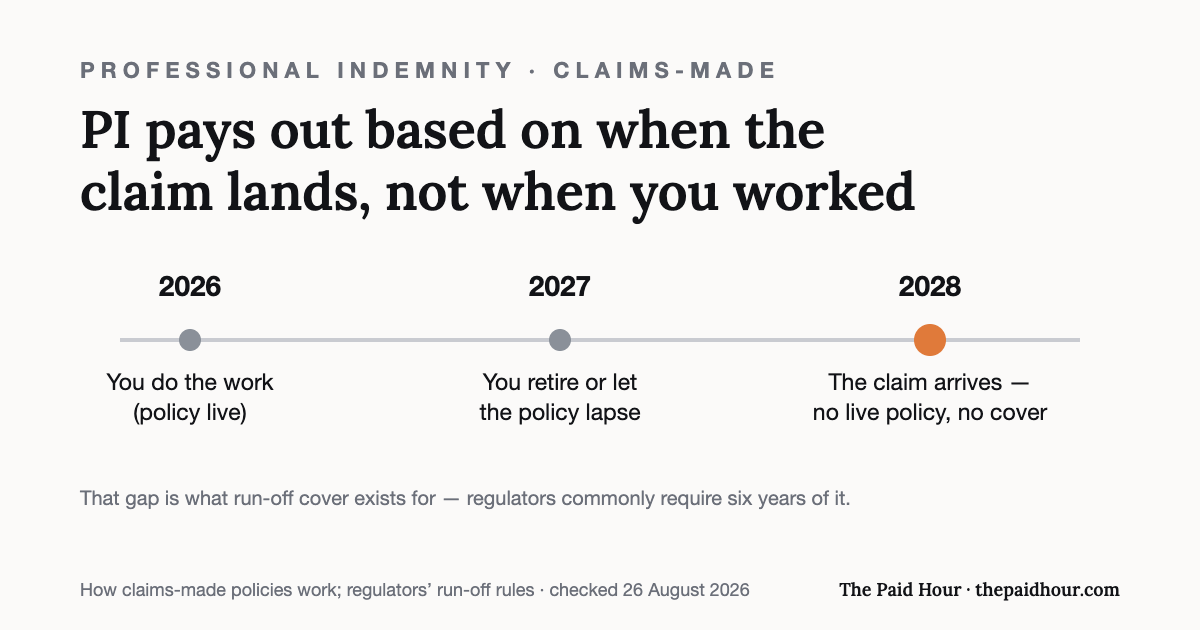
Your car insurance covers the crash that happened while it was live. Professional indemnity is written the other way round: it responds to the claim that is made while it is live, whenever the work was done. Cancel the policy in March and a claim in April about work you did three years ago has nothing to answer it. The policy that was in force when you did the job is irrelevant, because it is no longer in force.
That is not a quirk of one insurer. It is the reason run-off cover exists at all, and it is why two regulators have written it into their rules rather than leaving it to good sense. The SRA requires an additional six years after a firm stops. The ARB tells architects to “always maintain a minimum of six years’ worth of run-off cover (five years’ if they practice in Scotland)”, held “at the same level as the last year prior to the cessation of practice”.
Six years is not arbitrary either. It is roughly the window in which a contract claim can still be brought, which is the same six-year limitation period that governs how long anyone has to chase an unpaid invoice. The ARB also flags longer exposures, twelve years where work was done under a deed.
So the day you stop trading is the day to think about it
Going back into employment, retiring, or just letting the freelance thing wind down, that is the moment the temptation to cancel is strongest and the exposure is unchanged. You have stopped earning from the work. The work has not stopped being able to produce a claim.
If you are not regulated, nobody will make you buy run-off. Ask the price anyway before you cancel, and make the decision knowingly instead of by forgetting to renew.
The professional indemnity premium comes off your tax bill
HMRC is broad about this: “You can claim for any insurance policy for your business”. Professional indemnity qualifies on the same footing as public liability, and it belongs on the same list as the rest of your allowable expenses.
Run-off is the awkward case. If you have ceased trading there is no trade to set it against, so the deduction may not be available in the way it was while you were working. Worth asking an accountant about in the year you stop, rather than assuming it either way.
Professional indemnity and cyber cover get sold together and are not the same thing: one is about the work being wrong, the other about the data getting out. We went through what cyber insurance pays for, and what it excludes.
Signing client contracts as they arrive?
Protect the Business: Legal, IP & Insurance 2026/27. Eight modules and five working sheets built around a complete annotated freelance contract, with a negotiation note under every clause.
- Registering a trade mark yourself: searching, classes, fees and the opposition period
- UK GDPR without a consultant: the ICO fee tiers, a privacy notice, and the 72-hour breach plan
- An insurance sizing calculator by work type, and the client clauses never to sign as they stand, with the redline for each
You own the copyright in what you make until you assign it in writing. Most clients assume the opposite, and most freelance contracts are silent on it.
Buying more than one? All ten 2026/27 courses for £107, against £328 at full price.
Professional indemnity is one cover among several, and most sole traders end up weighing it against public liability instead of buying it alone. Our guide to business insurance for the self-employed sets out which covers are legally required, which are contract-driven, and which are optional.
Sources
- SRA — Indemnity Insurance Rules and Minimum Terms and Conditions
- Architects Registration Board, Professional Indemnity Insurance guidance
- Association of British Insurers. Liability insurance
- Companies House, What insurance does a small business need?
- gov.uk: Expenses if you’re self-employed: legal and financial costs
Checked 25 August 2026. Regulator requirements change and only your own regulator’s current rules bind you, read those, not this. This is general information rather than insurance advice: The Paid Hour is not authorised or regulated by the Financial Conduct Authority, does not arrange or recommend insurance, and earns nothing from any insurer. For cover suited to your situation, speak to an FCA-authorised broker. The tax points are general information, not tax advice.