
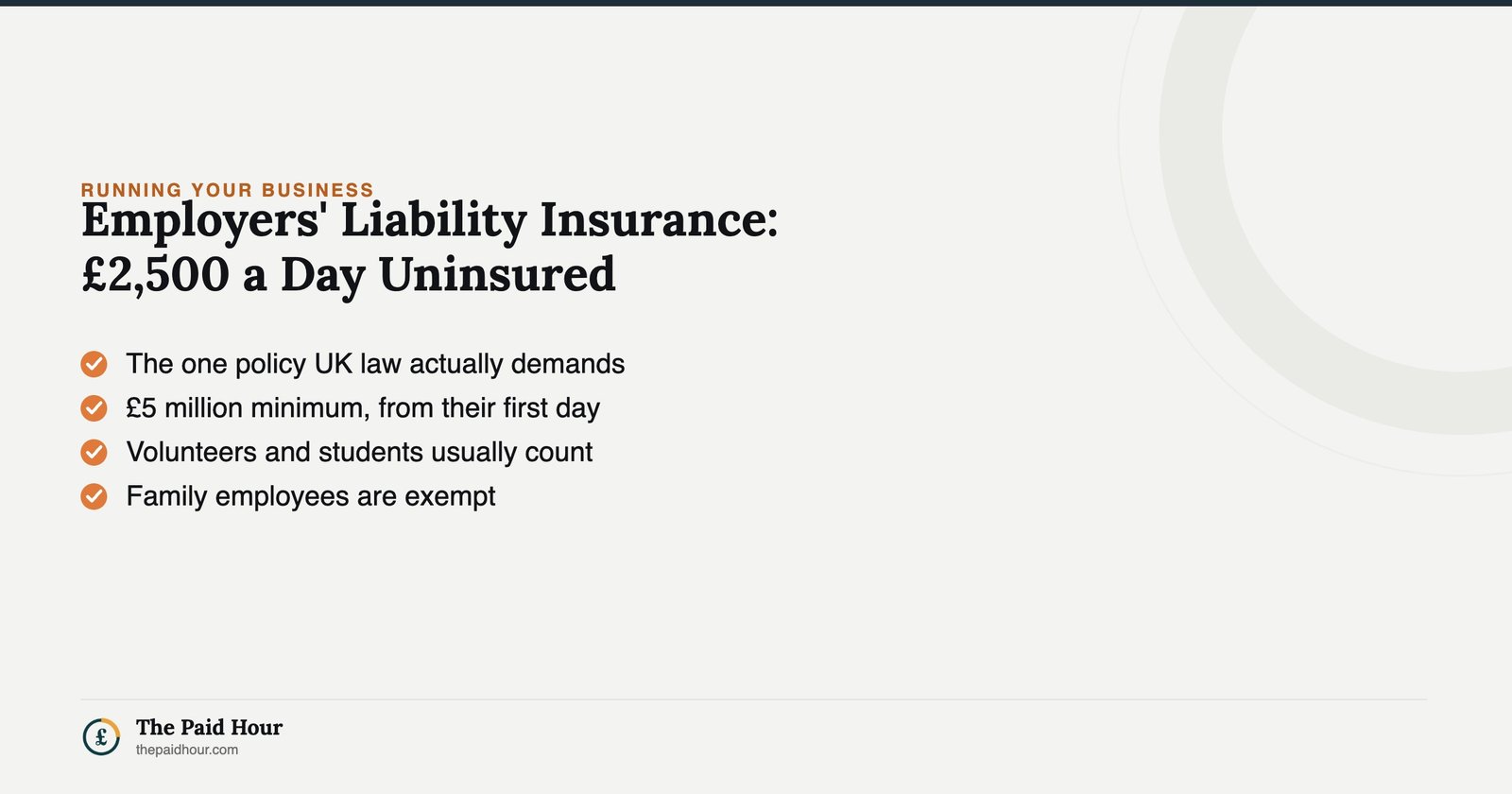
The one-paragraph answer: Employers liability insurance sole trader UK rules are simple: the moment you take on staff, cover becomes compulsory. Employers’ liability is the only insurance UK law forces on a small business. It bites “as soon as you become an employer” and has to cover you “for at least £5 million”. The fine is £2,500 for every day you are uninsured, plus £1,000 for not displaying the certificate. The trap for the self-employed is that “employer” is decided by how the relationship works, not by what you call it.
Employers Liability Insurance Sole Trader UK: The HMRC and Legal Position
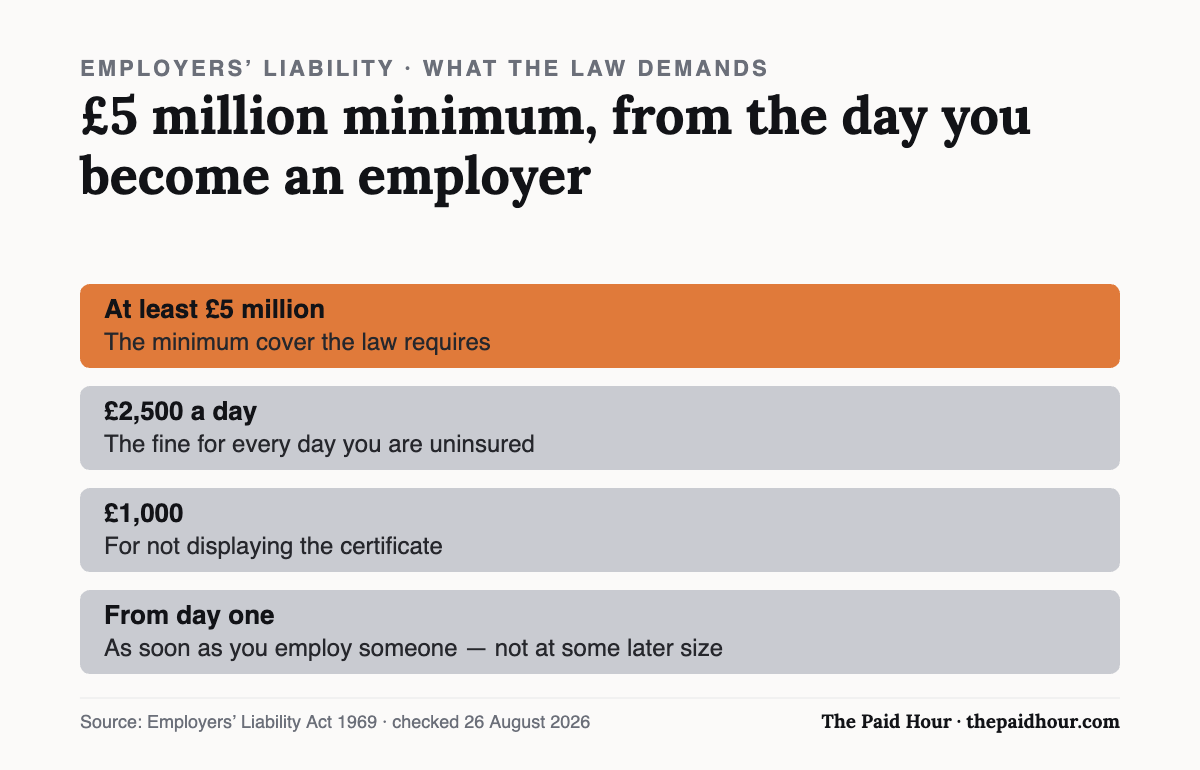
Employers’ liability insurance sole trader rules come from the Employers’ Liability (Compulsory Insurance) Act 1969, not from HMRC directly, but HMRC’s own guidance for the self-employed treats the premium as a normal allowable business expense, the same as any other insurance policy. The legal requirement itself is enforced by the Health and Safety Executive (HSE): once you take on staff, you must hold at least £5 million of cover, display the certificate where employees can see it (or make it available electronically), and keep expired certificates for 40 years. Miss it and the HSE can fine you £2,500 for every day you are uninsured, plus a further £1,000 for failing to display or produce the certificate.
Most self-employed people will never need this policy. The ones who do usually find out late, because they never thought of themselves as an employer in the first place.
Somebody helps out for a fortnight. A student comes in on work experience. You take on a lad who brings his own boots but works your hours, on your job, with your materials. None of that feels like running a payroll. Some of it is still employment as far as the insurance rules are concerned.
Employers’ liability: the only insurance the law demands
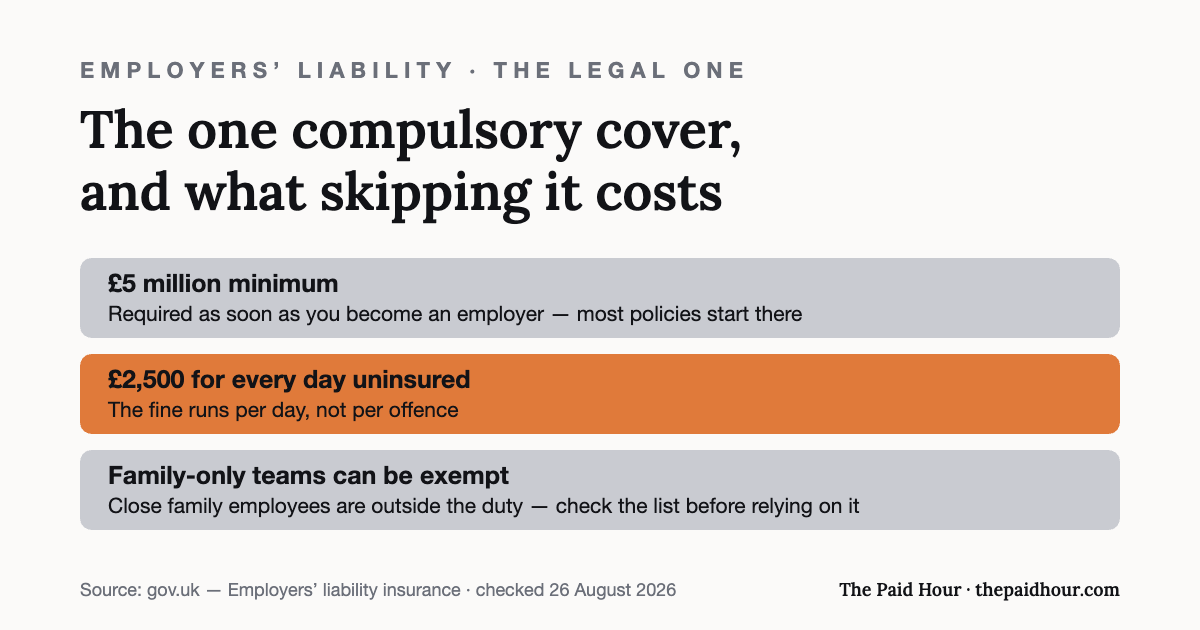
Public liability is not compulsory. Professional indemnity is not compulsory unless a regulator says so. Employers’ liability is, and Companies House puts it plainly: “There’s only one policy you’re legally required to have as a small business, and that’s employers’ liability insurance.”
gov.uk sets out the two hard numbers. You need it “as soon as you become an employer”, and the policy must cover you “for at least £5 million”. Employers liability insurance sole trader UK cover has to meet both numbers at once, not just one.
When does a self-employed person become an employer?
Not when you decide you are one. The Health and Safety Executive is direct about this: “What matters is the real nature of your relationship with the people who work for you and the nature and degree of control that you have over the work they do.”
The HSE lists what points each way.
| Points towards employment | Points away from it |
|---|---|
| You deduct National Insurance and Income Tax from what you pay them | They do not work exclusively for you |
| You control where and when they work, and how they do it | They supply most of their own equipment and materials |
| You supply their materials and equipment | They can send a substitute when they cannot do the job |
| They cannot send a substitute in their place |
Read that list next to the last person who “helped you out on a job”. Your van, your tools, your hours, your instructions, and no chance of them sending their cousin instead, that is four out of four, whatever the invoice said.
Calling someone a subcontractor does not settle it, and the distinction has consequences well beyond insurance. The rules on hiring a subcontractor as a sole trader go through the tax side of the same question.
The people you would never count, but insurers do
Here is the part that catches small operations. According to the HSE, insurers “will usually cover” volunteers, unpaid students, trainees and work-experience students under an existing employers’ liability policy.
Nobody is being paid. Nobody is on a payroll. There is still a person on your premises, under your direction, who can be hurt, and a policy is the thing standing between that and your own money.
Taking on a work-experience student for two weeks is the single most common way a one-person business acquires an insurance obligation it never went looking for.
Who is exempt from employers’ liability?
Two exemptions, and the first is the one that keeps a lot of family businesses out of it. You do not need cover for an employee who is “a family member”. Gov.uk lists spouse, parents, grandparents, step-relations, siblings and half-siblings, or for someone “based outside of England, Scotland and Wales”.
So a sole trader whose partner does the books and whose brother covers Saturdays is not caught. Take on one person outside that circle and the requirement starts on their first day, not at the end of the month.
The employers’ liability certificate, and where it has to live
You have to display a copy of the certificate “where your employees can easily read it”. Since 1 October 2008 that can be electronic, as long as “employees know how and where to find the certificate and have reasonable access to it”.
Which for most small businesses means a PDF somewhere people can reach rather than a link buried in a folder only you can open. An inspector can ask to see it, and failing to display it or produce it is its own £1,000 penalty, entirely separate from the cover itself.
£2,500 a day without employers’ liability
gov.uk: “You can be fined £2,500 every day you are not properly insured.”
Per day. Not per incident rather than per employee, and not capped at anything comforting. A fortnight uninsured is theoretically £35,000, which is more than most one-person businesses turn over in a year.
Whether an inspector would ever run the meter that hard is a different question. The point is that the exposure is structured to make going uninsured indefensible instead of merely expensive, and that is deliberate.
Keep the old certificates, even though you do not have to
This is the most useful thing in the HSE’s guidance and the least known. Since 1 October 2008 “there has been no legal requirement for employers to keep copies of out-of-date certificates”, and the HSE then strongly advises keeping “as far as is possible, a complete record” anyway.
The reason is disease. Some conditions surface decades after the exposure that caused them, and a former employee can bring a claim long after the business, the job and the paperwork have gone. The certificate names the insurer who was on risk in the year the harm was done. Without it, the claim lands on you personally.
A folder of PDFs costs nothing and takes ten seconds a year. Do that.
Employers’ liability is an allowable expense
HMRC’s wording is broad, “You can claim for any insurance policy for your business”, and employers’ liability sits inside it as squarely as anything does. If you are paying for it, it goes on the return with the rest of your allowable expenses.
And if you are weighing this up alongside the cover that is not compulsory, the comparison is in the guide to public liability insurance for the self-employed. Employers’ liability is for the people who work for you. Public liability is for everybody else.
Insurance sized to a guess?
Protect the Business: Legal, IP & Insurance 2026/27. Eight modules and five working sheets built around a complete annotated freelance contract, with a negotiation note under every clause.
- Registering a trade mark yourself: searching, classes, fees and the opposition period
- UK GDPR without a consultant: the ICO fee tiers, a privacy notice, and the 72-hour breach plan
- An insurance sizing calculator by work type, and the client clauses never to sign as they stand, with the redline for each
You own the copyright in what you make until you assign it in writing. Most clients assume the opposite, and most freelance contracts are silent on it.
Buying more than one? All ten 2026/27 courses for £107, against £328 at full price.
Employers’ liability is the one cover that carries a statutory fine, but it is rarely the only one a sole trader needs. Our guide to business insurance for the self-employed puts it alongside public liability, professional indemnity and the rest, with what each one is actually for.
Sources
- gov.uk: Employers’ liability insurance
- HSE — Employers’ liability (compulsory insurance) act 1969: a guide for employers
- Companies House, What insurance does a small business need?
- gov.uk. Expenses if you’re self-employed: legal and financial costs
The £5m minimum, daily fine and family exemption were re-checked against gov.uk on 26 August 2026.
Checked 25 August 2026. This is general information about what the law requires, not insurance advice, The Paid Hour is not authorised or regulated by the Financial Conduct Authority, does not arrange or recommend insurance, and earns nothing from any insurer. Whether a particular person counts as your employee turns on the facts; if it is close, take advice before deciding you are exempt. The tax points are general information, not tax advice.