
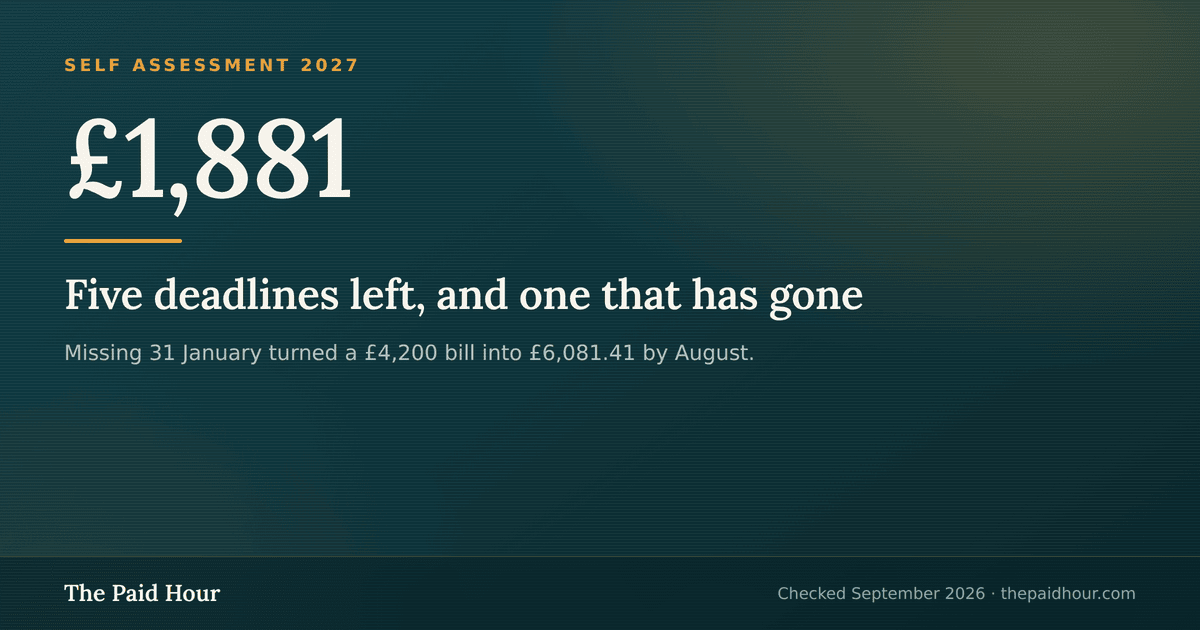
The 2027 Self Assessment deadlines are 31 January 2027 (online return and payment for 2025/26), 31 July 2027 (second payment on account), 5 October 2027 (tell HMRC you need to file for 2026/27), 31 October 2027 (paper return) and 30 December 2027 (to have a bill under £3,000 collected through your PAYE code). Late filing starts at £100.
Search for the self assessment deadline 2027 and almost every result gives you one date. There are five that matter, plus four more if Making Tax Digital applies to you, and the expensive ones are not in January at all. The charges for missing 31 January arrive in instalments through the spring and summer, which is why people who thought they had got away with it get a letter in August.
The one that has gone, and the five still coming
31 January 2027 fell on a Sunday. HMRC never moves the filing deadline for a weekend, though its own payment guidance warns that if you were paying by Bacs or an existing Direct Debit the money needed to reach HMRC by Friday 29 January. Faster Payments and card payments were fine on the day.
What is left in 2027 runs 31 July, 5 October, 31 October and 30 December, with the penalty dates for anyone who filed late threaded between them. Our 2026 deadline guide covers the year before if you are catching up on an older return.
Every Self Assessment deadline in 2027
| Date | Day | What happens | Tax year |
|---|---|---|---|
| 31 January 2027 | Sunday | Online return, balancing payment and first payment on account | 2025/26 and 2026/27 |
| 1 February 2027 | Monday | £100 late filing penalty, even if you owe nothing | 2025/26 |
| 7 February 2027 | Sunday | Third quarterly update, if you are in MTD | 2026/27 |
| 2 March 2027 | Tuesday | 30 days late: 5% of the tax still unpaid | 2025/26 |
| 1 May 2027 | Saturday | Daily penalties of £10 begin, capped at £900 | 2025/26 |
| 7 May 2027 | Friday | Fourth quarterly update | 2026/27 |
| 31 July 2027 | Saturday | Second payment on account | 2026/27 |
| 1 August 2027 | Sunday | Six months late: £300 or 5% filing penalty, whichever is greater, plus a second 5% on unpaid tax | 2025/26 |
| 7 August 2027 | Saturday | First quarterly update | 2027/28 |
| 5 October 2027 | Tuesday | Tell HMRC you need to file, if you started trading in 2026/27 | 2026/27 |
| 31 October 2027 | Sunday | Paper return deadline | 2026/27 |
| 7 November 2027 | Sunday | Second quarterly update | 2027/28 |
| 30 December 2027 | Thursday | Online filing deadline to have a bill under £3,000 coded out | 2026/27 |
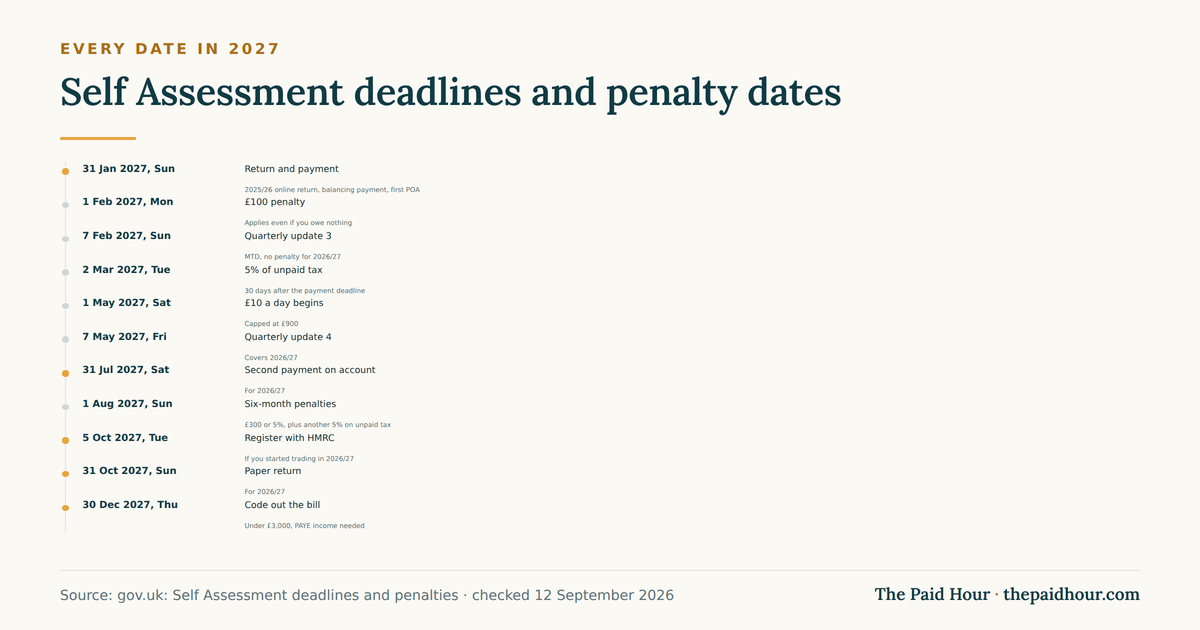
The 30 December date is the one people miss and then regret. File online by then, owe less than £3,000, and already pay tax through PAYE somewhere, and HMRC collects the bill through next year’s tax code instead of asking for it in one go. You cannot make a part payment to get under £3,000. It is the whole bill or nothing.
What missing 31 January 2027 actually costs
Take a freelance photographer with £4,200 of tax owed for 2025/26, return not filed and nothing paid. Here is the bill as it builds, with every charge taken from HMRC’s own penalties page and interest at 7.75%, the rate in force since 9 January 2026.
| When | Charge | Amount | Owed in total |
|---|---|---|---|
| 31 January 2027 | Tax due | £4,200.00 | £4,200.00 |
| 1 February 2027 | Late filing, fixed | £100.00 | £4,300.00 |
| 2 March 2027 | Late payment, 5% | £210.00 | £4,510.00 |
| 1 May to 29 July 2027 | Daily penalties, 90 at £10 | £900.00 | £5,410.00 |
| 1 August 2027 | Late filing at six months, greater of £300 or 5% | £300.00 | £5,710.00 |
| 1 August 2027 | Late payment at six months, 5% | £210.00 | £5,920.00 |
| 1 August 2027 | Interest, 181 days at 7.75% | £161.41 | £6,081.41 |
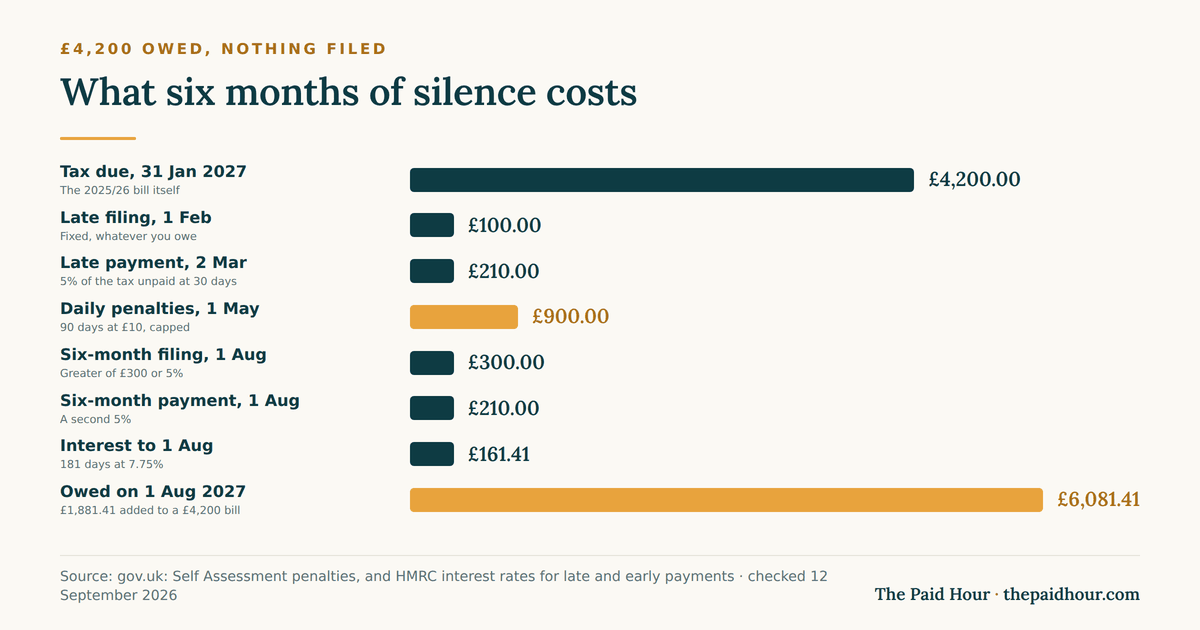
£1,881.41 added to a £4,200 bill in six months, and £1,300 of that is for not filing rather than not paying. Interest keeps running on the penalties too, which I have left out of the table to keep the arithmetic checkable. At twelve months, on 1 February 2028, another £300 and another £210 land on top.
Which is the argument for filing even when you cannot pay. Filing stops £1,300 of that stack dead. Then call HMRC about Time to Pay, which spreads the tax and stops the late payment penalties, though interest carries on. Our penalties guide goes through the reasonable excuse route if you have one.
Two penalty regimes are running at once in 2027
This is the bit that trips people up, and it will get worse before it gets simpler. The table above is the old regime, and it applies to 2025/26 and to anyone not in Making Tax Digital.
If you joined MTD on 6 April 2026 because your qualifying income was over £50,000, a different set of rules applies from that tax year onwards. Late payment is charged at 3% of the tax outstanding at day 15 and another 3% at day 30, then an annual rate of 10% charged daily from day 31. For 2027/28 onwards those two 3% charges become 4%. HMRC waives the day 30 charge once, in your first year in the system. Late filing moves to points: a point per missed submission, £200 once you reach four. Our points guide works through how they expire.
One detail from HMRC’s guidance that is worth knowing before you panic about quarterly updates: there are no penalties for missing a quarterly update deadline for the 2026 to 2027 tax year. Points start with 2027/28. The two updates due in 2027 for the 2026/27 year, on 7 February and 7 May, carry no penalty at all if you are late.
The July payment nobody budgets for
31 July 2027 is the second payment on account for 2026/27, usually half of your 2025/26 tax bill. It is not an extra tax, it is an advance, and it catches out anyone whose first year in Self Assessment was 2025/26 because they paid one and a half years of tax in January and now owe another half in July.
If your 2026/27 profit is clearly lower, you can ask HMRC to reduce both payments on account, but get the estimate wrong on the low side and interest runs on the shortfall from the original due dates. Building the July payment into your monthly set-aside is the safer route, and our HMRC Tax and Expense Mastery course sets out the percentage to hold back so the July date stops being a surprise.
What readers ask
What is the Self Assessment deadline for 2027?
31 January 2027 for the 2025/26 online return and payment. The next filing deadlines in the year are 31 October 2027 for a paper 2026/27 return and 30 December 2027 if you want a bill under £3,000 collected through your tax code.
Do I still get a £100 penalty if I owe no tax?
Yes. The fixed £100 applies to a late return whatever the tax position, including a nil return. The later penalties are the ones that scale with what you owe.
When do I register if I started self-employment in 2026/27?
By 5 October 2027. Register after that and HMRC sets you a different filing deadline, three months from the date on its letter or email, so the January date stops applying to you.
If you are behind right now
- File the return today, even with nothing to pay with. It stops the daily penalties that start on 1 May 2027 and the £300 that lands on 1 August.
- Pay whatever you can before 2 March 2027. The 5% is calculated on what is still unpaid that day, not on the original bill.
- Ask for Time to Pay once the return is filed. HMRC needs the figure on record before it will set up a plan.
- Put 31 July 2027 in the calendar with the amount, and set the alert for Wednesday 28 July so a weekend deadline cannot catch you.
- If you started trading in the 2026/27 tax year, register by 5 October 2027 and do it in September, because the Government Gateway steps take a few days.
- Check whether you are in MTD for 2026/27. If you are, your penalties work differently from everything in the table above.
Sources
- GOV.UK: Self Assessment tax returns, deadlines
- GOV.UK: Self Assessment tax returns, penalties
- GOV.UK: Pay your Self Assessment tax bill
- GOV.UK: Pay your Self Assessment tax bill through your tax code
- GOV.UK: Understand your Self Assessment tax bill, payments on account
- GOV.UK: Penalties for Making Tax Digital for Income Tax
- GOV.UK: Use Making Tax Digital for Income Tax, send quarterly updates
- GOV.UK: HMRC interest rates for late and early payments
- GOV.UK: Self Assessment tax returns, registering and sending a return
Figures checked against GOV.UK on 12 September 2026. This is general information, not financial or tax advice.
Filing it yourself this year?
HMRC Tax & Expense Mastery 2026/27. Nine modules and eleven working templates that take a UK freelancer from “do I even need to register” to a correct return, with MTD quarters built in.
- Fifteen expense categories, with the trap inside each one (training, clothing, meals, the seven-year pre-trading rule)
- Home and vehicle: flat rate against actual cost, with the £312 break-even worked out and the mileage lock-in rule
- The year-one payments-on-account cash shock, and the routine that stops it landing twice
HMRC does not send a list of what you forgot to claim. Most freelancers leave several hundred pounds of legitimate expenses on the table every single year, and the return still gets filed.
Buying more than one? The Complete Freelancer System, all five for £87, against £193 bought separately.