

Trading losses can be carried forward against future profits of the same trade, set against your other income for this year or last, set against capital gains, carried back three years if you are in the first four years of trading, or carried back three years if the trade has ended. The rule almost nobody knows: when you set a loss against other income, partial claims are not allowed. You use all of it, or as much income as it can reach, so the relief can consume your personal allowance and waste it. Carrying forward has no such problem.
Table of Contents
A loss-making year is not a wasted one for tax. It is an asset, and how much it is worth depends entirely on which relief you point it at.
The instinct is to claim it against other income immediately, because relief now beats relief later. Sometimes that is right. Sometimes it throws away several thousand pounds of allowance, and the reason is a single sentence in HMRC’s helpsheet.
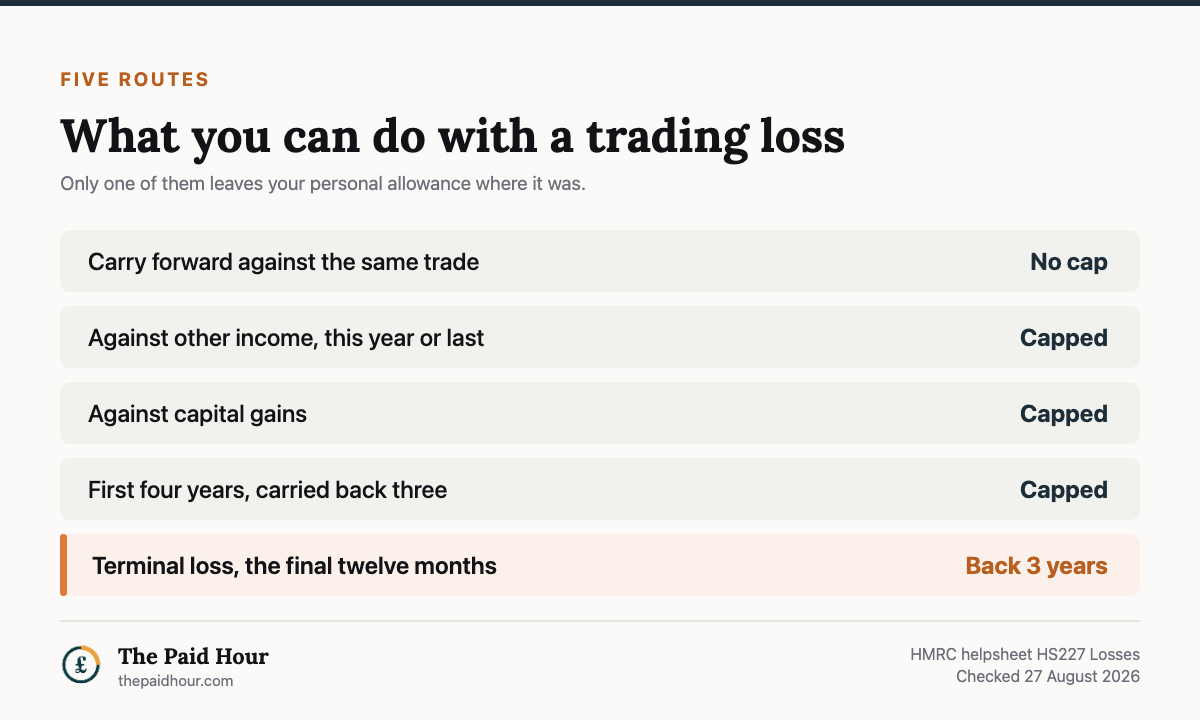
Carrying trading losses forward
The simplest route. The loss sits and waits, and the first profits the same trade makes are reduced by it.
No cap, no election about how much to use, no interaction with anything else on your return. It reduces the trade’s profit and everything downstream follows. Your payments on account, your Class 4 National Insurance, all of it.
The catch is patience. If the trade never makes a profit, the loss never gets used, and it dies with the business apart from the terminal relief below.
You still have to claim it. The time limit is four years from the end of the tax year the loss arose in, so a 2024/25 loss has to be claimed by 5 April 2029, even though it might not be used for a decade.
Setting trading losses against other income
This is the one people reach for, and it is powerful. You can use it against your total income for the year of the loss, the previous year, or both, so a freelancer who also had a job, or who had a strong year before a bad one, can turn the loss into cash back rather than a credit note against the future.
The claim goes in by 31 January nearly two years after the end of the tax year. The same deadline as the amendment window for that return.
Two limits apply.
A cap. Relief against other income is limited to the higher of £50,000 or 25% of your adjusted total income. For most sole traders that is not binding. For a large one-off loss it is.
All or nothing. HMRC’s wording: partial claims are not allowed so you must use all the loss or relieve as much of the income as possible.
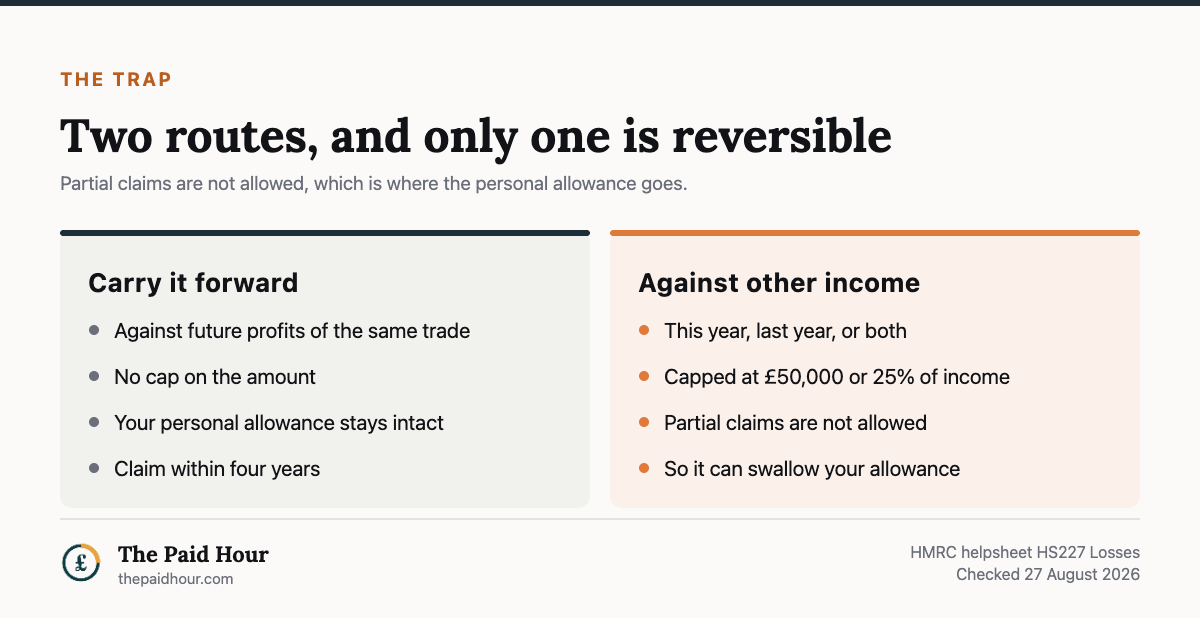
Why all-or-nothing trading losses cost money
Say you had employment income of £20,000 and a trading loss of £18,000.
Claim against other income and the loss reduces that £20,000 to £2,000. But you had a personal allowance sitting there covering the first slice of it anyway, so a large part of that loss has been spent relieving income that was never going to be taxed.
What you cannot do is claim £7,430 of it, leave the allowance intact and carry the rest forward. That is exactly the partial claim the rule forbids.
The choice is between the whole claim and none of it. And none of it is a real option, carry the loss forward instead and every pound of it eventually reduces profits that would otherwise be taxed, at whatever rate applies then.
So the honest rough guide: sideways relief is worth it when your other income is comfortably above the personal allowance and preferably taxed at a higher rate. When it is not, carrying forward usually wins, even though it feels slower.
Trading losses in the first four years
Early trade losses relief exists because new businesses lose money and their owners usually had income before starting.
A loss in any of the first four tax years of the trade can be carried back three years and set against your income then, earliest year first. For someone who left a salaried job to go out on their own, that means a first-year loss reaching back into years when they were paying tax on a wage.
It is one of the more generous reliefs in the system and one of the least used, because the people entitled to it are in their first year of self-employment and have never heard of it. If that is you, it is worth asking about before you file. The starting point for everything else is in your first Self Assessment.
Trading losses when the trade has ended
Terminal loss relief covers losses in the final twelve months of trading, set against the profits of that trade in the final year and the three years before it.
This is the relief that stops a closing loss being stranded. It is also easy to miss, because by the time you realise the business has finished you are usually thinking about anything other than the tax position of the last twelve months.
The condition underneath every trading losses claim
Relief against other income is only available where the trade is carried on commercially and with a view to profit. HMRC also excludes losses that were generated by tax avoidance arrangements.
The commerciality test is the same reasoning that separates a hobby from a business, and it bites hardest on exactly the activity you would expect: something enjoyable that has lost money for several years running and is being set against a salary. Carrying forward does not have that condition attached in the same way, which is another reason it is the safer default.
One thing that changed recently
If you are on the cash basis, none of this used to be available. Cash basis losses could only be carried forward against the same trade.
That restriction was removed from the 2024/25 tax year, and cash basis losses can now be used the same way accruals basis losses are. Since the cash basis is also now the default, this is one of the more consequential changes of recent years and one of the quietest.
The paperwork that backs this up
A running note of every loss: the year, the amount, which relief you claimed and how much is left. It sounds like bookkeeping theatre until you carry a loss forward for six years and cannot remember whether part of it was already used.
Keep the calculation showing how the loss arose too. A loss is the figure most likely to be looked at on a return, for obvious reasons, see what triggers a tax return enquiry, and it needs to be as evidenced as any expense claim. Retention rules in how long to keep business records.
Want the whole tax system, not one rule?
HMRC Tax & Expense Mastery 2026/27. Nine modules and eleven working templates that take a UK freelancer from “do I even need to register” to a correct return, with MTD quarters built in.
- Fifteen expense categories, with the trap inside each one (training, clothing, meals, the seven-year pre-trading rule)
- Home and vehicle: flat rate against actual cost, with the £312 break-even worked out and the mileage lock-in rule
- The year-one payments-on-account cash shock, and the routine that stops it landing twice
HMRC does not send a list of what you forgot to claim. Most freelancers leave several hundred pounds of legitimate expenses on the table every single year, and the return still gets filed.
Buying more than one? The Complete Freelancer System, all five for £87, against £193 bought separately.
Sources
- Relief for trading losses, helpsheet HS227, GOV.UK
- Expanding the cash basis, GOV.UK
- Self Assessment tax returns, GOV.UK
- BIM37007: wholly and exclusively, overview, HMRC Business Income Manual
The five reliefs, the wording that partial claims are not allowed, the cap at the higher of £50,000 or 25% of adjusted total income, the four-year and 31 January time limits and the commerciality condition are from HMRC’s helpsheet HS227 on relief for trading losses. Helpsheets are published for a specific tax year. Check the edition for the year of your loss, since the dates move each time.
The removal of the cash basis loss restriction from 2024/25 is from the measure published on 22 November 2023. All pages read on 27 August 2026. This is general information about how the rules work, not tax advice. Loss relief choices are irreversible in practice and worth putting to an accountant before you file.