

Most Self Assessment refunds are not HMRC making a mistake. They are the system working as designed: payments on account set from a better year, CIS deducted from every invoice, or tax already taken from a job. The refund arrives once the Self Assessment return is filed. Two things worth knowing: HMRC will usually set a repayment against what you owe next before paying anything out, and the interest is deliberately lopsided, base rate plus 4% when you owe, base rate minus 1% when you are owed. That is 7.75% against 2.75% as of 9 January 2026.
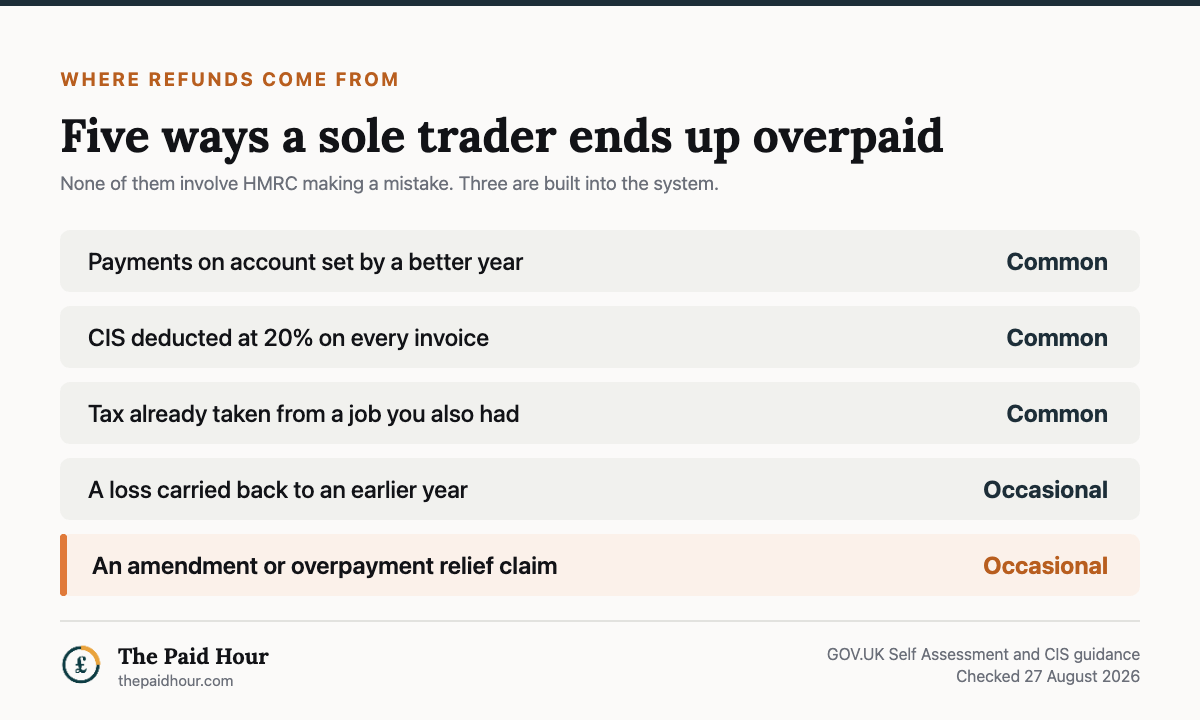
A Self Assessment tax refund tends to feel like luck. It is not. For a sole trader there are three routine ways to end up ahead, and all of them are the tax system collecting money before it knows what you actually earned.
Payments on account: the usual Self Assessment culprit
Payments on account are calculated from last year’s bill. Have a strong year followed by an ordinary one and you will have paid two instalments sized for income you did not go on to earn.
The correction comes when you file. Which is fine, except that the money sat with HMRC in the meantime, and the whole point of the second instalment, due at the end of July, is that it is paid nearly six months before the return that proves it was too much.
There is a way to avoid lending it in the first place. If you know the year is going to be smaller, you can ask HMRC to reduce your payments on account before they fall due. Get it wrong in the other direction and interest runs on the shortfall, so it is a judgement rather than a free option, but it beats waiting for a refund of your own money.
CIS: where the Self Assessment refund is structural
Subcontractors in the Construction Industry Scheme have 20% taken off every payment before it reaches them, or 30% if they are not registered. That deduction is against the labour element of the invoice, and it takes no account of the personal allowance, of expenses, or of anything else that reduces the actual liability.
The result is that a great many CIS subcontractors are due a refund every single year, and the return is the only mechanism for getting it. That is not an anomaly. It is what a flat deduction on gross labour does to someone with real costs and an allowance.
It also makes filing early worth money for that group, in a way it is not for most people.
Self Assessment interest is not symmetrical
Here is the thing worth carrying away from this page.
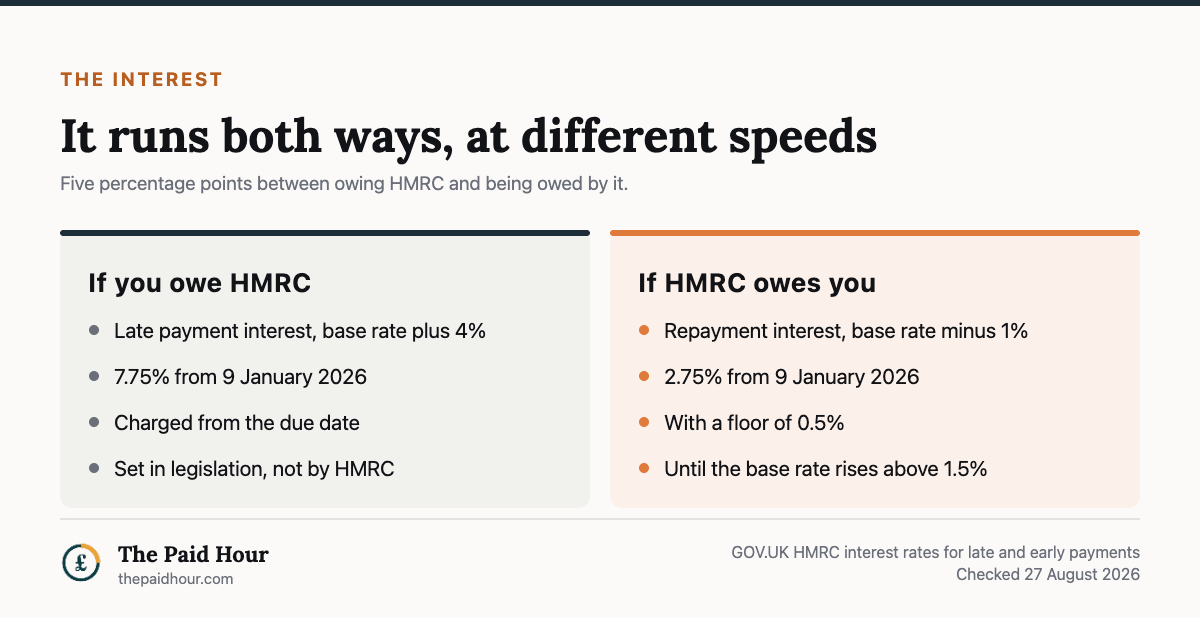
Late payment interest is set at base rate plus 4%. Repayment interest is base rate minus 1%, with a floor of 0.5% that holds until the base rate goes above 1.5%. On the rates in force from 9 January 2026 that is 7.75% against 2.75%.
Five percentage points. Both figures are set in legislation rather than by HMRC, so there is nobody to complain to, but knowing the gap changes how you think about the timing of everything else. Money sitting with HMRC is earning you less than almost anywhere else it could be, and money you owe HMRC is costing you more than most commercial borrowing.
Which is the arithmetic behind a piece of advice that otherwise sounds like fussiness: pay on the day it is due, not before, and never after. And if you cannot, a Time to Pay arrangement does not stop the 7.75% running.
How a Self Assessment refund actually comes back
File the return, and the overpayment shows on your account. You give bank details, HMRC pays it, and for simple cases that is the whole process.
Two things interrupt it.
Set-off. If you have a liability coming (the January balancing payment, or a payment on account) HMRC will generally apply the credit to it rather than sending you money and asking for it back weeks later. Sensible, and startling if you were expecting a bank transfer.
Security checks. Repayments are a target for fraud, so some are held while HMRC verifies them. A first return, a large repayment, or a change of bank details all make that more likely. There is nothing to do but wait, and HMRC publishes current processing times through its own tool rather than in a guide, so check that rather than an article, including this one.
Refund scams are the most common HMRC scam there is
The reason is obvious once you see it: an unexpected message about money you are owed gets read, and the person reading it wants it to be true.
The safe habit costs nothing. Never follow a link in a message about a refund. Go to your own tax account the way you normally would, and look. If the repayment is real it will be there; if it is not, you have lost fifteen seconds. HMRC publishes examples of current phishing messages, and it is worth looking at them once so you know the shape of them.
This matters more for people who are due refunds every year, which brings us back to CIS subcontractors. If a refund message would be plausible in your case, treat every one of them as false until your own account says otherwise.
Keep these on file
Your CIS deduction statements, every one. That is what the refund is calculated from, and reconstructing a year of them from bank credits is miserable work.
Also the dates you paid each instalment, since repayment interest runs from the payment date and a repayment that ignores it is worth querying. And if you also had a job, the P60 or P45 that shows the tax already deducted. The position for someone employed and self-employed at the same time is where the largest avoidable refunds usually hide. Deadlines for all of it are in the Self Assessment deadlines.
Want the whole tax system, not one rule?
HMRC Tax & Expense Mastery 2026/27. Nine modules and eleven working templates that take a UK freelancer from “do I even need to register” to a correct return, with MTD quarters built in.
- Fifteen expense categories, with the trap inside each one (training, clothing, meals, the seven-year pre-trading rule)
- Home and vehicle: flat rate against actual cost, with the £312 break-even worked out and the mileage lock-in rule
- The year-one payments-on-account cash shock, and the routine that stops it landing twice
HMRC does not send a list of what you forgot to claim. Most freelancers leave several hundred pounds of legitimate expenses on the table every single year, and the return still gets filed.
Buying more than one? The Complete Freelancer System, all five for £87, against £193 bought separately.
Sources
- HMRC interest rates for late and early payments, GOV.UK
- Claim a tax refund, GOV.UK
- Check when you can expect a reply from HMRC, GOV.UK
- Examples of HMRC-related phishing emails, suspicious phone calls and texts, GOV.UK
- What is the Construction Industry Scheme, GOV.UK
The interest rates are quoted from GOV.UK’s rates and allowances page for HMRC interest: late payment interest at base rate plus 4% and repayment interest at base rate minus 1% with a 0.5% floor, giving 7.75% and 2.75% from 9 January 2026. Rates move with the Bank of England base rate, check the current figures before relying on them. HMRC does not publish a fixed processing time for repayments; it publishes current timescales through its own online tool, which is why none is quoted here. All pages read on 27 August 2026. This is general information about how the rules work, not tax advice. Check your own position with HMRC or an accountant before you file.