
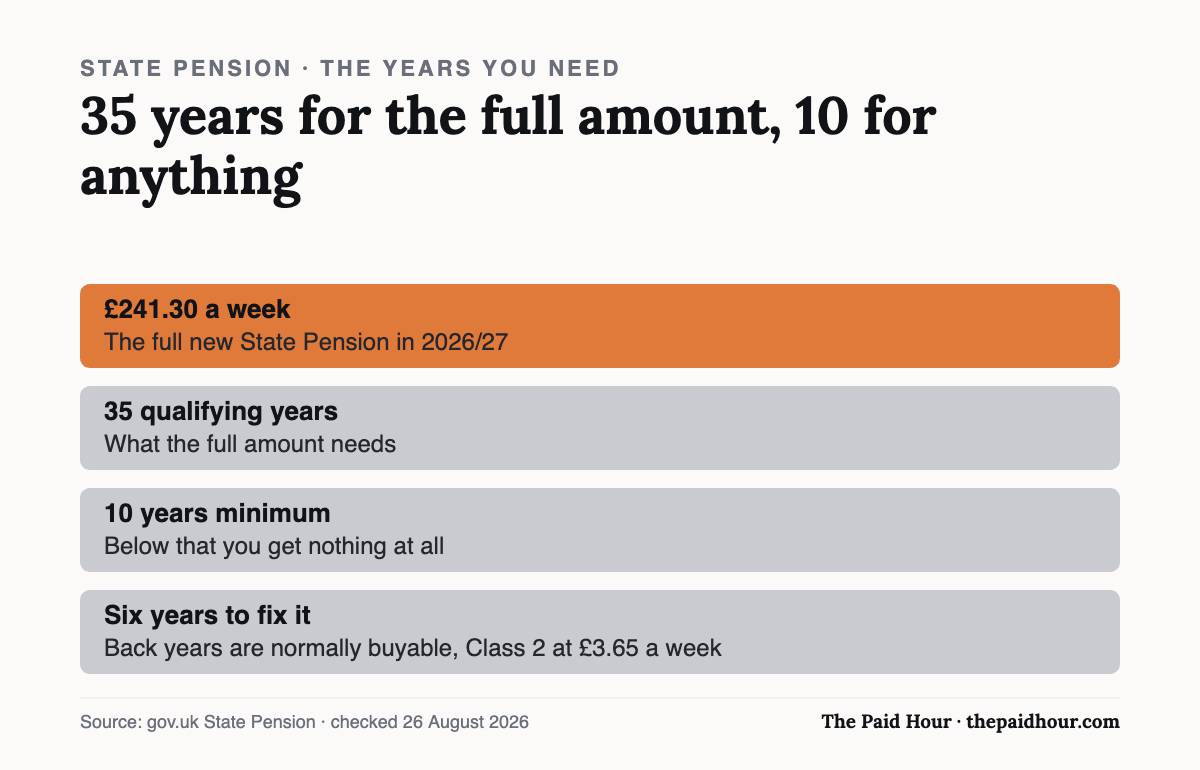
Straight answer: You need 35 qualifying years of National Insurance for the full new State Pension: £241.30 a week in 2026/27, and at least 10 years to get anything at all. Freelancers collect gaps far more easily than employees do. You can normally buy back the last six tax years: Class 2 at £3.65 a week if you were self-employed that year, Class 3 at £18.40 a week otherwise. Check the forecast first, it is free and takes about ten minutes.
Table of Contents
Checking your State Pension forecast takes about ten minutes, and most self-employed people have still never done it. Employees at least get an onboarding email that mentions pensions once, even if nobody reads it. Self-employed, there’s no HR department, no default nudge, just you, an accountant paid to think about this year’s tax bill rather than year forty, and a government website you’ve never had reason to open.
That’s worth fixing. The numbers involved aren’t small, and freelancers end up with more gaps in their National Insurance record than employees do, for reasons that have nothing to do with doing anything wrong.
What your State Pension forecast shows you
The gov.uk Check your State Pension forecast service does three things: it tells you what you’re currently on track to receive, when you’ll reach State Pension age, and whether there’s anything worth doing to increase the amount. You sign in with a Government Gateway ID, or set one up on the spot, which needs photo ID for verification, and it pulls your actual National Insurance record rather than an estimate.
What you’re really looking for is your number of “qualifying years.” Every tax year you paid enough National Insurance (Class 2 or Class 4 as a sole trader, Class 1 if you were employed before going freelance, or NI credits if you were claiming certain benefits), counts as one. Years where you earned too little, or simply didn’t register in time, show up as gaps. Run your own State Pension forecast before reading any further, because the rest of this post only matters in light of your actual numbers.
The number your State Pension forecast turns on: 35
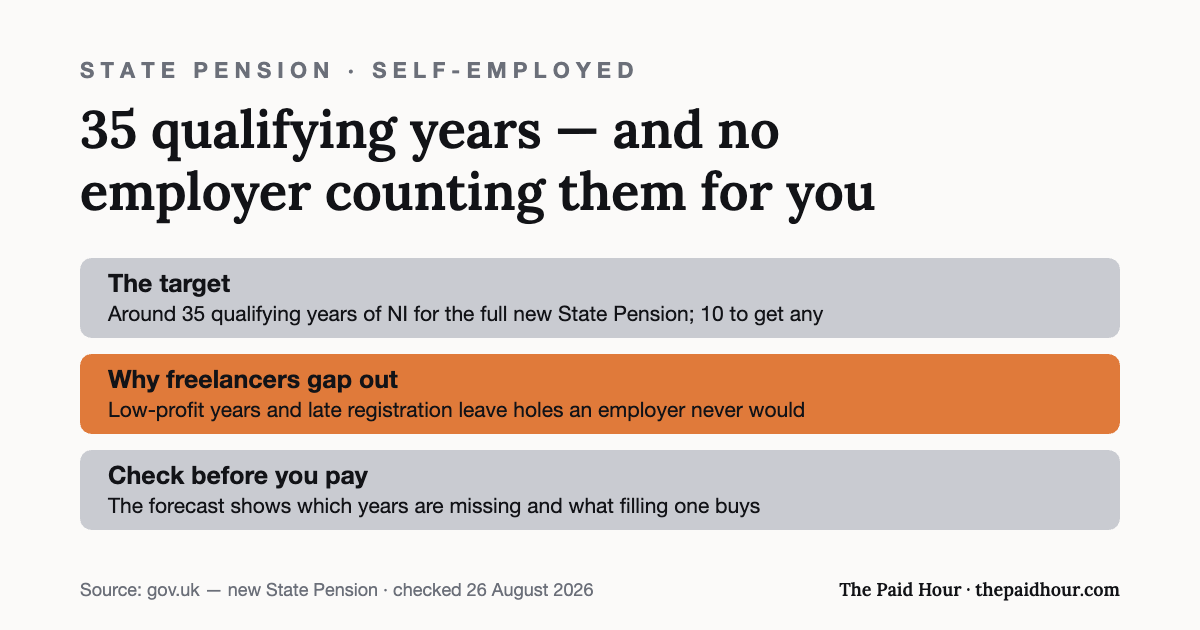
For anyone whose National Insurance record started after April 2016, you need 35 qualifying years to get the full new State Pension. Currently £241.30 a week, just over £12,547 a year. You need a minimum of 10 qualifying years to get anything at all. Land somewhere between 10 and 35 and your pension is roughly proportional: each qualifying year is worth about a thirty-fifth of the full rate.
That word “roughly” matters more than most guides let on. If you were contracted out of the old additional State Pension at any point before 2016 (common if you were in certain older workplace pension schemes), your own number can sit above 35, and the only way to know your real figure is your State Pension forecast itself instead of a rule of thumb from a blog post.
Why freelancers end up with more gaps in a State Pension forecast
A few patterns show up constantly on self-employed people’s forecasts:
- The year you switched from employed to self-employed, if your profits stayed under the Small Profits Threshold, may not have automatically built up a qualifying year.
- Years spent building the business before it made real money, plenty of freelancers have one or two lean years where turnover barely covered costs, let alone National Insurance.
- Time abroad, whether that was travel, working for an overseas client with no UK NI liability, or a genuine career break.
None of that is a mistake, exactly. It’s just what irregular income does to a system that was built around steady employment.
Filling the gaps your State Pension forecast shows
If your forecast shows gaps, you can usually pay voluntary contributions to close them: Class 2 if you were self-employed that year (£3.65 a week for 2026/27), Class 3 otherwise (£18.40 a week). There’s a separate, more detailed post on this site covering the voluntary Class 2 National Insurance route specifically, since the eligibility rules there deserve their own explanation rather than a rushed paragraph here.
The deadline is the part people miss. Normally you can only go back six tax years, and the cut-off for each year is 5 April, so a gap from 2025/26 needs sorting by 5 April 2032. HMRC ran an extended window a while back that let people fill much older gaps, back to 2006, but that closed in April 2025 and it isn’t coming back on the same terms. If you’re staring at a gap from 2019 or earlier, the ordinary six-year rule is what you’re working with now.
Is buying back a year actually worth it?
Usually, yes, if you’re within striking distance of State Pension age. A year of Class 3 costs roughly £956 (52 weeks at £18.40) and typically adds about £6.89 a week to your pension for life (call it £358 a year), one qualifying year is worth one thirty-fifth of the full £241.30 rate, so the uplift moves with the headline figure each April. That division is arithmetic from the published rate rather than a number HMRC prints on the forecast itself.
That’s a payback period under three years, and most people draw their pension for a couple of decades after that. If you’re 55 with three or four gap years showing on your forecast, the arithmetic is unusually favourable next to most other ways of buying guaranteed income for life. Whether it is right for you still depends on your own record, your health and whatever else you have put aside, which is why the forecast comes first and the decision comes second.
It’s a weaker case at 28 with decades of working life left, since the gaps will likely close naturally through ordinary Class 2 or Class 4 contributions anyway, and the rates and rules here will change more than once before you retire. Checking your State Pension forecast is still worth doing at any age. Rushing to buy years this early usually isn’t.
And the forecast is only half the picture — what you pay in privately gets topped up by the government, at 20% or more. How that works, and what a State Pension year costs to protect at each profit level, is in the guide to self-employed pension tax relief and options.
State Pension forecast showing gaps?
Pension & Safety Net for the Self-Employed 2026/27. Eight modules and four working sheets that turn “I should sort my pension out” into a plan you can finish in an afternoon, with the tax relief doing a third of the work.
- Your State Pension forecast, qualifying years, and when voluntary Class 2 is worth paying and when it buys nothing
- The Self Assessment step that recovers higher-rate relief, which most people never claim
- Sick pay, income protection and critical illness: what each actually pays, and the underwriting traps for the self-employed
There is no statutory sick pay for the self-employed at all. Higher-rate pension relief is not automatic either. Both are fixable in an afternoon, and both are still costing most freelancers money.
Buying more than one? All ten 2026/27 courses for £107, against £328 at full price.
Sources
- GOV.UK, Check your State Pension forecast
- GOV.UK, The new State Pension: what you will get (full rate £241.30 a week)
- GOV.UK, The new State Pension: eligibility (10 and 35 qualifying years)
- GOV.UK: Voluntary National Insurance: rates (Class 2 £3.65, Class 3 £18.40 for 2026 to 2027)
- GOV.UK, Voluntary National Insurance: deadlines (six-year rule, 5 April cut-off)
The qualifying-years rules were re-checked against gov.uk on 26 August 2026.
Checked against gov.uk on 25 August 2026. General information, not financial advice. Your own forecast is the only figure that describes your record, and for a decision about buying back years it is worth speaking to a qualified adviser.
Work out your own numbers. Our free UK freelancer tax calculator gives you the 2026/27 Income Tax and Class 4 National Insurance on your profit, plus the amount to set aside each month.