
Before you read on: “Freelancer” and “contractor” describe how you work; “sole trader” is a legal structure for tax. Most freelancers are sole traders, and the same person can be all three at once. What matters to HMRC is the structure and the working relationship, never the word on your website.
Sole trader vs freelancer vs contractor, Google “am I a sole trader or a freelancer?” and the honest answer is: probably both, and that’s not a contradiction. “Freelancer” and “contractor” describe the kind of work you do. “Sole trader” describes your legal and tax status with HMRC. One sits on top of the other, they’re not competing options. Here’s how gov.uk draws the lines.
What’s the real difference between a sole trader, a freelancer, and a contractor?
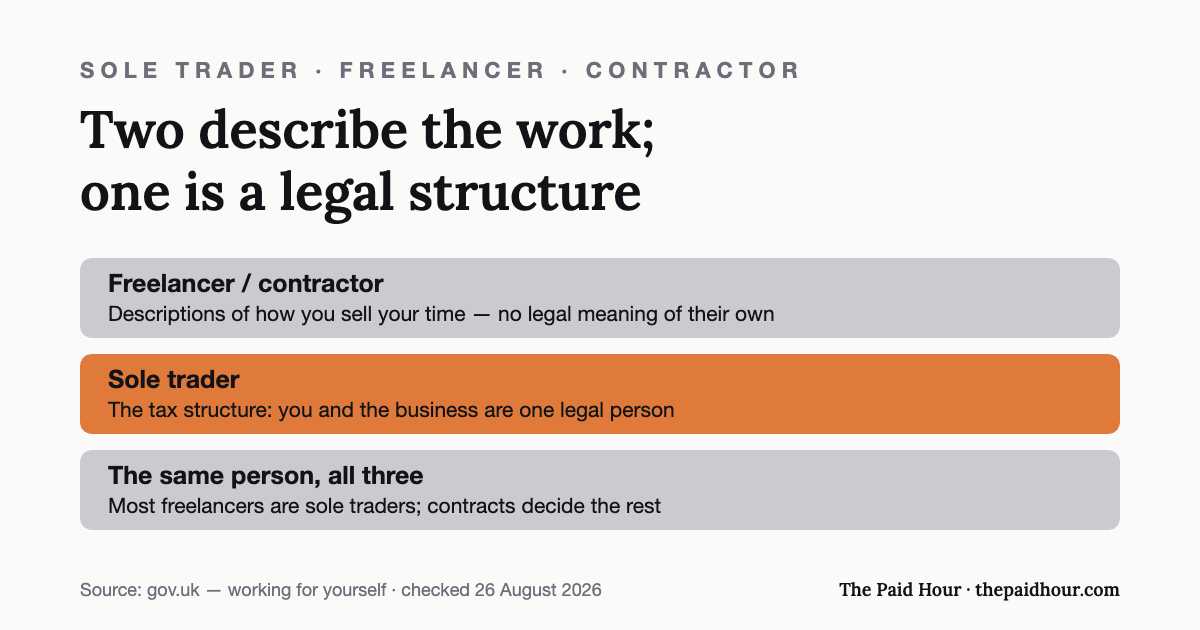
In the sole trader vs freelancer vs contractor comparison, only one of these three words is an official legal category: sole trader. Gov.uk’s list of business structures for setting up on your own includes sole trader, limited company, business partnership, social enterprise, overseas company, and unincorporated association (“freelancer” and “contractor” don’t appear anywhere on it (gov.uk), Set up a business).
“Freelancer” and “contractor” are job-description terms. They tell people what you do (short-term, project-based, self-directed work) but say nothing about your tax status. Gov.uk’s own guidance for employers on these arrangements groups all three terms together and describes freelancers, consultants and contractors as people who are, legally speaking, “self-employed or are part of other companies” (gov.uk, Freelancers, consultants and contractors). In other words: the informal label sits on top of one of the real legal structures underneath, usually sole trader, sometimes limited company.
How does gov.uk define “working for yourself”?
Gov.uk’s “working for yourself” guidance sets out signs that you’re running a business rather than just doing occasional casual work. You’re likely working for yourself if you can decide how, where and when you do your work, take on several customers at the same time, hire other people at your own expense to help you, provide your own main equipment, are responsible for fixing unsatisfactory work yourself, and charge an agreed price for the job rather than being paid a wage for your time (gov.uk: Working for yourself).
None of that test mentions “freelancer” or “contractor.” It’s purely about how you actually work: the control you have, and who carries the financial risk. Once you meet that test, the legal structure you register under (sole trader being the simplest and most common) is what determines how you’re taxed instead of whatever you call yourself on LinkedIn.
Is “freelancer” a real legal or tax category?
No. Search gov.uk for a formal definition of “freelancer” and you won’t find one as a registration option or tax status (it doesn’t show up alongside sole trader, limited company or partnership on the official business-structures page (gov.uk), Set up a business). Almost everyone who calls themselves a freelancer in the UK is, for HMRC’s purposes, a sole trader: classed as self-employed, working for yourself, and required to register for Self Assessment once your self-employed income goes over £1,000 in a tax year (gov.uk: Become a sole trader).
That’s really the heart of the sole trader vs freelancer vs contractor question. If you want the detail on what being a sole trader involves versus running things through a limited company instead, we’ve covered that comparison in full in sole trader vs limited company — that post is about choosing between two legal structures, whereas this one is about matching an informal job title to the legal structure you’re probably already using.
Is “contractor” a legal status, and how does it connect to IR35?
Not on its own. Gov.uk is explicit that a contractor “can be self-employed, have the employment status of a worker, or have the employment status of an employee if they work for a client and are employed by an agency” (gov.uk, Employment status: self-employed and contractor). “Contractor” describes the working arrangement; your actual legal status still has to be worked out separately.
Where “contractor” gets tangled up with tax rules is when someone provides their services through their own limited company, often called a personal service company, or PSC. That’s the setup the off-payroll working rules (IR35) are built around: gov.uk describes a worker in this situation as one who “provides their services through their own intermediary (usually a limited company, often known as a PSC)” (gov.uk. Understanding off-payroll working (IR35)).
If you invoice clients directly as a sole trader, with no limited company between you and the client, IR35 simply doesn’t apply to you, a distinction worth knowing in the sole trader vs freelancer vs contractor picture. We go through exactly who IR35 catches and why in IR35 and off-payroll working for freelancers: worth reading in full if “contractor” is the term you use for yourself and a limited company is involved.
So which one am I — sole trader, freelancer, or contractor?
For the sole trader vs freelancer vs contractor question, ask two separate questions. First: what’s your legal/tax structure, sole trader, limited company, or partnership? Second: what do you call the work you do, freelancer, contractor, consultant, none of the above? Most people reading this site are sole traders (legal status) who call themselves freelancers (job description). Someone billing through their own limited company and calling themselves a contractor is describing the same kind of work through a different legal structure, which is exactly why IR35 becomes relevant for them and not for a sole trader freelancer.
Quick recap
- Sole trader, limited company, partnership: the actual legal/tax structures gov.uk recognises for working for yourself.
- Freelancer, contractor, consultant: informal job-description terms, not HMRC categories, that sit on top of one of those structures.
- Gov.uk’s “working for yourself” test looks at control, risk and how you’re paid rather than what you call yourself.
- If you invoice as a sole trader with no limited company involved, IR35 doesn’t apply to you; it’s built around limited company/PSC arrangements.
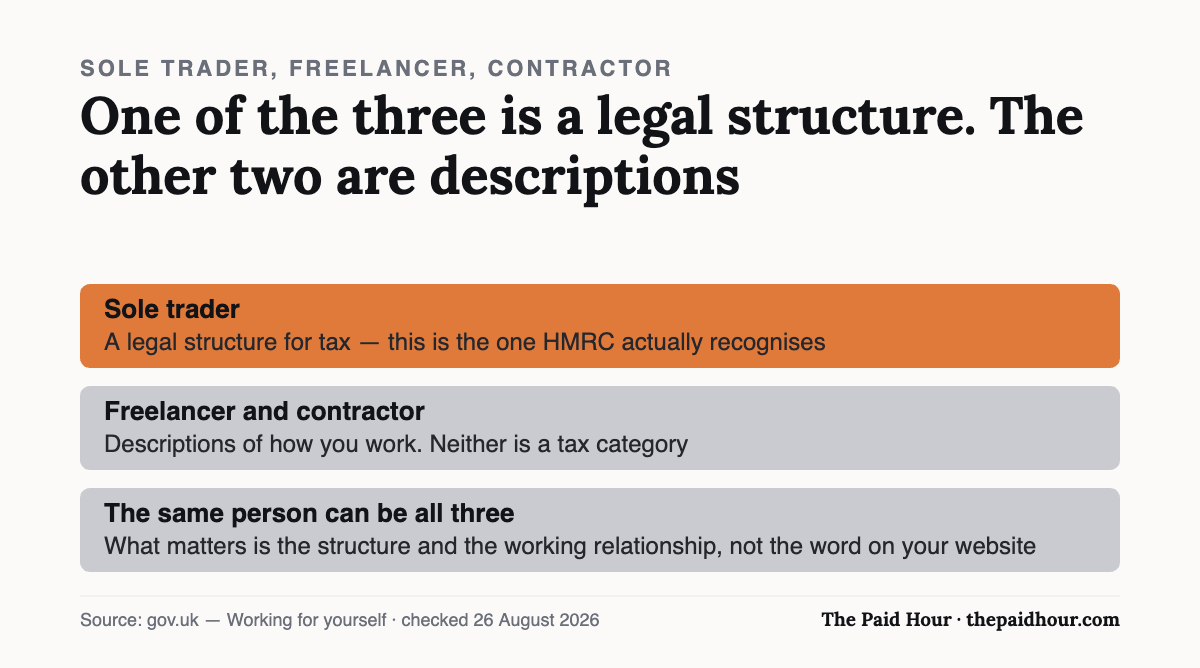
That’s the sole trader vs freelancer vs contractor distinction in full: one is a legal status, the other two are job descriptions, and most freelancers are sole traders wearing both labels at once.
Know your status before the client decides it?
IR35 & Contractor Operating Guide 2026/27. Eight modules and four working sheets covering status, evidence, umbrella companies after April 2026, and the rate maths on both sides of the line.
- The small-client test, the Status Determination Statement, and the client-led disagreement process
- CEST walked through where it is weakest, and how to keep evidence of the run
- An outside-to-inside rate converter, an umbrella payslip checker, and the contract red-flag checklist
For medium and large clients the client decides your status. Most contractors do not know which side of that line their client sits on until the determination lands.
Buying more than one? All ten 2026/27 courses for £107, against £328 at full price.
Sources
- Working for yourself: gov.uk
- Set up a business, gov.uk
- Become a sole trader. Gov.uk
- Set up as a sole trader: step by step, gov.uk
- Employment status: self-employed and contractor: gov.uk
- Freelancers, consultants and contractors — gov.uk
- Understanding off-payroll working (IR35), gov.uk
Reviewed 26 August 2026. This is general information about how the rules work, not tax advice. The links above go to the primary sources; for your own circumstances, speak to an accountant or contact HMRC directly.