
Straight answer: For 2026/27, if your self-employed profits are £7,105 or more, Class 2 National Insurance is treated as paid: you owe nothing and your National Insurance record is still protected. If your profits are below £7,105, you also owe nothing, but nothing gets credited to your record unless you choose to pay voluntary Class 2 at £3.65 a week, which works out to £189.80 for the year. Class 4 starts above £12,570: 6% up to £50,270, then 2% above that.
Table of Contents
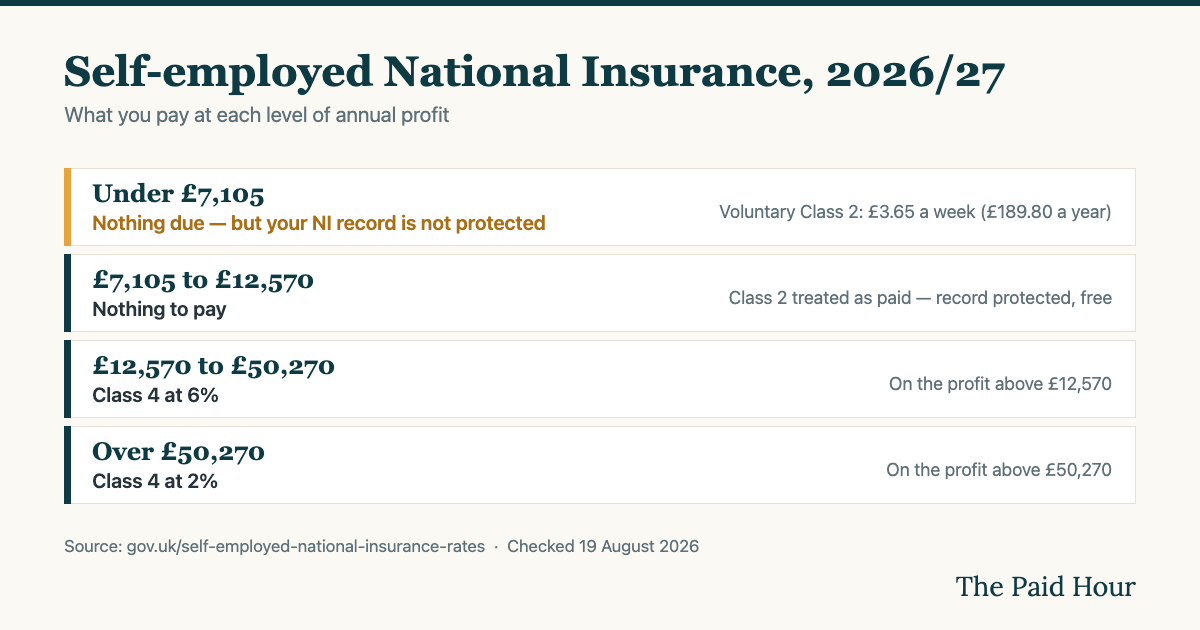
What self-employed National Insurance costs at each level of profit in 2026/27.
The self-employed National Insurance bit that goes wrong for a lot of people
Self-employed National Insurance isn’t really a tax. It’s a record. Qualifying years on that record are what buy you the new State Pension, and you need 35 qualifying years for the full amount. So the real question isn’t just “what do I owe?”, it’s “does this year count?”
This is where the arithmetic gets strange. Someone with £8,000 of profit pays no Class 2 at all and still gets the year credited. HMRC treats the contribution as having been made. Someone with £6,000 of profit also pays nothing, but gets nothing credited. If they want the year to count, they have to volunteer £3.65 a week.
The person who earned less ends up having to pay £189.80 for what the person who earned more gets for free. That’s not a loophole or an error, it’s simply how the Small Profits Threshold has worked since Class 2 stopped being compulsory. Almost nobody’s told about it, though, and a year missed is a year gone.
Class 2: the £7, 105 line
Two outcomes, depending on which side of £7,105 your profit lands.
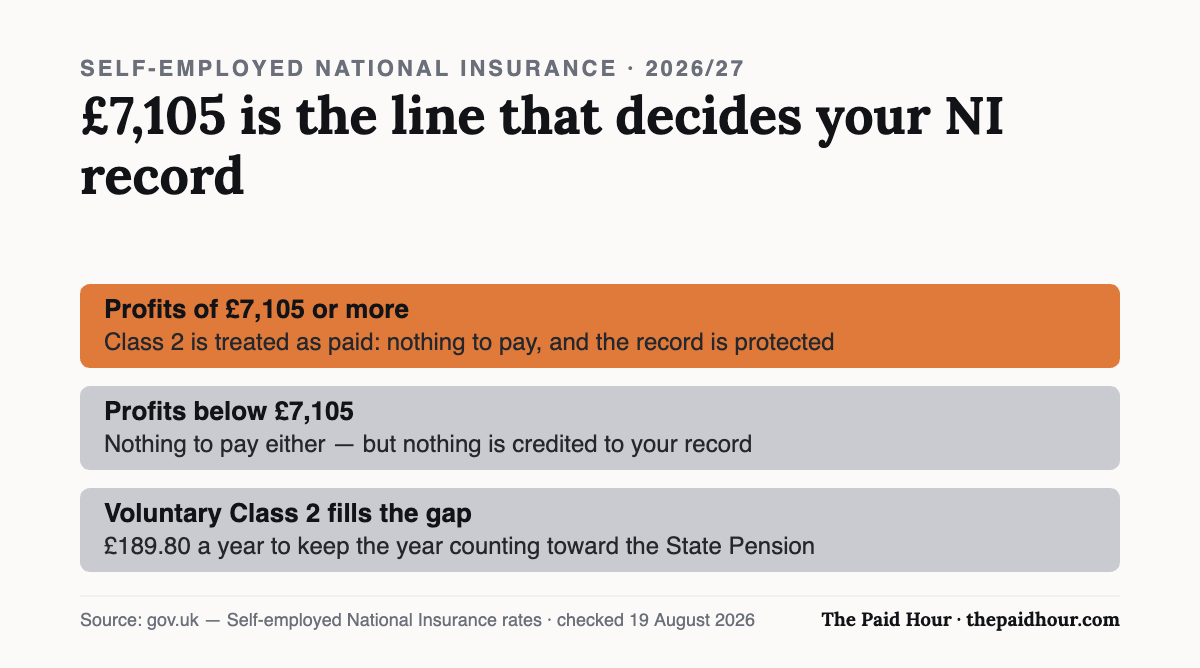
- Profits of £7,105 or more. Class 2 is treated as having been paid. You don’t pay it, and your record’s protected for that year.
- Profits under £7,105. Nothing’s due. You can choose to pay voluntary Class 2 at £3.65 a week for 2026/27.
Profit here means income after allowable expenses rather than turnover. That distinction matters: a photographer billing £11,000 who spends £4,500 on kit, travel and insurance has profits of £6,500 and sits below the line, even though the money coming in looked comfortable enough.
Is £189.80 worth paying for your self-employed National Insurance record?
It depends entirely on your record and it’s not a decision to make from a blog post. The things worth checking first:
- Check your existing record. The State Pension forecast on GOV.UK shows which years already qualify. If you’ve got decades of employment behind you, one gap may be irrelevant. If you’re early in your working life, it may not be.
- Check whether you’re covered another way. A part-time employed job, or National Insurance credits from claiming Child Benefit for a child under 12, can qualify the year without you paying anything.
- Remember the other entitlements. Class 2 also feeds things like Maternity Allowance, which is a reason some people register and pay voluntarily even when their income is small.
If you want to pay voluntarily and you’re not already in Self Assessment, you’ll need to register for it, that’s the mechanism most people pay through.
Class 4 self-employed National Insurance: the part that behaves like a tax
Class 4 is charged on profits above £12,570. For 2026/27 the rates are 6% on profits between £12,570 and £50,270, and 2% on anything above £50,270.
Worked through on three levels of profit, so the shape’s visible:
| Annual profit | Class 4 due |
|---|---|
| £20,000 | £445.80 |
| £35,000 | £1,345.80 |
| £60,000 | £2,456.00 |
Take the £60,000 case, because it’s the one people get wrong. The 2% rate doesn’t apply to the whole £60,000, it only applies to the £9,730 above £50,270. The band from £12,570 to £50,270 is still charged at 6%, which is £2,262. Add £194.60 on the top slice and you get £2,456. Bands stack; they don’t replace each other.
Class 4 buys you nothing, by the way. It doesn’t add qualifying years and doesn’t increase your pension. Class 2 is the one that counts towards your record; Class 4 is simply a charge on profit. Worth knowing before you decide the £189.80 isn’t worth it.
How you actually pay self-employed National Insurance
Both classes go through Self Assessment for most people. You don’t make separate National Insurance payments: you file your return, HMRC works out Income Tax and National Insurance together, and one bill comes back. It’s due by 31 January after the end of the tax year, alongside any payment on account.
That single combined figure is exactly why people underestimate what they owe. If you’re budgeting from an Income Tax calculation alone, Class 4 is an extra 6% of profit sitting on top that you haven’t set aside.
A few situations work differently. Examiners, moderators and invigilators pay a special form of Class 4 that can’t go through Self Assessment. Ministers of religion without a salary or stipend don’t pay. And if you make investments for yourself without running it as a business or taking a fee, no self-employed National Insurance is due.
What to do about self-employed National Insurance
- Work out your profit rather than your turnover. Income minus allowable expenses, that number decides everything on this page.
- If it’s under £7,105, check your State Pension forecast before deciding whether to volunteer the £189.80.
- If it’s over £12,570, set aside 6% of the excess on top of whatever you’ve put by for Income Tax.
- If you were employed as well this year, your record may already be covered without you paying anything.
Related: what counts as an allowable expense decides your profit figure, and payments on account explains why the January bill is often bigger than the tax year it relates to. First year doing this? Start with your first Self Assessment.
Class 4 does not arrive on its own. Added to Income Tax it makes the rate on your next pound 26p in the basic band — the combined view is in self-employed tax rates for 2026/27.
For where these NI settings came from, see what Autumn Budget 2025 changed for the self-employed.
State Pension forecast showing gaps?
Pension & Safety Net for the Self-Employed 2026/27. Eight modules and four working sheets that turn “I should sort my pension out” into a plan you can finish in an afternoon, with the tax relief doing a third of the work.
- Your State Pension forecast, qualifying years, and when voluntary Class 2 is worth paying and when it buys nothing
- The Self Assessment step that recovers higher-rate relief, which most people never claim
- Sick pay, income protection and critical illness: what each actually pays, and the underwriting traps for the self-employed
There is no statutory sick pay for the self-employed at all. Higher-rate pension relief is not automatic either. Both are fixable in an afternoon, and both are still costing most freelancers money.
Buying more than one? All ten 2026/27 courses for £107, against £328 at full price.
Sources
- GOV.UK, Self-employed National Insurance rates
- GOV.UK. Voluntary National Insurance contributions
- GOV.UK, Check your State Pension forecast
- GOV.UK: Expenses if you are self-employed
Rates and thresholds checked 19 August 2026 and apply to the 2026/27 tax year. This is general information, not financial or tax advice. Whether to pay voluntary contributions depends on your own self-employed National Insurance record, check your forecast, and speak to an adviser if the decision is close.