
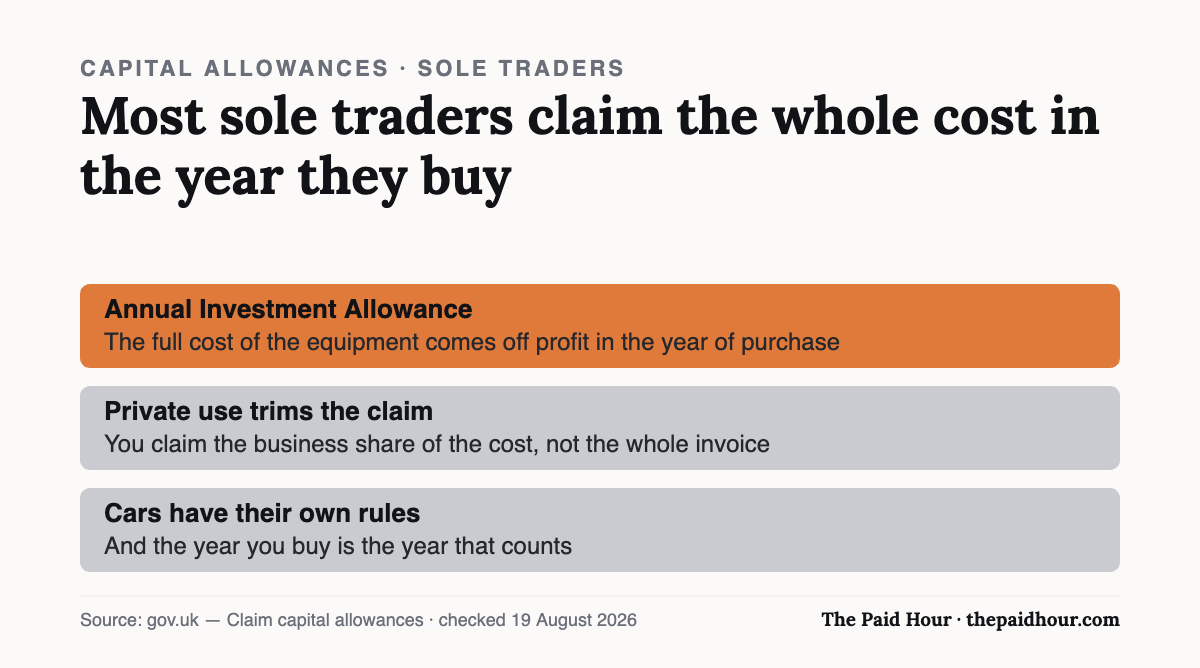
The one-paragraph answer: Capital allowances let you deduct equipment costs from profit, most sole traders just claim the full cost in the year of purchase through Annual Investment Allowance. The catches: private use trims the claim, cars have their own rules, and the year you buy is the year that counts.
Capital allowances for sole traders let you deduct the cost of equipment from your profits, but a private-use restriction and a strict claiming window catch a lot of people every year.
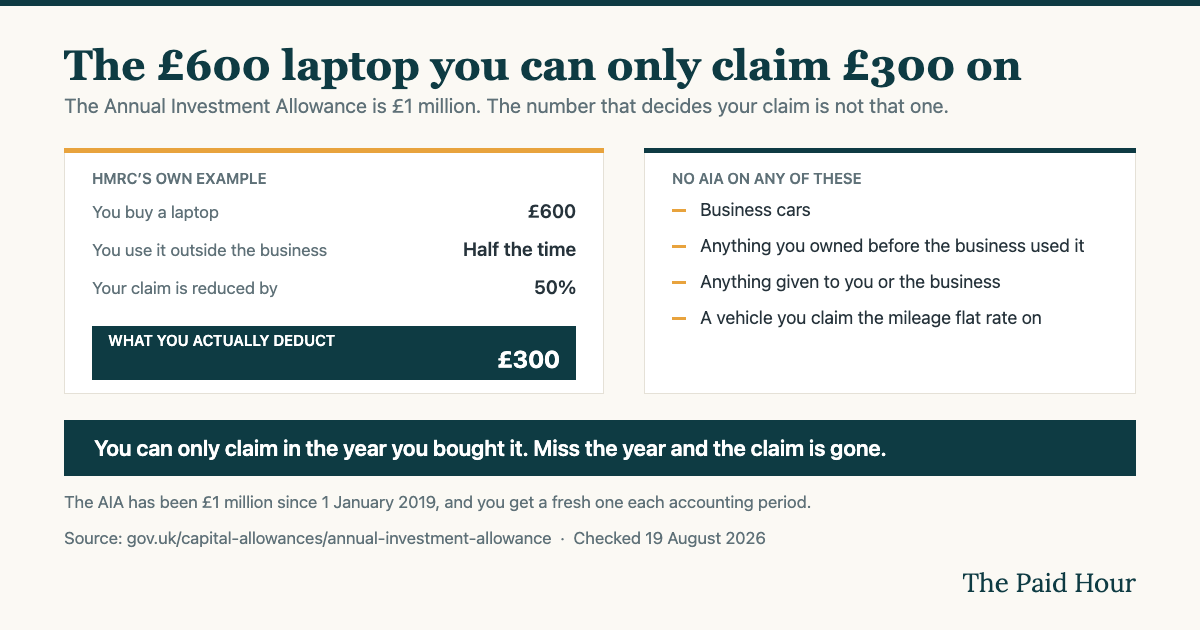
In short. Capital allowances let you deduct the cost of equipment from your profits. The Annual Investment Allowance sits at £1 million a year, which is irrelevant to almost every freelancer alive, and somehow every guide out there leads with it anyway. The number that decides your claim is how much you use the thing privately. HMRC’s own example: a £600 laptop used outside the business half the time gets you a £300 deduction rather than £600. And you can only claim it in the year you bought it, there’s no second chance later.
The private-use rule for capital allowances
Sole trader or in a partnership? You can’t claim the full value of anything you also use outside the business. The claim gets reduced by the proportion of private use, full stop.
HMRC’s example is deliberately plain: a £600 laptop, used privately half the time, means a claim cut by 50%. You deduct £300.
This matters far more than the £1 million headline figure, because almost everything a freelancer buys has some private use baked in. The laptop you edit on also streams films at night. The camera photographs weddings and then your own holiday. The phone does both jobs constantly, all day, every day.
There’s no HMRC-approved formula for working out the split. What’s expected is that you land on an honest, defensible proportion and can explain how you got there. A note in your records saying “laptop, roughly 70% business, based on work diary” is worth having. An unexplained 100% claim on a machine that plainly does both jobs is exactly the sort of thing a compliance check picks at.
What you can’t claim AIA on
- Business cars. Cars are excluded from AIA entirely and run through a separate, slower regime.
- Things you owned before the business used them. The laptop you bought two years ago and now use for work doesn’t qualify for AIA. You claim writing down allowances instead.
- Things given to you or given to the business.
One overlap worth stating plainly: you can’t claim capital allowances on a vehicle you’re already claiming the mileage flat rate on. It’s one or the other rather than both. The 55p mileage allowance is meant to cover the cost of buying and running the vehicle, so claiming both would mean claiming the same thing twice.
Timing: the year you bought it, and nothing else
You can only claim AIA in the period you bought the item. There’s no catching up later, ever. Bought a £2,000 camera in the 2025/26 tax year and forgot to claim it? You can’t just slot it into this year’s return instead.
“When you bought it” has a specific meaning here:
- When you signed the contract, if payment is due within less than four months.
- When payment is due, if that’s more than four months later.
On hire purchase, you can claim for all the payments you’ll make under the contract once you start using the item, but not the interest. The interest counts as an ordinary business expense, not a capital allowance.
You don’t have to claim the whole thing
Worth understanding if you had a lean year. If your profits are low, deducting the full cost of a big purchase can push your profit below the Personal Allowance, and at that point the deduction is partly wasted, because you weren’t going to pay tax on that money anyway.
You can instead claim writing down allowances, which spread the deduction across several years, or split it: part as AIA now, part as writing down allowances later. That shifts relief into years where it actually reduces a real bill.
This is a genuine planning decision with real money riding on it, and it’s one of the clearest cases for spending an hour with an accountant if the purchase is large.
A few edges worth knowing
- A fresh allowance applies each accounting period. The £1 million isn’t a lifetime figure.
- Short accounting periods get pro-rated. A nine-month period gives 9/12 of £1 million, or £750,000.
- Two businesses usually get an AIA each, unless they’re controlled by the same person and sit in the same premises or do similar things.
- Sell the item later and it may create a tax charge, so keep the record of exactly what you claimed.
- Closing the business? You can’t claim AIA on things bought in the final accounting period. A balancing charge or allowance goes on the return instead.
What to do about capital allowances for sole traders
Capital allowances for sole traders are one of those areas worth double-checking against your actual bank statements once a year, it’s easy to miss a small purchase that would have qualified.
- List what you bought this tax year that will last more than a year, equipment, tools, computers, furniture.
- Put an honest business-use percentage against each one and write down how you arrived at it.
- Check nothing on the list is a car, or a vehicle you’re already claiming mileage on.
- Low profit this year? Ask whether claiming the full cost now saves you anything, or whether spreading it makes more sense.
- Claim it on this year’s return. There is no next year for this.
Related: day-to-day costs go through allowable expenses instead of capital allowances, and both feed into the profit figure that decides your Income Tax band.
Tracking equipment purchases for your capital allowances claim? Get an HMRC-ready invoice template to keep your own paperwork straight too.
Filing it yourself this year?
HMRC Tax & Expense Mastery 2026/27. Nine modules and eleven working templates that take a UK freelancer from “do I even need to register” to a correct return, with MTD quarters built in.
- Fifteen expense categories, with the trap inside each one (training, clothing, meals, the seven-year pre-trading rule)
- Home and vehicle: flat rate against actual cost, with the £312 break-even worked out and the mileage lock-in rule
- The year-one payments-on-account cash shock, and the routine that stops it landing twice
HMRC does not send a list of what you forgot to claim. Most freelancers leave several hundred pounds of legitimate expenses on the table every single year, and the return still gets filed.
Buying more than one? The Complete Freelancer System, all five for £87, against £215 at full price.
Sources
- GOV.UK: Annual investment allowance
- GOV.UK — What you can claim capital allowances on
- GOV.UK, Writing down allowances
- GOV.UK. Capital allowances on business cars
Rules and the AIA amount checked 19 August 2026. This is general information, not financial or tax advice. Whether to claim in full or spread the relief depends on your profits, take advice where the sums are significant.