
HMRC Time to Pay is the official route if you can’t pay your Self Assessment bill in full by the deadline, here’s how it works.
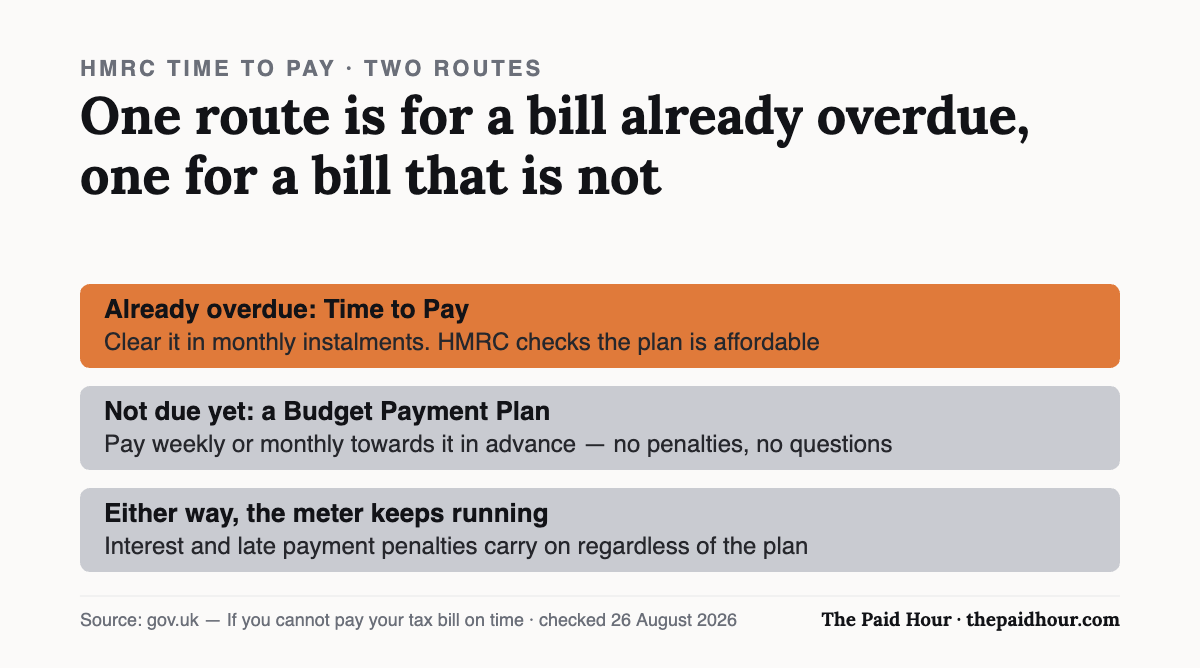
In short: If your Self Assessment bill is already overdue, you may be able to set up an HMRC Time to Pay plan and clear it in monthly instalments, HMRC checks it’s affordable, and interest plus late payment penalties keep running regardless. But there’s a second option almost nobody mentions: if the bill isn’t due yet, a Budget Payment Plan lets you pay weekly or monthly towards it in advance, with no penalties and no questions asked about your spending. By a distance, the worst option is saying nothing at all.
For people who aren’t in trouble yet
Nearly every article on this topic assumes you’ve already missed the deadline. HMRC’s own guidance quietly points somewhere else first: if your bill isn’t overdue and you want to make weekly or monthly payments towards your next Self Assessment bill, you may be able to set up a Budget Payment Plan instead.
For a freelancer this is close to ideal, because the actual problem with 31 January usually isn’t the amount owed. It’s that the money arrived spread across twelve months and the bill arrives on a single day. A Budget Payment Plan just turns that into a standing order.
Crucially, this isn’t a negotiation. You’re ahead of the deadline, so there are no penalties, no interest, and no affordability interview. You’re simply paying early, in pieces. It also removes the temptation to spend money that was never really yours, the tax sitting in your current account, looking a lot like profit.
If you take nothing else from this page, look this one up before your next payment on account falls due.
HMRC Time to Pay: for a bill that’s already late
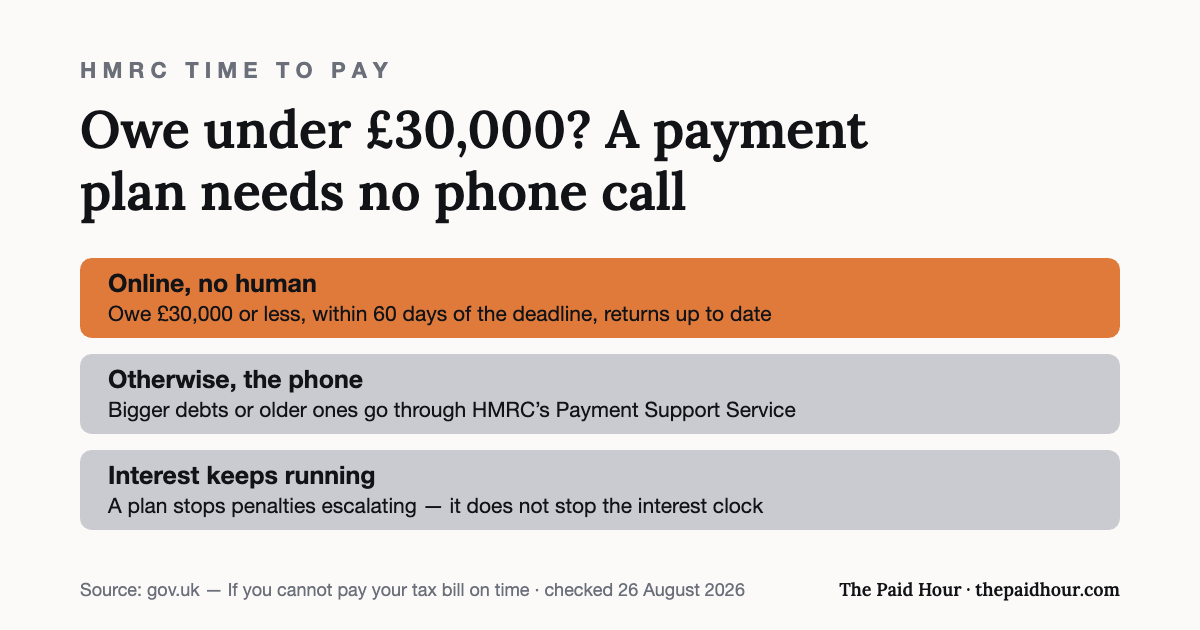
Once the deadline’s gone, the route is a payment plan to clear the overdue amount in monthly instalments. There’s an online service, and if you’re eligible you can set it up yourself without ever speaking to anyone, the online route works if you owe £30,000 or less and you’re applying within 60 days of the payment deadline. Owe more than that, or missed the 60-day window, and it’s a phone call to HMRC instead.
What you’ll need to hand:
- The reference number for the tax you can’t pay, usually your Unique Taxpayer Reference, sitting on any letter HMRC has sent you.
- UK bank account details, and you need to be authorised to set up a Direct Debit on that account.
- Details of your income and spending.
That third item is the one people show up unprepared for. HMRC is assessing affordability here, not just processing a form.
If you can’t set up HMRC Time to Pay online
You call HMRC, and the conversation gets a lot more searching. Expect to be asked:
- whether you can pay in full
- how much you can repay each month
- whether there are other taxes you owe
- how much you earn
- how much you usually spend each month
- what savings or investments you have
Two things worth knowing before that call.
HMRC will expect you to use savings and assets first. If you’ve got money set aside, the expectation is it reduces the debt as much as possible before any plan gets agreed. Going in hoping to keep a savings account intact while spreading the tax instead simply isn’t how this works.
A Standard Financial Statement helps enormously. Taken independent debt advice already: from Citizens Advice, say, and you may already have one. HMRC accepts it as evidence of what you earn and spend, which turns a difficult conversation into more of a document exchange.
And the limit, in HMRC’s own words: can’t agree a payment plan, and they’ll ask you to pay the amount you owe in full. A plan is something you qualify for, not something you’re automatically entitled to.
HMRC Time to Pay doesn’t stop the meter running
This is the point most guides skate straight over. Agreeing an HMRC Time to Pay arrangement doesn’t erase what’s already accrued, and interest keeps running on the outstanding balance the whole time.
The late payment penalties are 5% of the tax unpaid at 30 days, again at 6 months, and again at 12 months — the detail is in what a late return and a late payment cost. On a £4,000 bill left for a year, that’s £600 before interest is even added.
Which is exactly why timing matters so much here. Filing on time and paying late is a far cheaper mistake than the other way round, and setting up a plan early is cheaper than setting one up in June once things have snowballed.
What to do about HMRC Time to Pay next
If you take one thing from this: apply for HMRC Time to Pay before your bill becomes overdue rather than after, it’s far easier to arrange and looks much better on your record.
- Next bill not due yet? Look at a Budget Payment Plan now. This is really the whole point of this page.
- Already missed the deadline? File the return regardless, the filing penalties are separate and larger, and they stop the day you file rather than the day you pay.
- Then set up a payment plan, online if you can manage it. Do it before the 30-day and 6-month penalty points, not after.
- Get your numbers ready first: what you earn, what you spend, what you hold. HMRC will ask for all of it.
- Money tight? Take free debt advice before the call, a Standard Financial Statement makes the conversation shorter and fairer.
The single worst thing you can do is nothing. Interest and penalties keep running whether or not HMRC hears from you, and a plan gets much harder to agree once enforcement’s already started.
Related: payments on account is usually why a January bill is larger than expected, and Class 4 National Insurance is the part people forget to set aside.
Want the whole tax system, not one rule?
HMRC Tax & Expense Mastery 2026/27. Nine modules and eleven working templates that take a UK freelancer from “do I even need to register” to a correct return, with MTD quarters built in.
- Fifteen expense categories, with the trap inside each one (training, clothing, meals, the seven-year pre-trading rule)
- Home and vehicle: flat rate against actual cost, with the £312 break-even worked out and the mileage lock-in rule
- The year-one payments-on-account cash shock, and the routine that stops it landing twice
HMRC does not send a list of what you forgot to claim. Most freelancers leave several hundred pounds of legitimate expenses on the table every single year, and the return still gets filed.
Buying more than one? The Complete Freelancer System, all five for £87, against £215 at full price.
Need this ready-made? → Self Assessment Prep Checklist Pack: every deadline, record and allowance in 9 pages (£7.99, instant download)
Sources
- GOV.UK, If you cannot pay your tax bill on time
- GOV.UK. Setting up a payment plan
- GOV.UK, Budget Payment Plan
- GOV.UK: Self Assessment penalties
- GOV.UK — Options for dealing with your debts
The online-plan conditions are as published on gov.uk and linked above; sources re-visited 26 August 2026.
Reviewed 26 August 2026, HMRC Time to Pay routes are as linked on gov.uk. Checked 19 August 2026. This is general information, not financial or debt advice. If you’re struggling with debt, free independent advice is available from Citizens Advice and other charities, it costs nothing, and HMRC accepts their financial statements.