
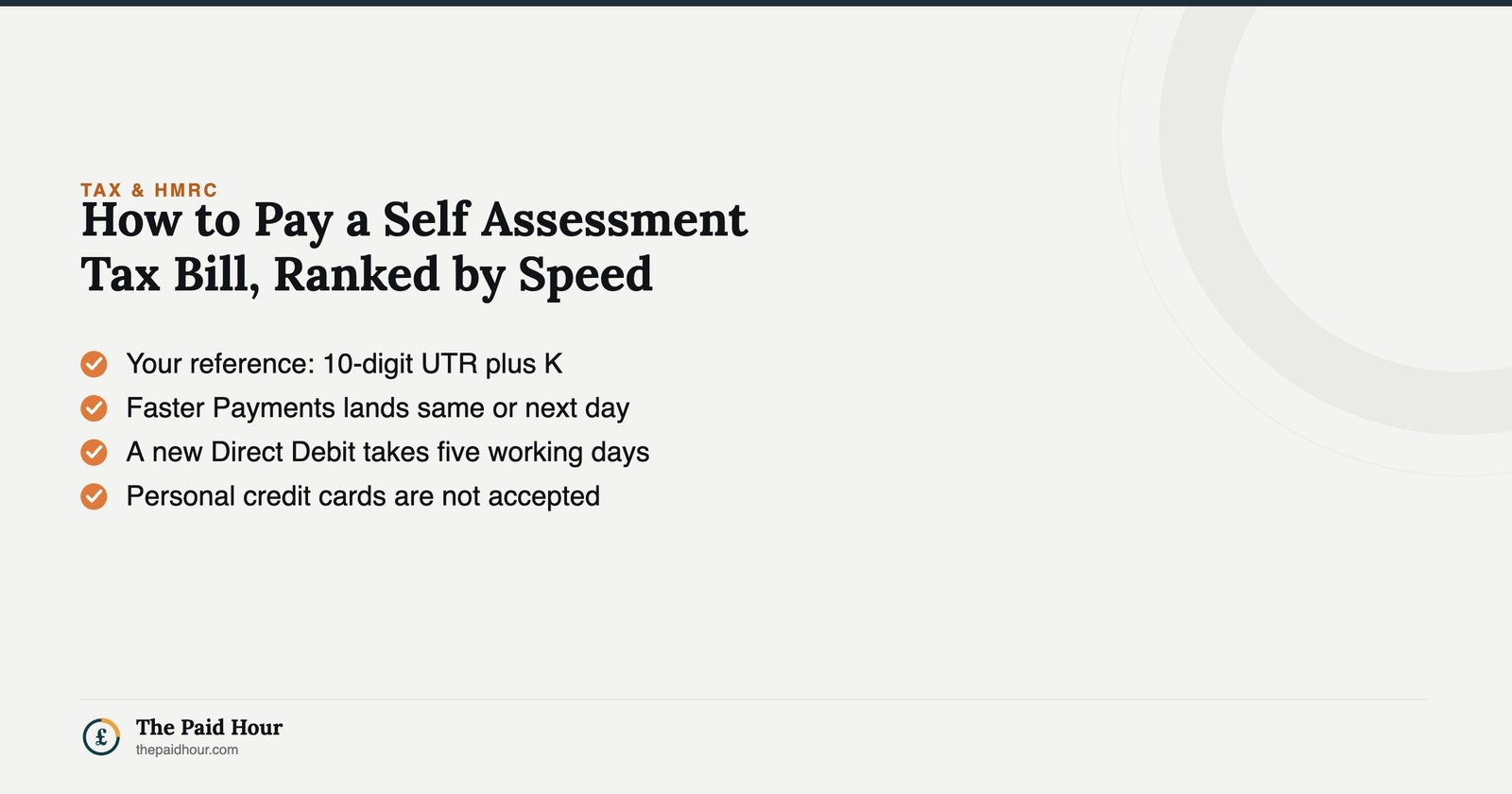
What matters here: Your reference is your 10-digit UTR followed by the letter K. Faster Payments, CHAPS, debit card and paying at your own bank all reach HMRC same or next day, weekends included. Bacs and an existing Direct Debit take 3 working days. A brand new Direct Debit takes 5, which is how people miss a deadline they thought they had made.
Table of Contents
The mechanics of paying HMRC are simple. The timing is what catches people, every January and every July.
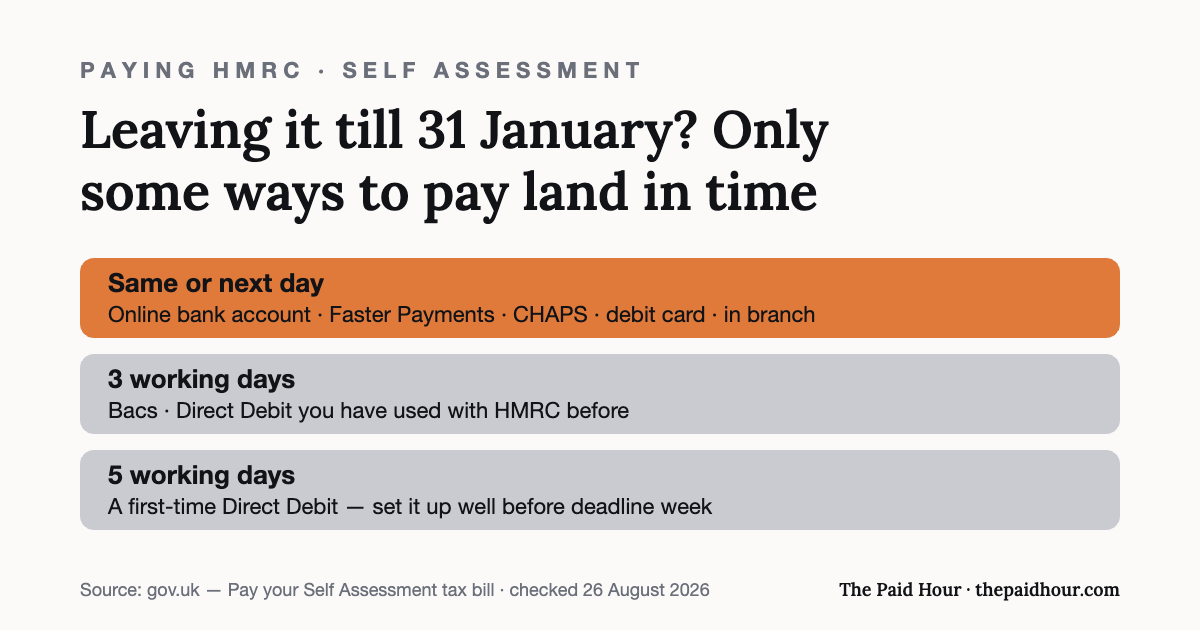
Choose the wrong method on the 29th and the money arrives after the 31st, and HMRC charges you interest for a payment you made on time. So the useful way to sort the options is not by convenience. It is by how many days each one eats.
The Self Assessment payment reference: UTR plus K
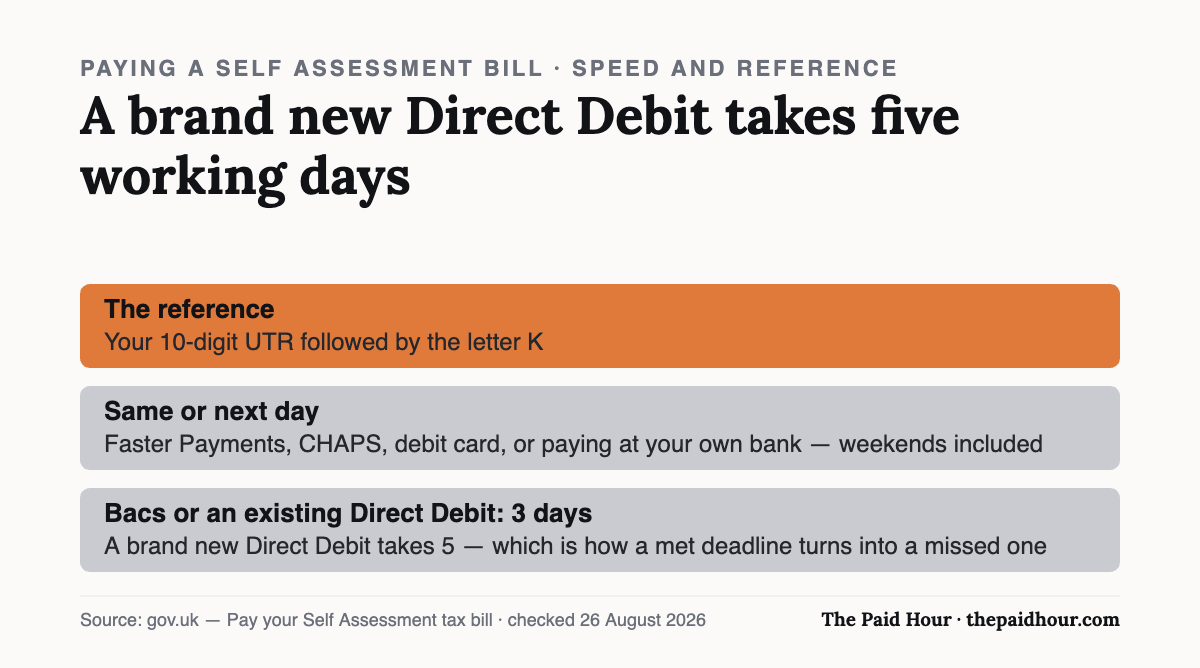
Whatever method you use, HMRC wants an “11-character payment reference… your 10-digit Unique Taxpayer Reference (UTR) followed by the letter ‘K'”.
No spaces, no dashes, and no leaving the K off. Get it wrong and the payment does not bounce, it sits unallocated somewhere at HMRC while your account still shows the debt, which is a far more annoying problem than a rejected transfer. Your UTR is on your Self Assessment statements and in your HMRC online account; there is more on finding it in the guide to what a UTR number is and where to find yours.
Cumbernauld or Shipley?
HMRC has two accounts on the same sort code, 08 32 10: account 12001039 (Cumbernauld) and 12001020 (Shipley). People lose an evening to this.
They should not. gov.uk: “Your bill will tell you which bank account to pay into. If you do not have a bill, or you’re not sure, you can pay into either account.”
Either. The reference is what matters rather than the branch name.
Every Self Assessment payment method, by how long it takes
| Method | Reaches HMRC | Worth knowing |
|---|---|---|
| Online or telephone banking (Faster Payments) | Same or next day | Works weekends and bank holidays. What most freelancers use. |
| Through your online bank account | Same or next day | Approve it from your banking app via your HMRC account. |
| CHAPS | Same working day | If you are inside your bank’s cut-off. Usually carries a fee. |
| Debit card or corporate credit card online | Same or next day | Personal credit cards are not accepted. See below. |
| At your bank or building society | Same or next day | Needs a paper payslip from HMRC, which not everyone still gets. |
| Bacs | 3 working days | Fine if you are organised. Not on the 30th. |
| Direct Debit, already set up | 3 working days | Same bank details as last time. |
| Direct Debit, first time | 5 working days | The one that ruins deadlines. |
| Cheque by post | Slowest | Allow real time, not optimistic time. |
Read the last two rows together. Setting up a Direct Debit for the first time in the last week of January does not pay your bill in January. Five working days across a weekend is a week, and the deadline does not move because you were trying to be responsible.
Personal credit cards do not work
Only a corporate credit card can be used to pay HMRC online. Personal credit cards have not been accepted for Self Assessment since 13 January 2018, when the rules on fees for card payments to HMRC changed and the personal card option was withdrawn.
Which matters most to exactly the people who would most like to use one, a sole trader short of cash in January, with no business card. That route is closed. Debit card or bank transfer, and if the money is not there, see the last section rather than reaching for a credit card at 20-something per cent.
The Post Office option is gone
gov.uk, flatly: “You can no longer pay at the Post Office.” The old bank giro credit route has been discontinued.
If you preferred paying cash over a counter, what is left is your own bank or building society, using an HMRC paying-in slip, and whether you have one depends on whether HMRC still sends you paper statements.
Paying a Self Assessment bill from outside the UK
Common enough for freelancers who bank abroad or spend part of the year elsewhere. HMRC’s BIC is BARCGB22, with IBAN GB62 BARC 2011 4770 2976 90 for Cumbernauld and GB03 BARC 2011 4783 9776 92 for Shipley.
One warning from gov.uk worth taking seriously: “Some banks will charge you if you do not pay in pounds sterling.” Send sterling, and send enough that a conversion spread does not leave you a few pounds short, an underpayment of £4 is still an underpayment.
Through your tax code, if you filed the Self Assessment early
There is a route that spreads the bill across the following year with no interest and no arrangement to negotiate, and almost nobody uses it because the deadline is two months before everyone starts thinking about tax.
File online by 30 December and HMRC can collect the bill through your PAYE tax code instead. Three conditions: you owe less than £3,000, you already pay tax through PAYE, and you filed in time. You cannot make a part payment to get under the £3,000.
It only works if you have employment or pension income alongside the freelancing, which plenty of people do. The date sits with everything else in the 2026/27 tax year calendar.
If the Self Assessment payment is late
gov.uk: “You’ll be charged interest and may be charged a penalty if your payment is late.” Interest runs from the day after the due date, and the penalties sit on top of it as separate charges at 30 days, six months and twelve months.
Filing and paying are penalised separately, which is worth repeating because it changes what you should do in a bad January: file the return anyway, even with nothing to pay it with. How the interest is calculated is in the guide to late payment interest.
If you cannot pay at all
Do not let the date pass in silence. HMRC has a Time to Pay process, and an arrangement agreed before things escalate is a different conversation from one attempted afterwards. The steps are in what to do if you cannot pay your tax bill.
And if the size of the bill was the surprise instead of the date, check whether a payment on account was bundled into it, that is why January is often half again what people expect.
The January figure can also include student loan repayments, and if profits have fallen since last year, the advance payments can be reduced with form SA303.
Filing it yourself this year?
HMRC Tax & Expense Mastery 2026/27. Nine modules and eleven working templates that take a UK freelancer from “do I even need to register” to a correct return, with MTD quarters built in.
- Fifteen expense categories, with the trap inside each one (training, clothing, meals, the seven-year pre-trading rule)
- Home and vehicle: flat rate against actual cost, with the £312 break-even worked out and the mileage lock-in rule
- The year-one payments-on-account cash shock, and the routine that stops it landing twice
HMRC does not send a list of what you forgot to claim. Most freelancers leave several hundred pounds of legitimate expenses on the table every single year, and the return still gets filed.
Buying more than one? The Complete Freelancer System, all five for £87, against £215 at full price.
Need this ready-made? → Self Assessment Prep Checklist Pack: every deadline, record and allowance in 9 pages (£7.99, instant download)
Sources
- gov.uk — Pay your Self Assessment tax bill
- gov.uk, Bank details for paying HMRC
- gov.uk. Pay through your tax code
- gov.uk, If you cannot pay your tax bill on time
- gov.uk: Self Assessment tax returns: penalties
- The Fees for Payment of Taxes, etc. by Credit Card (Amendment) Regulations 2017
Payment methods and clearing times re-checked against gov.uk on 26 August 2026.
Payment methods, clearing times and bank details checked against gov.uk on 25 August 2026. HMRC’s details do change, confirm them on gov.uk before you send money. This is general information, not tax advice; for your own circumstances, speak to an accountant or contact HMRC directly.