
Software subscriptions are a running cost and comes straight off your profits. The part worth knowing is what it does to VAT. If the supplier is outside the UK and charges you no UK VAT, the reverse charge makes you account for it, and HMRC is explicit that an unregistered business must add those services to its taxable turnover when working out whether it needs to register. Enough overseas software, and your software subscriptions can push you towards the £90,000 threshold without a single extra client.
Are software subscriptions tax deductible? Yes. Adobe, Microsoft 365, your accounting software, the design tool, the AI assistant, the password manager. They are tools you pay for monthly to do the work, and nothing about them is controversial.
So this is a short answer followed by a longer one about the thing nobody warns you about.
The software subscriptions themselves
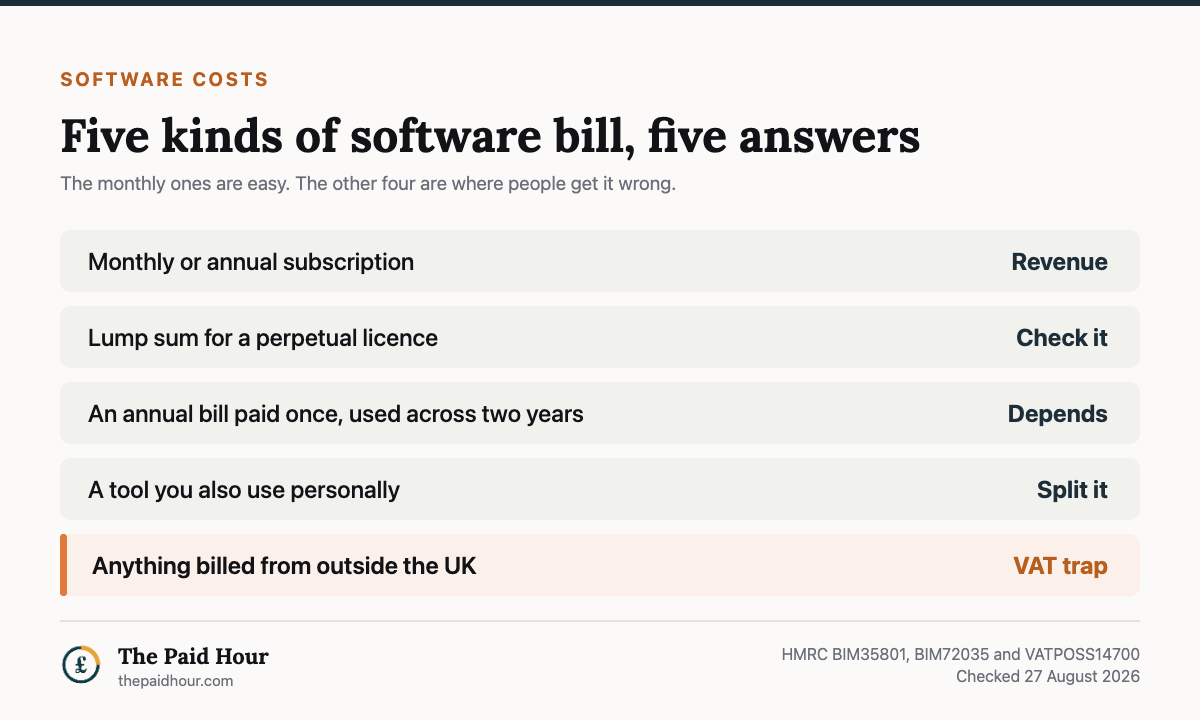
You pay every month, you get the software that month, nothing lasting is created. That is a revenue cost by every measure, and it goes through with the rest of your allowable expenses without argument.
A lump sum for a permanent licence is different enough to be worth a second look. HMRC tells its own staff to give critical consideration to whether lump sums paid out for licences are in law capital expenditure. In practice most one-off software purchases a sole trader makes are small and short-lived, but a large perpetual licence is not automatically a running cost just because it arrived as a download.
Annual software subscriptions that straddle your year end
You pay £360 in February for twelve months of something. Your accounting year ends on 5 April. How much goes in this year?
On the cash basis, which has been the default since 2024/25, all of it. You deduct what you paid, in the period you paid it, and nobody apportions anything.
On traditional accounting you would spread it across the months it covers, so roughly £60 this year and £300 next. Same money, different year, and the difference matters if you are near a threshold or had an unusual year.
This is one of the few places where the cash basis is not merely simpler but better for anyone whose spending is lumpy.
Tools you also use personally
A design subscription used for client work and for your own projects. A cloud storage plan holding both the accounts and the family photographs. A music service you have on while you work.
Claim the business proportion, using a method you can describe. That is the same principle as GOV.UK’s phone example. A £200 bill with £70 of business calls claims £70. The last of those three, incidentally, is not a business cost at all in most cases: enjoying your working day is not a purpose of the trade.
Where your software subscriptions are billed from
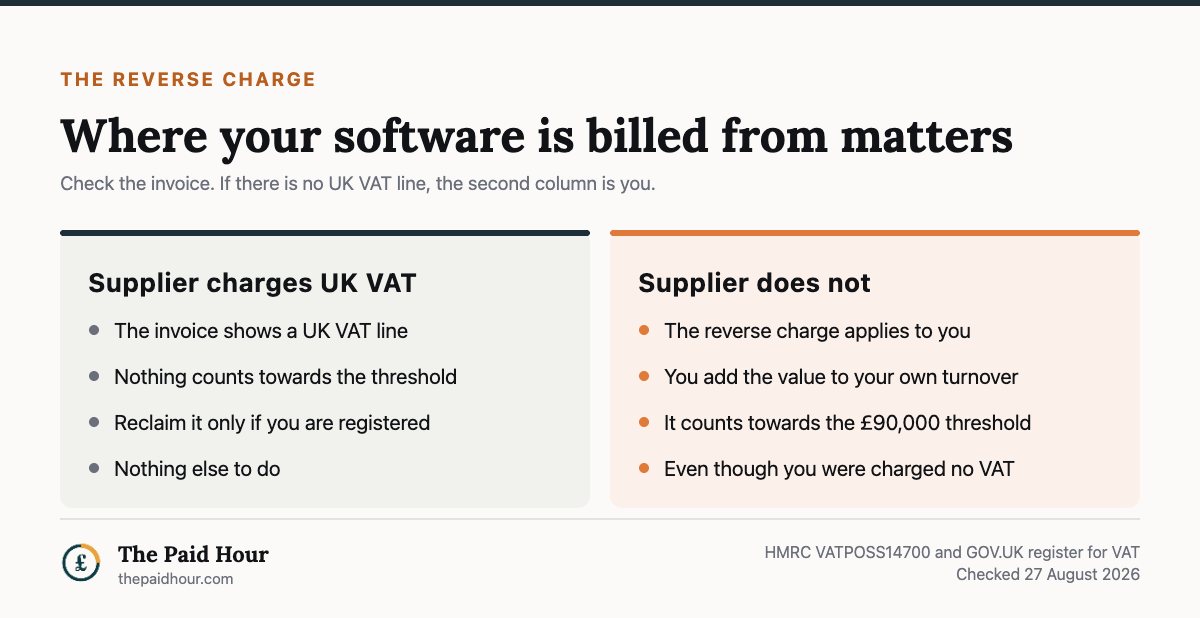
Look at a software invoice. Some show a UK VAT line and a UK VAT number. Some show neither, because the supplier is established outside the UK and the VAT is not theirs to charge.
When a UK business buys services from outside the UK, the reverse charge applies. You account for the VAT as though you had supplied the service to yourself: you charge it and you reclaim it, and if you are registered and fully taxable the two cancel out. Administratively fiddly, financially neutral.
The software subscriptions trap for unregistered businesses
If you are not VAT registered, the reverse charge does not go away. It changes shape.
HMRC’s manual puts it plainly: where the relevant UK business customer is unregistered, any reverse charge services they receive must be added to their taxable turnover when considering the need to register.
Read that twice. The value of software you bought from abroad is added to your turnover for the purpose of the £90,000 registration test, even though it is money going out rather than in, and even though nobody charged you any VAT.
For a freelancer invoicing £70,000 and spending £3,000 a year on overseas software, that is not the difference between registered and not. For someone already close to the line it can be. And the rolling twelve-month test does not wait for your accounting year, you go over, you have thirty days to register.
The practical move is unglamorous: know which of your suppliers charge you UK VAT and which do not, and keep the second list somewhere you will look at it. Many large providers now bill UK customers through a UK entity and charge UK VAT, so this is not every subscription, but it is not none of them either, and the only way to know is the invoice.
If you are registered
The reverse charge is a bookkeeping exercise rather than a cost. You put the VAT on as output tax and take the same figure off as input tax in the same return. Most accounting software handles it if you tag the supplier correctly, and gets it wrong if you do not.
Worth checking rather than assuming, because a reverse charge entered as a plain expense understates both boxes on the return and is the kind of thing that only surfaces years later.
Subscription records worth saving
Every invoice, not just the card statement. A statement line saying ADOBE tells you nothing about whether UK VAT was charged, and that is now the piece of information that matters most.
Beyond that, the business-use percentage for anything shared, and a note of when each subscription renews. Five years after the filing deadline is the retention rule, and the treatment of anything you decided was capital rather than revenue belongs with your disallowable expenses notes.
Claiming everything you are owed?
HMRC Tax & Expense Mastery 2026/27. Nine modules and eleven working templates that take a UK freelancer from “do I even need to register” to a correct return, with MTD quarters built in.
- Fifteen expense categories, with the trap inside each one (training, clothing, meals, the seven-year pre-trading rule)
- Home and vehicle: flat rate against actual cost, with the £312 break-even worked out and the mileage lock-in rule
- The year-one payments-on-account cash shock, and the routine that stops it landing twice
HMRC does not send a list of what you forgot to claim. Most freelancers leave several hundred pounds of legitimate expenses on the table every single year, and the return still gets filed.
Buying more than one? The Complete Freelancer System, all five for £87, against £193 bought separately.
Sources
- VATPOSS14700: reverse charge, registration, HMRC VAT Place of Supply manual
- VAT on services from abroad, GOV.UK
- Register for VAT, GOV.UK
- BIM35801: capital/revenue divide, computer software, HMRC Business Income Manual
- BIM72035: cash basis, capital expenditure, HMRC Business Income Manual
- Expenses if you are self-employed, GOV.UK
The registration wording is quoted from HMRC’s VAT Place of Supply of Services manual at VATPOSS14700, last updated 24 January 2022. The £90,000 threshold and the rolling twelve-month and next-thirty-days tests are from GOV.UK’s register for VAT guidance. The wording on lump sum licences is from BIM35801. The £200 phone example is GOV.UK’s own. All pages read on 27 August 2026. Whether a particular supplier charges UK VAT is a question about that supplier’s own invoice, not something any article can answer for you. This is general information about how the rules work, not tax advice. Check your own position with HMRC or an accountant before you file.