

Taking a client to lunch is not deductible, and no amount of business purpose changes that: section 45 of ITTOIA 2005 bars business entertaining outright, leaving client gifts as the only way through, rather than leaving it to the wholly and exclusively test. Gifts are barred too, with one narrow way through: the gift must carry a conspicuous advertisement on the gift itself, must not be food, drink, tobacco or a voucher, and must total under £50 to that person across the tax year. Miss any one condition and the whole cost is disallowed, not just the part over £50.
Is client entertaining tax deductible? No. Not the coffee, not the lunch, not the box at the cricket, and not the round you bought because the meeting overran.
What makes this different from most disallowed costs is why it fails. Nearly everything else on your return is decided by whether the spending was wholly and exclusively for the trade. Entertaining does not get that far.
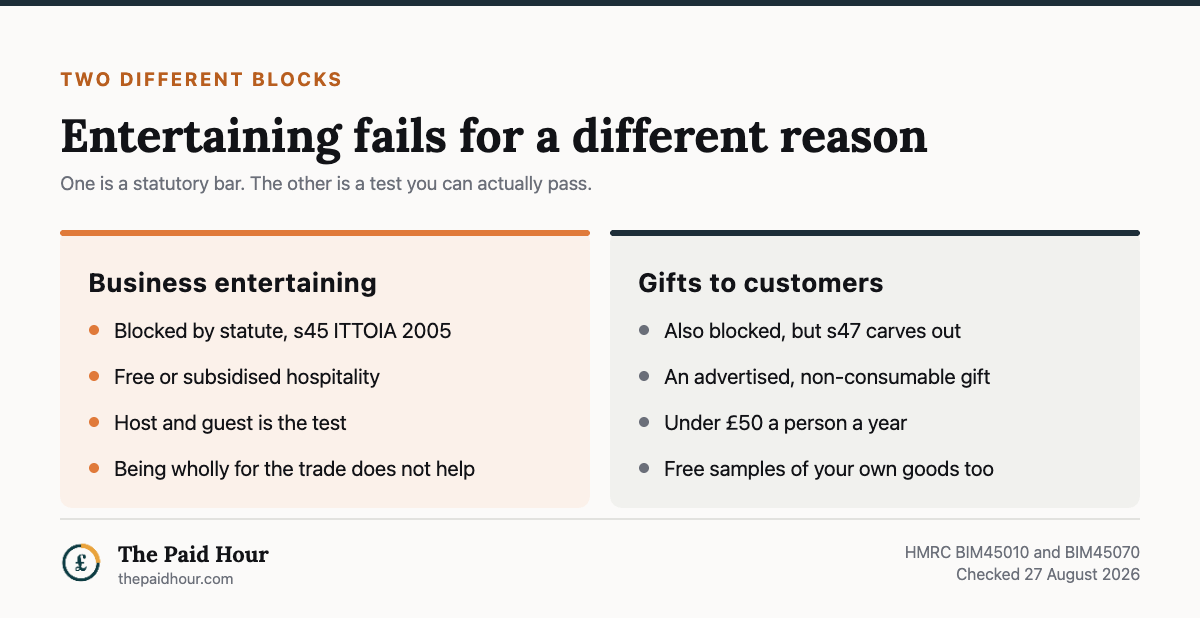
Entertaining is blocked by statute
Section 45 of the Income Tax (Trading and Other Income) Act 2005 denies a deduction for business entertainment. HMRC defines it as the provision of free or subsidised hospitality or entertainment, and notes that the test is the relationship of host and guest, if that applies, so does the bar.
So you can win the argument about purpose and still lose. A dinner arranged purely to close a contract, with no personal element whatsoever, is entertaining. The statute does not care that it worked.
Your own meal at that dinner goes down with it. It is part of the same hospitality.
Client gifts: the exception and its four conditions
Gifts start from the same place, barred, and then section 47 opens a door. It is a narrow one, and all four conditions have to hold at once.
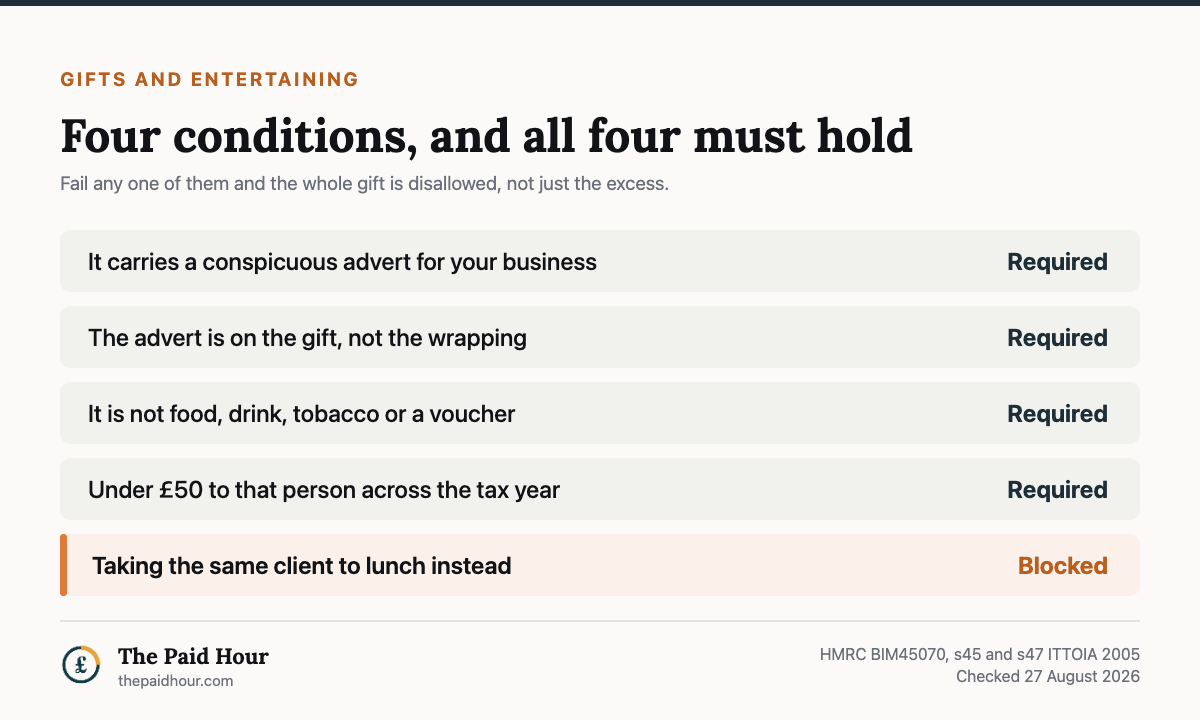
A conspicuous advertisement. Not tasteful. Not subtle. The word HMRC uses is conspicuous, and it means the gift has to be advertising your business to whoever looks at it.
On the gift, not the wrapping. HMRC says this in as many words: the advertisement should be on the gift itself, and not just on the wrapping. A branded bag around an unbranded present fails.
Not food, drink, tobacco or a voucher. These are excluded whatever they cost and whatever is printed on them. A bottle of wine with your logo on the label is still a bottle of wine. A £20 gift card with your name on it is still a token exchangeable for goods.
Under £50 to that person, across the year. The limit is per recipient per tax year and it counts everything you gave them, not each item separately. Two £30 gifts to one client is £60 and the deduction is gone.
Client gifts: a cliff, not a taper
This is the detail that costs people money, and it is easy to miss because most tax thresholds work the other way.
Go over £50 and you do not lose the excess. You lose the deduction. A £48 branded item is allowable in full; a £55 one is disallowed in full, and there is no £50 of relief hiding inside it.
Which makes this one of the few places where knowing the rule before you buy is worth actual money rather than just tidiness.
Which client gifts still get through
Free samples of what you actually sell. If you are a baker handing out a tray of your own product to prospective stockists, that is not caught in the same way a hamper bought from someone else would be, you are demonstrating the goods.
Branded items that are advertising: pens, diaries, notebooks, mouse mats, the calendar nobody asked for. HMRC lists that sort of thing itself. They are cheap, they carry the name, and they are not consumables.
And ordinary advertising, which is a different category entirely and has nothing to do with any of this, see allowable expenses for UK freelancers.
Where client gifts go on the return
Box 24 is advertising and business entertainment costs, and HMRC’s note is unusually blunt about what to do next: if you include the cost of entertaining clients, suppliers and customers, or hospitality at events, you also need to put those costs in box 39.
Box 39 is the disallowable column. You are being asked to record the spending and then take it straight back out. That is not an accident of form design. It is HMRC wanting entertaining visible in your accounts rather than hidden inside a line called marketing.
Anything that fails the gift test belongs there too, alongside the rest of your disallowable expenses.
The honest version of the client gifts advice
Buy the client lunch if the relationship is worth it. Take it out of your profits rather than off them, and stop thinking of it as a tax question. It is a marketing decision that happens to be paid for after tax.
The pens-and-diaries route works, but it is worth being honest about what it buys. A £6 branded notebook at 20% tax saves you £1.20. Nobody should be reorganising their client relationships around that.
Where the rule matters is at the other end: the business that sends fifty Christmas hampers and expects a deduction. That is a four-figure disallowance discovered in January, and it is entirely avoidable by asking the question in November.
What to note on gift and entertaining receipts
A running total per client, not a pile of receipts. The £50 limit is annual and per person, so the only record that answers the question is one organised by recipient.
Keep a photograph of the branding too, if the gift was branded. It is the sort of thing that is obvious at the time and impossible to prove three years later. Five years after the filing deadline, as always.
Filing it yourself this year?
HMRC Tax & Expense Mastery 2026/27. Nine modules and eleven working templates that take a UK freelancer from “do I even need to register” to a correct return, with MTD quarters built in.
- Fifteen expense categories, with the trap inside each one (training, clothing, meals, the seven-year pre-trading rule)
- Home and vehicle: flat rate against actual cost, with the £312 break-even worked out and the mileage lock-in rule
- The year-one payments-on-account cash shock, and the routine that stops it landing twice
HMRC does not send a list of what you forgot to claim. Most freelancers leave several hundred pounds of legitimate expenses on the table every single year, and the return still gets filed.
Buying more than one? The Complete Freelancer System, all five for £87, against £193 bought separately.
Sources
- BIM45010: entertainment, the general rule, HMRC Business Income Manual
- BIM45070: gifts to customers, HMRC Business Income Manual
- Self-employment (full) SA103F and notes, GOV.UK
- Expenses if you are self-employed, GOV.UK
The statutory bar on business entertainment is section 45 ITTOIA 2005 and the gifts exception is section 47, both as set out in HMRC’s Business Income Manual at BIM45010 and BIM45070, last updated 4 August 2026. The £50 per recipient per tax year limit, the four exclusions and the wording that the advertisement should be on the gift itself and not just on the wrapping are HMRC’s.
The box 24 and box 39 instruction is from HMRC’s notes to the SA103F self-employment pages, reference 12/25. All pages read on 27 August 2026. This is general information about how the rules work, not tax advice. Check your own position with HMRC or an accountant before you file.