

What matters here: Training is deductible when it relates to the business you already run, and since HMRC rewrote its guidance on 6 March 2024, that includes learning something new, as long as it sits inside your existing trade. A boiler fitter can train on heat pumps and claim it. A taxi driver taking a decorating course cannot. The old shorthand (new skill means no deduction) is out of date, and plenty of advice online has not caught up.
Are training courses tax deductible if you are self-employed? Usually yes, and more often than they were three years ago. The test is not how new the skill is. It is whether the course belongs to the business you are already running.
That sounds like a small distinction. It decides a four-figure course fee.
What HMRC lets you claim for training courses
GOV.UK puts it in three limbs. You can claim training that improves skills and knowledge you currently use in the business, training that keeps you up to date with the technology used in your industry, and training in skills that relate to changes in your industry or to running the business itself.
You cannot claim a course that helps you start a new business, or one that expands you into an area not directly related to what you already do.
HMRC publishes worked examples, and they are more useful than the rule.
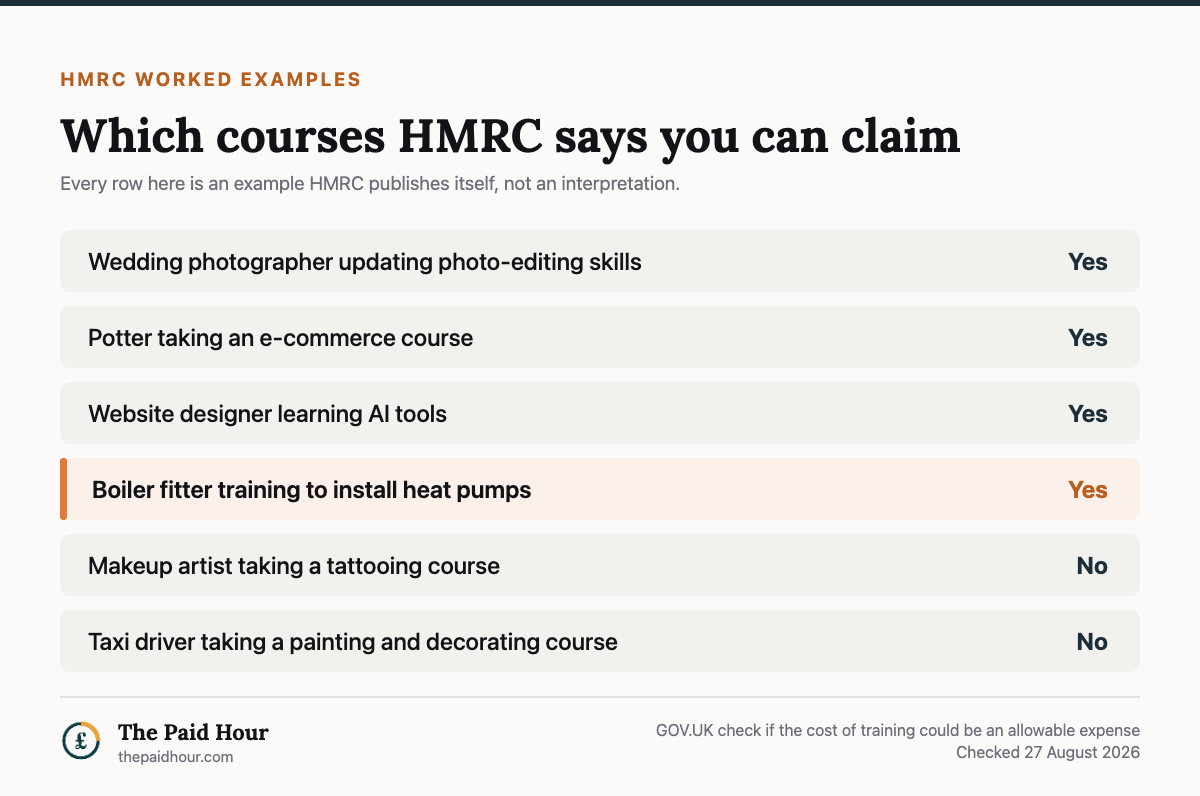
Look at the fourth row. Installing heat pumps is not something a boiler fitter already knows how to do. It is a new skill, a new qualification, new equipment, a new market, and HMRC says claim it.
Training courses: the line moved on 6 March 2024
For years the working rule was simple and harsh. Refreshing a skill you already had was revenue and deductible; acquiring a new one was capital and got nothing. Advisers applied it, and a lot of blog posts still do.
HMRC published new guidance on 6 March 2024 and its Business Income Manual now says training is revenue where it updates existing expertise or knowledge or provides new expertise or knowledge in the owner’s existing business area. It goes further and names the case people used to lose: costs incurred on training to acquire new skills or knowledge to keep pace with advancements in technology and changes in industry practices, related to the owner’s existing business area, will usually be allowable.
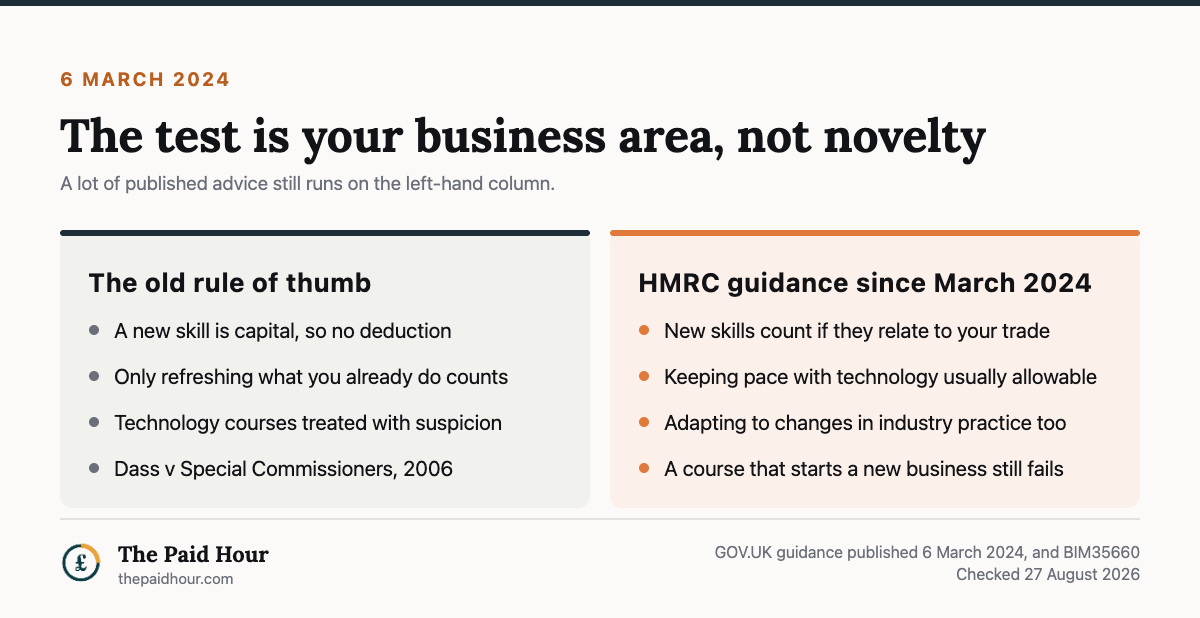
Nothing in the legislation changed. What changed is HMRC saying out loud where it draws the line, which for a sole trader deciding whether to book a course is the part that matters.
Which training courses count as related to your business area
Put HMRC’s two trade examples side by side and the test becomes obvious.
The boiler fitter learning heat pumps is still in heating. Same customers, same vans, same call-outs, a technology the industry is moving to whether he likes it or not. The taxi driver learning to paint and decorate is starting a second, unrelated business that happens to share a bank account.
So the question to ask is not have I done this before. It is would my existing customers recognise this as something I do. Adding video to a photography business passes that. Leaving photography to retrain as a plumber does not.
Why a qualification is treated differently
The case HMRC still cites is Dass v Special Commissioners, from 2006. Mr Dass tutored English and claimed the fees for a law diploma. The court refused them: the course was one that would equip him with a new qualification enabling him to venture into new areas of practice.
That is worth reading carefully, because the reason was not that a diploma is expensive or that it takes two years. It was what the qualification unlocked. A certificate that lets you keep doing your job is not the same as one that lets you do a different job, even where both hang on the same wall.
Capital here does not mean claim it later
This is easy to get wrong. When a cost is capital rather than revenue, the instinct is that relief arrives more slowly rather than not at all. A van, after all, gets capital allowances.
Training does not. Capital allowances attach to plant and machinery, and a diploma is not plant. If your course falls on the wrong side of the line, there is no deduction this year and no deduction in any later year either. It goes in the same bucket as the rest of your disallowable expenses and stays there.
Which is why it is worth thinking about before you book, not in January.
The grey training courses
HMRC’s examples are clean because they were written to be. Real ones are not.
A freelance copywriter takes a course in front-end development. A bookkeeper studies for a full accountancy qualification. A one-person consultancy pays for a coaching diploma. None of those are settled by HMRC’s list, and the honest answer is that they turn on facts nobody but you knows. What you already sell, what you are about to sell, and whether the course is the reason.
My reading, and it is a reading rather than a rule: the closer the course sits to work you have already invoiced for, the safer it is. If the first invoice using that skill would surprise your existing clients, expect HMRC to be surprised too.
Travel, materials and exam fees
HMRC’s training guidance does not deal with the costs around the course, so those fall back on the ordinary rules. Travel to a one-off course is a journey outside your normal pattern, which is the category that also carries reasonable food and drink; the mileage allowance covers the driving. Course materials follow the course. If the training itself is not allowable, none of the costs attached to it are.
What to keep
The invoice, the course outline, and one line in your own words connecting it to work you already do. That last part costs nothing at the time and is almost impossible to reconstruct later.
Training is a large single figure in a small set of accounts, which is exactly the shape that gets looked at, see what triggers a tax return enquiry. Keep the file for at least five years after the filing deadline, and if you are working through the wider list, start from allowable expenses for UK freelancers.
Filing it yourself this year?
HMRC Tax & Expense Mastery 2026/27. Nine modules and eleven working templates that take a UK freelancer from “do I even need to register” to a correct return, with MTD quarters built in.
- Fifteen expense categories, with the trap inside each one (training, clothing, meals, the seven-year pre-trading rule)
- Home and vehicle: flat rate against actual cost, with the £312 break-even worked out and the mileage lock-in rule
- The year-one payments-on-account cash shock, and the routine that stops it landing twice
HMRC does not send a list of what you forgot to claim. Most freelancers leave several hundred pounds of legitimate expenses on the table every single year, and the return still gets filed.
Buying more than one? The Complete Freelancer System, all five for £87, against £215 at full price.
Sources
- Check if the cost of training could be an allowable business expense, GOV.UK, published 6 March 2024
- Expenses if you are self-employed: training courses, GOV.UK
- BIM35660: capital/revenue divide, proprietor’s training courses, HMRC Business Income Manual
- BIM47705: travel and subsistence, general, HMRC Business Income Manual
- Expenses if you are self-employed, GOV.UK
The worked examples and the three limbs are GOV.UK’s own, from guidance first published on 6 March 2024. The revenue test and the technology wording are quoted from HMRC’s Business Income Manual at BIM35660. Dass v Special Commissioners is from 2006 and is described here as HMRC records it rather than from the law report. All pages read on 27 August 2026. This is general information about how the rules work, not tax advice. Check your own position with HMRC or an accountant before you file.