
In short: If your client is a limited company in liquidation or administration, you are an unsecured creditor: fifth in the queue, behind the liquidator’s own fees, the staff, HMRC and the bank. File the proof of debt, because it costs nothing, then plan on getting nothing back. The situation where you have real leverage is a different one: if the director is quietly applying to strike the company off the register, you can object with your invoices, for free, and freeze the whole thing for six months.
Table of Contents
The first sign is usually silence. Then a letter from a firm you have never heard of, about a client you have, and somewhere in it the word liquidation and a form asking you to state what you are owed.
Fill the form in. It takes ten minutes and costs nothing. Just do not build your month around what comes back, because for most freelancers the honest answer is nothing at all, and the reason is worth understanding before you spend another hour or another pound on it.
What “gone bust” actually means, and why it decides what you do
Four different things get described as a client going bust, and they call for completely different responses.
- Administration. An insolvency practitioner has taken control and is trying to rescue the business, or at least get a better result than an immediate wind-up.
- Liquidation. The company is being wound up, its assets sold, and the proceeds shared out in a fixed order.
- Proposed strike off. The directors have applied to have the company removed from the register. There is no practitioner, no process and nobody checking whether the creditors were told. This is the one you can fight.
- Already dissolved. The company no longer exists. Anything it owned passes to the Crown as bona vacantia, and anything it owed goes nowhere.
Ten minutes on the free Companies House search tells you which of the four you are dealing with. Do that before anything else. The advice for a company in liquidation is close to useless for a company in the middle of a strike off, and the strike off is the one with a clock running.
Where your unpaid invoice ranks when the company is liquidated
GOV.UK’s own guidance for creditors sets out the order in which money is handed out. It is not a matter of negotiation or persuasion. It is a queue, and you are near the back of it.
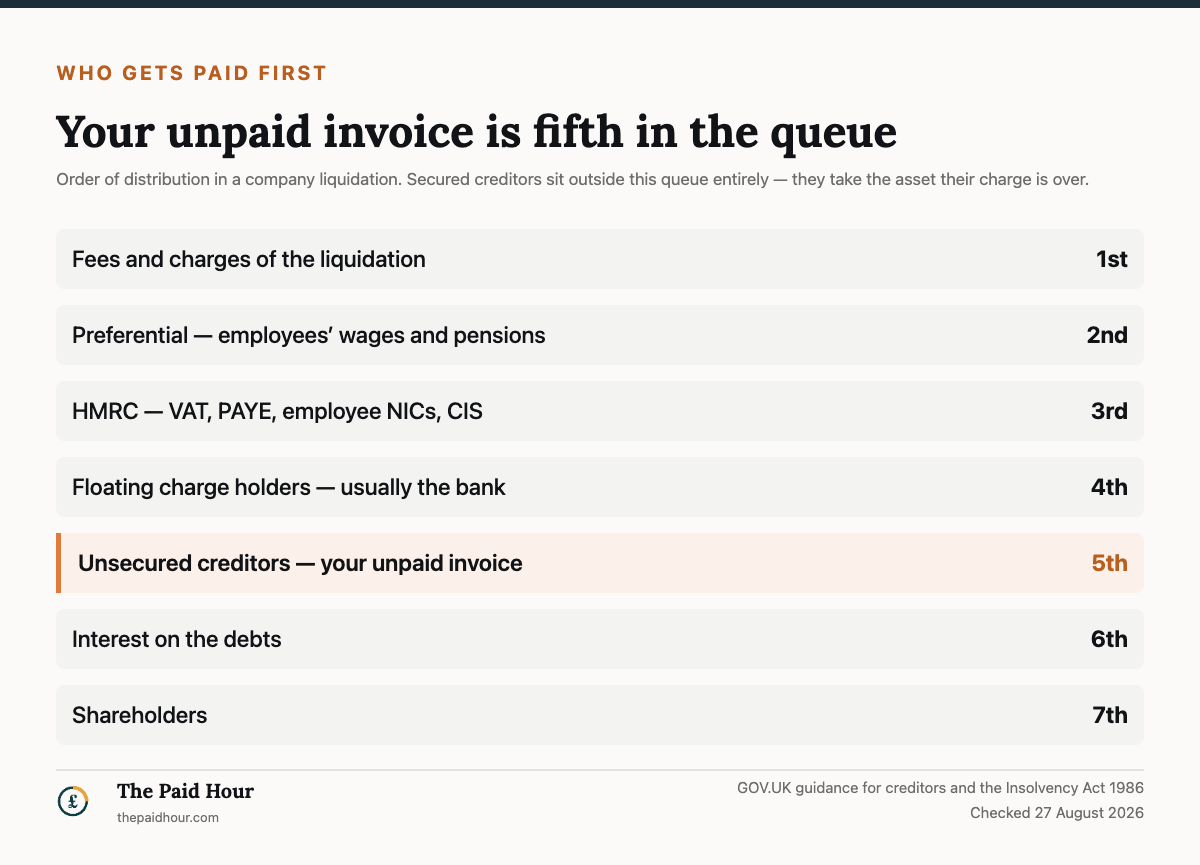
Secured creditors do not appear on that ladder because they are not in the queue at all. A lender with a charge over a specific asset takes that asset and sells it. What is left over is what everybody else is arguing about.
One rung in particular has got worse for freelancers. Since 1 December 2020, HMRC ranks as a secondary preferential creditor for taxes the company collected on somebody else’s behalf: VAT, PAYE income tax, employee National Insurance, student loan deductions and Construction Industry Scheme deductions. It stays unsecured for its own taxes, such as corporation tax and employer National Insurance. In plain terms, a large slice of what used to be shared out among unsecured creditors now sits above their heads.
Almost every article on this subject tells you to file a proof of debt and stops there. That reads as helpful and is not. Filing is right. Expecting a dividend is not.
File the proof of debt for your unpaid invoice anyway
The practitioner writes to the creditors they know about. Freelancers are frequently not on that list, because a one-off invoice from a sole trader is exactly the sort of thing that never made it into the purchase ledger. If no letter arrives, check the company’s status yourself and send a proof of debt in unprompted.
There is one deadline that matters, and it is not the start of the case. It is the notice of intended dividend. GOV.UK puts it bluntly: if you have not submitted a proof of debt form by then, “this is your last chance to do so. Otherwise you may lose your right to share in any money after the dividend has been declared.” Diary it when it lands.
Stop working. Today.
This is the part people get wrong out of professionalism. The project is half finished, the relationship was good, and finishing feels like the decent thing to do.
Every hour you put in after the company goes under becomes another unsecured claim, ranked exactly where the first one is. It does not improve your position and it does not increase your chance of being paid. Cancel the retainer, stop the hosting and the stock images you were fronting on their behalf, and do not hand over final files against a promise to sort it out later. The person making that promise no longer controls the money.
If the company is being struck off, you have real leverage
Voluntary strike off is how a director closes a company cheaply. It is not an insolvency procedure. No practitioner is appointed, no assets are gathered in, and nobody independently checks who is owed what. A notice goes into The Gazette, and if nobody objects the company is dissolved. Your unpaid invoice dies with it.
You can stop that, and it is free. GOV.UK is explicit about who may object: any shareholder “or other interested party, such as a creditor”, where “you have a reason to stop the company being removed from the register – for example, you have a legal claim against them or they owe you money.”
What you need is evidence, and the requirements are specific. Your documents must “support your reason for objecting, for example invoices proving the company owes you money”, must “clearly show the full name of the company, including the correct name ending”, must be images, Excel, Word or PDF files under 4MB, and must be less than six months old. That last condition surprises people: a two-year-old unpaid invoice on its own will not do, so send the invoice together with recent correspondence chasing it.
If the objection is accepted, “the company will not be struck off for another 6 months”, and you can ask for longer if you can show Companies House that you are making progress on the underlying issue. Six months of a company the director wanted gone still sitting on the register, still needing filings, is the cheapest pressure a freelance creditor will ever get. It is not a court claim and it does not pretend to be. It just makes disappearing quietly stop being an option.
The catch is finding out in time. Companies House runs a free service called Follow which “sends you email alerts of company transactions” and tells you “instantly what information has been filed as soon as we’ve accepted it”. Setting it on any client whose payment behaviour worries you costs nothing and takes a minute.
If your client is a sole trader rather than a company
Different register, different rules. Individuals appear on the Individual Insolvency Register, which covers bankruptcies, debt relief orders and individual voluntary arrangements, and lets you search by name or by trading name. Note that “records are usually removed within 3 months of an insolvency case ending”, so an empty search does not prove there was never a problem.
In a bankruptcy the trustee handles claims, and the proof of debt works the same way. In an individual voluntary arrangement you may be asked to vote on the proposal. What does not exist here is the strike off lever, because there is no register entry to remove.
The tax side: an unpaid invoice you never taxed
Here is where the standard advice goes backwards. People are told to claim the bad debt as an expense. For the majority of sole traders that is simply wrong, and understanding why takes thirty seconds.
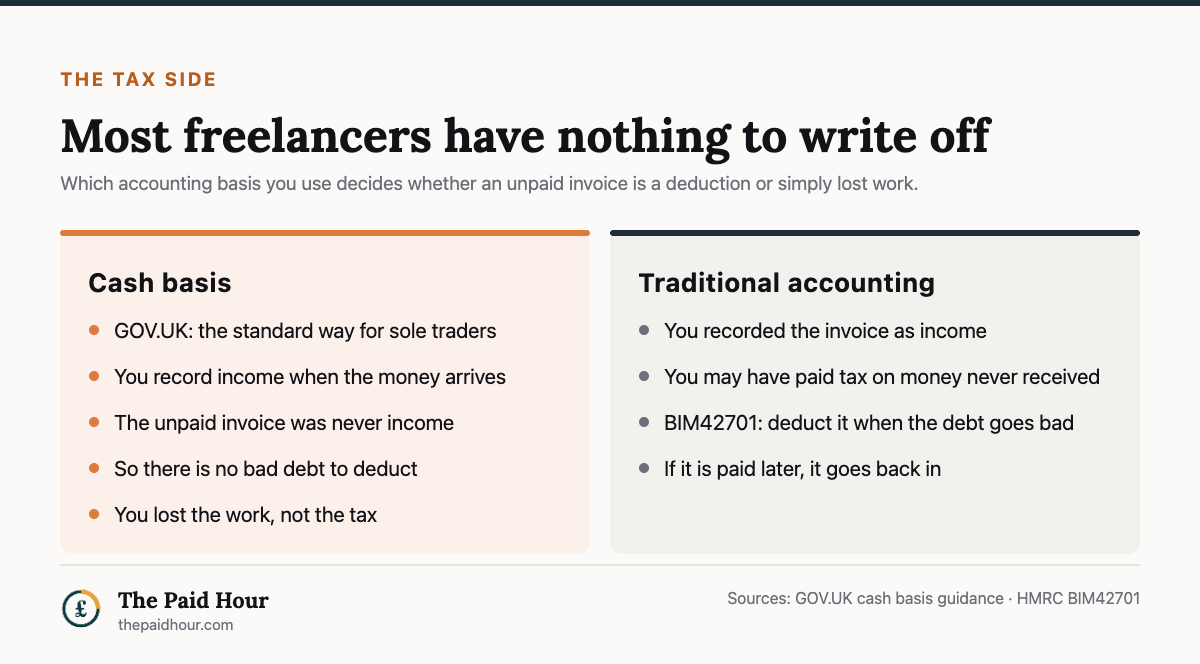
GOV.UK describes the cash basis as “the standard way to record your income and expenses if you’re a sole trader”, and the rule under it is that you “only record income you actually receive. Do not count any money you’re owed but have not yet received.” If that is you, the unpaid invoice never entered your figures as income. There is no deduction to claim because you were never taxed on it in the first place. That is not you missing out on relief. It is relief you never needed. If you are unsure which method you are on, our guide to the cash basis versus traditional accounting settles it in a couple of minutes.
On traditional accounting the position reverses. You recorded the invoice as income when you raised it, and you may already have paid tax on money that never arrived. HMRC’s guidance at BIM42701 allows the deduction: “a deduction for a bad or doubtful debt is to be made in arriving at the profits of the year in which the debt becomes bad or doubtful.” Doubtful debts count only to the extent you estimate them to be bad, judged debt by debt. A blanket percentage of your total sales is specifically not accepted.
The VAT on an unpaid invoice is real money
If you are VAT registered you charged VAT on that invoice and paid it over to HMRC whether or not the client ever paid you. Bad debt relief gets it back, and the conditions are workable.
You must already have accounted for the VAT and paid it. You must have “written off the debt in your day to day VAT accounts and transferred it to a separate bad debt account”. The write-off in your own books is a condition, not a formality. The debt must have “remained unpaid for a period of 6 months after the later of the time payment was due and payable and the date of the supply”. And you have to claim within four years and six months of that same later date.
On a £7,200 invoice (£6,000 plus VAT) that is £1,200 back. It is the only part of this entire process with a reliable answer at the end of it, and it is the part freelancers most often forget. Keep the unpaid invoice, the bad debt account showing the amount written off and the VAT claimed, and the customer’s name, invoice date and number.
What to do about an unpaid invoice, in order
- Ten minutes on Companies House. Establish which of the four states the company is in.
- If there is a strike off notice, object, with the invoices and recent chasing correspondence attached. Free, and it is the only real leverage on this list.
- If a practitioner is appointed, send the proof of debt, watch for the notice of intended dividend, and then put the money out of your mind.
- Stop every hour of work and every pound of spending on that client, today.
- If you are VAT registered, diary the six-month date and claim the relief.
- If you are on traditional accounting, tell whoever prepares your figures before the year end.
- Spend nothing chasing it. A solicitor’s letter to a company already in liquidation buys you a solicitor’s bill.
The uncomfortable truth is that the defence against this happens long before the letter arrives. It is taking a deposit and billing in stages, a contract that says when payment is due, and never letting one client’s outstanding balance grow past what you could absorb losing. Once a company is in a practitioner’s hands, your options are a form and a shrug.
If the client is merely slow rather than insolvent, that is a different problem with much better odds. Start with the order to chase an unpaid invoice in, add statutory interest and compensation, and check how long you have to chase it before the limitation period runs out.
Sources
- Claim money back from a bankrupt person or company in compulsory liquidation: guidance for creditors, GOV.UK
- Object to a limited company being struck off, GOV.UK
- HMRC as a preferential creditor, GOV.UK
- Relief from VAT on bad debts (VAT Notice 700/18), GOV.UK
- Cash basis, GOV.UK
- BIM42701: bad and doubtful debts, HMRC Business Income Manual
- Search the Individual Insolvency Register, GOV.UK
The order of distribution, the wording on the last chance to submit a proof of debt, the objection grounds and evidence rules, the six-month suspension, the VAT bad debt conditions and the cash basis wording are all quoted from the GOV.UK pages listed above. HMRC’s secondary preferential ranking applies to insolvency procedures beginning on or after 1 December 2020. All read on 27 August 2026. This is general information about how the process works, not legal advice and not tax advice, for a substantial debt, or a company you suspect was wound up to avoid paying you, take advice from a solicitor or an insolvency practitioner.
Client gone quiet on an invoice?
Late Payment Recovery & Legal Safeguards. The seven-stage escalation ladder with dates, every letter written for you, an interest calculator that adds what the law owes you, and the Money Claim Online walkthrough with real fees.
- Reminder letters for stages one to four, then a Letter Before Action that complies with the Pre-Action Protocol (company and individual versions)
- Auto-calculating statutory interest and compensation statement: £40 to £100 per invoice plus interest at base rate plus 8%
- Payment plan with a default clause, particulars of claim wording, hearing bundle index, and the client scorecard that fires slow payers
A solicitor charges around £40 plus VAT for a single letter before action. This is every letter in the sequence, the interest you are legally entitled to claim, and the court route, for one fee.
Buying more than one? The Complete Freelancer System, all five for £87, against £215 at full price.