
Before you read on: A deposit is not money on account for tax purposes. If you are VAT registered, HMRC’s rule is blunt: a deposit meant to form part of the payment for an identified job creates a tax point the moment it lands, and it does so even when the deposit is refundable if the job falls through. The one real exception is a security deposit against goods you hire out. If you are not VAT registered, cash basis gets to the same place by a different route: money in is income on the day it arrives. Either way, the deposit needs its own invoice with its own number.
Invoicing deposits and part-payments looks like the simplest thing in freelancing. Take half up front, do the work, take the rest. Then a VAT quarter ends between the two halves, or a tax year does, and the question of exactly when that money counted turns out to have a specific answer, one that a lot of people guess wrong, and guess in their own favour.
Invoicing deposits: why a deposit needs its own invoice
A deposit is not an informal transfer that gets tidied up later. It is a payment, and a payment needs an invoice: its own number, its own date, its own line explaining what it is a deposit against.
HMRC’s guidance on what an invoice must include is specific about the number, it has to be a unique identification number. Not the project number rather than the same number as the final invoice with an A on the end. A separate document with a separate number. Sole traders also have to show their own name alongside any trading name, and, if they trade under a business name, an address where legal documents can be served. That page was last updated on 20 August 2026. There is a fuller breakdown of what a UK invoice must legally include.
The paperwork reason is obvious enough: without a deposit invoice, six months later nobody can agree what was paid or what it was for. The tax reason is the one that costs money, and it starts the day the deposit arrives.
What a deposit does to your VAT
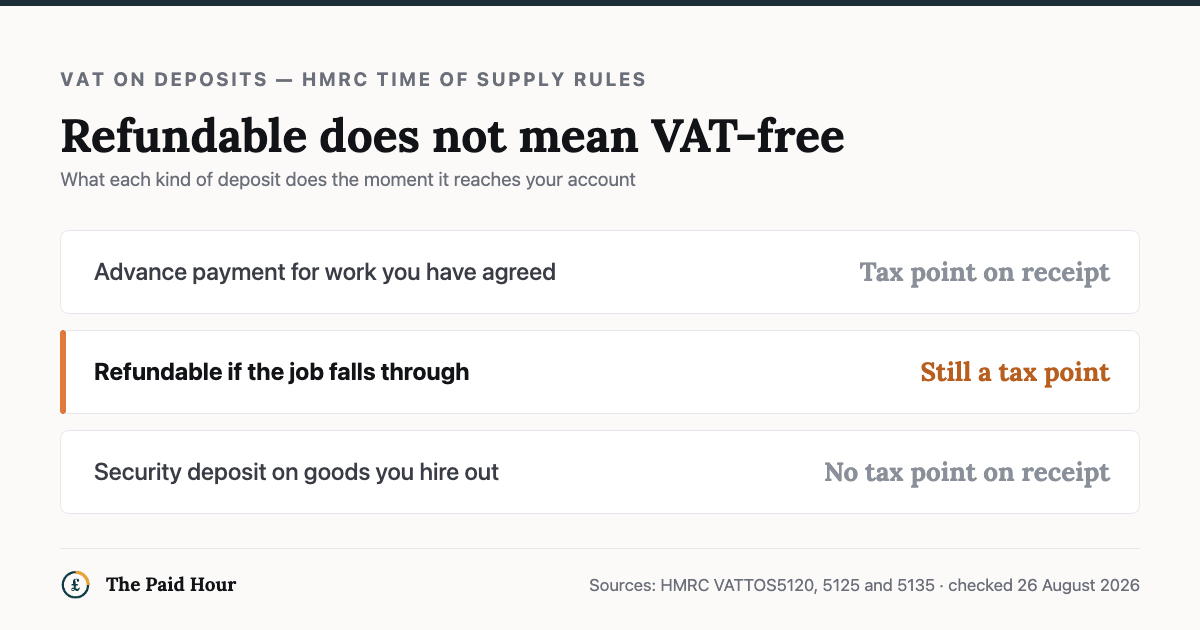
If you are VAT registered, taking a deposit is a taxable event. HMRC’s public guidance puts it in one sentence: the tax point will be either the date you issue a VAT invoice for the advance payment, or the date you receive the advance payment, whichever happens first.
So the VAT on that deposit belongs to the quarter the money landed in rather than the quarter you finish the job in. Take a 50% deposit on a £4,000 project in the last week of a VAT quarter and that is £400 of VAT going to HMRC before you have written a line of the work.
Now the part almost every article gets wrong. A deposit being refundable does not postpone the tax point. HMRC’s time of supply manual says a tax point arises even though the payer has some entitlement to a refund in the event of the supply not proceeding, and cites three tribunal cases where exactly that argument was tried and lost. Writing refundable on the invoice changes your contract with the client. It does not change your VAT return.
The rule that creates the tax point is worth reading closely: a pre-payment or deposit intended by the payer and recipient to eventually form part of the consideration for an identifiable supply creates one. Two conditions hiding in that sentence. The money has to be meant as part of the payment, and the job has to be identifiable. A vague retainer against unspecified future work is a different case from a 50% deposit on a defined project, if you are in that position, it is worth an accountant instead of a blog.
The exception HMRC does allow is narrow. Security deposits taken as security for the safe return of goods on hire or loan do not normally represent payment for a supply, so their receipt creates no tax point. That covers equipment hire. It does not cover a designer taking 50% up front.
Below £90,000 of taxable turnover in the last 12 months, none of this applies to you yet, see the £90,000 registration threshold. Once you are registered, what changes on your invoices is worth reading in full.
Invoicing deposits when you are not VAT registered: the timing still bites
Cash basis is the standard way a sole trader records income, and its rule is as simple as it sounds: you only record income or expenses when you receive money or pay a bill. Traditional accounting works from the other end, you record income by the date you invoiced or were billed.
Read those two together and a deposit taken on 20 March is income for the tax year that ends on 5 April, on either basis, because you both invoiced it and banked it before the year ended. The work happening in May does not move it.
That is the trap worth planning around. A large deposit taken in late March lands in a tax year where you have not yet paid the costs it is meant to cover, so it inflates that year’s profit and the payments on account that follow from it. Taking the deposit on 8 April instead moves the whole thing into the next year. Whether that is worth doing depends on your numbers, but it is a decision, not an accident, and cash basis versus traditional accounting is the piece to read before you make it.
One job, two tax points
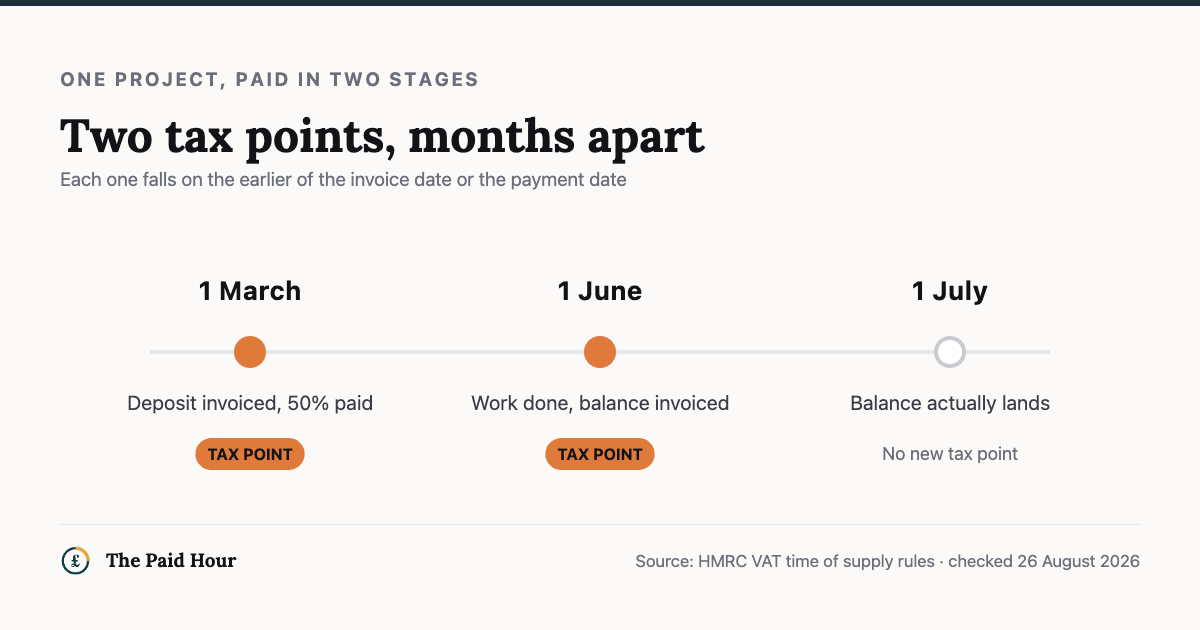
A staged job does not have one moment where the tax falls due. It has one per stage.
Deposit invoiced and paid on 1 March: tax point. Work finished and the balance invoiced on 1 June: second tax point, because the invoice came before the payment. The balance landing on 1 July does nothing at all, the tax point was already set in June. If your client pays late, the VAT was still due on the June date. That is worth knowing before you agree 60-day terms on the balance.
Invoicing deposits: what to put on the invoice
- Its own unique number and its own date, never a suffix on the final invoice’s number.
- The deposit amount, and if you are VAT registered, the VAT on it shown separately.
- What the deposit is against: the total project value, and what that total includes.
- A line saying the deposit will be deducted from the final invoice, so the client can see it will not be charged twice.
- When the balance falls due: a date, not on completion.
Then, on the final invoice, show the full project value, the deposit deducted as a separate line, and the balance owing. A final invoice that shows only the balance is the one clients query, because it does not match the number they agreed.
Invoicing deposits, part-payments and stage invoices
Longer jobs split into three or four stages work the same way, just more often. Each stage gets its own invoice and its own number. The temptation to reuse a number with a letter after it (INV-104, INV-104a, INV-104b), fails the unique identification number requirement, and it makes your own records harder to reconcile when a client pays two of the three.
If the same client pays you the same amount on the same day every month, that is a different arrangement with different mechanics: see recurring invoices for retainer clients.
If the balance never arrives
The deposit is the reason you are not out the whole fee, which is most of the argument for taking one. On the balance, the Late Payment of Commercial Debts rules give you statutory interest at 8% above the Bank of England base rate, and it applies whether or not your contract mentions it. There is more on what you can legally charge on a late invoice, and on what the contract should say before the job starts.
If the deposit is going to be paid by card, the processor takes its cut of that too. What card payments cost, and the fee you cannot pass on has the current rates.
Owed money right now?
Late Payment Recovery & Legal Safeguards. The seven-stage escalation ladder with dates, every letter written for you, an interest calculator that adds what the law owes you, and the Money Claim Online walkthrough with real fees.
- Reminder letters for stages one to four, then a Letter Before Action that complies with the Pre-Action Protocol (company and individual versions)
- Auto-calculating statutory interest and compensation statement: £40 to £100 per invoice plus interest at base rate plus 8%
- Payment plan with a default clause, particulars of claim wording, hearing bundle index, and the client scorecard that fires slow payers
A solicitor charges around £40 plus VAT for a single letter before action. This is every letter in the sequence, the interest you are legally entitled to claim, and the court route, for one fee.
Buying more than one? The Complete Freelancer System, all five for £87, against £215 at full price.
Need this ready-made? → All 5 HMRC-ready invoice templates: bundle (£14.99, instant download)
Read next
- Proforma Invoice: Not an Invoice, and No 30-Day Clock
- Booking Software for UK Sole Traders: Which Ones Let You Charge for a No-Show
- SimplyBook.me review: taking deposits to stop no-shows
Sources
- Invoices: what they must include — GOV.UK
- VAT: instalments, deposits, credit sales, GOV.UK
- VATTOS5120: deposits and pre-payments. HMRC manual
- VATTOS5125: refundable deposits, HMRC manual
- VATTOS5135: security deposits: HMRC manual
- Cash basis: GOV.UK
- VAT registration: when to register, GOV.UK
The invoice contents come from HMRC’s guidance last updated 20 August 2026. The tax point wording is quoted from HMRC’s public VAT guidance and from the VAT time of supply manual pages VATTOS5120, 5125 and 5135. The cash basis wording is HMRC’s own. All were checked on 26 August 2026 and all of them move, check before you rely on a figure. This is general information, not financial or legal advice; a deposit against work that is not yet defined is a case for an accountant. No affiliate links on this page.