
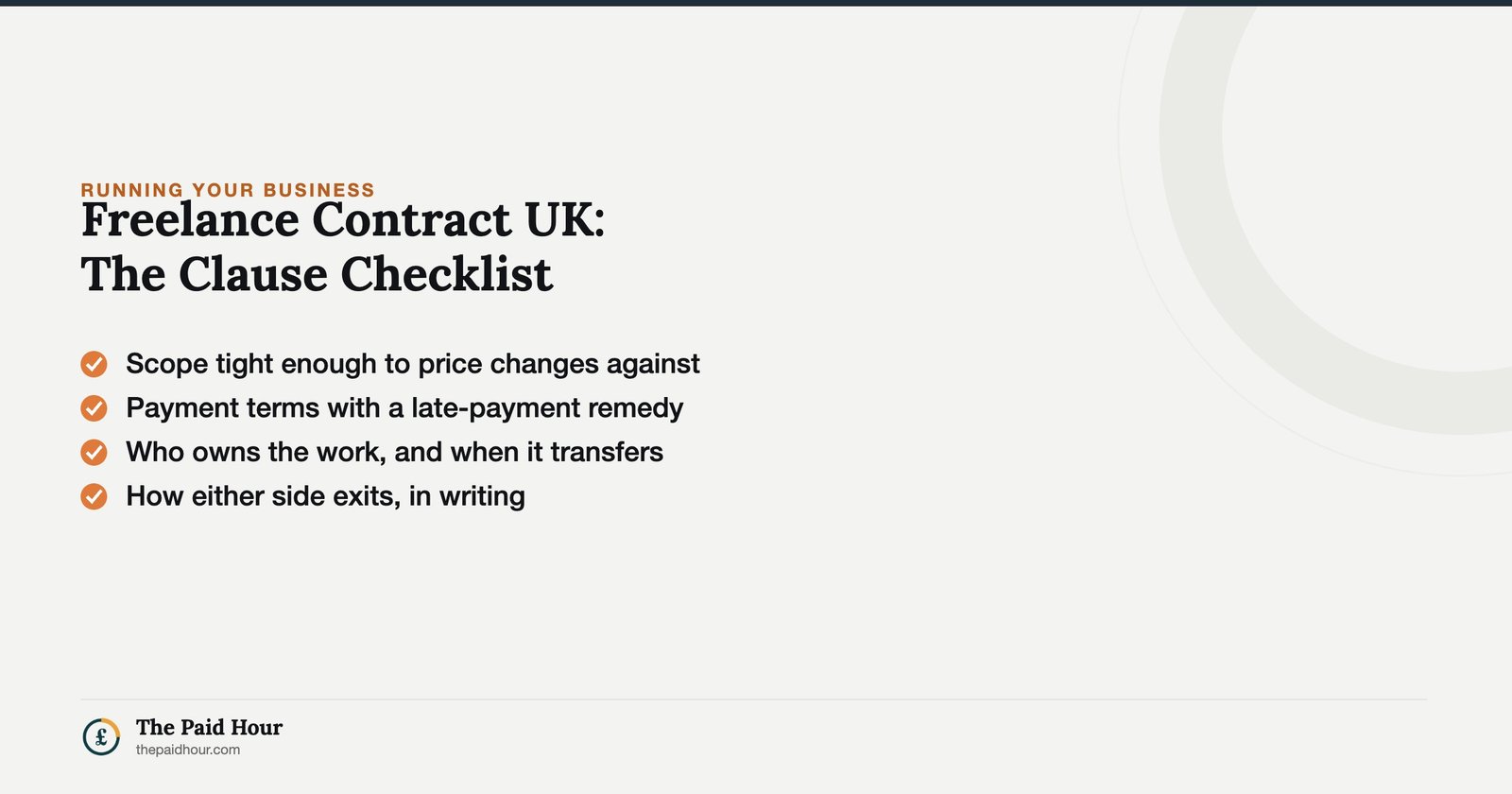
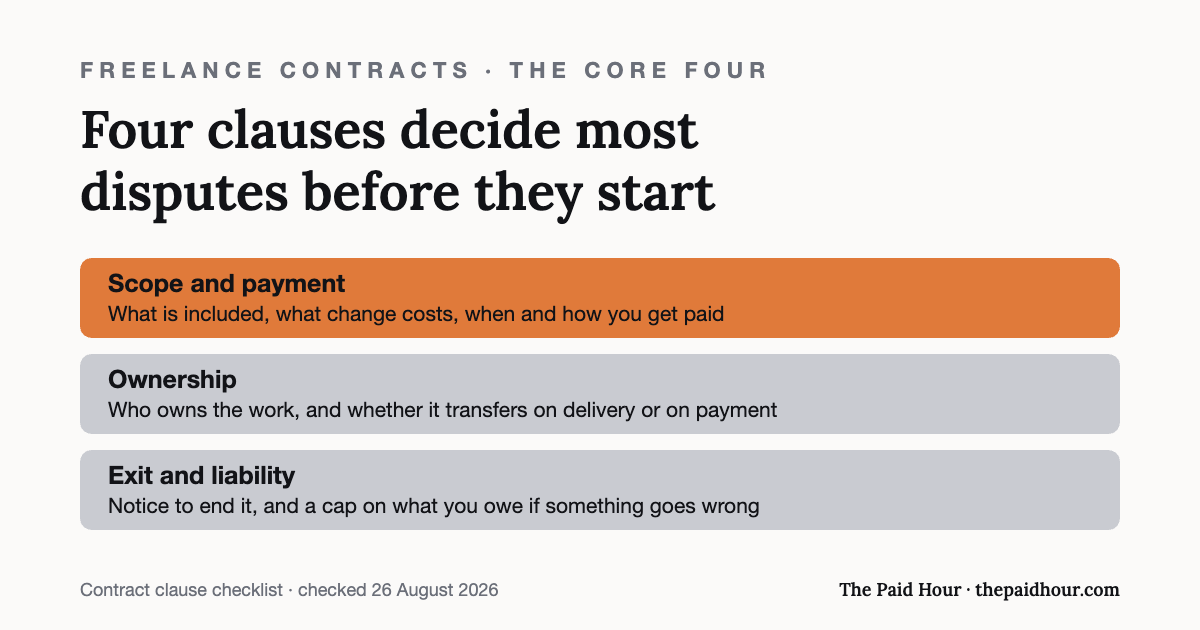
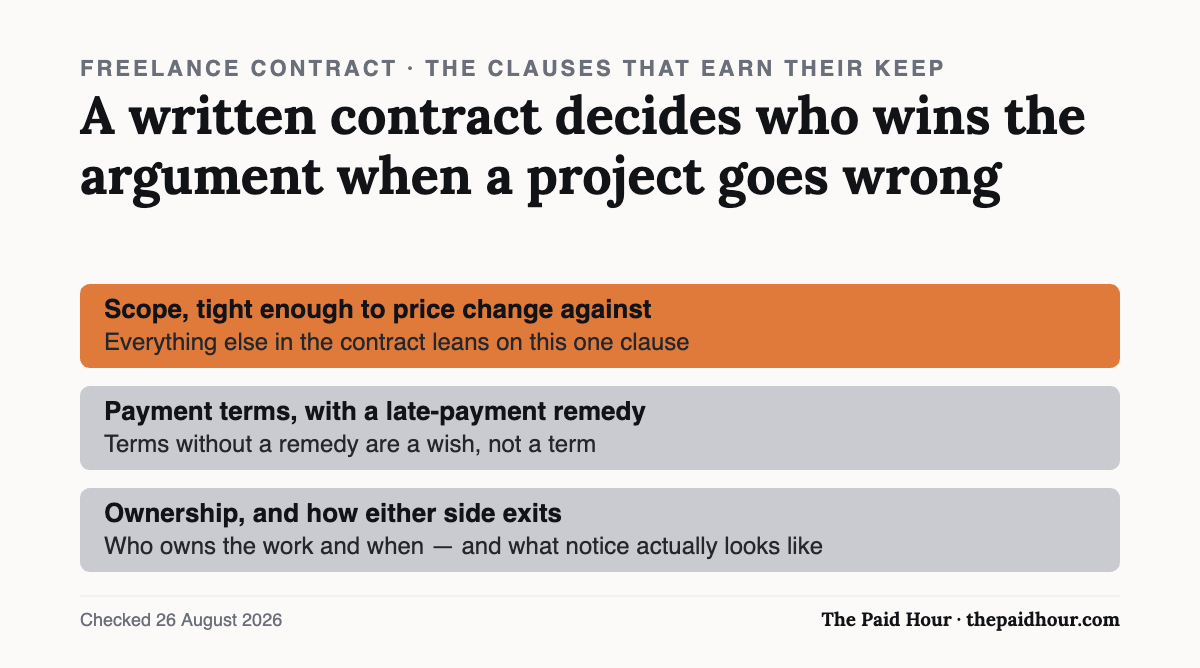
Before you read on: A written contract decides who wins the argument when a project goes wrong. The clauses that earn their keep: a scope tight enough to price change against, payment terms with a late-payment remedy, who owns the work and when, and how either side exits. Checklist below, check yours against it before you start work.
A good freelance contract is the cheapest insurance policy you’ll ever buy. It won’t stop every client dispute, but it decides who wins the argument when one happens. This is a practical checklist of what should be in a freelance contract UK clients sign with you rather than a template to copy blindly, but the clauses worth checking for before you start work.
Why does a written freelance contract matter?
Freelance and contractor relationships in the UK are governed by ordinary contract law rather than employment law, gov.uk’s own guidance draws a hard line between employees, workers, and the self-employed, and freelancers/consultants/contractors normally fall outside statutory employment protections (gov.uk). That means the written agreement between you and your client largely is the rulebook. There’s no fallback set of employee rights to lean on if it’s silent or vague. A verbal agreement or a one-line email confirming a job is technically a contract, but it leaves almost everything open to dispute later.
What should the freelance contract scope of work say?
Vague scope is the single biggest cause of freelancer-client fallouts, “creep” where a client keeps adding asks under the original fee. This is exactly what a written freelance contract UK freelancers use is meant to prevent. Your contract should nail down:
In broad terms it pins down four things: the specific deliverables, the timeline, how many revision rounds are included, and: just as usefully, what is explicitly excluded. The exact wording that makes each of those stick (including the revisions sentence that quietly earns more than any other clause) is in the 12-clause contract inside the Freelance Ops Playbook.
What payment terms need to be in writing?
A well-drafted freelance contract UK payment section covers, at minimum: your rate or fee, when invoices go out, payment terms (30 days is standard, but you can set anything both sides agree to), accepted payment methods, and what happens if a project is paused or cancelled partway through (a deposit or kill fee clause protects time already spent).
If a client pays late, UK law gives you statutory rights to claim interest and compensation on qualifying business-to-business debts automatically — you don’t need a special clause for that baseline protection, though your contract can set its own terms instead if they’re a substantial alternative. The detail is covered in full in Late Payment Interest: What UK Freelancers Are Entitled To, and what to do when an invoice goes unpaid is in Chasing Unpaid Invoices UK. Your invoices themselves also need specific information to be valid and easy to chase, see What a UK Invoice Must Include.
Who owns the work, you or the client?
This is the clause freelancers most often get wrong on a freelance contract UK deal, because the default rule surprises most people.
Under the Copyright, Designs and Patents Act 1988, the general rule is that the author/creator of a work is its first owner of copyright (legislation.gov.uk, s.11). There is a specific exception for work created by an employee in the course of their employment, there, the employer owns it by default. That exception is about employment status, not about who paid for or commissioned the work. gov.uk’s own IPO guidance confirms first ownership sits with the creator unless a contract term assigns it elsewhere (gov.uk, Ownership of copyright works).
In practice, this means: if you’re a freelancer and your contract is silent on IP, you instead of the client who paid you. Generally still own the copyright in the design, photos, code, or copy you created for them. The client typically only gets an implied licence to use it for the purpose they hired you for rather than full ownership or the right to reuse or resell it elsewhere. If your client expects to own the work outright (common for logos, bespoke code, or commissioned photography), the contract needs an explicit assignment of IP clause saying so, it doesn’t happen automatically just because they paid the invoice.
Get this clause reviewed by a solicitor if the work is high-value or IP is central to your business: it’s one of the few areas where a missing sentence can cost real money later.
What should a termination or notice clause include?
Cover: how much written notice either side must give to end the contract early, what happens to work in progress and payment for it if terminated partway through, and any grounds for immediate termination without notice (e.g. non-payment, breach of confidentiality). Without a notice clause, you’re relying on general contract law principles about “reasonable notice,” which is far less predictable than agreeing a fixed number of days upfront.
Other freelance contract clauses worth including
Beyond the essentials above, a thorough freelance contract UK freelancers can rely on in a dispute usually also covers:
The usual additions are confidentiality, a liability cap, an employment-status statement and a governing-law line. Which of these you need depends on the client and the work, the Playbook’s contract includes all twelve clauses with the wording done.
Get the parties right at the top of it, too. If you trade under a name that is not your own, the contract needs your real name alongside that name, which is one of the rules a sole trader trading name has to follow.
Where this leaves you
None of this needs to be complicated, most freelance contracts fit on two or three pages. Whatever template you start from, a solid freelance contract UK clients will actually sign covers scope, payment, IP ownership, and an exit clause explicitly, so nothing is left to a “well, it’s normal to assume…” argument later.
This is general guidance, not legal advice. Contract law can turn on small wording differences, and what’s “standard” varies by industry and client size. Before signing or sending a contract for a significant piece of work, get it drafted or reviewed by a solicitor or a reputable contract-review service.
Related reading
- Late Payment Interest: What UK Freelancers Are Entitled To
- Chasing Unpaid Invoices UK
- What a UK Invoice Must Include
- Free download: Client Onboarding Checklist
- Self-employed insurance: what cover a freelancer actually needs
The pricing basis belongs in the contract too. day rate or fixed price is its own decision.
And if the brand itself is becoming the asset, the contract isn’t what protects the name: a registered trade mark is.
Sources
- gov.uk, Contract types and employer responsibilities: Freelancers, consultants and contractors
- gov.uk: Ownership of copyright works (IPO guidance)
- Copyright, Designs and Patents Act 1988, s.11 — First ownership of copyright
- Late Payment of Commercial Debts (Interest) Act 1998, s.8, contract terms and substantial remedy
Reviewed 26 August 2026. General information rather than advice.
Is your name, your work and your downside actually covered?
Protect the Business: Legal, IP & Insurance 2026/27. Eight modules and five working sheets built around a complete annotated freelance contract, with a negotiation note under every clause.
- Registering a trade mark yourself: searching, classes, fees and the opposition period
- UK GDPR without a consultant: the ICO fee tiers, a privacy notice, and the 72-hour breach plan
- An insurance sizing calculator by work type, and the client clauses never to sign as they stand, with the redline for each
You own the copyright in what you make until you assign it in writing. Most clients assume the opposite, and most freelance contracts are silent on it.
Buying more than one? All ten 2026/27 courses for £107, against £328 at full price.