
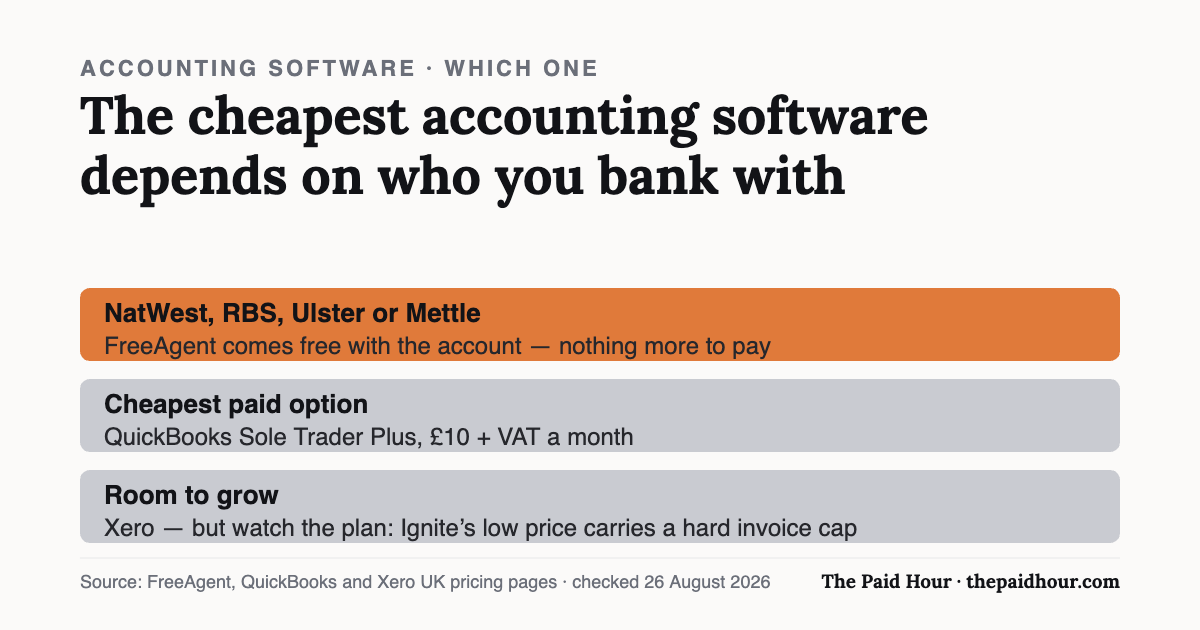
Before you read on: Bank with NatWest, RBS, Ulster Bank or Mettle? Just use FreeAgent, it’s free with those accounts. Cheapest paid option: QuickBooks Sole Trader Plus at £10 + VAT a month. Need room to grow: Xero, but watch the plan, because Ignite’s low price comes with a hard invoice cap.
Picking the best accounting software for UK freelancers usually comes down to price and whether you’re VAT-registered, here’s what QuickBooks, FreeAgent and Xero cost right now.
Quick update: Xero put its UK prices up on 1 September 2026. Ignite went to £18, Grow to £39. The figures below are the new ones. For the full picture, see what’s changing and what it’ll cost you if you want the full picture.
Disclosure. One thing to flag up front: some of the links here are affiliate links, meaning we might get paid if you sign up through them. That costs you nothing extra, and, more importantly, it hasn’t shaped what’s written here. FreeAgent, for instance, is free for a huge chunk of readers, and we say so plainly, even though that particular recommendation earns us nothing. Full details in our affiliate disclosure.
There’s no single best accounting software for UK freelancers: roughly a dozen tools get pitched at this crowd, and most round-ups rank them by whichever pays the best commission.
This one isn’t built that way — it’s pulled straight from each provider’s own published pricing, double-checked on 26 August 2026, warts and all.
The short answer on accounting software
- Bank with NatWest, RBS, Ulster Bank or Mettle? Just use FreeAgent. It comes free with those accounts, it’s full-featured, and nothing else at £0 comes close.
- Want the cheapest paid option? QuickBooks Sole Trader Plus, £10 a month excluding VAT.
- Need room to grow? Xero, just watch which plan you pick, since the cheaper one has a hard invoice cap.
- Low income, simple tax affairs? Hold off. If you’re under the MTD threshold and only file one straightforward return a year, software might be solving a problem you don’t have.
What accounting software actually costs
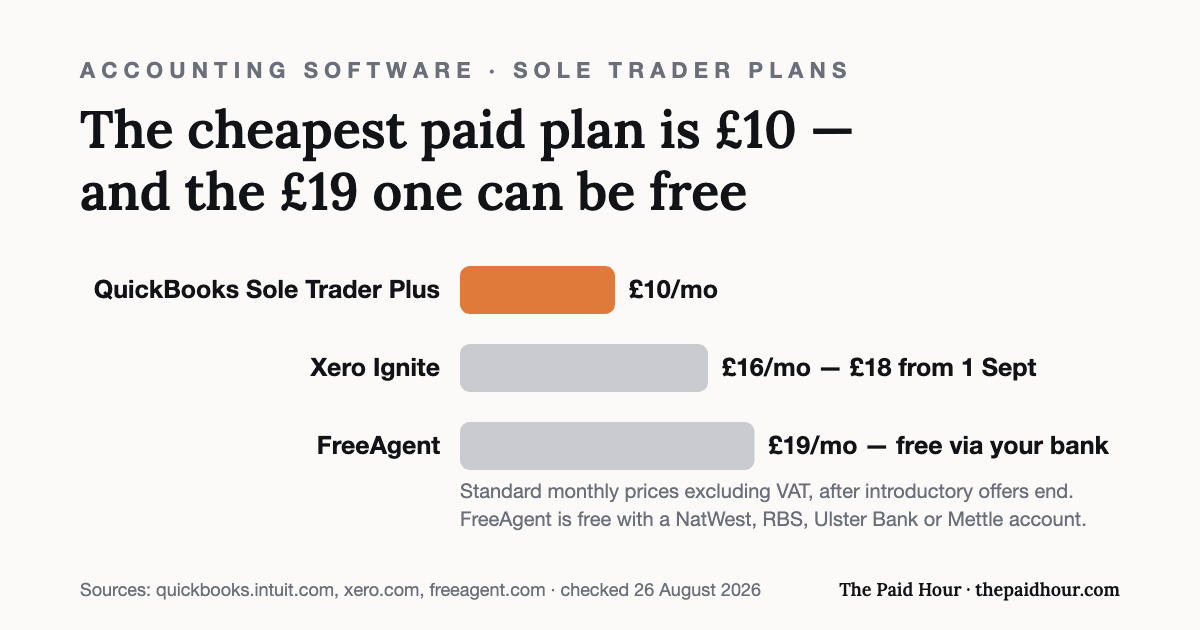
Every provider leads with their discounted price, naturally. Here’s what you’re really paying from month seven onward, VAT excluded:
| Plan | Standard price | Intro offer | MTD for Income Tax |
|---|---|---|---|
| QuickBooks Sole Trader Plus | £10/mo | 90% off for 6 months | Yes |
| Xero Ignite | £18/mo | 90% off for 6 months | Yes |
| FreeAgent Sole Trader | £19/mo | 50% off for 6 months | Yes |
| Xero Grow | £39/mo | 90% off for 6 months | Yes |
Two things worth knowing before you commit to anything. First, Xero put its subscription prices up on 1 September 2026. Second, and this one’s easy to miss. FreeAgent isn’t discounted for NatWest, RBS, Ulster Bank or Mettle customers, it’s free, because NatWest Group owns the company. The qualifying banks, the one-transaction-a-month condition and the cost of losing the deal later are unpacked in is FreeAgent free?
FreeAgent
£19/mo excluding VAT, or free with a NatWest, RBS or Ulster business account or a Mettle account, the one condition: at least one transaction from the account each month.
FreeAgent feels like it was built specifically for this reader: a UK sole trader who wants to see their tax position clearly without learning double-entry bookkeeping from scratch. It shows an estimated Self Assessment bill as you go: arguably the single most useful feature on this whole list, and it handles MTD quarterly submissions directly.
The catch, if you’re paying for it, is the price. At £19 a month it’s the priciest sole trader plan here. What softens that is how many of its users pay nothing at all, if you’re with NatWest, RBS, Ulster Bank or Mettle, the decision’s basically already made for you.
QuickBooks
Sole Trader Plus, £10/mo excluding VAT.
This is the cheapest credible option on the list, and it does cover MTD for Income Tax. QuickBooks quietly retired its old Self-Employed product and shifted everyone onto this plan instead.
Worth reading the fine print before you sign up, though. Sole Trader Plus is single-user only, and QuickBooks is upfront that VAT submission to HMRC isn’t available on this tier, if you’re VAT registered, or think you will be soon, you’ll need Simple Start or above, which costs more. Great value for a non-VAT-registered sole trader; the wrong plan for pretty much everyone else.
Xero
Ignite at £18 a month and Grow at £39, both excluding VAT, since the 1 September 2026 increase.
Xero’s the most capable of the three, and it’s the one accountants tend to ask for by name. Every plan is MTD for Income Tax ready.
The trap here is Ignite. At £18 it looks like the sensible budget choice, but it caps you at 20 invoices and 10 bills a month. If you’ve got a handful of retainer clients, that’s plenty. If you invoice per project or per session, you’ll blow past it fast, and the next tier up is £39, more than double. Work out your actual invoice volume before you pick.
How to choose accounting software as a freelancer
If you’re still weighing up the best accounting software for UK freelancers, the honest answer is: pick the cheapest one that covers what your VAT status requires, and switch later if you outgrow it.
The price gap between these is £10–£20 a month. That matters, sure, but honestly these questions matter more:
- Does your accountant already use it? If you’ve got one, ask before you buy anything. Their preference is worth more than saving a fiver a month.
- Does your bank feed actually work? They all connect to the major UK banks in theory, but check yours specifically, manually importing statements every month will put you off any of these tools fast.
- Is it on HMRC’s list? Check the official compatible software list rather than trusting the marketing page.
- What happens once the offer ends? An 80% discount for six months is a genuine saving, but budget for the standard price, that’s what you’ll be paying in years two, three and four.
When you don’t need accounting software at all
If your self-employed income sits under the MTD threshold, you file one straightforward return a year, and you’re only dealing with twenty-ish transactions a month, a spreadsheet and a separate bank account will do the job just fine, for free. That question is worth answering properly before you pay for anything: do you need accounting software as a sole trader? Software earns its keep once MTD applies to you, once you’re VAT registered, or once the admin is eating into your evenings. Not before.
Our full guide on what Making Tax Digital actually requires covers whether you’re caught by it, and from when.
Where to sign up
FreeAgent
The full product, no cost, with those accounts — NatWest Group owns FreeAgent, which is exactly why the offer exists. Paying for it otherwise rarely makes sense.
Visit FreeAgentQuickBooks
Sole Trader Plus at £10 a month excluding VAT. Check the price after the intro offer ends, not just the headline discount.
Visit QuickBooksXero
Good if you’re expecting to scale, but read the plan limits first, the cheap tier has a hard cap on invoices.
Visit XeroRelated: what Xero does, in plain English.
Outgrow your pick later? Switching software without losing your records is its own job, and if you would rather have an accountant bundled in with the software, start with the Crunch review.
MTD quarters coming and the books are a shoebox?
Digital Bookkeeping System (MTD-ready) 2026/27. Seven modules and a seven-sheet toolkit, built around a category-to-tax-box mapping table that makes your quarterly updates fill themselves.
- A software decision sheet costed over three years, split by turnover, VAT status and phone-or-desktop
- The chart of categories mapped to the Self Assessment and MTD boxes, and the three categories never to auto-categorise
- Weekly and month-end cards, an MTD quarter-close checklist, and an export-and-archive index so their cloud is never your only copy
Software is priced monthly, excluding VAT, and you will hold the subscription for years. Pick on the wrong number and the difference over three years is more than every course on this site combined.
Buying more than one? All ten 2026/27 courses for £107, against £328 at full price.
Sources
- Xero UK pricing plans
- FreeAgent pricing
- QuickBooks UK pricing
- HMRC, Choose the right software for Making Tax Digital for Income Tax
All three providers’ prices re-checked against their own pricing pages on 26 August 2026. Xero’s increase took effect on 1 September 2026.