
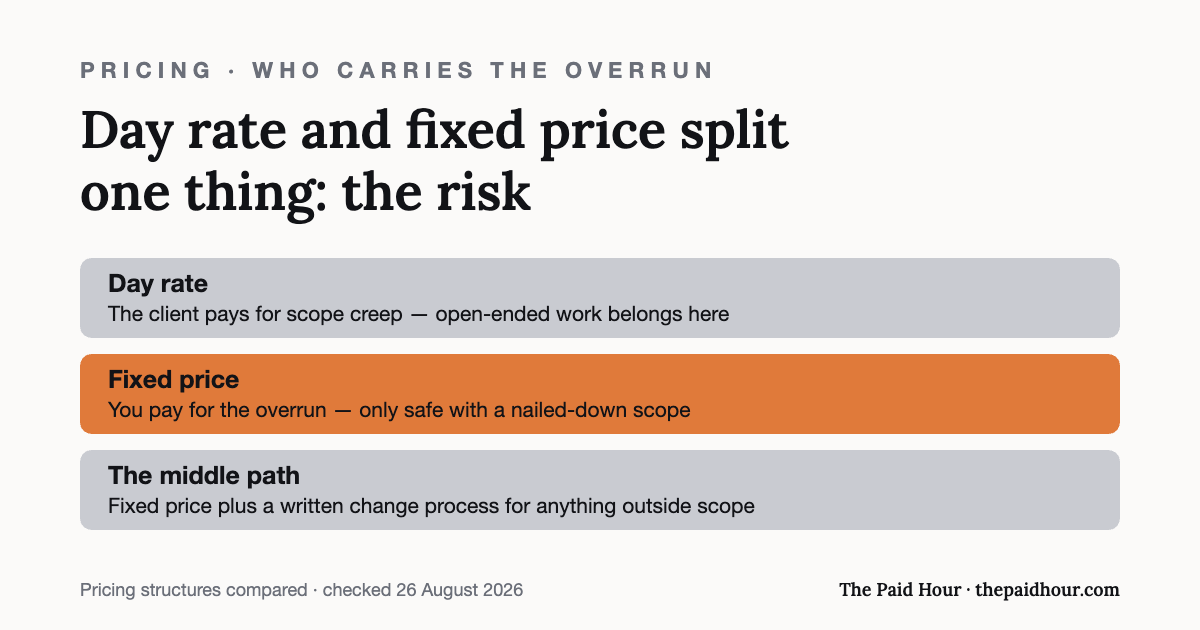
The one-paragraph answer: Fixed price and day rate split one thing: who carries the overrun. On a day rate the client pays for scope creep; on a fixed price you do, so fixed pricing only works with a nailed-down scope and a change process. Day rates suit open-ended work; fixed prices suit defined deliverables you have done before.
Two freelancers can do the same job and get paid completely different ways, one quotes a flat £2,000 for the project, the other bills £400 a day and it happens to take five days. Same work, same money, very different risk. This is the day rate vs fixed price decision: which model to pick for a given project, and what you’re trading off when you choose one over the other.
This isn’t an official rule from HMRC or anyone else, it’s professional practice and judgement, the kind freelancers build up project by project. Treat it as a framework to think with rather than a formula to follow blindly.
If you haven’t worked out your day rate yet, start with How to Set Your Freelance Day Rate, this post assumes you already have that number and are deciding when to use it.
Day Rate vs Fixed Price: What’s the Actual Difference?
A day rate charges for your time, you invoice for the days worked, whatever the output. The client carries the risk that the job takes longer than expected; you carry the risk of being asked to sit around on a slow day, or losing income if a booked block gets cancelled.
A fixed price (or “fixed fee”) charges for a defined deliverable (a logo, a website, a report), for one agreed sum, regardless of how many hours it takes you. Here the risk flips: you carry the cost if the job overruns, and the client gets budget certainty.
Neither is more “correct.” They’re just different ways of splitting the same risk between two parties.
When does a fixed-price quote work better?
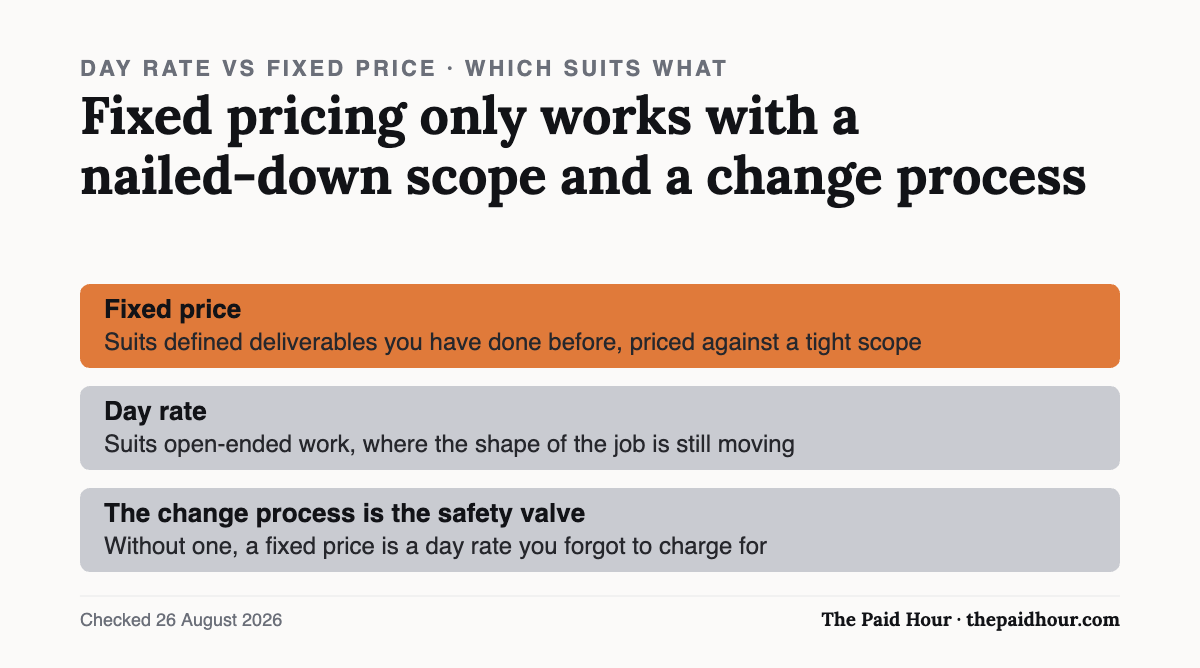
Fixed pricing tends to suit work where you can scope the deliverable tightly before you start: a defined set of pages, a fixed number of design revisions, a report with an agreed structure. The clearer the brief, the safer a fixed price is to offer, because you’ve priced in a known amount of work rather than an unknown number of days.
It also tends to suit clients who want a single number for their own budgeting, which is common with one-off projects, first-time clients, or fixed-budget engagements like grants or small business contracts.
The risk: if the brief turns out to be vaguer than it looked, you eat the extra hours. That’s the trade you’re making in exchange for winning work from budget-conscious clients and, often, being able to price a bit higher than your straight hourly-day-rate equivalent to cover that uncertainty.
When does a day rate work better?
A day rate suits work that’s hard to scope in advance: ongoing strategy input, iterative development, research that might go in several directions, or any project where the client themselves isn’t sure yet exactly what they need. It also suits situations where the client wants you embedded for a period (a few days a week, over several months) instead of delivering one discrete thing.
Because you’re paid for time regardless of outcome, a day rate protects you from underestimating a fuzzy brief. The trade-off is that clients sometimes find it harder to budget for, and may ask for an estimate of total days anyway — at which point you’re taking on some of the same forecasting risk as a fixed quote, just less formally.
How Does Scope Creep Affect Day Rate vs Fixed Price Differently?
This is where the two models really diverge. Under a fixed price, scope creep is a direct hit to your effective hourly rate, every unplanned extra you absorb for “free” quietly erodes what you’re actually earning per hour on that job. Under a day rate, scope creep is comparatively painless for you: more days, more invoiced amount, the pain shows up as budget pressure for the client instead.
That asymmetry is exactly why fixed-price agreements live or die on a tight scope document, and why many freelancers who quote fixed prices still track their hours privately, so they know if a “quick tweak” client is quietly costing them money project after project.
Does VAT or invoicing change depending on which model I use?
No, VAT treatment and the legal invoice requirements are the same either way. Whether you bill £2,000 as one fixed fee or as five days at £400, you’re invoicing for a taxable supply of services, and the same information is legally required on the invoice regardless of how the fee was calculated (gov.uk: what an invoice must include). For the full breakdown of what has to be on every invoice you send, see What a UK Invoice Must Include.
Could charging a day rate affect my IR35 or employment status?
It can be a factor rather than a fixed rule. A day-rate engagement that looks a lot like being paid as an employee (set hours, one client, direction over how you work, tools and equipment provided), can push an off-payroll working assessment the wrong way, separately from how the invoice is priced. Fixed-price project work, delivered against your own methods and schedule, tends to sit more comfortably outside that picture, but pricing model alone doesn’t decide it. We cover the actual tests and how they work in IR35 and Off-Payroll Working for Freelancers and won’t re-derive them here, see gov.uk’s off-payroll working (IR35) guidance collection for the official detail.
How do I protect myself whichever model I choose?
Whichever model you pick, the same document does most of the protecting: a written scope. For a fixed price, spell out exactly what’s included, what counts as a “revision,” and what happens if the client asks for more, usually a rate for additional work, agreed upfront. For a day rate, agree the expected number of days (even if it’s an estimate, not a promise) and how extra days get approved, so nobody’s surprised by the final total.
In practice, many freelancers use both models side by side, day rate for open-ended or ongoing work, fixed price for tightly defined one-off deliverables, and choose per project rather than picking one identity and sticking to it forever.
Related reading
- How to Set Your Freelance Day Rate
- What a UK Invoice Must Include
- IR35 and Off-Payroll Working for Freelancers
This post is general commentary on pricing strategy instead of official guidance, it reflects common freelance practice rather than a rule set by HMRC or any regulator. What suits your work best depends on your clients, your sector, and your own appetite for risk.
Sources
- gov.uk, Invoicing and taking payment from customers: what invoices must include
- gov.uk: Off-payroll working rules (IR35): detailed information
Reviewed 26 August 2026. This is general information, not financial advice. Pricing and terms are the provider’s own and change, check the linked pages before you rely on them.
Note on scope: the pricing-strategy advice in this post (which model suits which project, how to structure scope documents) is professional/business practice commentary, not sourced from an official body — there is no single gov.uk page on “day rate vs fixed price” to cite, because it isn’t a regulated or legally defined choice.
Quoting a rate you have never actually costed?
Freelance Ops Playbook. Ten modules and eighteen templates: the rate floor calculation, a pipeline that rejects bad clients early, the twelve-clause contract, onboarding, change orders and a Friday rhythm that holds it together.
- The rate floor calculator, which most people find puts their current rate below cost
- The twelve-clause contract, including the revisions sentence that quietly earns more than any other
- Enquiry log with live pipeline value, thirteen-week cash forecast, three-option proposal, change order, welcome pack
One under-scoped project, or one client who “just needs a couple more rounds”, costs more than this playbook several times over. The templates exist so that never happens again.
Buying more than one? The Complete Freelancer System, all five for £87, against £215 at full price.