
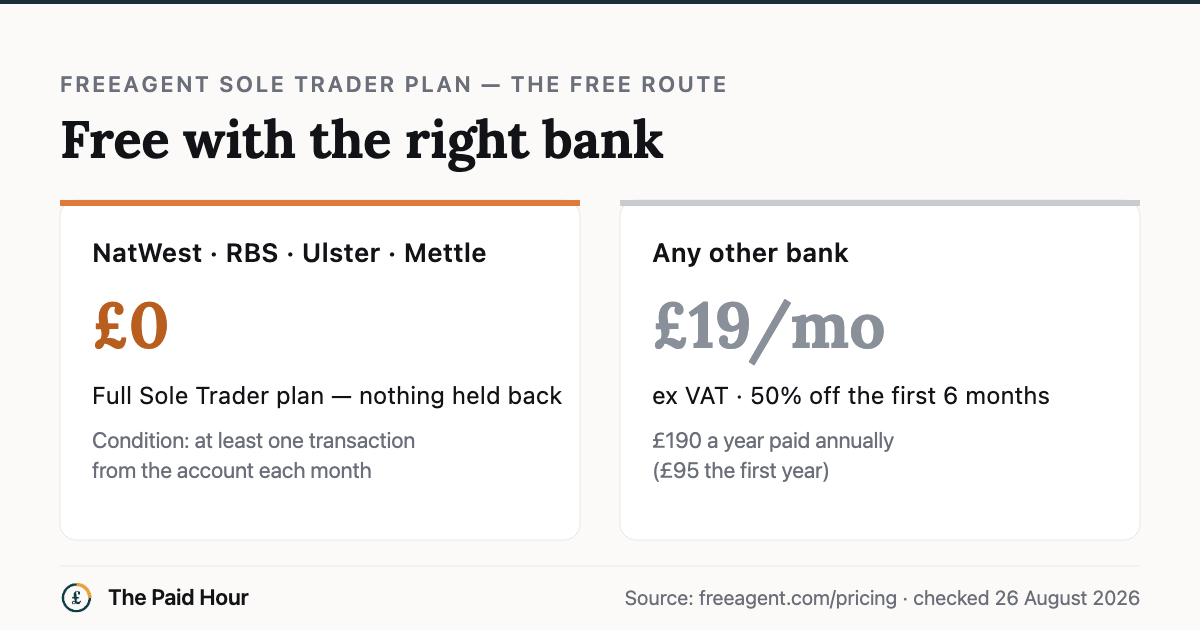
Quick answer: Yes, FreeAgent is free with a NatWest, Royal Bank of Scotland or Ulster Bank business current account, or a Mettle account, for as long as you keep the account. The one condition: at least one transaction from it each month. It’s the full product rather than a cut-down version. NatWest Group owns FreeAgent, which is why the deal exists. Everyone else pays £19 a month (50% off for six months), and at that price the comparison gets closer.
Table of Contents
Is FreeAgent free? For a large slice of UK freelancers, yes, and unlike most “free” software offers, this one isn’t a trial, a lite tier or an intro rate. It’s the standard product, paid for by who you bank with. Here’s exactly who qualifies, the one condition attached, what it costs everyone else, and what happens if you stop qualifying halfway through a tax year.
Who actually qualifies
FreeAgent’s own pricing page sets the terms: the full Sole Trader plan is free if you hold a business current account with NatWest, Royal Bank of Scotland or Ulster Bank, or a Mettle account, and make at least one transaction from that account each month. That last clause is the bit people miss. The free access isn’t a one-off unlock; it runs “for as long as you retain the account”, with the monthly transaction keeping it alive. A dormant account you opened just for the freebie, with nothing moving through it, doesn’t hold up the deal. The practical fix is boring: one monthly standing order, even into your own savings pot, keeps the account alive without a diary entry.
Why would a bank give away £228 a year of software? Ownership. NatWest Group owns FreeAgent outright, and the free offer is what makes its business accounts stickier, you’re not a charity case, you’re a retention strategy. That’s worth understanding because it means the offer is structural rather than promotional: it’s existed for years and is baked into how both products are sold. (Mettle, the free e-money account, is NatWest’s own too, the usual route in for freelancers who don’t want a full business bank account.)
“Free” means the full product
The detail that separates this from every other free tier: qualifying customers get the same Sole Trader plan paying customers get. The running Self Assessment estimate, MTD for Income Tax filing, invoicing, bank feeds: none of it is held back for a paid upgrade, because there is no separate free edition to hold things back from. That’s also why “free vs paid” isn’t the real FreeAgent question; the real question is whether FreeAgent itself is the right tool, and the price just depends on your bank.
One honest caveat on the Mettle route in particular: Mettle is an e-money account, not a bank account, which means no FSCS protection on money sitting in it — a trade-off covered in FSCS protection on business accounts. Free software is a good reason to pick an account; it shouldn’t be the only one.
What FreeAgent costs if you don’t qualify
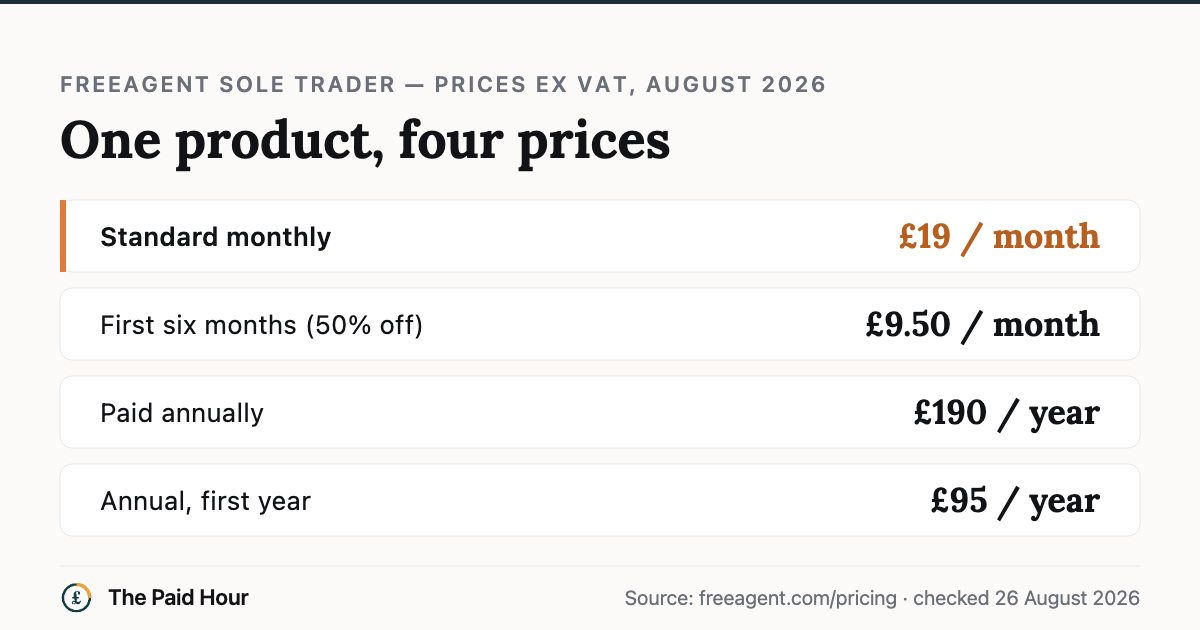
The Sole Trader plan is £19 a month excluding VAT, with 50% off the first six months: £9.50 a month while the discount runs. Paying annually, it’s £190 a year, £95 for the first year. That makes FreeAgent the priciest of the big three sole trader plans at full rate, which is exactly why the banking route matters: the same product is either the most expensive option on the shelf or the only free one, depending on where you bank.
If you stop qualifying
Close the qualifying account, or let it go silent, and the free access ends with it; carrying on means the standard subscription at the standard price. Nothing dramatic happens to your data: it’s the same product, so your books, invoices and history stay where they are and you simply start paying for the seat. But it’s worth pricing that scenario before you build your whole admin stack on the freebie: switching banks later quietly adds £228 a year to the decision, which is the kind of exit cost that never appears on a comparison table.
Is it worth paying for without the free route?
At £19 it needs to out-earn a £10–£18 rival, and the honest answer is: for some people it does. The feature that carries it is the running Self Assessment estimate, watching the January number build all year instead of meeting it in one go, plus MTD quarterly filing built in. If those two are why you’re buying software at all, FreeAgent competes even at full price; the head-to-head with its closest rival is in FreeAgent vs Xero for sole traders, and the wider field in the best accounting software comparison.
The cleanest decision path: already banking with NatWest, RBS, Ulster or Mettle, use FreeAgent, the price argument is over. Banking elsewhere and happy. Compare on features at full price instead of the intro rate. Thinking of moving banks partly for the freebie, what a business account move involves is its own question, and £228 a year of software is a real but rarely decisive reason to switch.
Disclosure. These run through a /go/ address and carry a sponsored tag. Neither pays us anything today — we have no relationship with Mettle, and FreeAgent’s referral scheme pays account credit to its own paying subscribers, not to us. The free route leads because it costs the reader nothing. If that changes, how we make money says so on the day. Full disclosure.
Mettle
A free business account that unlocks the full FreeAgent product for as long as you keep it open. This is the cheapest way in.
Visit MettleFreeAgent
£19 a month at full price. Worth it if the running Self Assessment estimate and built-in MTD filing are why you are buying software at all.
Visit FreeAgentFor the full picture of what you get once you are paying, and whether it is worth £19 a month against the free-with-Mettle route, read our FreeAgent review.
MTD quarters coming and the books are a shoebox?
Digital Bookkeeping System (MTD-ready) 2026/27. Seven modules and a seven-sheet toolkit, built around a category-to-tax-box mapping table that makes your quarterly updates fill themselves.
- A software decision sheet costed over three years, split by turnover, VAT status and phone-or-desktop
- The chart of categories mapped to the Self Assessment and MTD boxes, and the three categories never to auto-categorise
- Weekly and month-end cards, an MTD quarter-close checklist, and an export-and-archive index so their cloud is never your only copy
Software is priced monthly, excluding VAT, and you will hold the subscription for years. Pick on the wrong number and the difference over three years is more than every course on this site combined.
Buying more than one? All ten 2026/27 courses for £107, against £328 at full price.
Sources
The free-with-banking terms (NatWest, RBS, Ulster Bank or Mettle; at least one transaction a month; for as long as you retain the account), the £19/£9.50 monthly and £190/£95 annual prices were checked on FreeAgent’s own pricing page on 26 August 2026. Prices are the provider’s own and change, check before you rely on them. General information, not financial advice; no affiliate links on this page.