

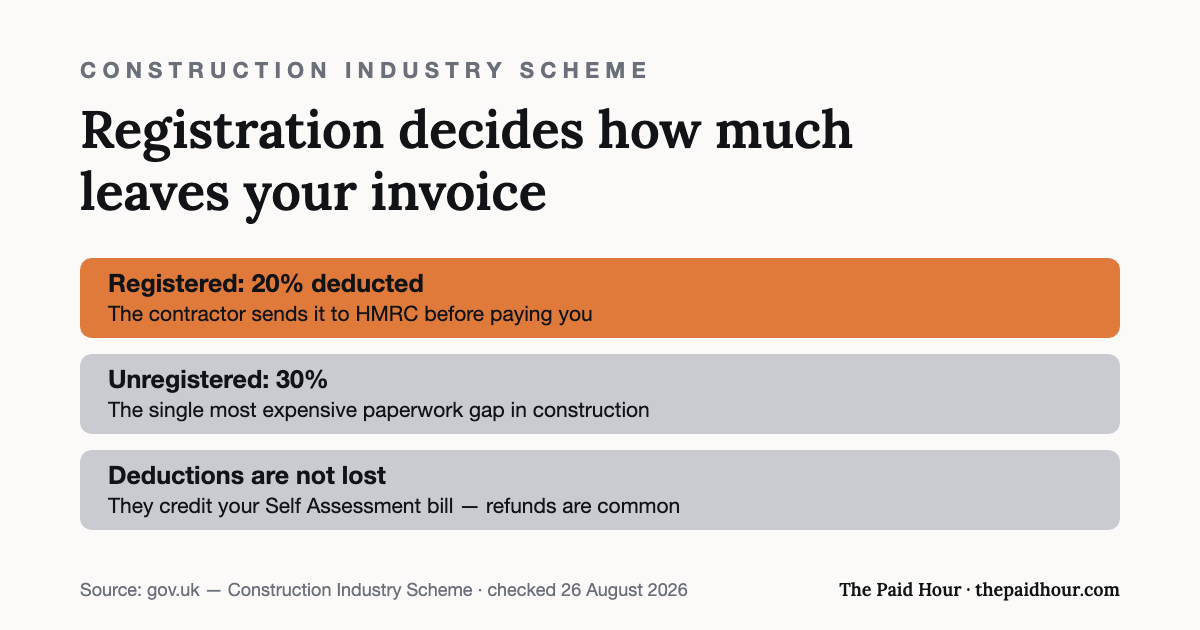
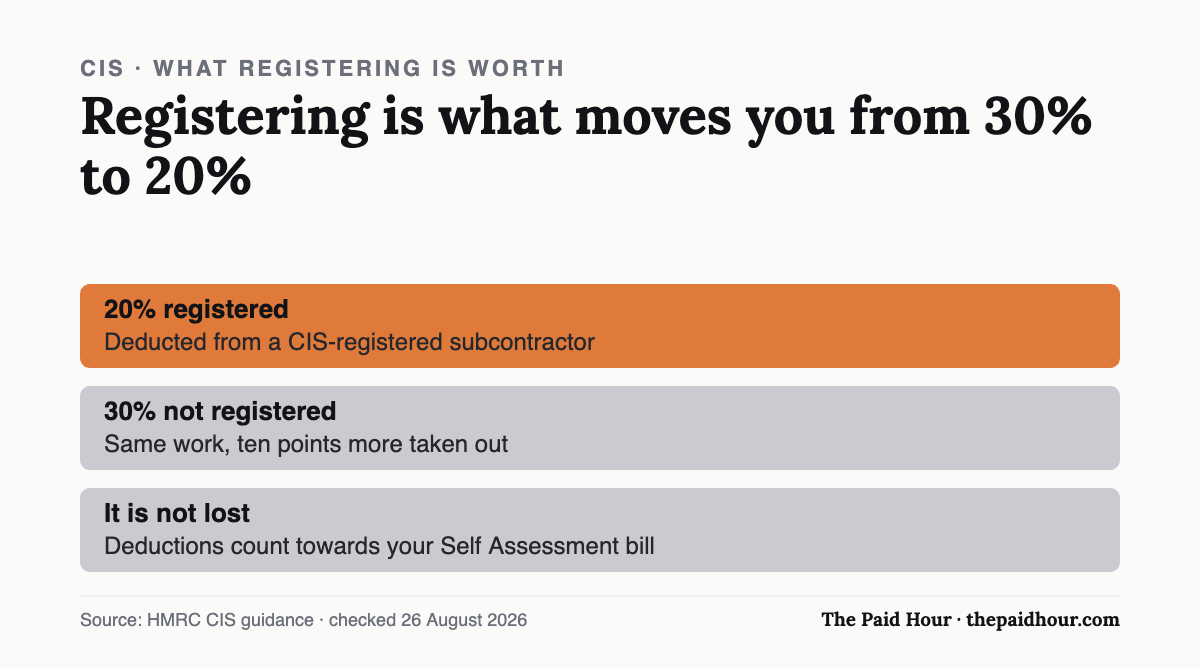
In short: Under CIS, contractors deduct tax from a subcontractor’s pay before it arrives: 20% if you are registered, 30% if you are not. The deductions count towards your Self Assessment bill, and many subcontractors end the year with a refund. Registering is what moves you from 30% to 20%.
A subcontractor on a building site gets paid 20% less than the invoice they sent. Nobody stole anything, that’s the Construction Industry Scheme doing exactly what it’s designed to do, and if you’re new to construction work in the UK, it catches most people off guard the first time it happens.
What the Construction Industry Scheme is
The Construction Industry Scheme is HMRC’s way of collecting tax from the construction trade before it has the chance to go missing. Instead of paying a subcontractor the full invoice amount, a contractor deducts a percentage and sends it straight to HMRC. That deduction counts as an advance payment toward the subcontractor’s own tax and National Insurance bill, it’s not an extra tax on top, it’s tax paid early. Most freelancers only meet the Construction Industry Scheme through work like this, so it helps to know the rules before the first deduction lands.
It applies to almost anything you’d recognise as building work: site preparation, demolition, general construction, alterations, repairs, and installing systems like heating or lighting. It does not apply to architecture, surveying, scaffolding hire on its own, or just delivering materials, those sit outside the scheme entirely.
Who has to register for the Construction Industry Scheme
Contractors must register if they pay subcontractors for construction work. That includes businesses outside construction too, if a non-construction business spends more than £3 million on construction within 12 months of its first payment, it’s treated as a contractor under CIS and has to register. Getting this Construction Industry Scheme registration right from day one saves a lot of admin later.
For subcontractors, registration is technically optional. In practice it isn’t much of a choice. Register, and 20% comes off your payments. Skip it, and contractors are required to deduct 30% instead, a full ten percentage points more of your cash flow gone before you’ve even invoiced for materials. That deducted amount still counts toward your Self Assessment bill at year end, if you’re also budgeting for payments on account, plan for both together so neither catches you short.
The deduction rates, plainly
- 30%: you’re not registered with HMRC for CIS
- 20%: you’re registered as a subcontractor
- 0%: you hold gross payment status
Whatever gets deducted isn’t gone. It’s sitting with HMRC against your eventual tax bill, and you claim it back (or offset it) through your Self Assessment or, for limited companies, through your PAYE scheme. The annoying part is the cash flow gap in between: that 20% or 30% disappears the moment you’re paid, months before your tax return settles the account.
Gross payment status: skipping the deduction altogether
If your business can absorb the admin, gross payment status is worth chasing. Contractors pay you in full, no deduction, and you settle everything through your own tax return instead. HMRC checks you against three tests before granting it:
- Business test: you run genuine UK construction operations (or provide labour for it) through a business bank account.
- Turnover test: your net construction turnover over the last 12 months, excluding VAT and materials, needs to clear roughly £30,000 for a sole trader, or £30,000 per partner/director (alternatively £100,000 combined) for a partnership or company.
- Compliance test (your tax affairs have to be up to date: PAYE, Self Assessment or Corporation Tax, and), since April 2024 — VAT returns and payments too. This one got noticeably stricter; a late VAT return can now cost you gross status where it wouldn’t have a couple of years ago.
Worth checking the current turnover thresholds directly with HMRC or your accountant before you apply, these figures are the standard ones but scheme rules do get revised, and getting it wrong wastes an application.
How to register for the Construction Industry Scheme
You’ll need to be registered as self-employed with HMRC first. CIS registration sits on top of that, it doesn’t replace it. From there:
- Register as self-employed with HMRC if you haven’t already.
- Register for CIS through your Government Gateway account, or by phone with HMRC’s CIS helpline.
- Apply for gross payment status at the same time if you think you’ll meet the tests, there’s no need to register twice.
- Give contractors your Unique Taxpayer Reference (UTR) so they can verify your status before the first payment.
Limited company subcontractors register slightly differently, through the company’s own CIS registration, and partnerships need each partner registered individually as well as the partnership itself. If that’s you, it’s worth twenty minutes with an accountant rather than guessing at the forms.
What contractors have to do too
If you take on subcontractors yourself, the paperwork runs the other way. You verify each subcontractor’s status with HMRC before paying them, deduct the right amount, give them a payment and deduction statement, and file a monthly CIS return, even in a month you didn’t pay anyone, you still need to tell HMRC nothing was due, or the penalties start stacking regardless.
One thing that causes the most mistakes on both sides: CIS deductions and VAT are separate systems that now interact. If you’re VAT-registered and working under the VAT domestic reverse charge for construction, the CIS deduction is calculated on the amount before VAT: get the order of operations wrong and your invoice math won’t match what actually lands in the bank.
Source: GOV.UK, Construction Industry Scheme (CIS).
What does a £30,000 hire really cost?
First Hire & Subcontracting 2026/27. Nine modules and five working sheets covering subcontractor, employee or agency on one table, the contract chain, status evidence, CIS, and the true cost of employee number one.
- The full cost-of-hire calculator: employer NI, pension, holiday, equipment and your own time, line by line
- A subcontractor status evidence file, so the arrangement survives an HMRC challenge
- The CIS monthly cycle, a new-starter checklist, and the fork decision sheet
Disguised-employment risk runs both ways: at you from your client, and at you from the person you engage. The paperwork is cheaper than the argument.
Buying more than one? All ten 2026/27 courses for £107, against £328 at full price.
Sources
The 20%/30% deduction rates and the verification requirements were re-checked against gov.uk on 26 August 2026. This is general information about how the rules work, not tax advice. The links above go to the primary sources; for your own circumstances, speak to an accountant or contact HMRC directly.