
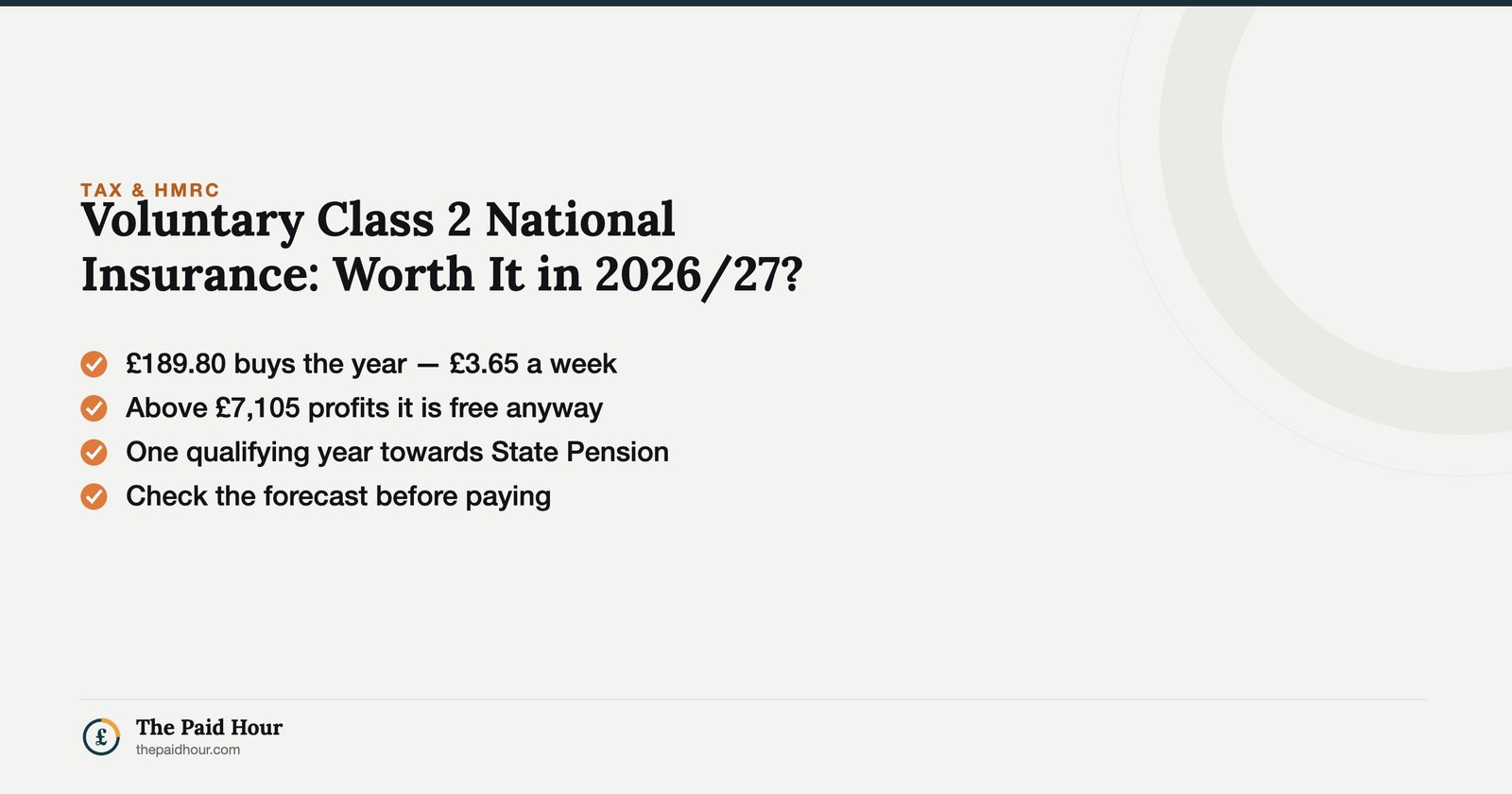
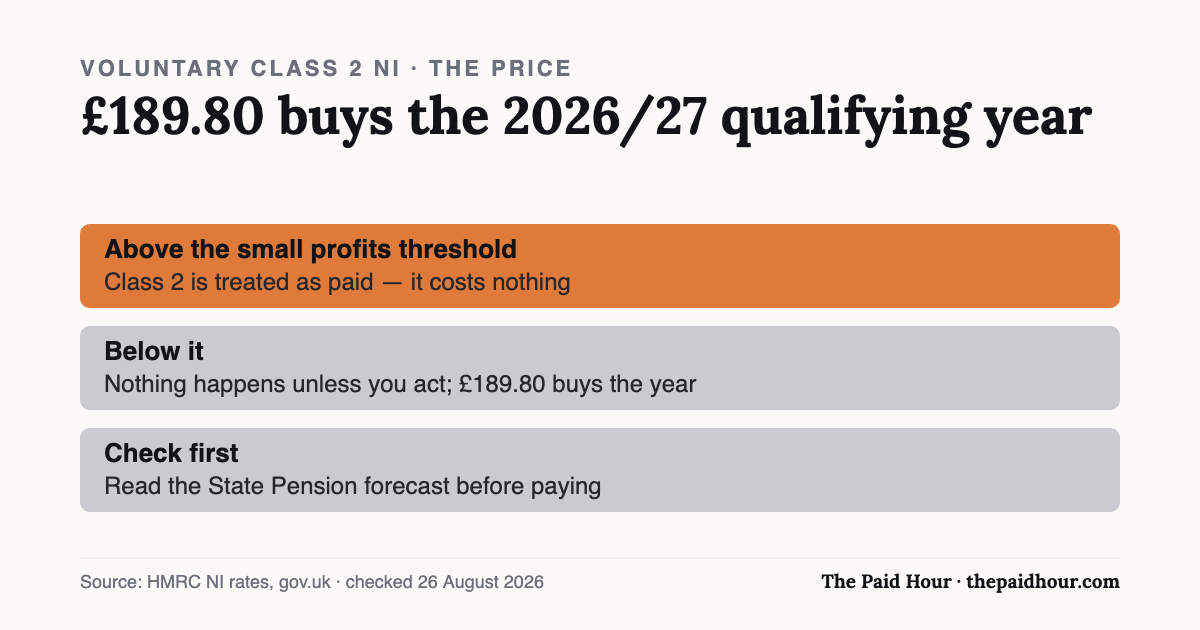
Straight answer: Profits above the small profits threshold and Class 2 is treated as paid, free. Below it, nothing happens unless you act: £189.80 buys the 2026/27 year voluntarily, and a qualifying year towards the State Pension. Whether that is worth it depends on your record, so check the forecast first.
Table of Contents
£189.80 a year. That’s the full cost of voluntary Class 2 National Insurance in 2026/27, and if your profits dipped below the small profits threshold this year, it might be one of the cheapest things you can buy from HMRC.
Since April 2024, Class 2 stopped being compulsory for most self-employed people. If your profits sit above a set threshold, HMRC treats Class 2 as paid automatically, you get the National Insurance credit without handing over a penny. Fall below that threshold, though, and nothing happens on its own. You get nothing unless you ask for it. That gap, and whether voluntary Class 2 National Insurance is worth paying to close it, is what this post is about.
What changed in April 2024
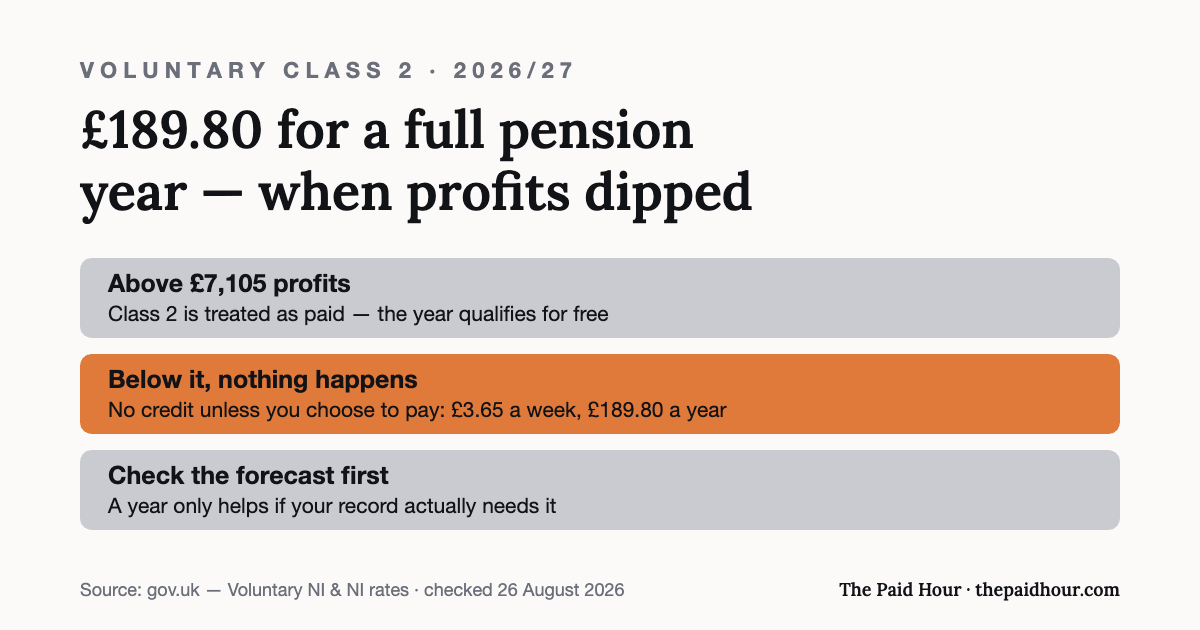
Before the change, most self-employed people with profits above the small profits threshold simply paid Class 2 alongside Class 4. That requirement was scrapped. Now, in 2026/27, if your profits are £7,105 or more, Class 2 is treated as having been paid. Your National Insurance record gets the credit for free, and you don’t pay anything for it.
Below £7,105, there’s no obligation at all. You can leave it. Plenty of people do, without realising what they’ve left on the table. But you can also choose to pay voluntary Class 2 National Insurance, at the same low rate as everyone else, purely to protect your record.
Who this actually applies to
This isn’t a decision most self-employed people need to make, only those with profits under £7,105 in a given tax year. In practice that’s a fairly specific group:
- Sole traders in their first year, when income is still ramping up
- Anyone who had a slow year: lost a client, illness, a project fell through
- People running self-employment as a side activity alongside part-time or full-time employment
- Freelancers who worked only part of the tax year, or scaled back deliberately
If your profits are consistently above £7,105, this whole question doesn’t apply to you, you’re already covered for free. Check that before you do anything else, because there’s no point reading the rest of this if voluntary Class 2 National Insurance was never going to be relevant to your situation.
How much voluntary Class 2 National Insurance costs in 2026/27
The rate is £3.65 a week for 2026/27, which works out to £189.80 for a full tax year (52 weeks). That’s the figure straight from gov.uk’s rates page, and it’s the same flat rate whether your profits were £500 or £7,000: Class 2 doesn’t scale with income the way Class 4 does.
Class 2 vs Class 3, and why Class 2 is so much cheaper
If you’ve looked into filling National Insurance gaps before, you’ve probably seen Class 3 mentioned too. It does a similar job — buying a qualifying year, but at a much higher price than voluntary Class 2 National Insurance.
| Contribution class | Weekly rate (2026/27) | Cost for a full year |
|---|---|---|
| Class 2 (voluntary, self-employed) | £3.65 | £189.80 |
| Class 3 (voluntary, general) | £18.40 | £956.80 |
That’s roughly five times the price for the same qualifying year. The reason isn’t arbitrary. Class 2 was built specifically for people HMRC already recognises as self-employed and economically active, you’re registered, you’re filing, you’re plainly working, so the rate stays low. Class 3 is the general-purpose gap-filler, aimed at people with no such link to work in that year at all: someone who took extended time abroad, or wasn’t working or claiming credits for another reason. There’s no self-employment discount built into it, so it’s priced much closer to what a qualifying year would otherwise cost the system.
If you have a choice between the two for the same gap year, and as a self-employed person under the threshold, you usually do. Voluntary Class 2 National Insurance is almost always the one to use. And if your Class 4 questions run deeper than this, our Class 2 vs Class 4 National Insurance guide covers how the two classes interact once your profits climb.
What a qualifying year protects
The headline benefit is the State Pension. You need 10 qualifying years on your National Insurance record to get any new State Pension at all, and 35 qualifying years to get the full rate: currently £241.30 a week. Each qualifying year is worth roughly a 35th of that full amount. Paid over a typical retirement, one £189.80 year can end up returning several times its cost, which is the main reason voluntary Class 2 National Insurance gets called cheap insurance rather than just a tax payment. If you’re building retirement income beyond the State Pension too, our guide to setting up a pension when self-employed covers that side of it.
It’s not only the pension, either. Maternity Allowance is a good example most freelancers never connect to this. For 2026/27, the standard rate is up to £194.32 a week, but if your National Insurance contributions in the relevant period weren’t enough, you drop to the lower rate of £27 a week for 39 weeks instead. That’s a real difference, and it’s directly tied to whether contributions like Class 2 were paid.
One honest caveat: paying voluntary contributions doesn’t automatically increase your pension for everyone. If you already have 35 qualifying years, or your record includes contracted-out periods that change the maths, an extra year might add nothing. This is exactly why the next step matters more than the payment itself.
Two examples that show why it depends on your record
Jamal is 27 and started freelancing eighteen months ago. His profits this year came in at £5,400, under the threshold, so this is his first genuine gap year. He has roughly 9 qualifying years on his record so far from earlier employment. For him, £189.80 to lock in year 10 is an easy call: it’s the difference between having any new State Pension entitlement at all and having none, and he’s got decades left to keep building toward the full 35.
Frances is 61, has worked continuously since her twenties, and already has 37 qualifying years showing on her record. She had one quiet year of self-employment this year while easing toward retirement. For her, an extra year of voluntary Class 2 National Insurance adds nothing to the State Pension, she’s already past the 35-year cap. Her forecast on gov.uk would show this clearly, which is exactly why checking first matters more for someone in Frances’s position than someone in Jamal’s.
How to check your record and actually pay
Don’t pay anything before you’ve looked. Sign in to check your National Insurance record on gov.uk: you’ll need a Government Gateway account, and photo ID if you haven’t verified before. It shows your contributions to date, any gap years, and whether paying voluntarily would change your State Pension forecast. That last part is the one people skip, and it’s the one that tells you whether voluntary Class 2 National Insurance is worth doing at all in your specific case.
If a gap is worth filling, you can normally pay for it going back up to six tax years, with a deadline of 5 April each year for the oldest year in that window. Worth flagging: the extended deadline that let people fill gaps all the way back to 2006 closed in April 2025, so the standard six-year rule is what applies now, don’t assume you’ve got longer than you do.
Once you know a year is worth buying, HMRC will confirm the exact amount owed and give you a payment reference through the same online service, and payment can usually be made by bank transfer or debit card. Keep the confirmation somewhere safe, records of voluntary payments are exactly the kind of thing worth having to hand if your pension forecast is ever queried years later.
Mistakes worth avoiding with voluntary Class 2 National Insurance
The most common one is paying before checking the forecast. It’s tempting to just pay the £189.80 because it’s cheap and feels like an obviously good idea, but if you’re in Frances’s position from the example above, that payment buys nothing. The forecast tool takes two minutes. Use it first, every time, no exceptions.
The second is mixing this up with Class 4. Class 4 is the profit-related National Insurance charge that self-employed people above a separate, higher threshold pay alongside Income Tax through Self Assessment, it isn’t voluntary, and paying voluntary Class 2 National Insurance has no effect on any Class 4 liability. They’re two completely different mechanisms that happen to share the same tax return.
The third is assuming the old rules still apply. Some older articles and forum threads still describe Class 2 as compulsory above the small profits threshold, because that was true before April 2024. If you’re reading advice that talks about “paying Class 2” as something everyone above the threshold must actively do, check the date on it, for most people above £7,105 in 2026/27, that credit now happens automatically, and there’s nothing to pay or arrange.
The fourth is missing the deadline. Because voluntary Class 2 National Insurance is cheap and easy to defer, it’s also easy to forget entirely, until the six-year window on a particular tax year quietly closes on 5 April and that year becomes permanently unbuyable. If a gap year shows up on your forecast, it’s worth actioning it that tax year rather than filing it away as “something to look at eventually.”
Is voluntary Class 2 National Insurance worth it for you
For a lot of low-profit sole traders, yes: £189.80 for a year that could be worth thousands over a full retirement is a good trade, and it’s one of the few places where “buy now, benefit later” holds up. But this depends on your own record: how many qualifying years you already have, what your State Pension forecast shows, and whether you’re likely to need contributory benefits like Maternity Allowance in the near future.
This isn’t personalised financial advice, it’s a description of how the mechanism works. Check your own forecast before paying, and if your situation is complicated (contracted-out years, gaps from time abroad, ill health), it’s worth a conversation with a pensions adviser or MoneyHelper’s free guidance service before you commit.
Either way, it costs nothing to check. The record’s already there. It’s just a question of whether you’re one of the people it’s quietly leaving £189.80 short, and whether that year of voluntary Class 2 National Insurance would actually move the needle on what you get back.
Related: checking your State Pension forecast: the forecast is what tells you whether buying a year back is worth anything.
The 5 April cut-off and the six-year window are listed with the rest of the year in the 2026/27 tax year calendar.
No employer, no sick pay, no pension. Built yours yet?
Pension & Safety Net for the Self-Employed 2026/27. Eight modules and four working sheets that turn “I should sort my pension out” into a plan you can finish in an afternoon, with the tax relief doing a third of the work.
- Your State Pension forecast, qualifying years, and when voluntary Class 2 is worth paying and when it buys nothing
- The Self Assessment step that recovers higher-rate relief, which most people never claim
- Sick pay, income protection and critical illness: what each actually pays, and the underwriting traps for the self-employed
There is no statutory sick pay for the self-employed at all. Higher-rate pension relief is not automatic either. Both are fixable in an afternoon, and both are still costing most freelancers money.
Buying more than one? All ten 2026/27 courses for £107, against £328 at full price.
Sources
The £3.65 weekly rate and the treated-as-paid rule were re-checked against gov.uk on 26 August 2026.
This is general information about how the rules work, not tax advice. The links above go to the primary sources; for your own circumstances, speak to an accountant or contact HMRC directly.