
The short version: A trading name gives you no ownership, a registered trade mark does. Registering costs at least £205, usually takes three to four months, lasts ten years at a time, and buys you the ® symbol plus the right to take legal action against anyone using your brand without permission. Worth it once the name has real value to lose; skippable while it’s still just a label.
Trademarking a business name as a sole trader is the step almost nobody takes on day one, correctly. But there’s a moment where it flips from overkill to overdue, and it usually arrives quietly: the name starts bringing clients in by itself. This guide covers what a trade mark protects, what the IPO will and won’t register, what it costs, and an honest answer on when a freelancer should bother.
What a trade mark protects, and a business name doesn’t
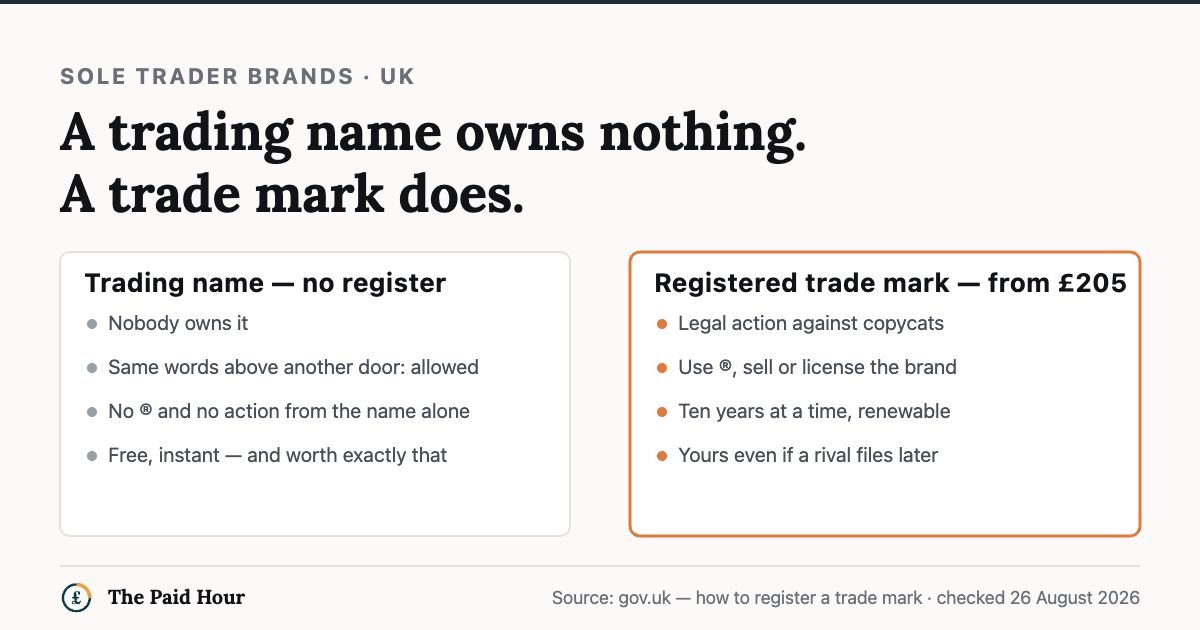
A sole trader’s trading name is not registered anywhere and nobody owns it, another business can put the same words above a different door, and the name itself gives you nothing to stop them with. That’s the deal explained in full in the business name rules guide, and it’s the gap a trade mark exists to close.
Register the name and the position reverses. Gov.uk puts the rights plainly: you can “take legal action against anyone who uses your brand without your permission”, put the ® symbol next to the name, and sell or license the brand as an asset. The mark can be a word, a logo, a sound, a colour, or a combination. For most freelancers it’s the name, sometimes the name plus the logo as a second application.
Which business name you can and can’t register
The IPO refuses more than people expect, and the refusals cluster in predictable places. A mark can’t simply describe what you sell, “Apple” fails for a fruit stall and works for computers, which is the whole doctrine in one example. It can’t be too common to distinguish anyone (“we lead the way”), misleading (“organic” on goods that aren’t), offensive, a generic shape tied to the trade, or borrow national flags and official emblems. And it can’t sit identical-or-confusingly-close to an existing mark in the same line of business, which is why the free trade mark search comes before everything else.
Descriptive is the one that catches freelancers. “Freelance Web Design” is a fine trading name and a hopeless trade mark, it describes the service and nothing else. The names that register are the ones that mean nothing until you make them mean something.
What it costs to trade mark a business name, and how long it takes
Registering starts at £205, and usually costs more depending on how many classes of goods and services you want the protection to cover: a designer protecting design services and an online course sits in more than one class, and each class widens the fee. With no objections it takes around three to four months from application to grant. Then it holds for ten years, and renews every ten years for as long as you keep paying, a £205 decision rather than a £205-a-year one.
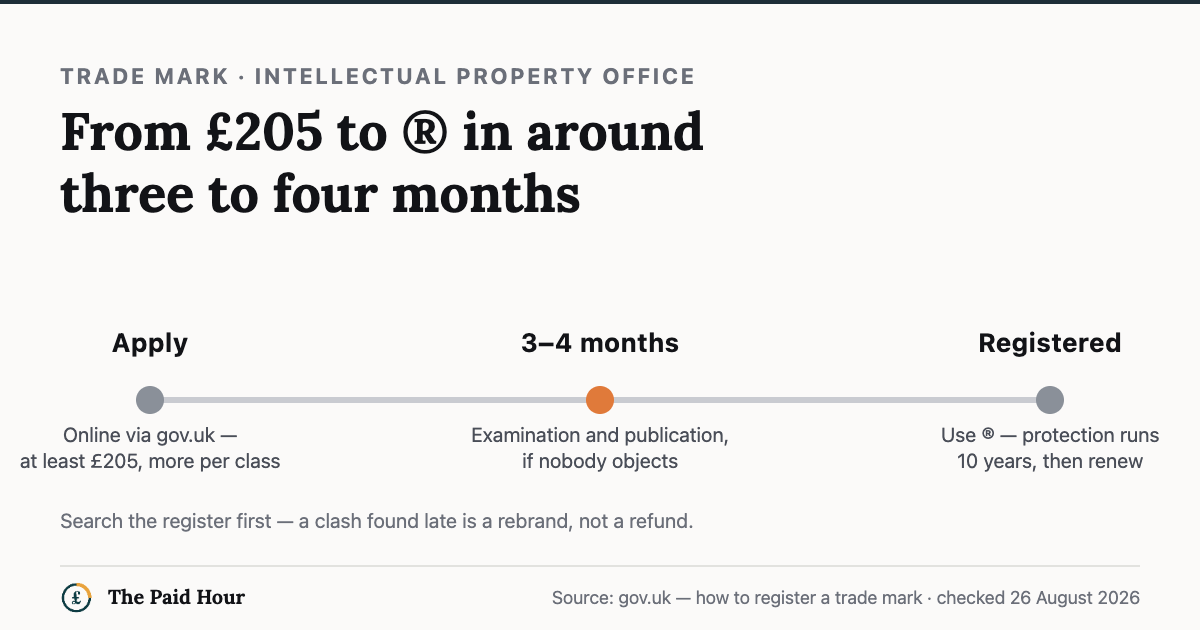
The two slow ways to make it expensive: apply for classes you don’t trade in, or skip the search and collide with an existing mark. Both are cheaper to avoid than to fix.
Is trade marking a business name worth it for a freelancer?
Mostly not on day one, and that’s not a hedge, it’s a sequencing point. While the name is a label on invoices, the realistic damage from a copycat is confusion rather than lost income, and £205-plus buys you protection for something that doesn’t yet have value to protect. The naming rules and a sensible search already keep you out of trouble at that stage.
The calculation flips when the name itself starts earning: clients find you by it, work arrives through word of mouth attached to it, you sell products or courses under it, or you’re building something you might one day sell. At that point the £205 is trivial against what a forced rebrand would cost — new domain, new signage, and the years of recognition that don’t transfer. If you’d wince at surrendering the name, that’s the signal it’s worth registering. It also stops mattering whether someone else registers it first, which is the quieter risk of waiting, because between two unregistered users, the one who files owns the future.
Before you apply for a business name trade mark
Three steps, in order. Search the register properly, the exact name, the obvious variants, and marks that look or sound close in your own line of work. Decide the classes: what you sell now plus what you will within a few years, not everything you can imagine. Then apply online through gov.uk. Complicated position, a crowded field, a mark someone might oppose, several classes across products and services, and a trade mark attorney earns their fee; a clean name in one class is a form most people can file themselves. This page explains the process instead of advising on your case, for a contested or valuable mark, take proper IP advice.
Is your name, your work and your downside actually covered?
Protect the Business: Legal, IP & Insurance 2026/27. Eight modules and five working sheets built around a complete annotated freelance contract, with a negotiation note under every clause.
- Registering a trade mark yourself: searching, classes, fees and the opposition period
- UK GDPR without a consultant: the ICO fee tiers, a privacy notice, and the 72-hour breach plan
- An insurance sizing calculator by work type, and the client clauses never to sign as they stand, with the redline for each
You own the copyright in what you make until you assign it in writing. Most clients assume the opposite, and most freelance contracts are silent on it.
Buying more than one? All ten 2026/27 courses for £107, against £328 at full price.
Sources
- How to register a trade mark: GOV.UK
- What you can register as a trade mark, GOV.UK
- Apply to register a trade mark. GOV.UK
- Search for a trade mark, GOV.UK
The £205 minimum fee, the 3–4 month timescale, the 10-year term and the registrability rules were checked against gov.uk on 26 August 2026. General information, not legal advice: for a mark with real value at stake, or one likely to be opposed, speak to a trade mark attorney.