
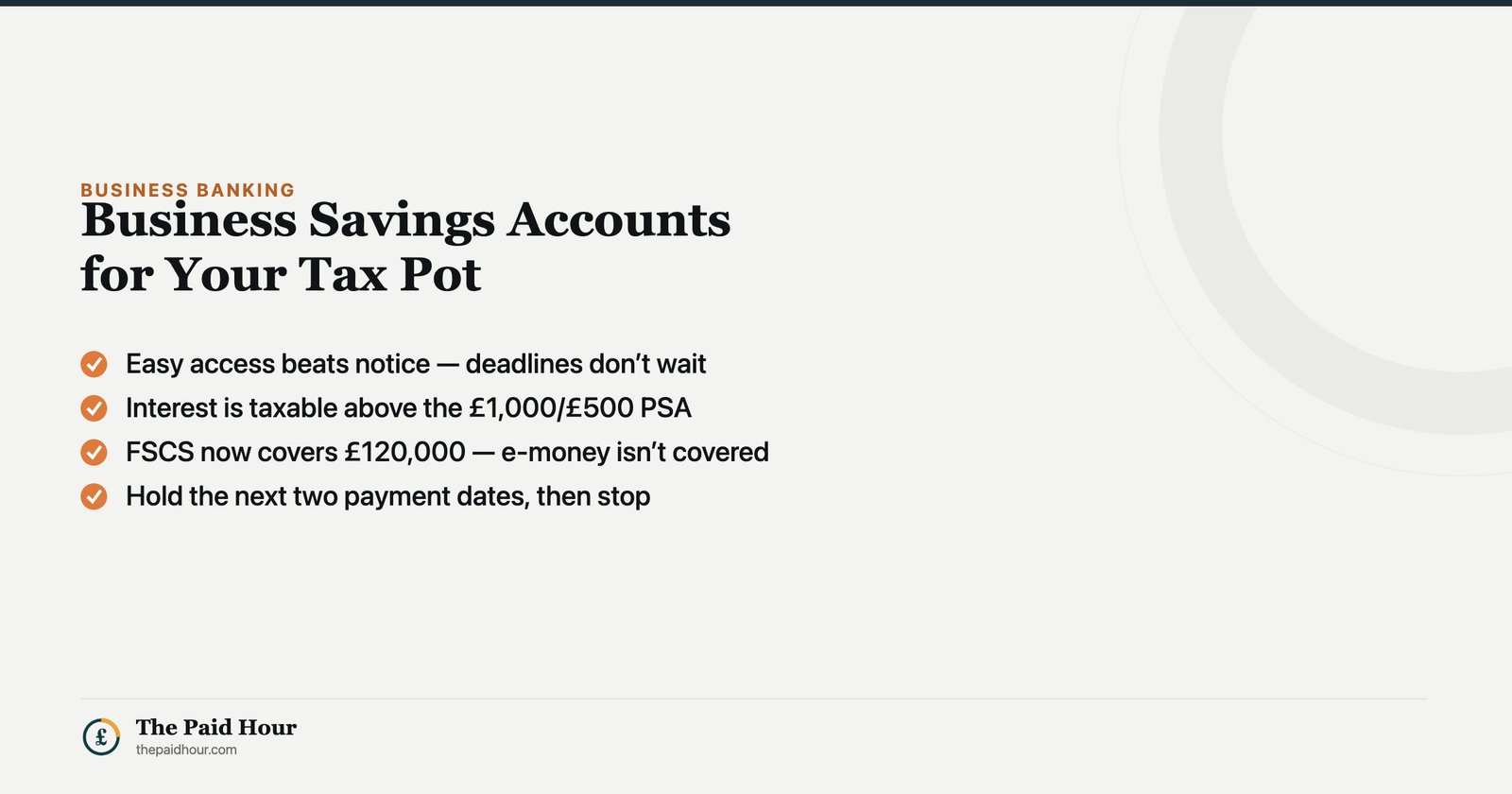
What matters here: The tax pot deserves its own home, an easy-access business savings account beats the current account it leaks from. Interest is taxable above the Personal Savings Allowance (£1,000 basic rate, £500 higher), FSCS protection now covers £120,000 per person per authorised firm (up from £85,000 on 1 December 2025), and e-money accounts carry no FSCS cover at all. Deadlines don’t wait out notice periods, access beats rate.
A business savings account is where the set-aside survives. The percentages are worked out in how much to save for tax, this page is about where that money sits for the months between invoice and January, and the three things that decide it: access, protection, and what the interest does to your tax return.
Why the tax pot gets its own business savings account
Money in the current account looks spendable, and eventually gets spent, that’s the whole failure mode. A separate account puts one honest number between you and January: what’s in the pot. It also earns something while it waits, which the current account almost never does. The habit side (moving a percentage across the day each invoice is paid, topping up after good months), is covered in budgeting on an irregular income; the account is just the container that makes the habit stick.
Does it have to be a business savings account? Legally, no: the tax pot is simply your money, and a personal savings account can hold it. The tidier version pairs a business savings pot with the business current account, so money moves in one straight, explainable line from invoice to HMRC. Pick whichever keeps your records honest; the separation is the point rather than the label.
Easy access or notice: which business savings account
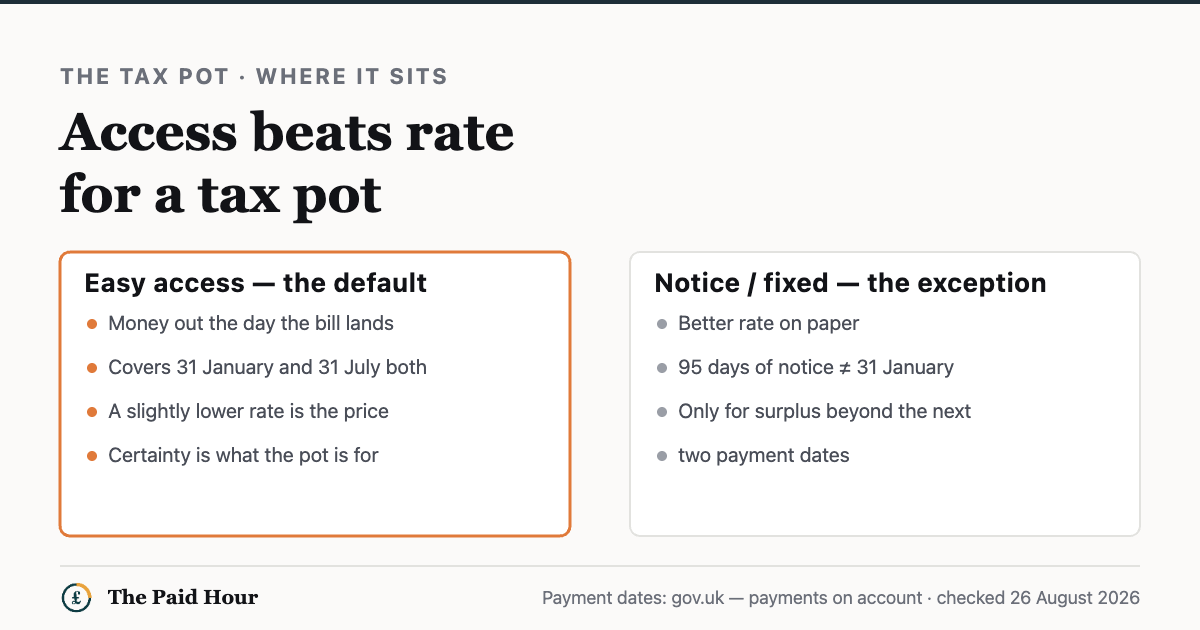
Notice accounts and fixed terms usually pay more, and for a tax pot they’re usually the wrong answer anyway. HMRC’s deadlines don’t move for a 95-day notice period, and payments on account mean money leaves in January and July, twice a year, on dates you don’t control. Easy access costs a slice of interest and removes the one risk that matters: the money being locked when the bill lands. If the pot grows well beyond the next two payments, the surplus above them is the only part worth putting behind a notice period.
Business savings interest is income — the PSA decides how much stays yours
Interest on the pot is taxable income, with the Personal Savings Allowance absorbing the first £1,000 for basic-rate taxpayers and £500 at higher rate. On a five-figure tax pot at ordinary rates, most sole traders stay inside the allowance, but it’s worth knowing the interest lands on the same Self Assessment return you’re saving for, not in a separate tax-free world. A pound of interest is still better than no interest; it just isn’t a whole pound.
FSCS: the £120,000 question
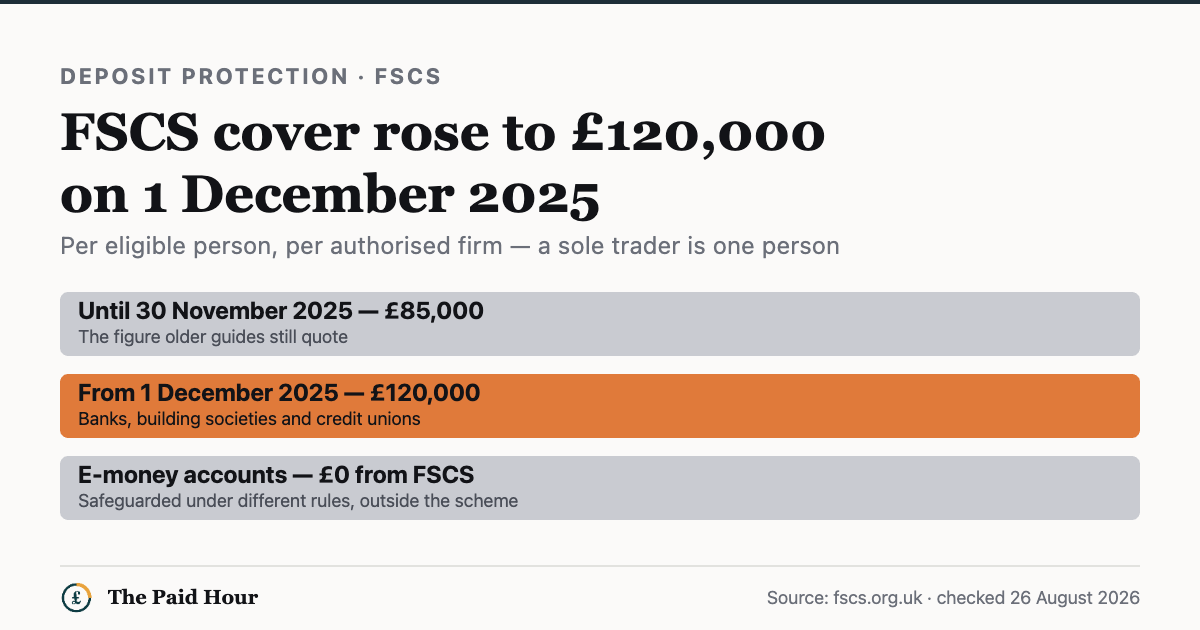
If the institution holding the pot fails, the Financial Services Compensation Scheme is what stands behind the money, and the limit rose on 1 December 2025: FSCS now covers up to £120,000 per eligible person, per authorised firm, up from the £85,000 figure most older guides still quote. Two working rules follow.
First, the limit is per authorised firm rather than per account — a current account and a savings account at the same bank share one £120,000 ceiling, and so do brands that sit under one banking licence. Second, the protection belongs to banks: e-money accounts are a different animal, safeguarded, not FSCS-protected, so a tax pot held in an e-money product is outside the scheme entirely. The full mechanics are in FSCS protection on business accounts.
One sole-trader wrinkle follows straight from the “per eligible person” wording: you and the business are the same person. A personal savings account and a business savings account at the same bank aren’t two protections, they count together toward one £120,000. If the tax pot, the emergency fund and the current account all sit under one licence and the total is drifting toward the limit, spreading across two banks is the fix.
A system that survives a busy year
How much should be in there? Enough to cover the next two payment dates in full, the January figure (which includes the first payment on account) and July’s second instalment. Once the pot holds both, it’s doing its whole job; beyond that you’re saving, not provisioning. The percentages that get you there are in the set-aside guide above.
The version that holds up in practice is small: an easy-access savings account at a real bank, fed by a fixed percentage the day each invoice is paid, checked once a month against profit so far, and never borrowed from without writing the IOU down. VAT-registered? That money was never yours, it gets a second pot of its own, separate from the income-tax one. And the two dates that empty the pot (31 January and 31 July), are worth putting in the calendar the day you open the account, because the account exists for them.
No provider is named or recommended here. Rates move weekly, and the right pick depends on where your business banking already sits: compare live rates when you open one, and check the FSCS position of the actual licence holder while you’re at it.
Want to pay yourself a salary from irregular income?
Freelancer Money System 2026/27. Seven modules and five working sheets that pay you a predictable monthly amount out of unpredictable income: the account structure, the percentages, and where every pot should sit.
- A salary set from your trailing twelve-month low, not the average, with the calculator that finds it
- The day-it-lands allocation split, so tax and costs are moved before you can spend them
- The written drought plan for a bad quarter, the FSCS licence checker, and the surplus waterfall for a good year
Normal budgeting assumes a payday. Freelance income does not have one. The fix is not discipline, it is structure, and structure is a one-afternoon job.
Buying more than one? All ten 2026/27 courses for £107, against £328 at full price.
Sources
- FSCS deposit limit increase to £120,000, FSCS
- Tax-free savings interest: Personal Savings Allowance. GOV.UK
- Understand your Self Assessment bill: payments on account, GOV.UK
The £120,000 FSCS limit (effective 1 December 2025), the £1,000/£500 Personal Savings Allowance and the payments on account dates were checked against the linked pages on 26 August 2026. General information, not financial advice, no savings account or provider is recommended here.