
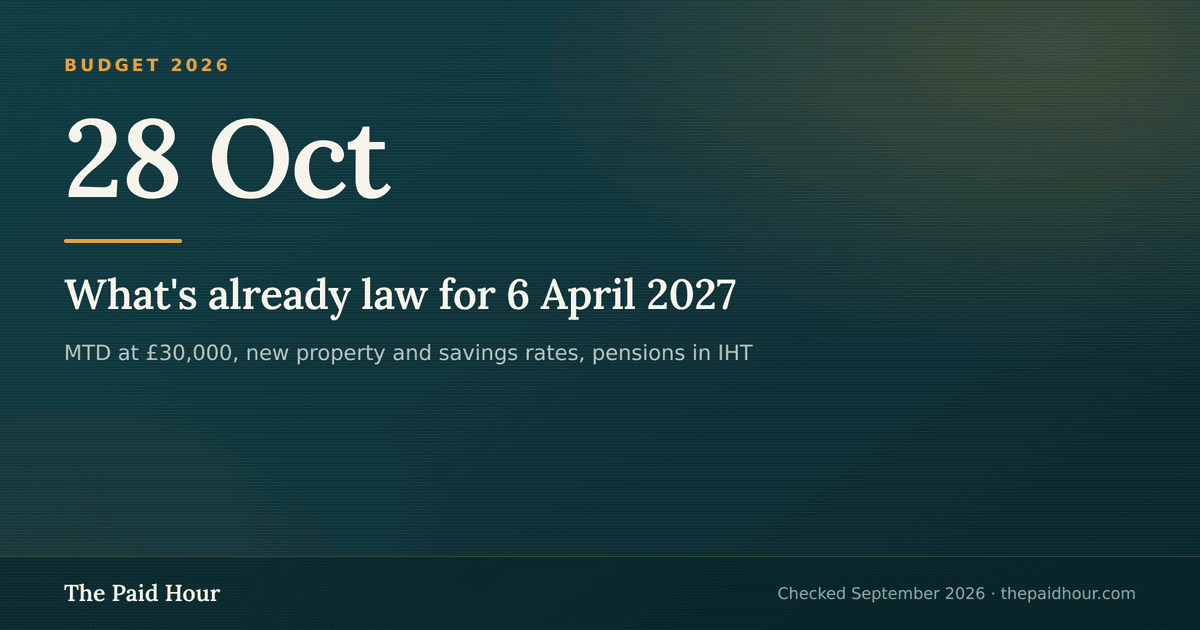
WHAT MATTERS HERE: The autumn Budget is Wednesday 28 October 2026, confirmed in the Chancellor’s letter to the Treasury Select Committee published on GOV.UK on 31 July 2026. Four changes are already law for 6 April 2027: Making Tax Digital at £30,000 qualifying income, property income taxed at 22%, 42% and 47%, the same new rates on savings income, and unused pension funds inside inheritance tax. Checked 11 September 2026.
Search “autumn budget 2026 self employed” today and most of what comes back is guesswork dressed up as reporting. That is the trap. There is a real list of measures already law for 6 April 2027, signed off and published, and you can plan against it with no risk. The rest is opinion about 28 October. This piece keeps the two piles apart and labels every item.
The date, and where it is confirmed
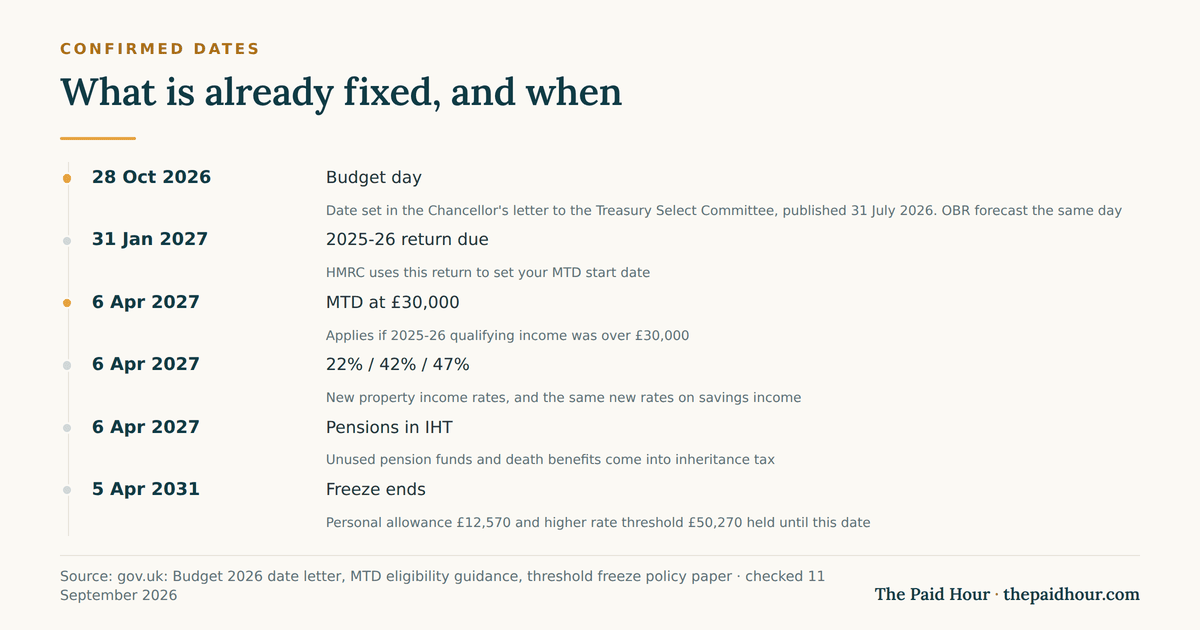
CONFIRMED. The Budget is Wednesday 28 October 2026. The Chancellor, Rt Hon John Healey MP, set the date in a letter to the Treasury Select Committee published on GOV.UK on 31 July 2026, which also asks the Office for Budget Responsibility to publish its forecast the same day. Anything giving a different date is out of date.
Documents land on GOV.UK the same afternoon. Open the Overview of Tax Legislation and Rates, which lists every measure and its start date in one table. Dry, and far faster than the coverage.
Already law for 6 April 2027
Four things are locked in. Making Tax Digital for Income Tax reaches you from 6 April 2027 if your qualifying income was over £30,000 in the 2025 to 2026 tax year. Qualifying income is gross turnover plus gross property income, before expenses, so a sole trader billing £32,000 and spending £9,000 is in scope on £32,000, not £23,000. HMRC works that out from the return due 31 January 2027.
Property income gets its own rates from 6 April 2027: 22% basic, 42% higher, 47% additional. Savings income rises to the same rates that day. Unused pension funds and death benefits come into inheritance tax on 6 April 2027 too. All three were announced at Budget 2025 and sit on GOV.UK now.
The freeze is the quiet one. The personal allowance stays at £12,570 and the higher rate threshold at £50,270 until 5 April 2031, along with the Class 4 lower and upper profits limits sitting on the same numbers. Announced 26 November 2025. I re-read the policy paper on 11 September 2026 to check the end date had not moved.
Already law for 6 April 2027 vs what the Budget could still change
| Item | Status for 6 April 2027 | Could 28 October change it? |
|---|---|---|
| MTD for Income Tax, £30,000 threshold | CONFIRMED. Applies if 2025-26 qualifying income exceeded £30,000 (GOV.UK eligibility guidance) | No change announced. A delay or a new threshold would have to be said on the day |
| Personal allowance £12,570, higher rate threshold £50,270 | CONFIRMED frozen to 5 April 2031 (policy paper, 26 November 2025) | Frozen by legislation, so it can be amended. Nothing announced |
| Class 4 NI 6% and 2% | CONFIRMED for 2026-27: 6% on £12,570 to £50,270, 2% above. NOT CONFIRMED for 2027-28 | Rates are set year by year, a live Budget item |
| Class 2 voluntary £3.65 a week | CONFIRMED for 2026-27, with the small profits threshold at £7,105. NOT CONFIRMED for 2027-28 | As Class 4. The weekly rate is set in the Budget documents |
| £1,000 trading allowance | CONFIRMED at £1,000. No change announced for 2027-28 | Unchanged since 6 April 2017. Nothing announced |
| Property income rates 22%, 42%, 47% | CONFIRMED from 6 April 2027 (Budget 2025 measure) | Already legislated. A reversal would need a new announcement |
| Savings income rates 22%, 42%, 47% | CONFIRMED from 6 April 2027 | As above |
| Unused pension funds in inheritance tax | CONFIRMED from 6 April 2027. HMRC consulted on liability, reporting and payment | Implementation detail is still moving, not the start date |
Why timing a purchase around Budget day rarely pays
Every October someone tells you to buy the laptop before the Budget. Check the logic. Measures from an autumn Budget almost always start the following 6 April, so a purchase on 27 October and the same one on 4 November sit in the same tax year.
Take Priya, a freelance designer with £46,000 of profit and a 5 April year end, on the cash basis. She wants a £1,400 laptop used only for work. On the cash basis the full £1,400 comes off profit in the year she pays for it. Her profit sits inside the basic rate band, so the saving is 20% income tax plus 6% Class 4: £1,400 × 0.26 = £364.
Buy it on 27 October 2026, she saves £364 in 2026-27. Buy it on 4 November 2026, she saves £364 in 2026-27. Identical. Both go on the return due 31 January 2028. The only date that changes the answer is 5 April: buy on 10 April 2027 instead and the same £364 lands a full year later, on the bill due 31 January 2029. Run your own figures through the UK tax calculator.
Pensions behave the same way. A £2,000 net contribution becomes £2,500 gross once the provider adds basic rate relief, and 20 October or 20 November 2026 both land in 2026-27. Our guide to self-employed pension tax relief covers the higher rate claim.
There are real exceptions. Duty rates on fuel and alcohol often change from Budget day itself. Capital gains tax did the same once: HMRC published guidance on working out an adjustment for disposals made on or after 30 October 2024, because the rates moved mid tax year. So if you are part way through selling an asset, timing can matter. For a laptop, it does not.
What to do before 28 October
None of this is about second guessing the Budget. It is about being able to work out your answer quickly on the day.
- Add up your 2025-26 gross turnover plus gross property income. Over £30,000 and MTD starts on 6 April 2027, whatever happens on 28 October.
- File the 2025-26 return early. HMRC reads it to set your MTD start date, and a late one leaves you guessing.
- Check your Class 2 and Class 4 position, especially if profits sit near the £7,105 small profits threshold.
- With rental income alongside self-employment, price the 22% property rate into your 2027-28 forecast.
- Diarise 28 October, with a second entry for the Overview of Tax Legislation and Rates.
- Leave planned spending where it is, unless the arithmetic above says otherwise.
If expense decisions are the part you keep second guessing, the HMRC tax and expense course walks through the rules HMRC actually applies.
What readers ask
When is the autumn Budget 2026?
Wednesday 28 October 2026, confirmed in the Chancellor’s letter to the Treasury Select Committee published on GOV.UK on 31 July 2026, with the OBR forecast due the same day.
Will the Budget change the £1,000 trading allowance?
Nothing has been announced. It has been £1,000 since 6 April 2017 and GOV.UK shows no planned change. Any move would come on 28 October and normally start on 6 April 2027 at the earliest.
Does Making Tax Digital still start in April 2027 for £30,000 earners?
Yes. GOV.UK guidance still says qualifying income above £30,000 in 2025-26 puts you into MTD from 6 April 2027. The first quarterly update falls due 7 August after the tax year starts.
Where this leaves you
- Plan against the confirmed list above. It will not move before 28 October.
- Treat every “expected” or “set to” headline as unconfirmed until GOV.UK says otherwise.
- Read the 2025 Budget changes for the self-employed to see what reached sole traders last time.
- Get your records into a shape MTD can read. Quarterly deadlines do not wait for a Budget.
- Come back on 28 October. This page gets rewritten with what was actually announced.
Sources
- GOV.UK: Chancellor letter to the Treasury Select Committee (TSC) – Budget 2026 date
- GOV.UK: Check if you’re eligible for Making Tax Digital for Income Tax
- GOV.UK: Maintaining Income Tax and equivalent National Insurance contributions thresholds until 5 April 2031
- GOV.UK: Income Tax – Changes to tax rates for property, savings and dividend income
- GOV.UK: Inheritance Tax – unused pension funds and death benefits
- GOV.UK: Self-employed National Insurance rates
- GOV.UK: Tax-free allowances on property and trading income
- GOV.UK: Budget 2025 – Overview of tax legislation and rates (OOTLAR)
- GOV.UK: Work out your Capital Gains Tax adjustment for the 2024 to 2025 tax year
- GOV.UK: Deadline approaches for first Making Tax Digital quarterly update
Figures checked against GOV.UK and HM Treasury pages on 11 September 2026. This is general information, not financial or tax advice.
Filing it yourself this year?
HMRC Tax & Expense Mastery 2026/27. Nine modules and eleven working templates that take a UK freelancer from “do I even need to register” to a correct return, with MTD quarters built in.
- Fifteen expense categories, with the trap inside each one (training, clothing, meals, the seven-year pre-trading rule)
- Home and vehicle: flat rate against actual cost, with the £312 break-even worked out and the mileage lock-in rule
- The year-one payments-on-account cash shock, and the routine that stops it landing twice
HMRC does not send a list of what you forgot to claim. Most freelancers leave several hundred pounds of legitimate expenses on the table every single year, and the return still gets filed.
Buying more than one? The Complete Freelancer System, all five for £87, against £215 at full price.
Read next
- MTD for Income Tax: What Changes for Sole Traders
- Autumn Budget 2025 Self-Employed: What Actually Changed