
Straight answer: Yes, you can sell a sole trader business. You are not selling a company, though. You are selling what the business owns: its clients, its name, its website, its kit and its goodwill. Any profit on that sale is a capital gain. If you have run the business for at least two years, Business Asset Disposal Relief taxes that gain at 18% for sales from 6 April 2026, on up to £1 million of gains over your lifetime.
Most freelancers never think about selling. You work, you get paid, and one day you stop. But if you have built steady clients, a known name in your area or a website that brings in work, that has a price. Someone else may want to buy it rather than start from nothing.
This guide covers what a buyer actually pays for, how to make the business worth buying, how to put a number on it, where to find a buyer, and the tax you pay when the money lands.
What you are actually selling
A limited company has shares, so the buyer can take over the whole thing. A sole trader has no shares. The business is you, trading under your own name. So a sale means passing over the things the business uses to earn money.
- Goodwill. Your reputation, your repeat customers and the reason people call you and not someone else.
- Client contracts. Most can only move to a new owner if the client agrees, so check the wording of each one.
- The name, website, domain and social accounts. These often carry more value than people expect, especially if the site ranks locally.
- Equipment and stock. Tools, vans, computers and anything you hold for resale.
- How the work gets done. Price lists, templates, supplier terms and written processes.
Here is the honest part. If every client hires you because of you, there is very little to sell. A buyer pays for income that keeps coming after you leave. The less the business depends on you personally, the more it is worth.
Make it worth buying before you list it
Buyers want proof that the money is real and that it will keep coming. Six months of preparation can change the price a lot.
- Put regular work on paper. A retainer or a rolling contract is worth far more than a client who rings when they feel like it.
- Clean up your books. Two to three years of clear accounts, kept apart from your personal spending. A separate business bank account makes this much easier to show.
- Write down how jobs get done. Quoting, booking, delivery, invoicing. If a stranger could follow it, a buyer can too.
- Move clients off your personal phone. A business number and inbox can pass to the new owner. Your mobile cannot.
- Decide how long you will stay on. Most buyers want a handover period where you introduce them to clients. Know what you can offer before anyone asks.
How to put a price on it
There is no fixed formula, but buyers tend to start from profit. They take your yearly profit, knock off a fair wage for the work they will now have to do themselves, and look at what is left. That figure is what they are really buying.
For a small owner-run business the multiple paid on that profit is usually low, because so much of the value can walk out of the door with you. A business with contracts, staff or a strong website sits higher. One that is mostly equipment may simply sell for what the kit is worth.
A free online valuation is a sensible first look. World Businesses for Sale offers one, and it gives you a starting range in a few minutes. Treat it as a rough guide, then test it against your own accounts and, for anything sizeable, an accountant’s view.
Where to find a buyer
Start close to home. The most likely buyer is often someone who already knows the business.
- A competitor or a business in the next town that wants your clients.
- A subcontractor or someone who works with you and knows how the jobs run.
- A larger client who might bring the service in-house.
If nobody in your circle bites, list it online. World Businesses for Sale lists small businesses for UK and overseas buyers. Its no-commission plans charge a fixed fee rather than a cut of the sale price, which suits a small sale where a percentage would hurt. Plans and prices change, so check the current options on their site before you pay. When we checked, the code AWN10 took 10% off.
We earn a commission if you buy a plan through our World Businesses for Sale links. It does not change what we say about them.
Business brokers are the other route. They do more of the work, such as screening buyers and handling offers, but most take a percentage of the sale. That is easier to justify on a bigger business than on a one-person trade.
Whichever way you go, ask a serious buyer to sign a confidentiality agreement before you share accounts or client names.
The tax when you sell
The money you get for the business is split in two for tax. Anything paid for stock counts as trading income in your final accounts. The rest, mainly goodwill, is a capital gain.
Your gain is the sale price minus what you paid for those assets and the costs of selling, such as listing fees, broker fees and legal fees. Most freelancers built their goodwill from nothing, so its cost is usually nil.
You then take off your Capital Gains Tax allowance, which is £3,000 a year. What is left is taxed at 18% for the part that fits inside your unused basic rate band and 24% above it.
Business Asset Disposal Relief
This relief caps the rate at 18% on the whole gain, however much other income you have. The rate has gone up in steps: 10% for sales up to 5 April 2025, 14% for sales in the 2025 to 2026 tax year, and 18% for sales from 6 April 2026.
To qualify as a sole trader, you must have owned the business for at least two years up to the day you sell, and you must be selling all or part of the business itself. Selling one van while you carry on trading does not count. The lifetime limit is £1 million of gains.
You claim it on your Self Assessment return, or with Section A of HMRC’s helpsheet. For a sale in the 2025 to 2026 tax year, the deadline is 31 January 2028. The deadline moves on a year for each later tax year.
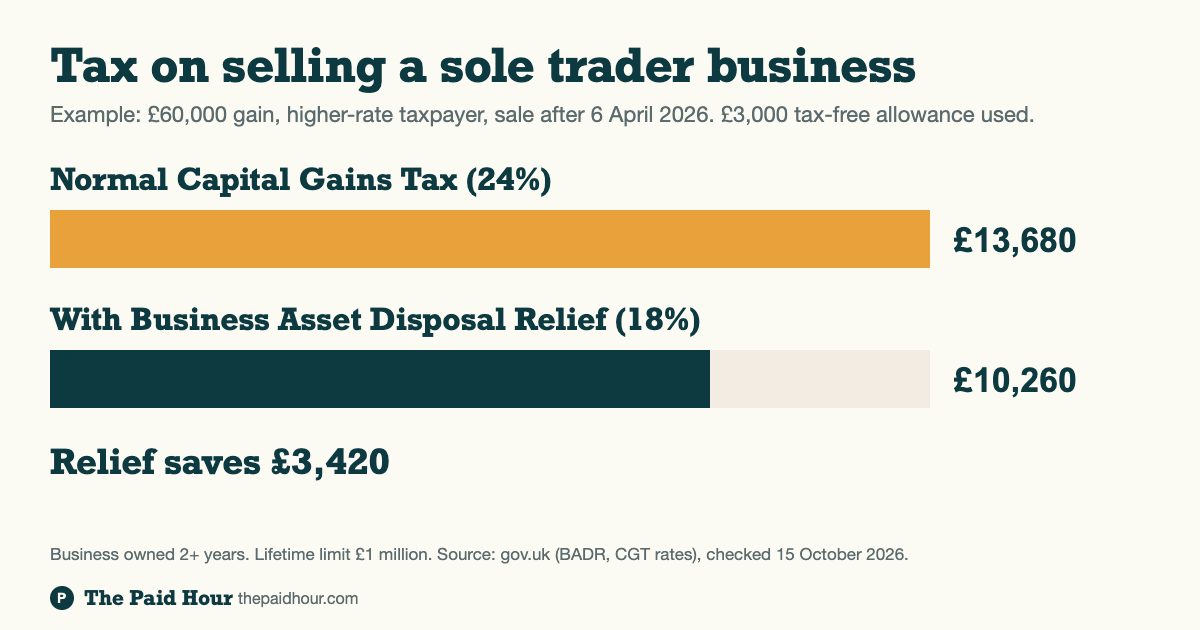
A worked example. You sell for a £60,000 gain and you are already a higher rate taxpayer. Take off the £3,000 allowance and £57,000 is taxable. At the normal 24% rate that is £13,680. With the relief at 18% it is £10,260, so the relief saves you £3,420.
If your income is low that year, some of the gain may sit in the basic rate band at 18% anyway, so the saving is smaller. The relief matters most when the gain would otherwise be taxed at 24%.
Equipment needs its own sum. If you claimed capital allowances on tools, a van or a computer, selling them in your final period can lead to a balancing charge or a balancing allowance in your last accounts.
VAT and closing down properly
If you are VAT registered and the buyer will run the same business, the sale may count as a transfer of a going concern. When the conditions are met, no VAT is charged on the sale. The buyer usually needs to be VAT registered too. HMRC’s Notice 700/9 sets out the rules, and they apply automatically, so agree early whether your sale fits.
Once you stop trading, tell HMRC you have stopped being self-employed and cancel your VAT registration if you have one. Your last Self Assessment return covers your final profit, your capital allowances and the Capital Gains Tax on the sale. Check the Self Assessment deadlines so the final bill does not catch you out.
Your client list is personal data. Tell clients the business is changing hands and check what your privacy notice says before you pass their details on.
The order to do it in
- Tidy the books and put regular clients on written terms. Give this three to six months.
- Get a valuation so you know the range you are aiming for.
- Approach buyers you know, or list the business online. Use a confidentiality agreement.
- Agree the price, what is included and how long you will stay on. A solicitor then draws up the sale agreement.
- Hand over clients, accounts and passwords on the agreed date.
- Tell HMRC you have stopped trading, and claim Business Asset Disposal Relief on your return.
If you are still deciding how to run things for the long term, it is worth reading sole trader vs limited company first. A company can be easier to sell later, because the buyer takes over the whole thing in one go.
Sources
- gov.uk, Business Asset Disposal Relief: eligibility and rates
- gov.uk, Business Asset Disposal Relief: how to claim and lifetime limit
- gov.uk, Capital Gains Tax rates
- gov.uk, Capital Gains Tax allowances
- gov.uk, Transfer a business as a going concern and VAT (Notice 700/9)
- gov.uk, Stop being self-employed
All figures checked 15 October 2026.