
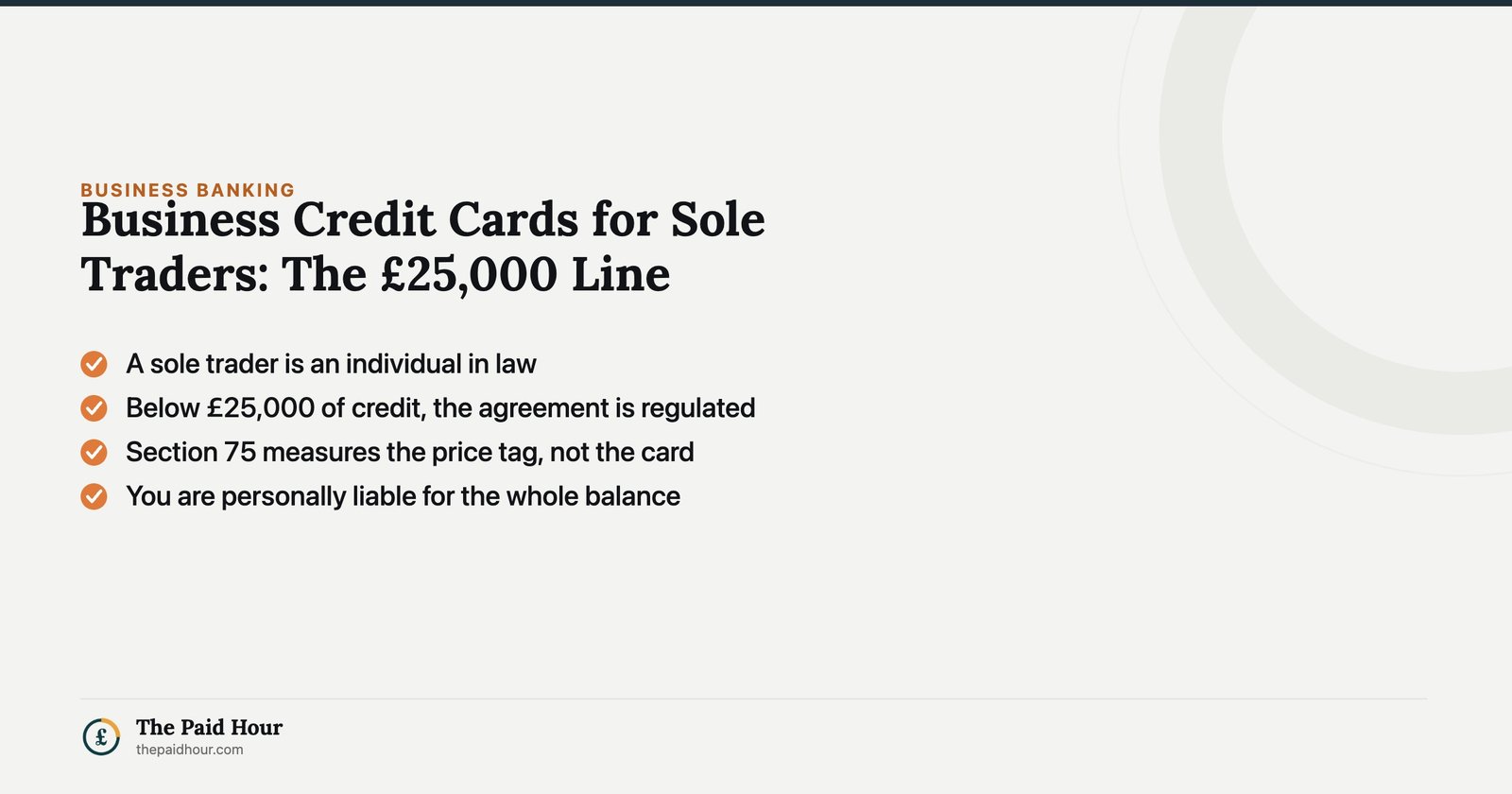
The short version: The line you will read everywhere (that business credit cards never carry Section 75), is not something a sole trader can rely on in either direction. A sole trader is an individual in law, and the FCA’s own guidance puts the business-purpose exemption above £25,000 of credit, not at the word business on the card. Below that threshold the agreement is a regulated one. Whether Section 75 attaches to a particular purchase still turns on your specific agreement, so the useful move is not to assume, it is to ask your provider in writing, before you need the answer.
Table of Contents
Business credit cards for sole traders get sold on cashback, limits and expense tracking. The question that actually matters if something goes wrong (whether the card provider is on the hook alongside the supplier), barely comes up, and the answer that circulates online is wrong often enough to be worth unpicking.
The business credit cards claim everyone repeats
The claim goes like this: Section 75 is consumer protection, a business card is not a consumer product, therefore no Section 75. It sounds tidy. It skips a step.
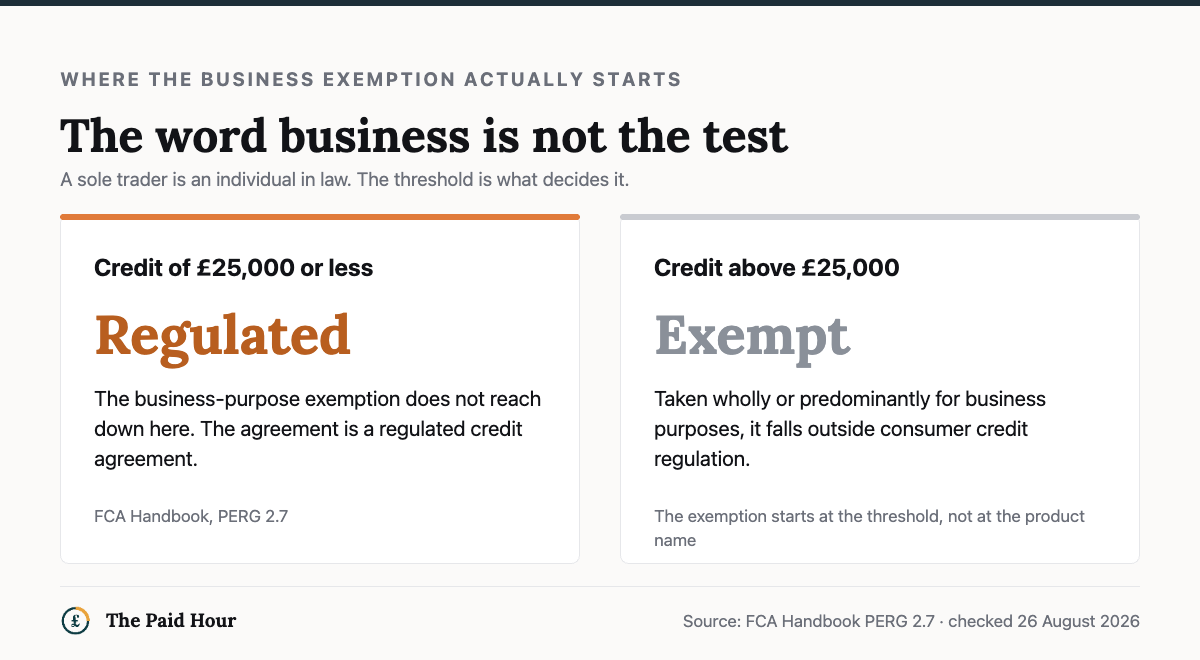
The step it skips is who you are. A sole trader is not a company. There is no separate legal person. You and the business are the same individual, which is the whole reason sole trader tax works the way it does. And the consumer credit perimeter is drawn around individuals rather than around what a product is called.
The FCA’s own guidance is specific. A credit agreement is within the perimeter where the borrower is an individual and… the amount of credit provided is less than or equal to £25,000. The business-purpose exemption sits above that line rather than below it. So a sole trader with a £6,000 limit on a card marketed as a business card has not automatically stepped outside consumer credit regulation by picking that product.
That does not mean every such card carries Section 75. It means the blanket claim is not a rule, and treating it as one is how people talk themselves out of a claim they might have had. If this is the difference between eating a loss and not, it is a question for the provider in writing, and if the sum is large, for a solicitor.
What Section 75 says
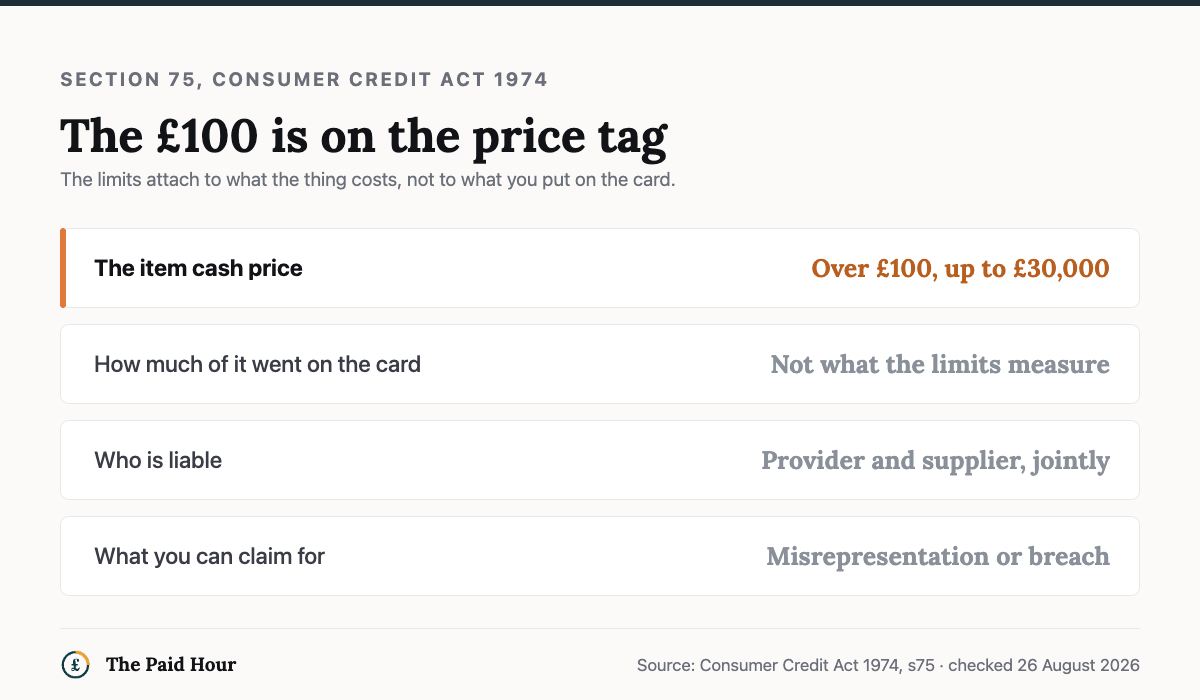
Section 75 of the Consumer Credit Act 1974 makes the creditor jointly and severally liable with the supplier for a claim in misrepresentation or breach of contract. Jointly and severally is the part that matters: you can pursue the card provider for the whole thing, not a share of it, and the provider then sorts it out with the supplier.
The limits are narrower than people think, and pointed at something different from what people think. The section does not apply so far as the claim relates to any single item to which the supplier has attached a cash price not exceeding £100 or more than £30,000. So the test is the price tag on the item, over £100, and no more than £30,000.
It is not a test of how much you put on the card. If a £900 camera goes on the card as a £100 deposit and the rest by transfer, the item still has a cash price of £900. That is the detail most people get backwards, and it is worth knowing before you split a payment to save a fee.
What business credit cards make you declare
There is one thing you can actively get wrong at application time, and it is easy to click past.
Business card applications often include a declaration that the credit is being taken wholly or predominantly for business purposes. The FCA notes that where an agreement includes such a declaration, this may create a presumption that this is the case.
Read that twice. A box you tick to get through an application can shift the starting point of any later argument about which side of the line your agreement sits on. It does not settle the question, a presumption is not a conclusion, but it is not nothing either. If the card is for the business, ticking it is honest and correct. Ticking it on a card you also use for the weekly shop is neither.
What is certain: you are liable for all of it
Everything above is a question with an it depends in it. This part is not.
A sole trader is personally liable for the whole balance on a business credit card. Not the business, which does not exist as a separate thing. You. If the work dries up and the balance does not, the debt follows you and not a company, because there is no company. That is the same trade-off that makes sole trader status simple everywhere else, and it is the single biggest difference between this and a card issued to a limited company: sole trader versus limited company goes through the rest of it.
Which makes the practical advice unglamorous. A business credit card is a good short-term cash-flow tool and a bad long-term one. If it exists to smooth the gap between doing work and being paid for it, fine. If it exists because the work is not covering the costs, the card is postponing a decision instead of solving anything.
What you can claim on business credit cards
Interest and charges on borrowing used for the business are allowable. HMRC lists financial costs, for example insurance or bank charges among the expenses you can claim, and card interest on genuine business spending sits in that box. What you cannot do is claim on the personal half of a mixed card — the test is still that the cost has to be for the business, and a card statement full of both is a card statement you will end up sorting line by line.
Which is the real argument for keeping business and personal spending on separate cards, and it has nothing to do with the law. It is that one of them is deductible and the other is not, and telling them apart in April is worse than separating them in August. Our guides to allowable expenses and what you cannot claim cover where the line falls.
What to check before you apply for business credit cards
- Ask the provider, in writing, whether the agreement is regulated and whether Section 75 applies. An email you can keep beats a forum post.
- Read the business-purpose declaration rather than clicking through it, and only sign it if it is true.
- Check what the card costs: annual fee, purchase rate, and the rate on cash withdrawals, which is usually worse and usually starts charging immediately.
- Check the foreign transaction fee if you buy software or hosting priced in dollars, because that is where a lot of sole trader spending goes.
- Decide what it is for before the limit decides for you.
If the underlying problem is that a bank account and a card are getting tangled together, whether a sole trader needs a business bank account is the more useful question to answer first.
Feast one month, famine the next?
Freelancer Money System 2026/27. Seven modules and five working sheets that pay you a predictable monthly amount out of unpredictable income: the account structure, the percentages, and where every pot should sit.
- A salary set from your trailing twelve-month low, not the average, with the calculator that finds it
- The day-it-lands allocation split, so tax and costs are moved before you can spend them
- The written drought plan for a bad quarter, the FSCS licence checker, and the surplus waterfall for a good year
Normal budgeting assumes a payday. Freelance income does not have one. The fix is not discipline, it is structure, and structure is a one-afternoon job.
Buying more than one? All ten 2026/27 courses for £107, against £328 at full price.
Sources
- Consumer Credit Act 1974, section 75, legislation.gov.uk
- PERG 2.7: activities, a broad outline. FCA Handbook
- Expenses if you are self-employed, GOV.UK
The section 75 wording is quoted from the Consumer Credit Act 1974 as published on legislation.gov.uk. The £25,000 threshold, the individual-borrower test and the wording on the business-purpose declaration are quoted from the FCA Handbook at PERG 2.7. The expenses wording is HMRC’s. All were read on 26 August 2026.
This is general information about how the rules are written, not legal or financial advice, and it is not a recommendation to take out any credit product. Whether a specific agreement is regulated, and whether section 75 applies to a specific purchase, depends on facts about that agreement: get it from your provider in writing, and take proper advice if real money turns on the answer. No affiliate links on this page.