
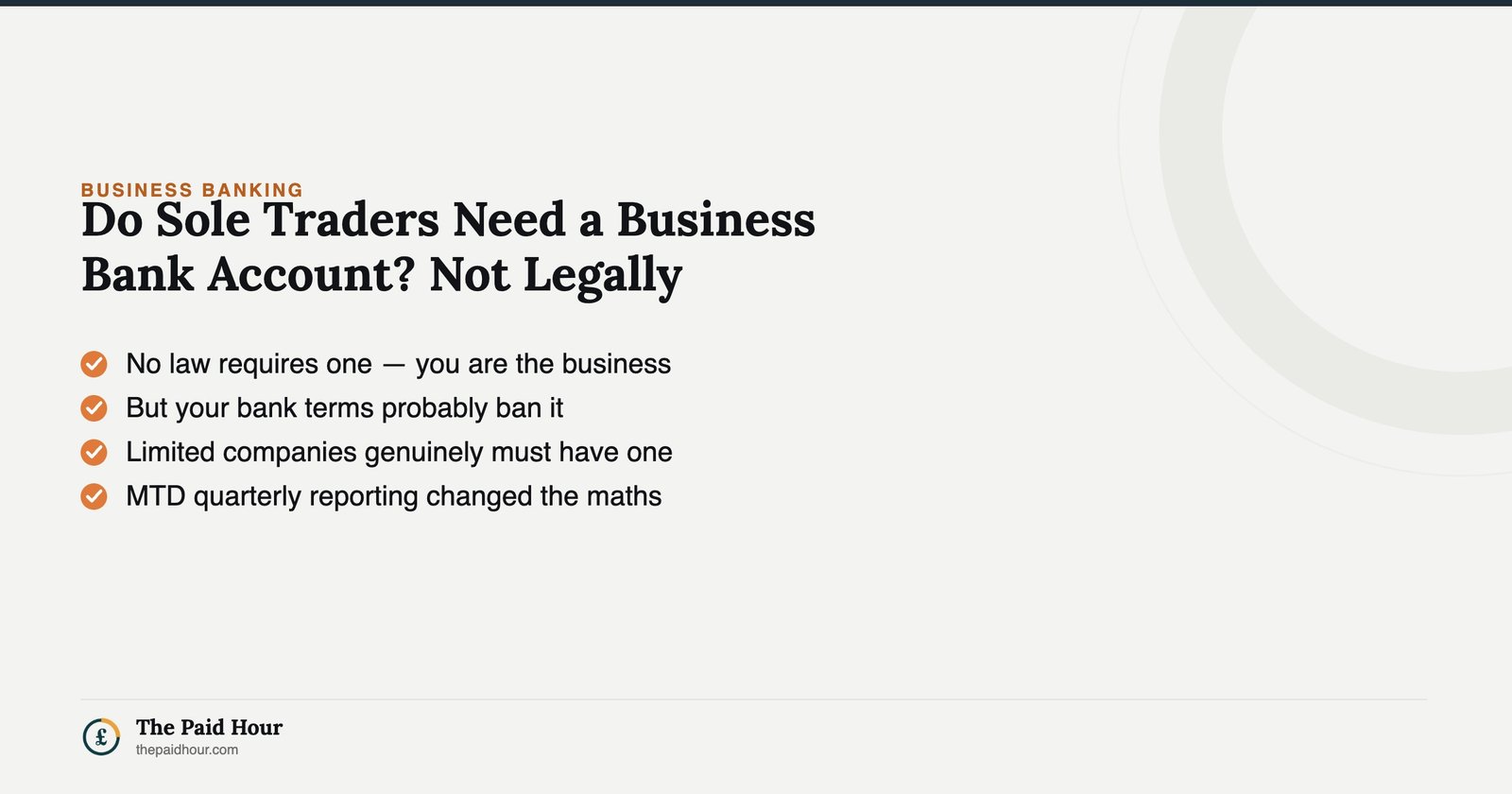
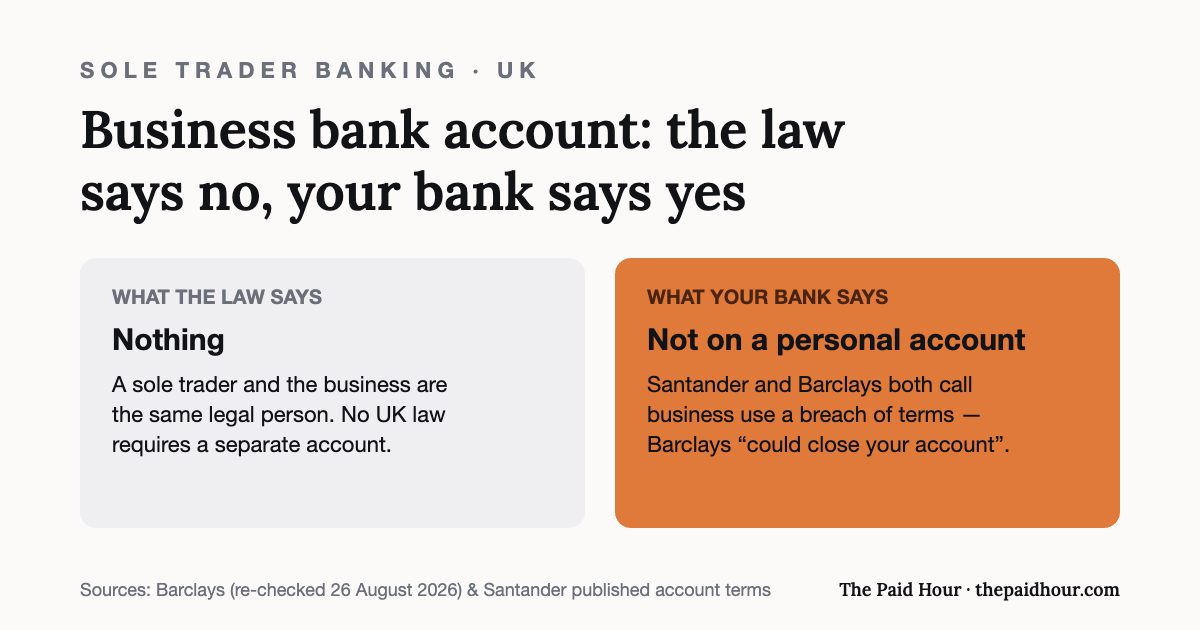
Before you read on: No law requires a UK sole trader to have a business bank account, you and the business are the same legal person, so there is nothing to separate. But your bank probably requires it. Santander: “Using a personal account for business is in breach of our terms and conditions… This includes if you’re a sole trader.” Barclays says the same and adds that it “could close your account”. Limited companies are a different question entirely, and there the answer is yes. And yes, you can open one: banks offer business accounts to sole traders as standard, and you apply as yourself, trading under your own name or a trading name.
Two different answers get mixed together here, and only one of them is about the law.
Barclays reckons three-quarters of the UK’s self-employed workforce run everything through a personal account. So this is not a fringe question. It is what most sole traders are doing, and most of them have never read the terms they agreed to.
The legal answer on a business bank account: no
gov.uk’s guidance on setting up as a sole trader and on keeping business records contains no requirement for a dedicated account. What it asks of you is short:
- Choose a business name, your own name is fine.
- Register for Self Assessment if you earn more than £1,000 in a tax year.
- Keep records of your business income and expenses for the return.
“Open a business bank account” is not on that list, and the reason is structural. As a sole trader you and your business are legally the same person. There is no second entity for the money to belong to, so there is no rule about which account it sits in.
The contractual answer: probably not allowed
This is the part almost every article on the subject either skips or hedges, so here it is from the banks themselves.
Santander: “Using a personal account for business is in breach of our terms and conditions.” And it closes the obvious loophole in the next line. “This includes if you’re a sole trader, or if you receive rental income from property you own.”
Barclays: “Using your personal account for business use is also in breach of our terms and conditions… so we could close your account or stop providing a service.”
Not a fine. Not HMRC. Your bank ending the relationship, at a point when your income is landing in that account. Terms vary between banks and some are more relaxed about low volumes than others, so read your own rather than assuming either way, but “it is not illegal” and “it is allowed” are not the same sentence.
Why a limited company is different
Most of the confusion starts here, because for a company the advice is different. gov.uk on running a limited company: “There must be a clear division between the company’s finances and those of the owners and directors. This is because the company is a separate legal entity.”
The company’s money is not the director’s money, even where the director owns every share. Mixing them is not untidy bookkeeping, it crosses a legal boundary. So a limited company needs its own account, and the same logic applies to anything else with its own legal personality, an LLP, or an American LLC being run from here.
Sole traders have no separate entity, so that rule simply does not reach you. Which is exactly why the two questions need answering separately rather than together.
What a sole trader has to do about a business bank account
Keep enough evidence of income and expenses to file an accurate return, and keep it for at least five years after the 31 January deadline. gov.uk does not say how. A spreadsheet, an app, a shoebox of receipts or a dedicated account all satisfy it, as long as the numbers are right and you can back them up.
The retention rules are set out in the guide to how long to keep business records, and if you are on the cash basis (the default for most small sole traders), a single stream of business-only transactions is close to the whole job, which is the argument in cash basis versus traditional accounting.
How Making Tax Digital changed the business bank account maths
This is the part that makes older advice on the subject out of date.
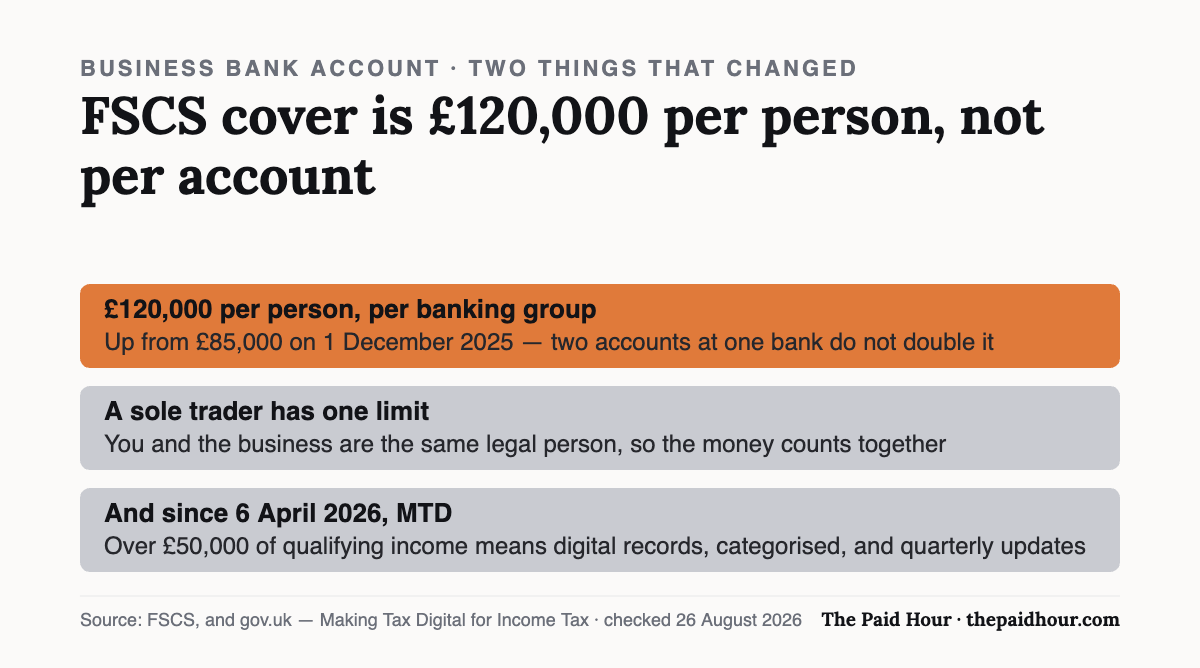
Since 6 April 2026, sole traders with qualifying income over £50,000 have been inside Making Tax Digital for Income Tax: digital records, categorised, and a quarterly update instead of one annual reckoning. The £30,000 group joins in April 2027 and the £20,000 group in April 2028.
Untangling business transactions from the weekly shop was an annual irritation. Four times a year it becomes a routine, and software that connects to a mixed personal account cannot categorise anything reliably without you doing it by hand. That is the real reason a separate account has stopped being a preference and started being infrastructure. Who is in and when is in the guide to MTD for Income Tax for sole traders.
Can a sole trader open a business bank account?
Yes. You do not need to be a company, you do not need a Companies House number, and you do not need employees. Sole trader accounts are a standard product at every major bank and every app-based provider. And if you pick one and regret it, switching later takes seven working days under the switch guarantee.
What you will generally be asked for is proof of identity, proof of address, and details of the business: what you do, roughly what you expect to turn over, and your trading name if you use one. Many providers ask for your Unique Taxpayer Reference. Opening takes minutes with the app-based providers and rather longer with a branch bank.
Which one is worth having is a separate question — fees, app quality and whether it talks to your accounting software vary far more than the marketing suggests. The comparison is in the best business bank accounts for UK sole traders. One thing to check before you move money in: whether the provider is FSCS-protected, because several popular ones are not banks.
A business bank account does not double your FSCS protection
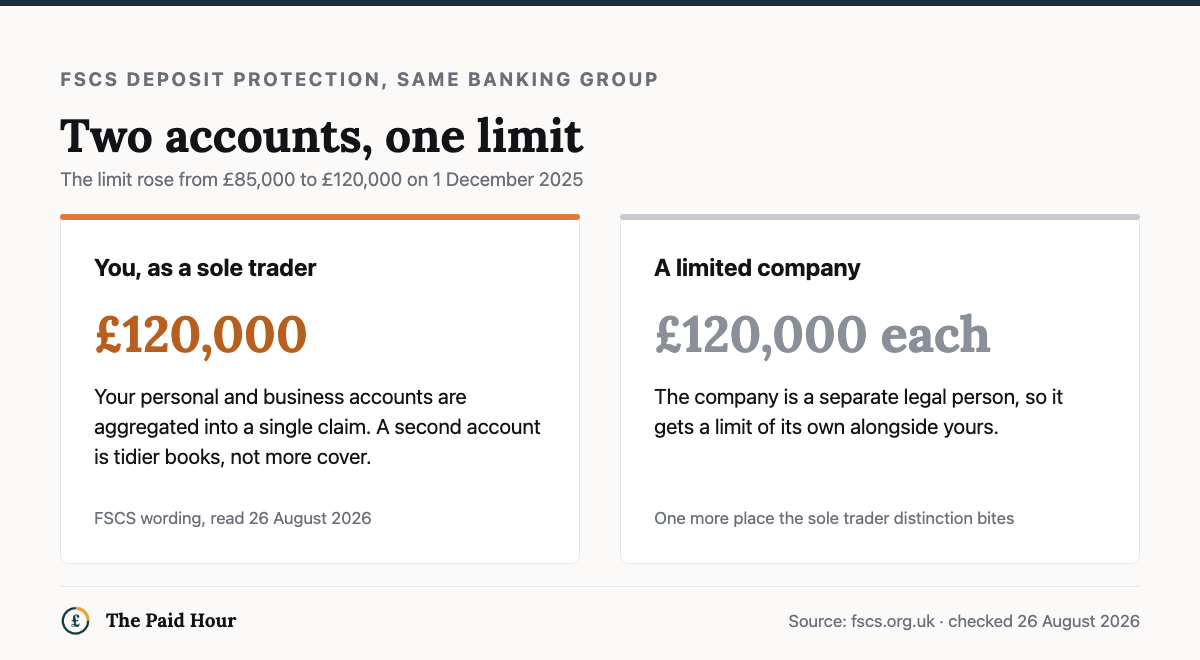
Worth knowing before you split money across two accounts at the same bank and assume it is safer. FSCS protects deposits up to £120,000 per person per banking group, a limit that rose from £85,000 on 1 December 2025. For a sole trader, the personal account and the business account hold the same person’s money.
FSCS puts it plainly: if you run your business as a sole trader, your business and personal accounts would be aggregated together, and you could only be able to claim up to £120,000 in total.
So a second account at the same bank buys you tidier books instead of more cover. A limited company is a separate legal person and gets its own limit, one more place the sole trader distinction actually bites. If you are holding more than £120,000 across both, the answer is a second banking group rather than a second account, and how FSCS protection works on business accounts goes through which providers are covered at all.
A “sole account” is something else entirely
Worth clearing up, because the words collide. A sole account just means an account in one person’s name, as opposed to a joint account held by two. It has nothing to do with being a sole trader.
So a sole trader can hold a business account (sole, in their own name), a personal sole account, and a personal joint account with a partner, and all three are different things. If you searched for one and landed on the other, that is why.
When a personal account is fine
Small, occasional, side-income trading (a few invoices a year, well under the trading allowance or barely over it), is not what those bank terms are aimed at, and the practical case for a second account is thin at that scale.
The line moves once the business is your income rather than a supplement: regular payments in, a real volume of expenses, and now quarterly reporting to do. At that point the question stops being whether the law requires it and becomes whether you want your income arriving in an account your bank could close for holding it.
If one app doing both the banking and the bookkeeping appeals, the Countingup review covers exactly that model.
And wherever the current account lands, the tax money deserves a pot of its own beside it, business savings accounts for the tax pot covers that half.
A card raises the same question in a sharper form, because the line you will read everywhere, that a business card gives a sole trader no Section 75, turns out not to be a rule. Business credit cards for sole traders has where the threshold sits.
If what you are really after is which account to open instead of whether to, the business accounts for sole traders worth comparing puts the fees, apps and accounting-software links side by side.
Want to pay yourself a salary from irregular income?
Freelancer Money System 2026/27. Seven modules and five working sheets that pay you a predictable monthly amount out of unpredictable income: the account structure, the percentages, and where every pot should sit.
- A salary set from your trailing twelve-month low, not the average, with the calculator that finds it
- The day-it-lands allocation split, so tax and costs are moved before you can spend them
- The written drought plan for a bad quarter, the FSCS licence checker, and the surplus waterfall for a good year
Normal budgeting assumes a payday. Freelance income does not have one. The fix is not discipline, it is structure, and structure is a one-afternoon job.
Buying more than one? All ten 2026/27 courses for £107, against £328 at full price.
Read next
- Switching Business Bank Accounts: The Easy 7-Day Process
- FSCS Protection on Business Accounts: What’s Covered in 2026
- E-Money Accounts vs Bank Accounts: The Difference
Sources
- Small businesses and limited companies protection: FSCS
>
- gov.uk, Set up as a sole trader
- gov.uk: Business records if you’re self-employed
- gov.uk, Running a limited company: company and accounting records
- gov.uk. Find out if and when you need to use Making Tax Digital for Income Tax
- Santander: Business or personal? Make sure you’re using the right type of account
- Barclays, Do I need a business bank account?
Barclays’ guidance re-checked 26 August 2026; other terms as published at the dates cited.
Checked 25 August 2026. Bank terms differ and change, so read your own provider’s current account terms rather than relying on the two quoted here. This is general information, not financial or tax advice: for anything more complicated than a straightforward sole trader setup, speak to an accountant.