
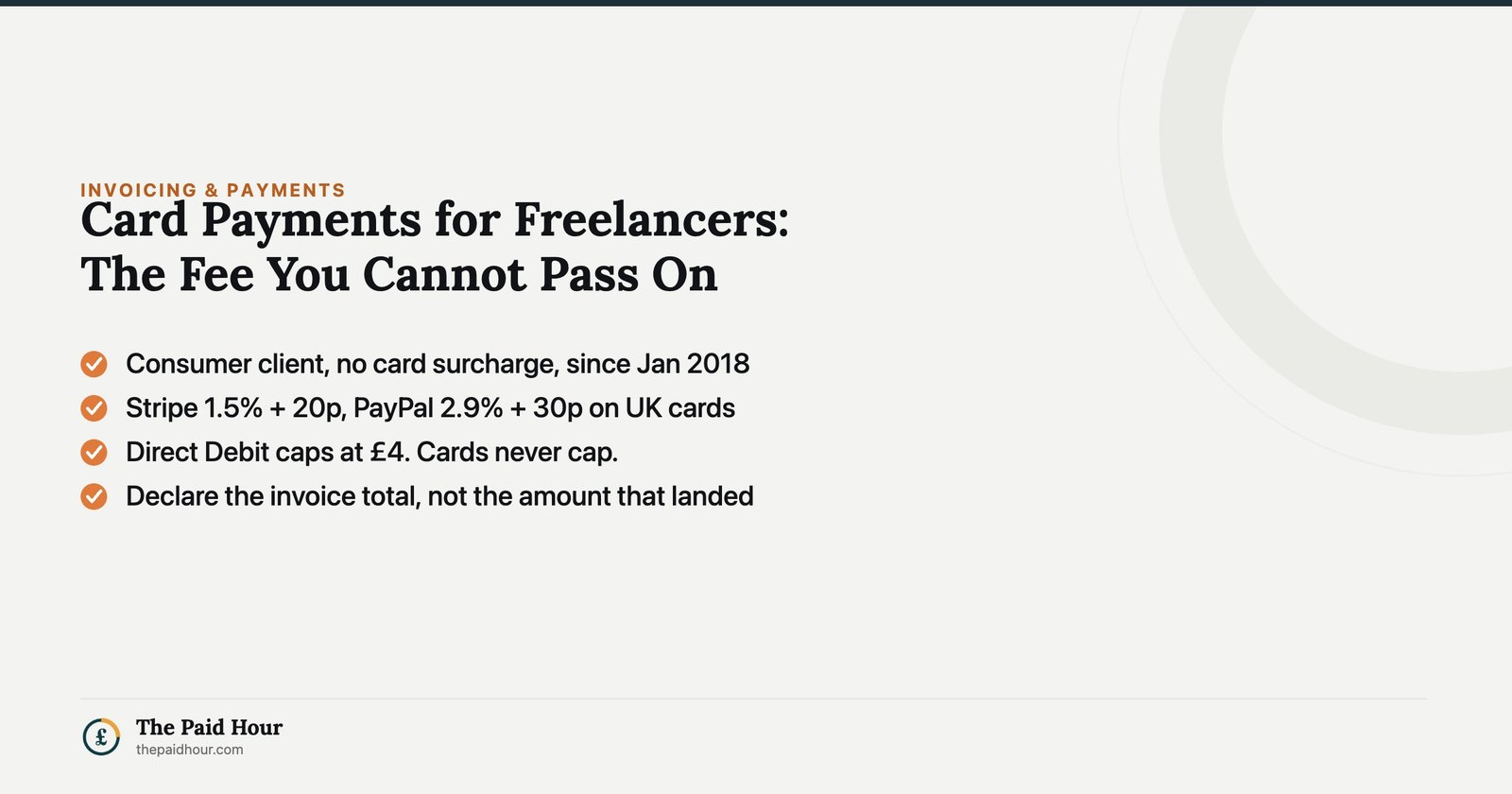
The one-paragraph answer: On a £1,000 invoice, a standard UK card through Stripe costs £15.20 and PayPal costs £29.30, while GoCardless Direct Debit costs £4.00 because its fee is capped and card fees are not. And you almost certainly cannot pass the fee on: since 13 January 2018 it has been unlawful to surcharge a consumer for paying by a normal card. Business clients on a corporate card are different, you can pass it on there, but never for more than it costs you.
Accepting card payments as a freelancer usually starts with a client asking whether they can just pay by card instead of doing a transfer. Saying yes is easy. What it costs depends less on which logo you pick than on two things nobody mentions in the sign-up flow: whether the fee is capped, and whether you are allowed to hand it to the client.
What accepting card payments as a freelancer costs
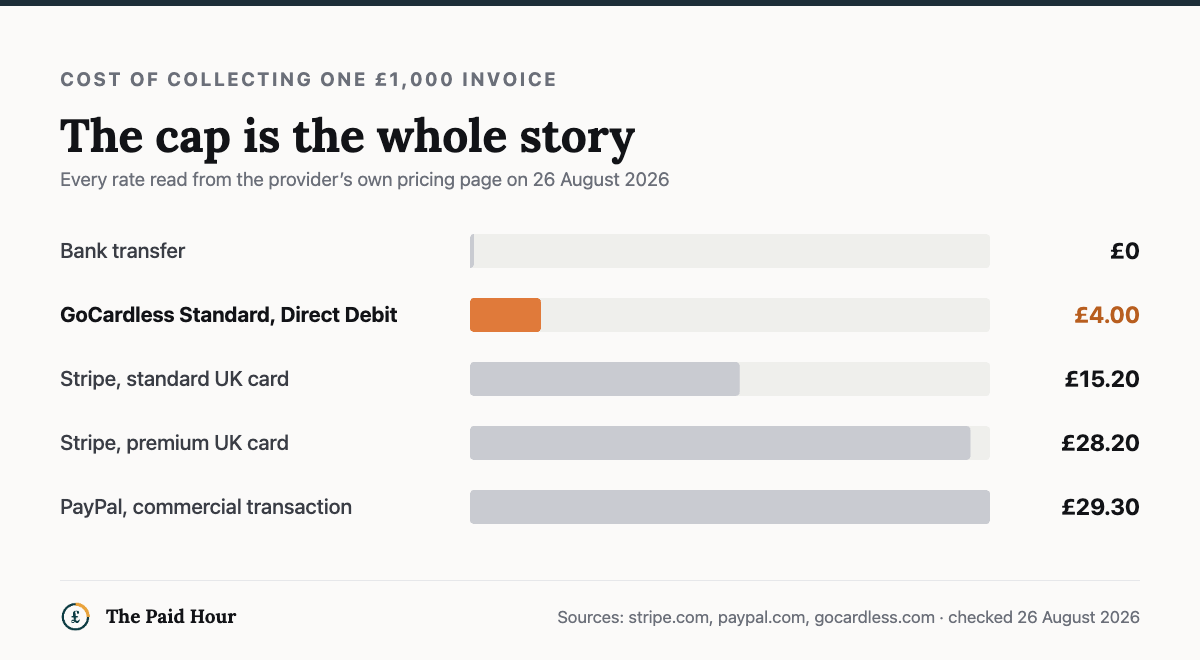
Every figure below came off the provider’s own pricing page on 26 August 2026.
- Stripe: 1.5% + 20p on a standard UK card, 2.8% + 20p on a premium UK card, 2.5% + 20p on an EEA card and 3.15% + 20p outside it. No setup fee, no monthly fee.
- PayPal: 2.9% + 30p on a domestic commercial transaction, plus 1.29% if the payer is in the EEA and 1.99% from anywhere else.
- GoCardless: Direct Debit rather than cards. 1% + 20p on the Standard plan, capped at £4. No setup or monthly cost, and prices exclude VAT.
Run a £1,000 invoice through each and the spread is not subtle. Stripe takes £15.20 on a standard UK card. PayPal takes £29.30. GoCardless would have taken £10.20, except the cap stops it at £4: £4.80 once you add the VAT they say is excluded, and still about a third of what Stripe costs and a sixth of PayPal.
That gap is not about one company being greedy. It is about the shape of the pricing. Card fees are a straight percentage with no ceiling, so they scale with your invoice forever. A capped fee stops. On a £200 invoice the difference is pennies. On a £5,000 project Stripe takes £75.20 on a standard UK card, while the capped route stays in single or low double figures. GoCardless adds 0.3% on Direct Debits over £2,000, so confirm the exact number with them, but the shape of it does not change.
The one card payments fee you cannot pass on to a customer
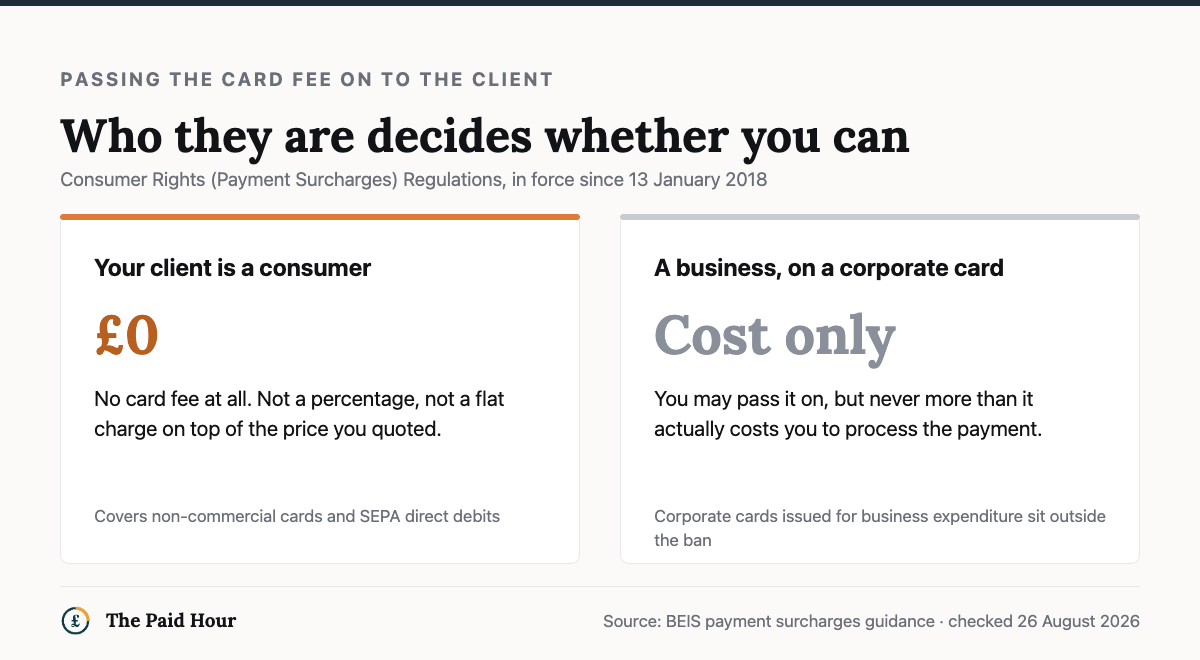
The obvious move (add 2% to the invoice and call it a card fee), is unlawful for most of the people you might do it to.
The Consumer Rights (Payment Surcharges) Regulations stop a merchant imposing a surcharge on a payer for using a particular payment method. The current version applies to charges made on or after 13 January 2018, and it covers non-commercial cards whose interchange fees are regulated, other non-commercial payment instruments, and SEPA direct debits and credit transfers. In plain terms: if your client is a person paying with their own Visa or Mastercard, you cannot add anything for the privilege.
Two things sit outside it. The regulations protect consumers, so business-to-business is not covered by the outright ban. And corporate cards issued to employees for business expenditure are excluded from the regulated set. Where a surcharge is allowed, it still cannot exceed what processing that payment actually costs you, so if Stripe charges you 1.5% + 20p, a flat 3% card fee is too much even on a client you were entitled to charge.
Which leaves most freelancers in a simple position. Price the work so the fee is inside it, or take payment by a method that does not have one. The fee is a cost of doing business, and pricing is where costs of doing business belong.
Direct Debit: the card payments alternative with a capped fee
Direct Debit is worth understanding properly because it is the only mainstream route where the fee stops growing. GoCardless Standard is 1% + 20p capped at £4, Advanced is 1.25% + 20p capped at £5, Pro is 1.4% + 20p capped at £5.60. International collections cost more: 2% + 20p on Standard, and anything over £2,000 adds 0.3% on Direct Debits.
The trade-off is speed and setup. A card takes seconds. Direct Debit needs a mandate from the client before the first collection, which means a conversation and a form rather than a payment link. For a one-off job with a new client that friction is the whole objection. For a client paying you every month it is a one-time cost that then never charges you more than a fiver again, which is exactly why it fits retainer arrangements better than card ever will.
What HMRC sees in your card payments, and the mistake to avoid
The processing fee is an allowable expense. HMRC lists financial costs, for example insurance or bank charges among the things you can claim, and a card fee sits squarely in that box.
Here is where people get it wrong. Stripe takes its cut before it pays you, so £1,000 invoiced arrives as £984.80. The temptation is to write £984.80 in the income column and be done. Do that and your books show the right profit but the wrong turnover, you have quietly netted the fee off your sales instead of recording it as a cost.
That matters for one reason above all: VAT registration is measured on taxable turnover, and the threshold is £90,000 over the last 12 months. Netting off fees on every invoice can leave you looking comfortably under a threshold you have crossed. Record the invoice total as income and the fee as an expense, every time. On cash basis that is still the rule; the fee is a payment you made instead of a sale you never made.
The card payments costs the headline rate hides
- Premium cards. Stripe’s 1.5% becomes 2.8% on a premium UK card, and you do not get to choose which card the client reaches for.
- Currency conversion. Stripe adds 2% where a conversion is needed. PayPal applies 3% above its base exchange rate. On an overseas client that is on top of the higher international rate rather than instead of it.
- Disputes. Stripe charges £20 when a dispute is received and £20 again if you counter it manually, refunded if you win, kept if you lose. One disputed £300 invoice can cost more than a month of ordinary fees.
- The cap that is not there. Worth repeating, because it is the one that compounds: no card processor caps the percentage. Every pound you add to the invoice adds to the fee.
Which way to take card payments, and when
Bank transfer stays the default for invoiced work, because it costs nothing and freelance invoices are usually large enough for a percentage to hurt. Put the details on the invoice and most business clients will simply pay them: what a UK invoice must legally include covers the rest of that page.
Add a card option when the friction is costing you money: a client who pays faster with a link than with a transfer, a deposit you want banked before the work starts, or a consumer client who does not think in bank transfers. On a deposit invoice the fee on a smaller amount is often worth paying to get the job moving.
Use Direct Debit when the same client pays you repeatedly. The mandate is a one-off annoyance and the cap does the rest.
And if the real problem is that clients are paying whenever they feel like it, the payment method is not the fix. What you can legally charge on a late invoice is a better place to start.
Ready to stop chasing and start recovering?
Late Payment Recovery & Legal Safeguards. The seven-stage escalation ladder with dates, every letter written for you, an interest calculator that adds what the law owes you, and the Money Claim Online walkthrough with real fees.
- Reminder letters for stages one to four, then a Letter Before Action that complies with the Pre-Action Protocol (company and individual versions)
- Auto-calculating statutory interest and compensation statement: £40 to £100 per invoice plus interest at base rate plus 8%
- Payment plan with a default clause, particulars of claim wording, hearing bundle index, and the client scorecard that fires slow payers
A solicitor charges around £40 plus VAT for a single letter before action. This is every letter in the sequence, the interest you are legally entitled to claim, and the court route, for one fee.
Buying more than one? The Complete Freelancer System, all five for £87, against £215 at full price.
If those payments are taken at an appointment rather than after a job, the booking tool sets as much of the cost as the card reader does. We compared the five most common ones in booking software for UK sole traders.
If the payments you are taking are deposits on appointments instead of invoices after the fact, the booking system usually decides the processor for you. Our SimplyBook.me review covers which plan is needed before a deposit is possible at all.
Sources
- Stripe UK pricing — stripe.com
- PayPal business fees, paypal.com
- GoCardless pricing. Gocardless.com
- The Consumer Rights (Payment Surcharges) Regulations 2012, legislation.gov.uk
- Consumer rights: payment surcharges, GOV.UK guidance (withdrawn from gov.uk in September 2026; archived copy at The National Archives)
- Expenses if you are self-employed: GOV.UK
- VAT registration: when to register, GOV.UK
Every rate here was read from the provider’s own pricing page on 26 August 2026 and providers change them without much notice, check before you rely on a number. The surcharge wording is quoted from the government’s guidance on the Consumer Rights (Payment Surcharges) Regulations, the expenses wording from HMRC, and the £90,000 figure from HMRC’s VAT registration guidance. This is general information, not financial or legal advice, and the surcharge rules turn on facts about your client that only you know. No affiliate links on this page.