
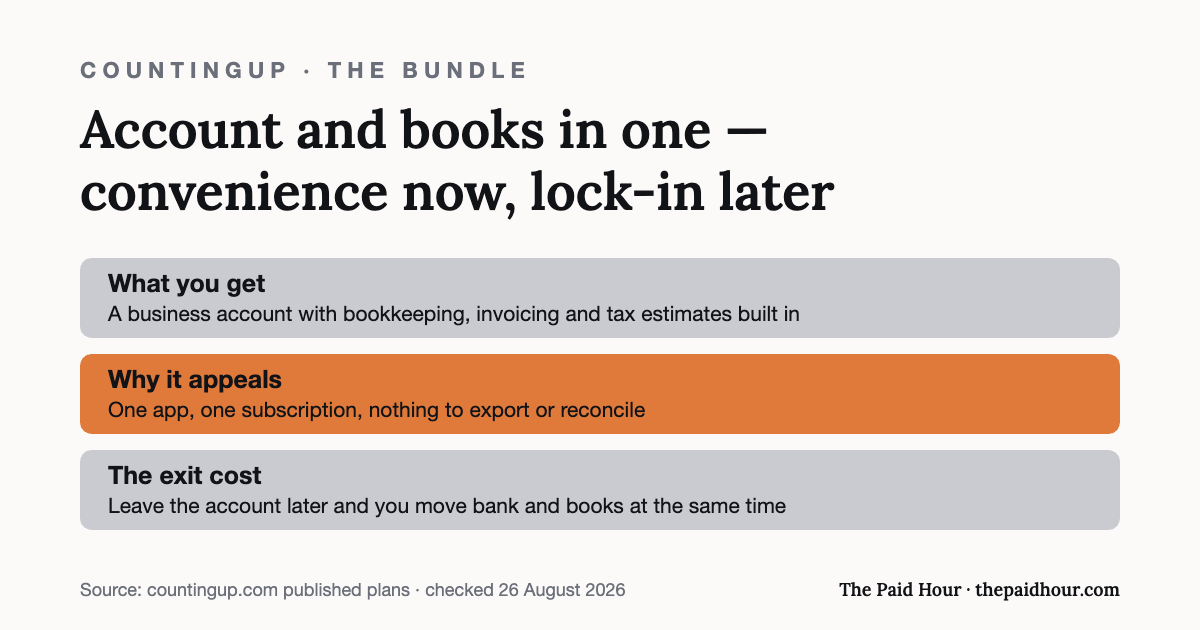
The one-paragraph answer: Countingup bundles the business account and the bookkeeping into one subscription, that is its whole pitch. It suits a sole trader who wants one app and no exports. The trade-off is lock-in: leave the account later and you are switching bank and books at the same time.
Table of Contents
A business account with bookkeeping already built in sounds like it should save a step, the real question is whether it saves enough to be worth the subscription. This Countingup review breaks down whether that all-in-one setup actually beats running a separate bank account and accounting app, or just repackages the same admin under one price tag. Most sole traders end up running two separate systems: a business bank account, and accounting software layered on top to make sense of what’s moving through it. Countingup’s pitch is to collapse that into one product, a business current account with bookkeeping and tax estimation built directly into the app, rather than bolted on via a bank feed integration.
Current pricing
Countingup prices by how much you’re depositing each month, not by a flat subscription:
- £5/month: up to £750 in monthly deposits
- £12/month: £750.01 to £7,500 in monthly deposits
- £20/month: unlimited deposits
All tiers come with a 3-month free trial, so you can test it against a full quarter of real trading activity before committing. This tiered-by-deposits model is worth understanding before you sign up, a slow month costs the same as a busy one, but if your income fluctuates a lot, check which band you’ll typically land in rather than assuming the lowest tier.
What’s built in
This part of the Countingup review covers what’s included beyond the account itself. Beyond the current account itself (a Mastercard debit card, FSCS protection on eligible deposits up to £120,000: the same protection level as a standard UK bank account), the bookkeeping side includes:
- Receipt capture and storage, with automatic expense categorisation
- A real-time estimate of what you owe in tax, updated as you trade instead of calculated after the fact
- VAT filing directly to HMRC at no extra cost on top of the subscription
- Unpaid invoice notifications, so you’re not manually chasing what’s overdue
- Financial reporting for cash flow visibility
- 1.2% variable interest on money set aside in a dedicated tax pot
That tax pot and running tax estimate are the features worth paying attention to specifically. A lot of sole traders’ worst tax-bill surprises come from spending money that was technically owed to HMRC without realising it — a running estimate you can see in the app, alongside a separate interest-earning pot to set the money aside in, addresses that directly rather than as an afterthought.
The fees to know about
Beyond the monthly subscription: transfers and Direct Debits get 3 free each month, then 27p per transaction; ATM withdrawals are £1 each; foreign transactions carry a 3% fee; and a replacement card costs £5. None of these are unusual for a challenger business account, but the 3% foreign transaction fee matters if you invoice international clients regularly, at that volume, a service built specifically for international payments (like Wise Business) may work out cheaper for that specific use case, even if you keep Countingup as your everyday account. Full fee details are published on Countingup’s own pricing page.
How it compares to a separate bank-plus-software setup
Our best business bank accounts guide covers standalone options if you’d rather keep banking and bookkeeping separate. Sometimes the better software (FreeAgent, Zoho Books) simply isn’t available as an integrated banking product. Countingup’s advantage is fewer moving parts: one login, one subscription, no bank-feed sync issues to troubleshoot. Its trade-off is less flexibility if you later want to switch accounting software without also switching banks.
The Honest Countingup Review Verdict
What this means of this Countingup review: Countingup is a useful all-in-one for sole traders who want tax visibility without juggling two separate apps, and its tiered pricing keeps the cost proportional to how much you’re actually processing. If you already have accounting software you like and just need a bank account, a standalone business account will likely cost less. If you want the “how much do I owe right now” question answered without doing the maths yourself, this is built specifically for that.
Before you commit: check the MTD list
Countingup bundles the account and the bookkeeping together, which is convenient right up to the point where Making Tax Digital for Income Tax applies to you. After that, one thing matters more than the monthly price: whether the software can file.
HMRC keeps that list, and it is the only authority on it, HMRC’s software finder. A provider’s own marketing is not a substitute. Check that the finder names the tier you are paying for rather than a different one, and check it before the quarter starts instead of in the week an update is due. The finder is free, public, and maintained by HMRC rather than by the companies listed on it.
Feast one month, famine the next?
Freelancer Money System 2026/27. Seven modules and five working sheets that pay you a predictable monthly amount out of unpredictable income: the account structure, the percentages, and where every pot should sit.
- A salary set from your trailing twelve-month low, not the average, with the calculator that finds it
- The day-it-lands allocation split, so tax and costs are moved before you can spend them
- The written drought plan for a bad quarter, the FSCS licence checker, and the surplus waterfall for a good year
Normal budgeting assumes a payday. Freelance income does not have one. The fix is not discipline, it is structure, and structure is a one-afternoon job.
Buying more than one? All ten 2026/27 courses for £107, against £328 at full price.
Sources
The £5/£12/£20 tiers and their £750/£7,500 deposit thresholds were re-checked on Countingup’s pricing page on 26 August 2026. This is general information, not financial advice. Pricing and terms are the provider’s own and change, check the linked pages before you rely on them.