
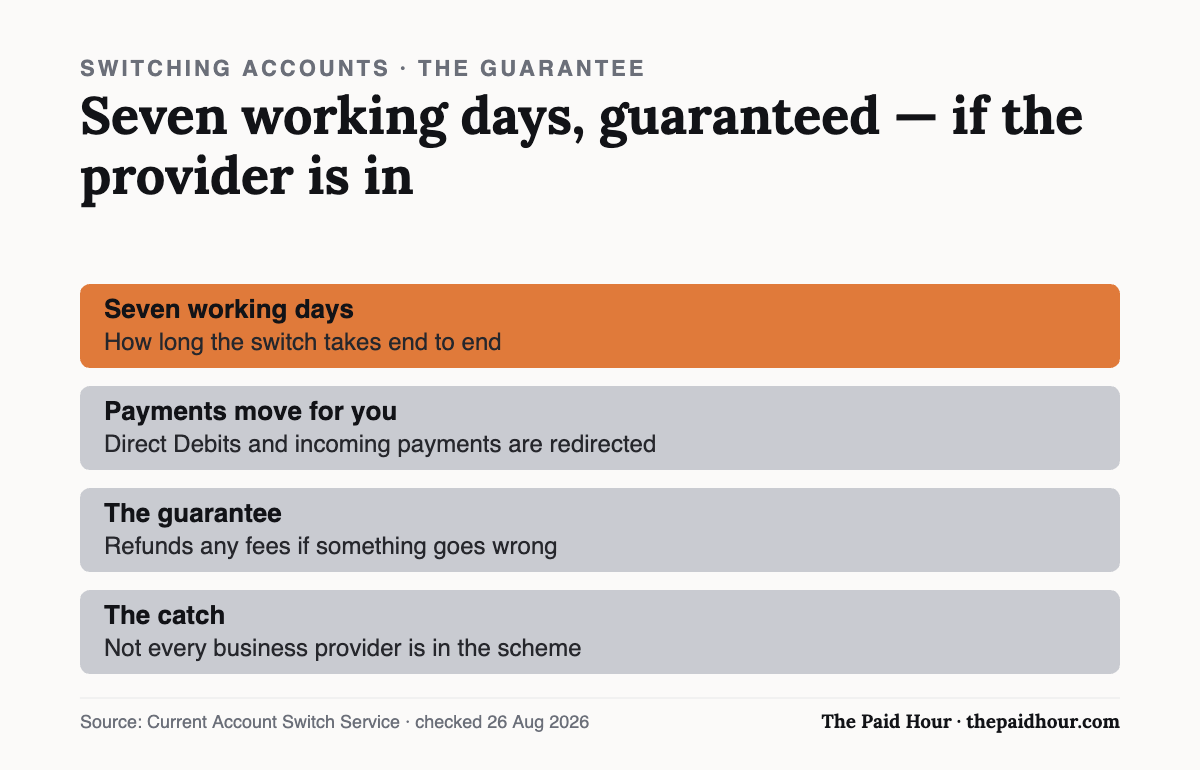
Before you read on: Switching business bank accounts runs through the Current Account Switch Service: seven working days, payments redirected automatically, and a guarantee that refunds any fees if something goes wrong. The catch is that not every business account provider is inside the scheme.
Switching business bank accounts sounds like it should be a hassle, updating every direct debit, chasing old standing orders, hoping nothing bounces in the gap. For most UK sole traders, it isn’t, because the same automated switching service that covers personal accounts also covers small business accounts.
The Current Account Switch Service covers business accounts
The Current Account Switch Service (CASS) isn’t just for personal banking. Businesses can use the full service if they have an annual turnover under £6.5 million and fewer than 50 employees, a threshold that covers essentially every sole trader and freelancer. Once you start a CASS switch, it contacts your old bank, confirms the switch can go ahead, and handles moving your payments, balance, and closing the old account automatically.
Switching business bank accounts, day by day
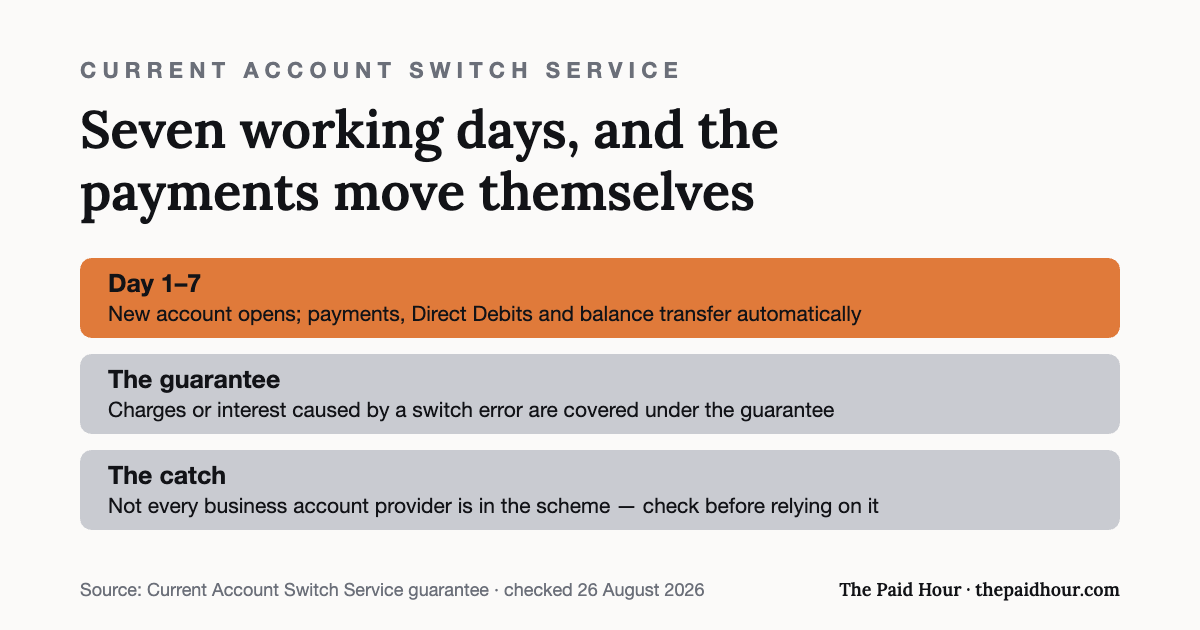
The full switch completes within 7 working days from when you start it:
- Day 1: Your old bank confirms you’re eligible to switch.
- Day 3: Regular payments, direct debits and standing orders, start transferring to the new account.
- Day 6: Your final balance transfer is arranged.
- Day 7: The remaining balance moves across and your old account closes.
You’re not left manually re-entering every client’s payment reference or chasing subscription providers one by one: that’s the part CASS automates, and it’s the main reason switching is far less painful than freelancers often assume before they’ve done it once.
The Switch Guarantee
CASS switches are backed by the industry-wide Current Account Switch Guarantee. If something does go wrong during the process (a payment gets missed, a fee gets charged that shouldn’t have been), you’re entitled to a full refund of any resulting bank charges. That protection only applies to full switches done through CASS, not to opening a new account manually and closing the old one yourself without using the service.
Before you start switching business bank accounts
- Check your new provider offers CASS-based switching — most mainstream banks do, but confirm before assuming, especially with newer app-based providers.
- Note down anything paid into your business account irregularly (annual subscriptions, one-off client payments) since CASS is built around regular recurring payments and may not catch every irregular one automatically.
- Keep your old account’s login details until the switch fully completes, in case you need to check something during the transition window.
- If FSCS protection on the new account matters to you, worth checking if you’re keeping meaningful balances, see our guide on FSCS protection on business accounts before you commit to a provider.
Source: NatWest’s business account switching page, describing the industry-wide Current Account Switch Service, checked 23 August 2026. Confirm specific eligibility and any switching incentives directly with your chosen provider.
Not every provider is part of the Current Account Switch Service
Switching business bank accounts through CASS only works if both your old and new providers actually participate in the scheme. Most high street banks and building societies do, but some newer fintech and e-money business account providers sit outside CASS entirely, which means the 7-day guarantee and automatic payment redirection don’t apply. In that case, “switching” is really a manual process: opening the new account, updating your bank details with clients and suppliers yourself, moving the balance across, and closing the old account once everything’s cleared.
Before you commit to switching business bank accounts, check the CASS website’s participant list, or simply ask the new provider directly whether they’re part of the scheme, it changes what kind of switch you’re signing up for.
What to do in the run-up to switching
A little preparation avoids most of the friction. Download several months of statements from the old account before you start, some providers make historic statements harder to access once an account is closed, and you’ll want them for your own bookkeeping and in case HMRC ever asks. Make a list of every recurring payment, direct debit, and standing order tied to the old account, even though CASS is meant to redirect these automatically; checking it yourself catches anything the automated process misses.
Common mistakes when switching business bank accounts
- Assuming a switch is CASS-covered without checking, then discovering payments didn’t redirect automatically.
- Closing the old account before confirming every incoming client payment has moved to the new details.
- Not updating the bank details stored in accounting or invoicing software, so new invoices still show the old account.
- Switching purely for a cash switching bonus without checking the new account actually suits how the business is run day to day.
If you’re switching to save money or get better features rather than just chasing an incentive, it’s worth comparing what’s on offer first, see our best business bank accounts for UK sole traders roundup before picking where to switch to.
Switching business bank accounts: is it worth the hassle?
For most sole traders, switching business bank accounts is low-effort once you know it’s CASS-covered: the 7-day guarantee exists precisely because Pay.UK wants switching business bank accounts to be routine rather than a deterrent to shopping around. If a better account, lower fees, or a switching bonus is on the table, there’s rarely a good reason to stay put purely out of inertia.
Considering Tide as the destination? Its full review is here.
Correction, 26 August 2026: a chart stated a three-year redirect period that none of the sources cited here supports. The claim was removed instead of re-sourced. See the corrections log.
Feast one month, famine the next?
Freelancer Money System 2026/27. Seven modules and five working sheets that pay you a predictable monthly amount out of unpredictable income: the account structure, the percentages, and where every pot should sit.
- A salary set from your trailing twelve-month low, not the average, with the calculator that finds it
- The day-it-lands allocation split, so tax and costs are moved before you can spend them
- The written drought plan for a bad quarter, the FSCS licence checker, and the surplus waterfall for a good year
Normal budgeting assumes a payday. Freelance income does not have one. The fix is not discipline, it is structure, and structure is a one-afternoon job.
Buying more than one? All ten 2026/27 courses for £107, against £328 at full price.
Read next
- Do Sole Traders Need a Business Bank Account? Not Legally
- FSCS Protection on Business Accounts: What’s Covered in 2026
- Business Credit Cards for Sole Traders: The £25,000 Line
Sources
The switch guarantee terms were re-checked against the Current Account Switch Service’s published guarantee on 26 August 2026.
This is general information, not financial advice. Pricing and terms are the provider’s own and change, check the linked pages before you rely on them.