
What matters here: If you expect this year’s bill to be lower than last year’s, form SA303 lets you reduce the payments on account HMRC has asked for. Reduce them too far, though, and interest runs on the shortfall from the date each payment was due, so estimate not optimistically.
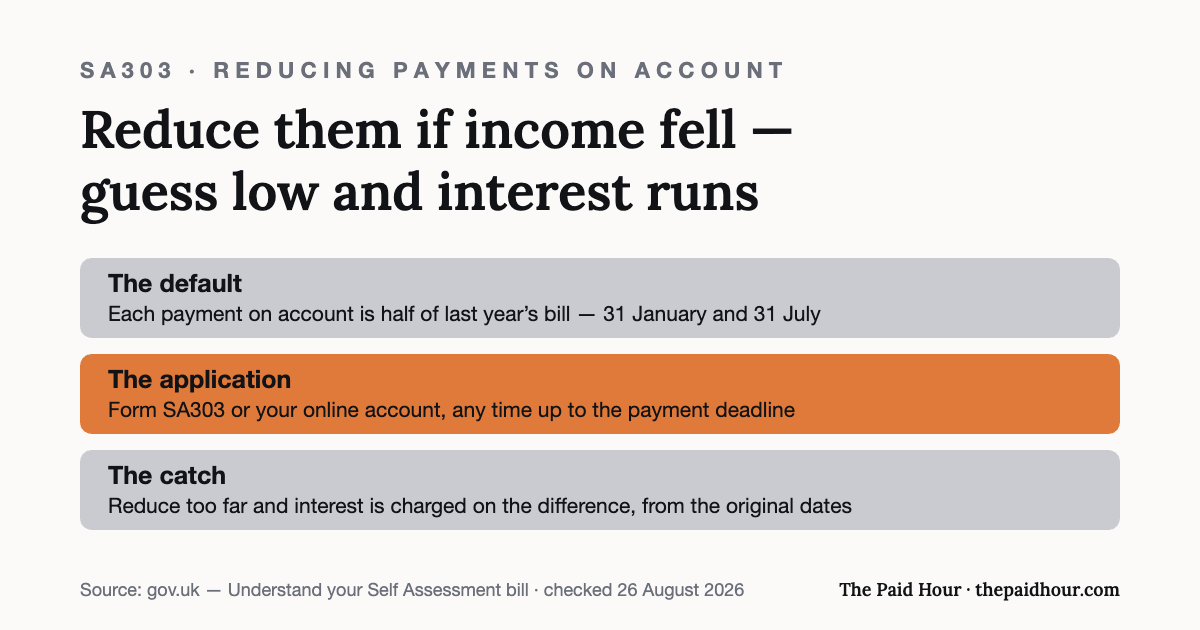
Reducing payments on account is one of the more underused tools available to a self-employed person with lumpy income. There is a separate post covering how payments on account work in general if you need the basics first. Payments on account are built around one assumption: next year looks roughly like last year. For a lot of self-employed people that assumption is wrong more often than it’s right, and HMRC lets you reduce your payments on account when you can see that coming, rather than handing them money in January and July that you’ll spend the rest of the year waiting to get back.
Why you’d want to
If last year was unusually good (a big one-off project, a client contract that isn’t repeating), your payments on account for this year are calculated as if that income continues. Pay them in full and you’re effectively giving HMRC an interest-free loan until you file next year’s return and claim the overpayment back. If you can see with reasonable confidence that this year’s profit will be meaningfully lower, reducing your payments on account keeps that cash in your business instead.
How to apply
There are two routes. Online, sign into your Self Assessment account, open your latest return, and select the option to reduce payments on account. By post, you fill in form SA303 and send it to HMRC. Either way, you need to give an estimate of what you expect to owe for the year, and HMRC uses that figure to recalculate what you pay in January and July.
The catch, and it’s a real one
If you reduce your payments on account and your actual tax bill ends up higher than the estimate you gave, HMRC charges interest on the shortfall, backdated to when the original, higher payment would have been due, not from when you eventually pay it. This is the detail that matters most: reducing payments on account isn’t a one-way bet. Guess too optimistically and the interest charge can wipe out some or all of the cash-flow benefit you were trying to get.
Getting the estimate right
The honest answer is that this only works well if you’re looking at real numbers. Management accounts, invoices raised so far this year, a realistic read on what’s still to come, rather than a gut feeling that business “seems quieter.” If you’re not confident in the estimate, reducing to a figure you’re fairly sure is still on the high side is safer than reducing all the way to your best guess. You can always apply again later in the year if your picture becomes clearer, right up until the payment deadline itself.
Reducing payments on account is a useful tool for anyone with lumpy, unpredictable income, it just isn’t a free one, and treating the estimate carelessly turns a cash-flow win into an interest bill a few months later.
A quick example
Say last year’s tax bill was £8,000, so this year’s two payments on account are set at £4,000 each. If you can see this year’s profit will come in around a third lower, reducing payments on account to roughly £2,600 each keeps an extra £2,800 in your business across the year instead of sitting with HMRC waiting to be reclaimed. If your estimate turns out to be too optimistic and the real bill is closer to £7,000, you would owe the £1,800 difference plus interest on it — still usually cheaper than getting the reduction wrong by a much wider margin, but not free.
Source: gov.uk: Understand your Self Assessment tax bill: Payments on account. Checked 23 August 2026.
The interest risk if your reduction turns out too low
Reducing payments on account is a genuine estimate instead of a guaranteed final figure, and HMRC treats it that way. If your actual tax bill for the year ends up higher than the reduced amount you paid, HMRC charges late payment interest on the shortfall — backdated to the original payment on account due date rather than the date you eventually settled up. As of January 2026, HMRC’s late payment interest rate is 7.75% (Bank of England base rate plus 4%), so an over-optimistic reduction on a large shortfall isn’t free.
This is the single biggest reason to be conservative when reducing payments on account rather than cutting them to the bone on a hopeful forecast. If you’re unsure whether income will hold up, reducing by a smaller, defensible amount is safer than reducing to nil and hoping.
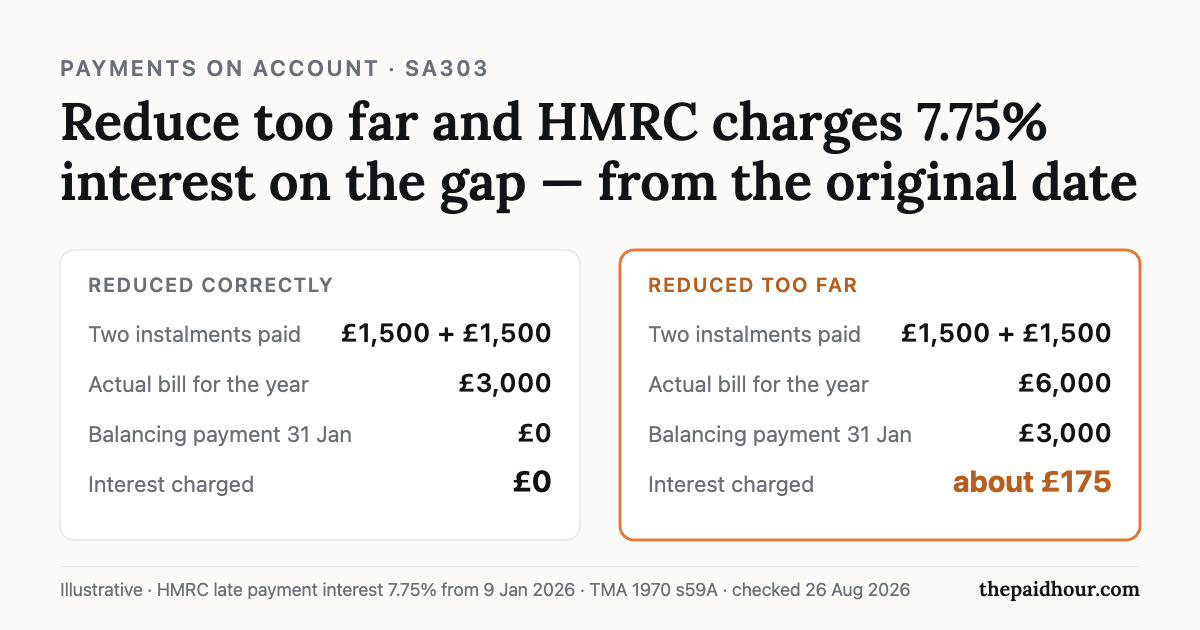
£175 is not a disaster. The point is that it scales: reduce by £10,000 more than you should and the interest is closer to £600, and the whole shortfall still lands on 31 January. Estimate honestly and slightly high, not low.
There is a sharper edge beyond interest. If HMRC decides a reduction claim was made fraudulently or negligently, section 59A(6) of the Taxes Management Act 1970 allows a penalty of up to the amount you under-paid on account. That clause is aimed at people who reduce to zero with no basis and hope. A reduction built on a real, documented drop in income is exactly what the form exists for.
Reducing to nil vs a partial reduction
You can set the reduction to any amount down to £0, including nil, if you expect your tax bill to be lower than last year’s. HMRC’s SA303 form (or the online equivalent through your Self Assessment account) asks for your reduced amount directly, there’s no requirement to reduce by a round number or a fixed percentage. The more common mistake is reducing to nil out of optimism instead of a proper income forecast; a partial reduction based on actual year-to-date figures tends to hold up better than an all-or-nothing guess.
Common mistakes when reducing payments on account
- Reducing based on a gut feeling about a slow year rather than actual invoiced income and outstanding work.
- Forgetting to revisit the estimate later in the year if income picks back up. You can increase a previously reduced payment on account before it’s due, avoiding interest building up.
- Not realising the reduction applies to both the January and July payments on account, not just the next one due.
- Confusing payments on account with the balancing payment itself, reducing on account payments doesn’t change what you ultimately owe, only when and how much you pay upfront toward it.
If your income has dropped, reducing payments on account is a legitimate and fairly routine piece of Self Assessment housekeeping, it just needs a real number behind it. For the wider payment calendar, see our Self Assessment deadlines guide, and if cash flow rather than a lower tax bill is the real issue, HMRC’s Time to Pay arrangement is worth reading before defaulting to a reduction that isn’t accurate.
Claiming everything you are owed?
HMRC Tax & Expense Mastery 2026/27. Nine modules and eleven working templates that take a UK freelancer from “do I even need to register” to a correct return, with MTD quarters built in.
- Fifteen expense categories, with the trap inside each one (training, clothing, meals, the seven-year pre-trading rule)
- Home and vehicle: flat rate against actual cost, with the £312 break-even worked out and the mileage lock-in rule
- The year-one payments-on-account cash shock, and the routine that stops it landing twice
HMRC does not send a list of what you forgot to claim. Most freelancers leave several hundred pounds of legitimate expenses on the table every single year, and the return still gets filed.
Buying more than one? The Complete Freelancer System, all five for £87, against £215 at full price.
Need this ready-made? → Self Assessment Prep Checklist Pack: every deadline, record and allowance in 9 pages (£7.99, instant download)
Sources
The rules, the SA303 grounds and the 7.75% interest rate were re-checked against gov.uk, and s59A(6) read on legislation.gov.uk, on 26 August 2026; the £175 example is the post’s own illustrative arithmetic.
This is general information about how the rules work, not tax advice. The links above go to the primary sources; for your own circumstances, speak to an accountant or contact HMRC directly.