
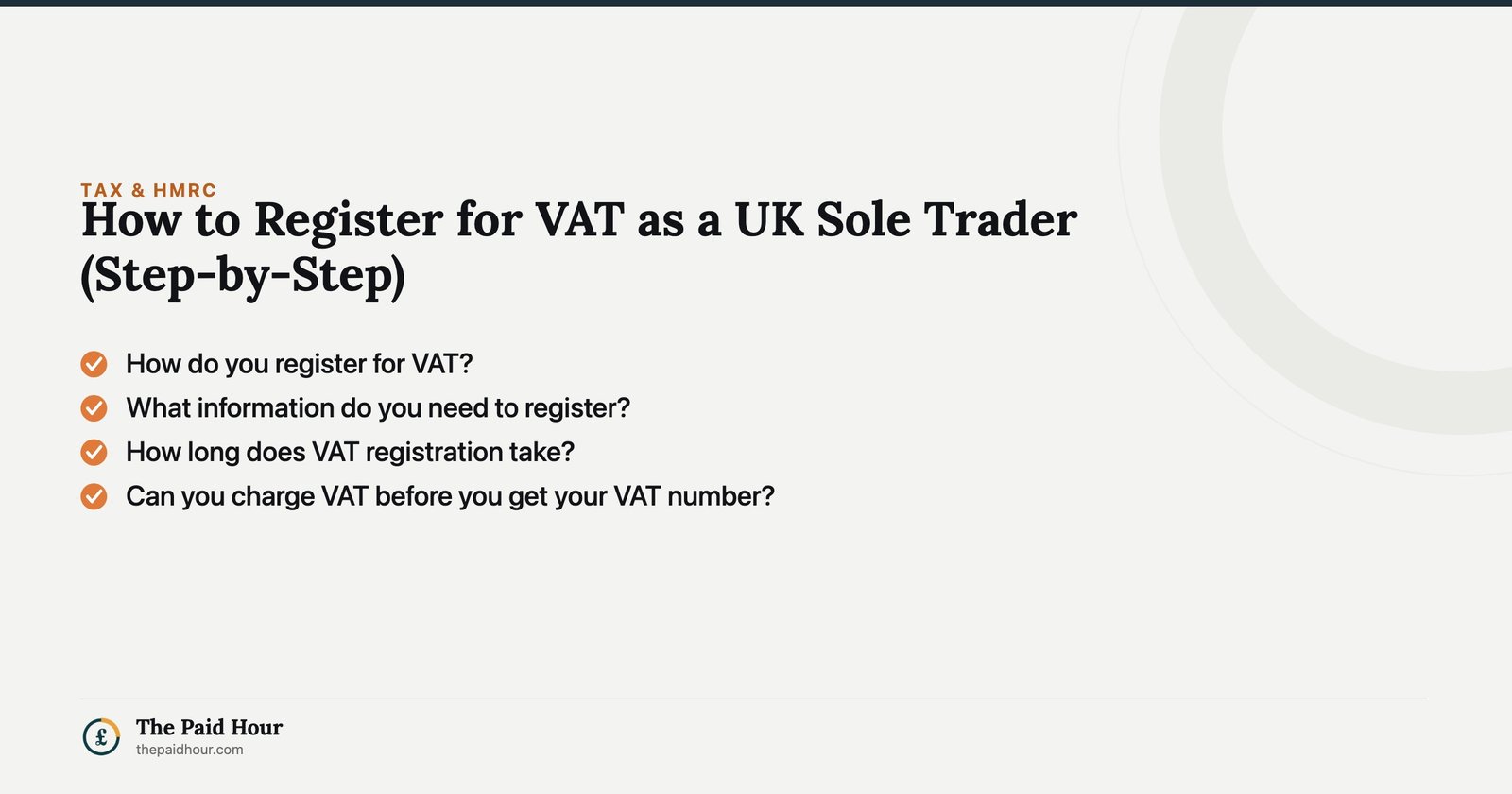
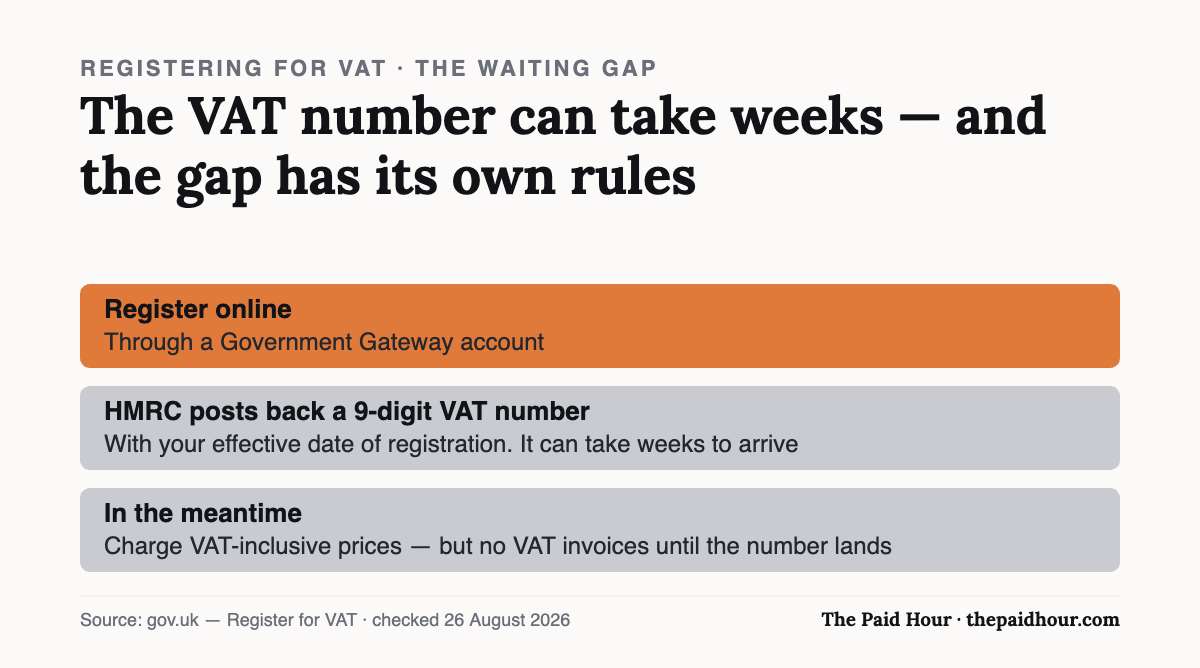
In short: You register online through a Government Gateway account, and HMRC posts back a 9-digit VAT number with your effective date of registration. The number can take weeks, you can charge VAT-inclusive prices meanwhile, but no VAT invoices until it arrives. Step by step below.
Here’s how to register for VAT as a UK sole trader. Maybe you’ve gone over the £90,000 threshold, or you’re registering voluntarily. If you’re still working out whether you need to do this, read our guide to the VAT registration threshold first. This post picks up from there: the actual mechanics of getting registered.
How do you register for VAT?
Most sole traders handle how to register for VAT entirely online. HMRC’s guidance is straightforward: “You can usually register for VAT online” (gov.uk). You sign in (creating Government Gateway details the first time, if needed) and fill in the online application, you don’t have to finish in one sitting, as you can save your progress and return later (gov.uk).
You don’t have to do this yourself. HMRC explicitly allows you to “appoint an accountant (or agent) to submit your VAT Returns and deal with HMRC on your behalf,” and you can still set up your own VAT online account once your registration number arrives (gov.uk). If you already use an accountant for Self Assessment, having them handle VAT registration too is common.
Registering by post using form VAT1 is only required in specific situations: for example, applying for a registration exception because you went over the threshold temporarily, joining the Agricultural Flat Rate Scheme, or registering as a local authority or insolvency practitioner. Almost no ordinary sole trader falls into these categories (gov.uk).
What information do you need to register?
Before you start the process of how to register for VAT, gov.uk lists what a sole trader or partnership needs ready (gov.uk):
- Your National Insurance number
- An identity document: passport or driving licence
- Your bank account details
- Your Unique Taxpayer Reference (UTR), if you have one
- Details of your annual turnover and an estimate of taxable turnover for the next 12 months
- Information about your Self Assessment return, payslips, and P60, where relevant
(Limited companies need a slightly different set — company registration number, UTR, bank details, turnover figures, plus Corporation Tax/PAYE details, but most readers here are registering as sole traders (gov.uk).)
How long does VAT registration take?
Honestly: gov.uk does not currently publish a fixed number of days or weeks for VAT registration. The official “how to register” page says only that if you’ve already applied and you’re waiting to hear back, you should “check when you can expect a reply from HMRC” using their online checking tool, which gives live, current estimates rather than a fixed figure (gov.uk).
Flag for the reader: figures like “around 30 working days” circulate on accountancy blogs, but that number isn’t stated on the current gov.uk pages we verified, and processing times shift with HMRC’s workload. Use the official checking tool for a current estimate rather than planning around a fixed number, especially if a client requires proof of VAT registration by a specific date.
Can you charge VAT before you get your VAT number?
No, and this causes the most mistakes. HMRC’s guidance is explicit: “You cannot include VAT on your invoices until you get your VAT registration number, but you can increase your prices to account for the VAT you’ll need to pay to HMRC” (gov.uk).
In practice: add 20% to your normal price on any invoice raised on or after your effective date of registration, but don’t show it as a separate VAT line, you legally can’t yet. Once your number arrives, reissue the invoice showing the correct VAT breakdown. Your customer doesn’t pay anything extra at that point; they simply reclaim the VAT shown on the reissued invoice on their next VAT return (gov.uk).
Gov.uk’s own worked example: with an effective date of registration of 1 May, a £100,000 invoice raised that day becomes a £120,000 invoice (20% added, no VAT line shown), then gets reissued showing £20,000 VAT once the number comes through (gov.uk).
What is the “effective date of registration”?
It’s the date your VAT obligations start, confirmed after you register instead of necessarily the day your number arrives. This is a detail people researching how to register for VAT often miss. Gov.uk states plainly: “You can start charging VAT on your sales and reclaiming VAT on items you bought from your effective date of registration” (gov.uk). This is the date that drives your VAT liability, your first return period, and the invoicing process above.
What happens after you register?
Once HMRC processes your application, you’ll receive, by post (gov.uk): a 9-digit VAT registration number (which must appear on every invoice from then on), confirmation of your effective date of registration, details of when your first VAT return and payment are due, and information on setting up a business tax account if you don’t already have one.
Registration also opens a choice about how you account for VAT. Standard accounting tracks input VAT line by line. The VAT Flat Rate Scheme replaces that with a fixed percentage of gross turnover, which suits some sole traders and costs others money.
You must sign up for a VAT online account as soon as your number arrives. Sign in, select “Add a tax, duty or scheme now,” then “VAT and VAT Services” (gov.uk). HMRC will also automatically sign your business up to Making Tax Digital for VAT, unless you’re exempt (gov.uk), meaning you’ll need MTD-compatible software for your VAT records and returns from that point. If you haven’t picked accounting software yet, our comparison of accounting software for UK freelancers covers the MTD-ready options.
Quick recap: how to register for VAT
- Register online in almost all cases; use an agent if you’d rather not; post (VAT1) is only for specific exceptions.
- Have NI number, ID, bank details, UTR, and turnover figures ready before you start.
- No fixed processing time is published by gov.uk: check HMRC’s live tool rather than a guessed number of days.
- You cannot charge VAT on invoices until your number arrives, increase prices instead, then reissue invoices once registered.
- Your effective date of registration, not the day your number lands in the post, is when obligations begin.
That’s the full process of how to register for VAT as a UK sole trader, from your online application through to your first return.
First VAT return coming up?
First Year of VAT 2026/27. Eight modules and a four-sheet toolkit that take you from monitoring the threshold to filing a correct first return, without a penalty.
- A rolling twelve-month threshold monitor that warns you before you cross, including the overseas purchases that count
- The flat-rate-versus-standard calculator with the limited cost trader test built in, on your own figures
- Pre-registration reclaims, the twelve mandatory invoice fields, and the price-rise letters for B2B and B2C clients
The £90,000 test runs on any rolling twelve months, not your tax year, and services you buy from overseas count towards it. Plenty of freelancers register late without ever noticing they crossed.
Buying more than one? All ten 2026/27 courses for £107, against £328 at full price.
Sources
- Register for VAT: How to register for VAT. Gov.uk
- Register for VAT: When to register for VAT, gov.uk
- Check when you can expect a reply from HMRC: gov.uk
The £90,000 registration threshold and the rolling 12-month test were re-checked against gov.uk on 26 August 2026. This is general information about how the rules work, not tax advice. The links above go to the primary sources; for your own circumstances, speak to an accountant or contact HMRC directly.