
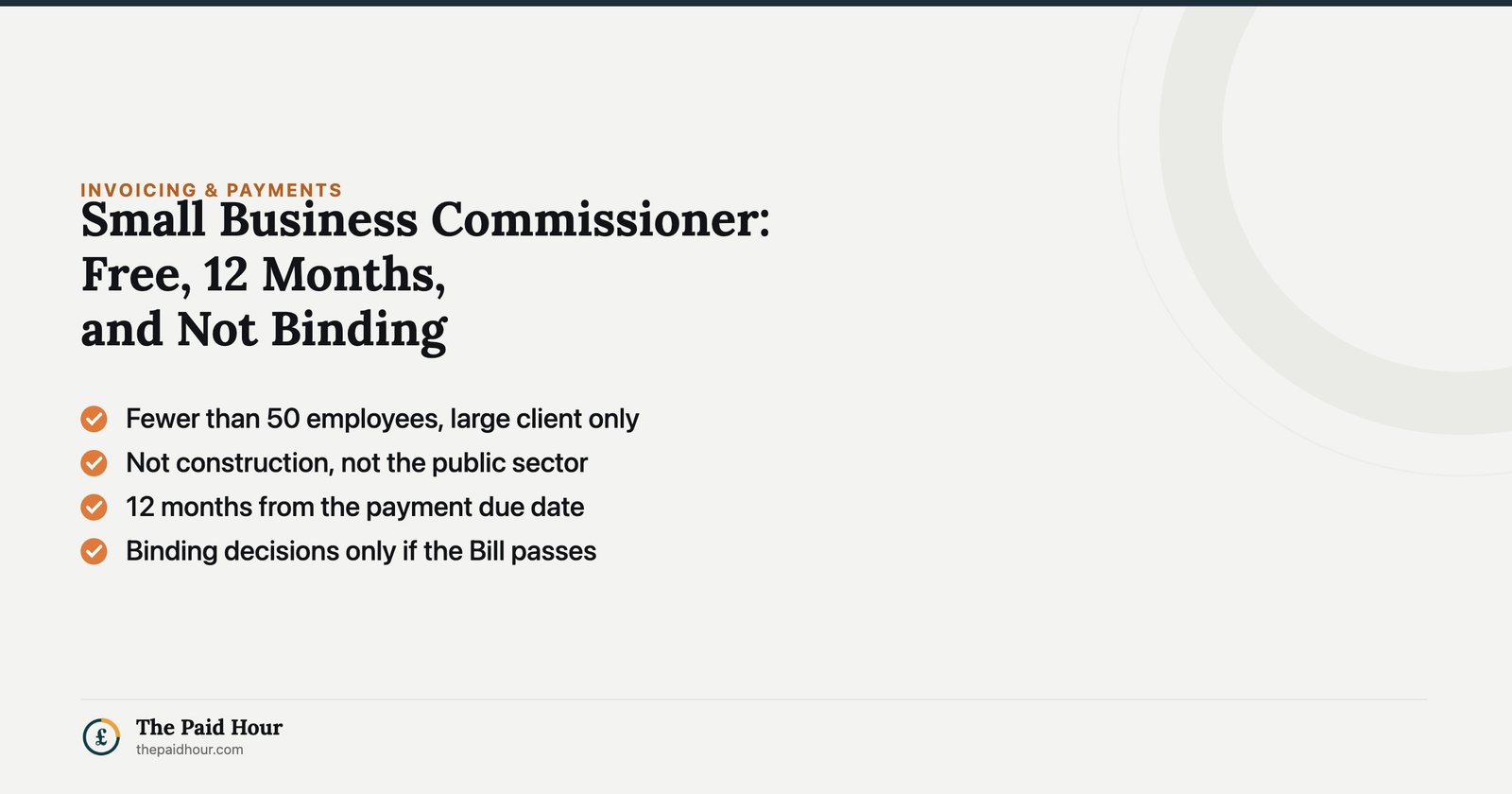
What matters here: The Small Business Commissioner is free, needs no lawyer, and is the single most recommended answer to late payment in the UK. It is also the one that cannot make anybody pay you. Five filters decide whether it will even look at your case, under 50 employees, a large client rather than construction rather than a public body, and within 12 months of the due date, and the client filter is the one most freelance work fails. What it produces at the end is a recommendation, not an order. A Bill now at report stage in the Lords would change that.
Ask about an unpaid invoice in any UK freelancing group and someone will tell you to report the client to the Small Business Commissioner. It is good advice in the sense that it costs nothing. It is bad advice in the sense that almost nobody who repeats it has checked whether you qualify, or what happens if you do.
Both halves are worth knowing, because the answer is about to change.
What the Small Business Commissioner is
An independent public body, set up under the Enterprise Act 2016, which describes its own job as tackling “late payments and unfair payment practices” in the private sector. It gives information and guidance, it runs a complaints scheme, and it will step into a dispute between a small supplier and a big customer and try to get it settled.
It is not a court instead of a regulator with teeth, and not an ombudsman that can award you money. Hold that thought, the rest of this page is really about what follows from it.
Five filters, and most freelance work fails one
The eligibility rules are on the Commissioner’s own FAQ page and they are stricter than the advice suggests.
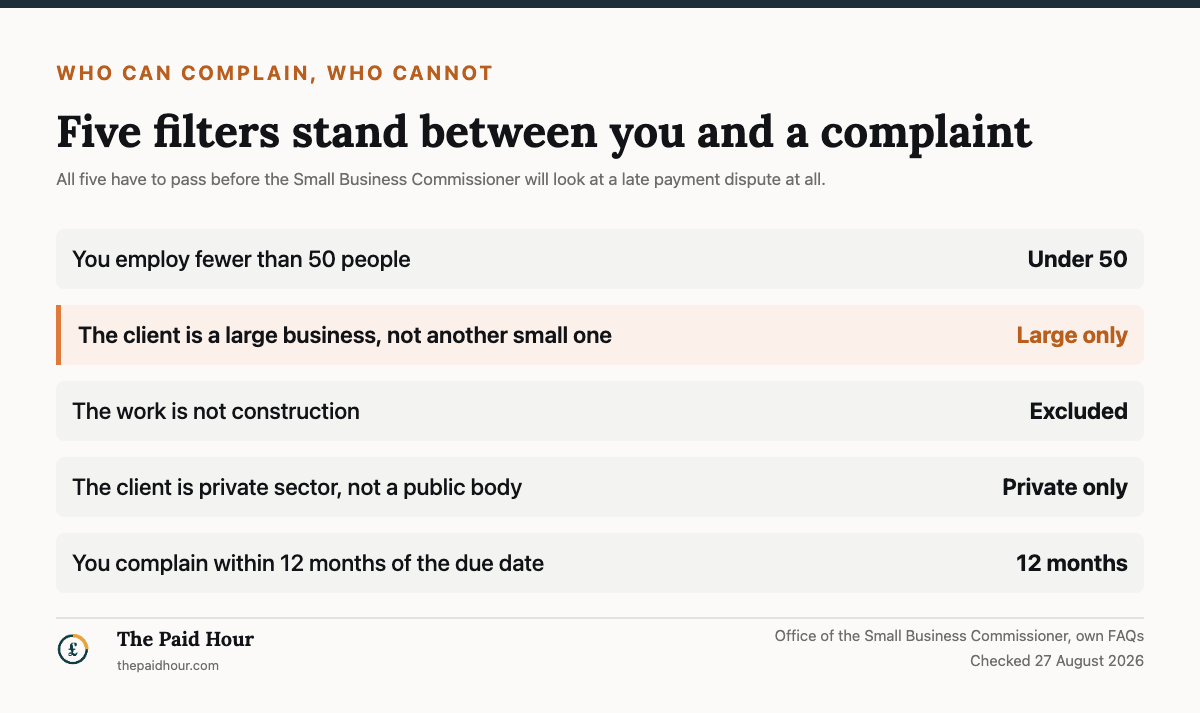
Your size is the easy one: “We define a small business as any firm with fewer than 50 employees.” Every sole trader clears that without thinking about it.
Their size is the filter that bites. The Commissioner is explicit that the Enterprise Act 2016 means complaints “can only be investigated if the dispute is made by a small business against a large business.” A design studio of six people that has not paid you is not a large business. Neither is the agency, the start-up, or the other freelancer who subcontracted the work. For a lot of freelance invoices the process stops on this line, and nobody in the group chat mentions it.
Construction is out: work under the Housing Grants, Construction and Regeneration Act 1996 is “outside the remit of the Small Business Commissioner”, because that sector has its own adjudication regime. The public sector is out too: it “can only investigate disputes between businesses in the private sector”, so a council, an NHS trust or a university is the wrong target. And the debtor needs “some form of UK presence, for example an office or factory in the UK”, which quietly rules out the overseas client.
Twelve months, and it costs nothing
The deadline is short and it is not the one you are used to. “Complaints regarding non-payment should be submitted within 12 months of the payment due date.” Not from the last chaser, not from when they stopped replying, from the date the invoice fell due.
That sits inside, and expires long before, the six years you have to sue. So a debt can be perfectly alive in court and already too old for the Commissioner.
Against that, the price is the strongest thing about it: “There is no charge to use our services. Information, guidance, and our complaint scheme is free and available to all small businesses with fewer than 50 employees.” No fee, no lawyer, no risk of a costs order. If you pass the five filters, there is very little reason not to.
What the Small Business Commissioner cannot do
It cannot order your client to pay you. That is the whole shape of the thing, and it is the part the recommendations skate over.
The proof is not on the Commissioner’s own pages, it is in the Bill written to fix it. The government’s factsheet for the Commercial Payments Bill says the Bill will let the Commissioner “adjudicate contractual payment disputes between small and larger businesses outside of the court process and make binding interim decisions”. You do not legislate to make something binding if it already is.
So what a complaint buys you today is pressure and a third party. A large business with a procurement team, a reputation and a payment-practices report to file does not enjoy an official body writing to it about an unpaid supplier. That works often enough to be worth the hour it takes. It is just not enforcement, and you should not stop the clock on anything else while you wait for it.
One practical consequence: keep statutory interest and the fixed compensation sum running on the invoice the whole time. The Commissioner cannot award them, but they are yours by statute, and they are what a settlement gets negotiated down from.
The Bill that would let it decide instead of recommend
This is the part worth watching, and it is moving.
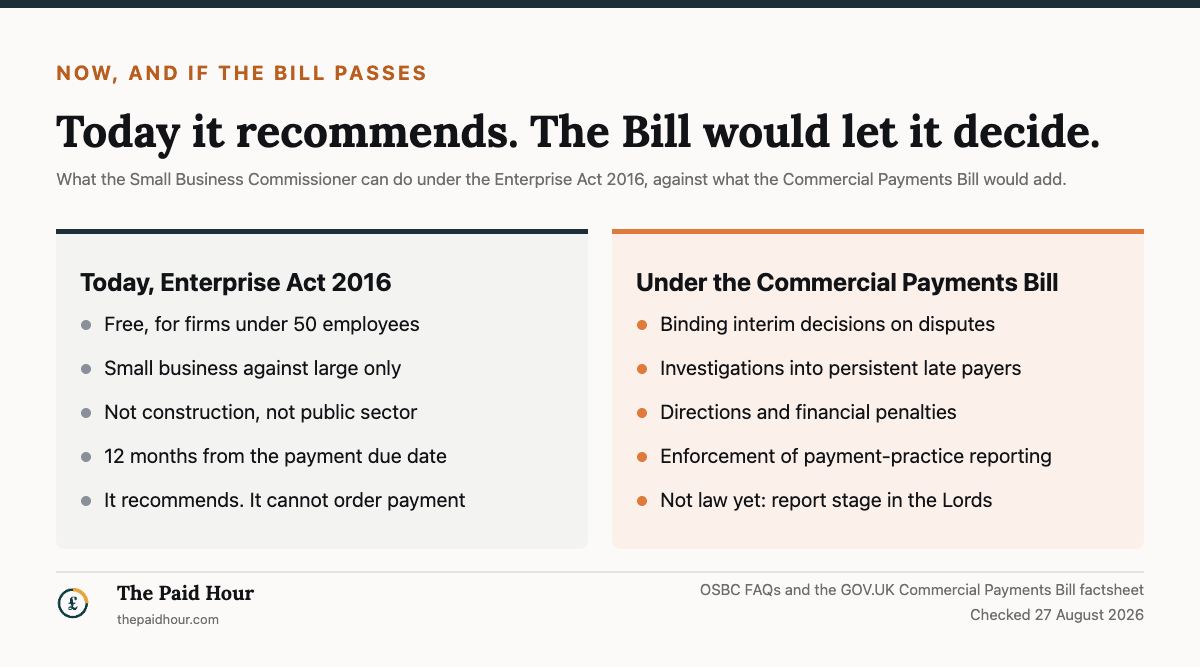
The Commercial Payments Bill would give the Commissioner three things it does not have. Binding interim decisions on individual disputes, as above. Power to “investigate larger businesses suspected of persistently engaging in poor payment practices”, with “the power to make directions and impose financial penalties”. And enforcement against firms that breach “their statutory reporting requirements on payment practices and performance”, the twice-yearly returns that big companies already have to file about how fast they pay.
The same Bill caps commercial payment terms at 60 days “with strictly limited exemptions”, which is the headline everyone quotes. The Commissioner’s new powers are the quieter half and probably the more useful one for a sole trader, because a cap you have to enforce yourself is not much of a cap.
None of it is law yet. The Bill was introduced in the Lords in May 2026 and, on its own Parliament page checked on 27 August 2026, it sits at report stage and has not reached the Commons. The government has said there will be “an appropriate lead-in time” and a transition period, and that the measures “will not be applied retrospectively”. Nothing here helps with an invoice that is late this week. The interest guide covers what the Bill changes in more detail.
The free lever nobody uses: the Fair Payment Code
The Small Business Commissioner runs a second thing that gets almost no attention, and it is useful before you have a problem instead of after.
The Fair Payment Code launched in December 2024 and replaced the old Prompt Payment Code. It is voluntary, free to join, and it grades signatories:
- Gold: “for those firms paying at least 95% of all invoices within 30 days”
- Silver: “for those paying at least 95% of all invoices within 60 days, including at 95% of invoices to small businesses within 30 days”
- Bronze: “for those paying at least 95% of all invoices within 60 days”
Awards run for two years and have to be reapplied for, so a badge is a claim about recent behaviour rather than a decoration from 2019. Over 450 businesses hold one.
Use it as a search box. Before you take a big job on 60-day terms, look up whether the client is on the Code and at what tier, and, separately, read its statutory payment-practices report, which every large UK company has to file. Ten minutes there tells you more about whether you will be paid than any clause in the contract does. Then write the terms accordingly and, if the answer was ugly, take a deposit.
So is a Small Business Commissioner complaint worth it?
Yes, in one situation, and it is a narrow one: a large private-sector UK client, an invoice that is not in dispute, within 12 months of the due date, where you have already chased properly and been ignored. It costs nothing, it carries an official letterhead, and a company that size has reasons to care.
No, or not yet, everywhere else. If the client is small, if the work was construction, if the customer is a public body, if the debt is over a year past due, or if the client is arguing about the work rather than ignoring you: the Small Business Commissioner is not your route and the delay costs you.
And run it in the right order. Chase, then charge interest, then complain if you qualify, then sue. The one thing not to do is treat a free complaint as a substitute for the step that ends in an enforceable judgment. The full order of escalation is here.
What to keep
- The invoice, with the due date visible: that date starts the Commissioner’s 12-month clock, and it needs everything a UK invoice must include
- The contract, the purchase order or the email that agreed the terms
- Every chaser you sent and every reply, with dates — the Commissioner expects you to have tried first
- Evidence the client is a large business, if it is not obvious
- Your running interest and compensation calculation
Sources
- Office of the Small Business Commissioner
- Small Business Commissioner, FAQs (eligibility, exclusions, time limit)
- The Fair Payment Code. About
- Commercial Payments Bill: overview, GOV.UK factsheet
- Commercial Payments Bill [HL]: UK Parliament
The 50-employee definition, the small-against-large rule, the construction and public-sector exclusions, the UK-presence requirement, the 12-month limit and the no-charge statement are quoted from the Small Business Commissioner’s own FAQ page. The Gold, Silver and Bronze thresholds are quoted from the Fair Payment Code’s own about page. The Bill’s new powers and the 60-day cap are quoted from the government’s Commercial Payments Bill factsheet, and its stage was read from the Bill’s Parliament page. All checked on 27 August 2026, the Bill is still moving, so re-check the stage before relying on it. This is general information about how the process works, not legal advice; for a substantial or disputed debt, speak to a solicitor.
If the Commissioner route does not fit your case, the alternatives are a court claim: see Money Claim Online and small claims court costs.
Ready to stop chasing and start recovering?
Late Payment Recovery & Legal Safeguards. The seven-stage escalation ladder with dates, every letter written for you, an interest calculator that adds what the law owes you, and the Money Claim Online walkthrough with real fees.
- Reminder letters for stages one to four, then a Letter Before Action that complies with the Pre-Action Protocol (company and individual versions)
- Auto-calculating statutory interest and compensation statement: £40 to £100 per invoice plus interest at base rate plus 8%
- Payment plan with a default clause, particulars of claim wording, hearing bundle index, and the client scorecard that fires slow payers
A solicitor charges around £40 plus VAT for a single letter before action. This is every letter in the sequence, the interest you are legally entitled to claim, and the court route, for one fee.
Buying more than one? The Complete Freelancer System, all five for £87, against £215 at full price.