
Before you read on: Once you are VAT registered, an invoice becomes a legal document with a fixed list of required fields, VAT number, the VAT amount shown separately, and more, plus a 30-day deadline to issue it. Smaller sales can use a simplified version. Get the fields wrong and a VAT check gets uncomfortable.
VAT invoices explained simply: once you register for VAT, your invoices stop being just a request for payment and become a legal document HMRC can ask to see. There’s a specific list of information you’re required to include, a deadline for issuing it, and a simpler version you’re allowed to use for smaller sales. Missing any of it isn’t just untidy, it can cause real problems if you’re ever checked.
What a full VAT invoice must include
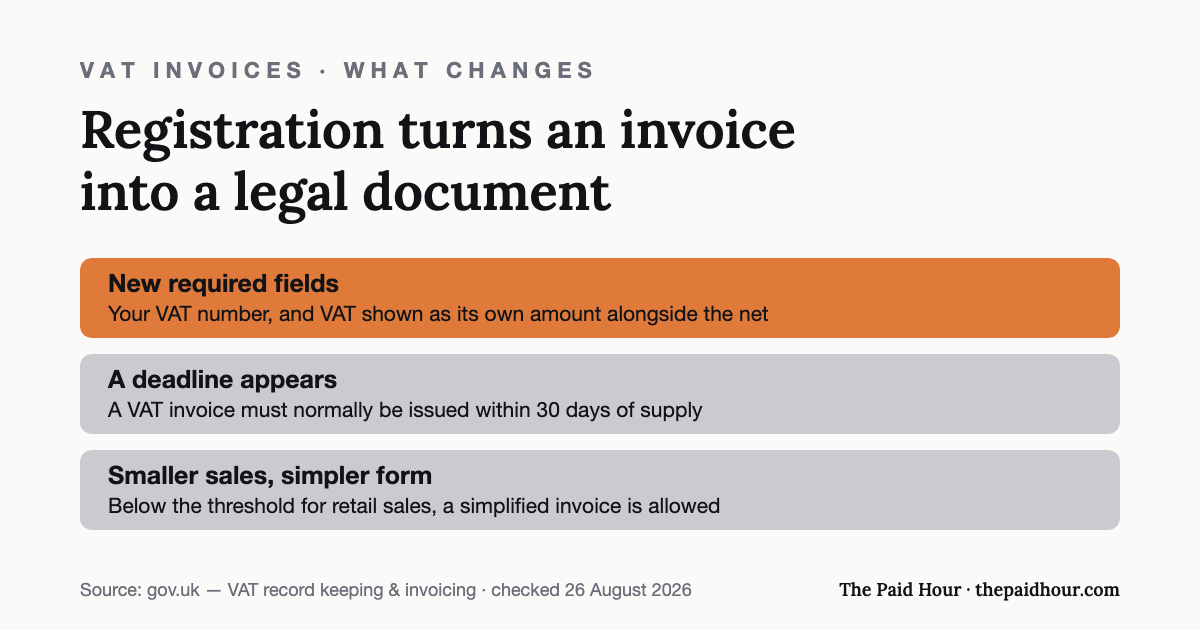
According to HMRC’s VAT record-keeping guidance, a full VAT invoice needs to show:
- A unique, sequential invoice number
- The date of supply (tax point) and the date of issue
- Your name, address, and VAT registration number
- Your customer’s name and address
- A description clear enough to identify what was supplied
- The quantity, unit price, VAT rate, and amount excluding VAT for each item
- The total amount payable excluding VAT
- The total VAT chargeable, shown in sterling
- Any cash discount rate, if one applies
That’s noticeably more than a standard freelancer invoice needs, see our guide on what a UK invoice must legally include for the baseline before VAT enters the picture.
The 30-day rule
HMRC’s guidance is specific here: “normally you must issue a VAT invoice within 30 days of the date you make the supply.” That’s not a soft guideline, it’s the standard deadline for a compliant invoice, and it’s worth building into your invoicing routine rather than treating invoicing as something you get to whenever.
Simplified invoices for smaller sales
For supplies of £250 or less including VAT, you don’t need the full invoice format. A simplified VAT invoice just needs your details, the time of supply, a description of what was supplied, and the total amount payable including VAT, along with the VAT rate charged. For anything over £250, you need either a full invoice or a “modified” invoice that shows figures inclusive of VAT rather than excluding it.
For most freelance work (a project fee, a day rate, a retainer), you’ll be well above the £250 simplified-invoice threshold most of the time, so the full format is what you’ll use day to day. The simplified version tends to matter more for small one-off items than for typical freelance invoicing.
What changes in practice
If you’re switching from unregistered to VAT-registered, the practical change is usually less about redesigning your invoice template from scratch and more about making sure your existing template has a slot for your VAT number, shows VAT as a clearly separated line instead of folded into the total, and uses a sequential numbering system rather than dates or project names as invoice references. Most invoicing software handles this automatically once you flip VAT registration on in the settings, but it’s worth checking a real invoice against the list above the first time, rather than assuming the software got every field right by default.
Source: gov.uk, Record keeping for VAT (Notice 700/21), checked 23 August 2026.
Credit notes and correcting a VAT invoice
Once a VAT invoice has gone out, you can’t just edit it if the amount was wrong or a client disputes part of the work. The correct fix is a VAT credit note: a document that references the original invoice number and reduces (or occasionally increases) the VAT-inclusive amount, with its own explanation of why. Credit notes need broadly the same core details as VAT invoices: a unique number, date, your VAT registration number, and a clear reference back to the invoice being adjusted.
Skipping this step and just reissuing a “corrected” invoice with the same number is one of the more common mistakes VAT-registered freelancers make, and it makes a mess of your VAT return reconciliation later.
Invoicing overseas clients once you’re VAT registered
VAT invoices explained for a UK-only client base is one thing; the rules shift again once a client is based outside the UK. Broadly, most B2B services supplied to a business client outside the UK are outside the scope of UK VAT under the “place of supply” rules, meaning you don’t charge UK VAT on that invoice, but you still need to show your VAT number and usually a note that the reverse charge applies where relevant. This is easy to get wrong, and getting it wrong either overcharges a client needlessly or under-declares VAT you should have charged, so it’s worth checking HMRC’s specific guidance for your situation instead of assuming the standard domestic invoice rules apply unchanged.
Letting software handle VAT invoices
Given how many fields a full VAT invoice legally needs, manually building each one in a word processor is where mistakes creep in — a missing VAT number, an inconsistent numbering sequence, or a wrong VAT rate on a mixed-rate invoice. Proper accounting or invoicing software applies the right template automatically once you flag yourself as VAT registered, which is one of the clearer arguments for using dedicated software over a spreadsheet the moment registration happens. See our best invoicing software for UK freelancers for options that handle this correctly out of the box.
Common mistakes with VAT invoices
- Reusing an invoice number after voiding an invoice, breaking the required sequential numbering.
- Forgetting the VAT registration number entirely on a template that predates registration.
- Charging VAT before the effective registration date shown on your VAT certificate.
- Not issuing a credit note when correcting a mistake, and instead editing or reissuing the original.
VAT invoices explained: quick answers
Do I need a new template the day I register? Yes, VAT invoices explained simply means every invoice from your effective registration date needs the full set of VAT fields, not just future ones you remember to update.
What if I forget and send a non-VAT invoice by mistake? Cancel it with a credit note and reissue a compliant one. VAT invoices explained this way means the paper trail has to show the correction rather than a silent edit.
Does this apply to every sale? VAT invoices explained above cover standard taxable sales; exempt or zero-rated supplies have their own, lighter rules, which is why checking your VAT rate per item matters before assuming one template fits everything.
Keep this page bookmarked for the first few months after registering, VAT invoices explained in the abstract are easy to nod along to, but the habit of actually including every required field only sticks after a few real invoices.
One last thing worth repeating: VAT invoices explained clearly to a client upfront (particularly the VAT-inclusive total), heads off more payment disputes than any amount of small print buried in your terms. Getting VAT invoices explained right the first time, before your first VAT-registered sale goes out, saves a annoying correction cycle later.
Deposits are where the tax point rules bite hardest, because the VAT falls due when the money lands rather than when the job finishes. We went through what a deposit does to your VAT, including the refundable ones.
Flat Rate Scheme: saving you money, or costing it?
First Year of VAT 2026/27. Eight modules and a four-sheet toolkit that take you from monitoring the threshold to filing a correct first return, without a penalty.
- A rolling twelve-month threshold monitor that warns you before you cross, including the overseas purchases that count
- The flat-rate-versus-standard calculator with the limited cost trader test built in, on your own figures
- Pre-registration reclaims, the twelve mandatory invoice fields, and the price-rise letters for B2B and B2C clients
The £90,000 test runs on any rolling twelve months, not your tax year, and services you buy from overseas count towards it. Plenty of freelancers register late without ever noticing they crossed.
Buying more than one? All ten 2026/27 courses for £107, against £328 at full price.
Need this ready-made? → HMRC-Ready Invoice Template: Navy Corporate (Editable) £4.99
Read next
Sources
The required fields were re-checked against VAT Notice 700 on 26 August 2026; the 30-day rule and simplified-invoice threshold are per VAT Notice 700/21, linked above.
This is general information about how the rules work, not tax advice. The links above go to the primary sources; for your own circumstances, speak to an accountant or contact HMRC directly.