
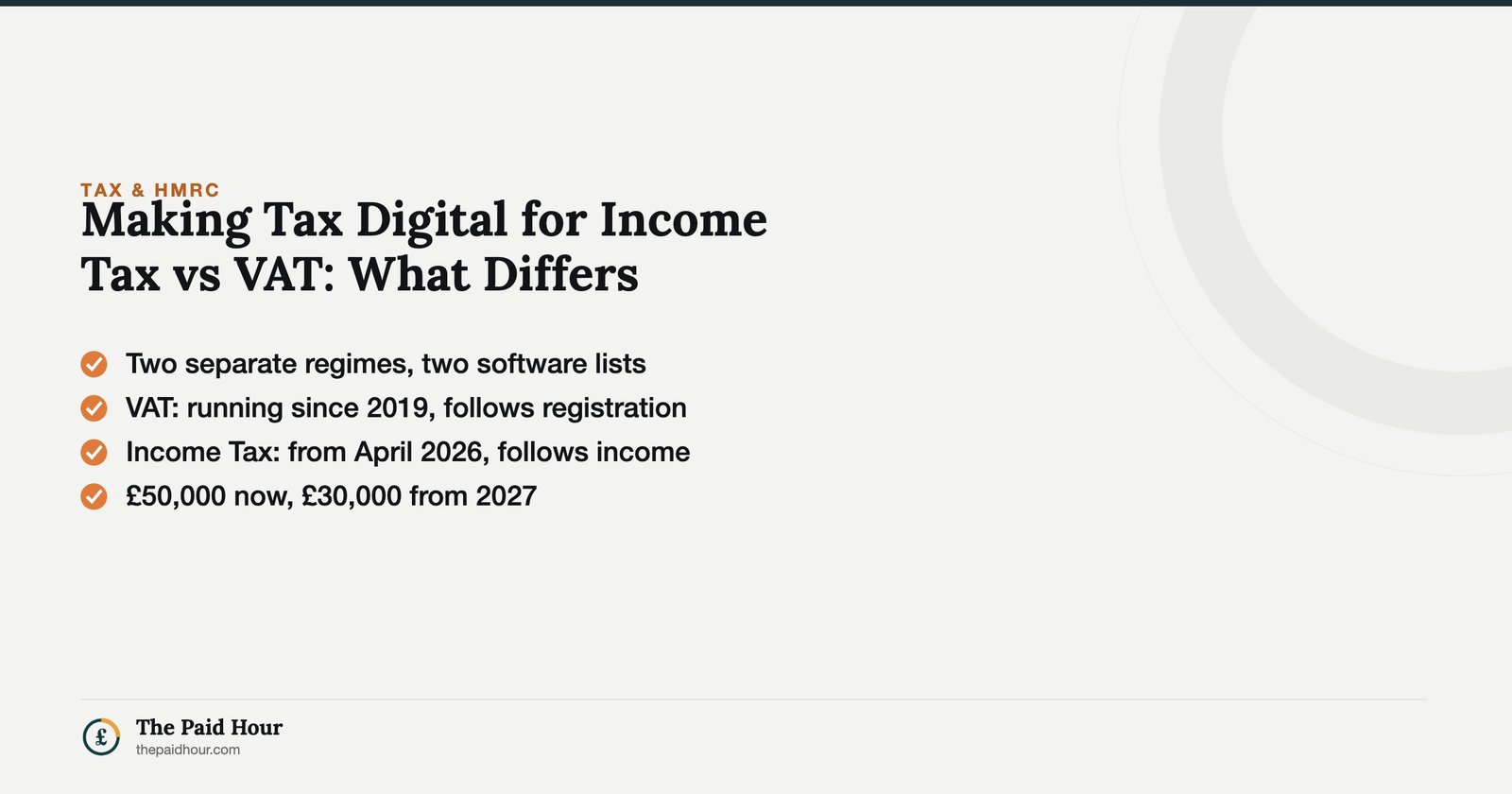
The short version: They are two separate regimes. MTD for VAT has run since 2019 and follows VAT registration; MTD for Income Tax started 6 April 2026 and follows qualifying income: £50,000 now, £30,000 from 2027. Different software lists, different deadlines, and being inside one does not put you inside the other.
Making Tax Digital for Income Tax and Making Tax Digital for VAT get mentioned in the same breath a lot, and mixing the two up is one of the most common freelancer mistakes right now.
Is Making Tax Digital mandatory?
Yes, but which version applies to you, and from when, depends on what you’re registered for. Making Tax Digital for VAT is already compulsory for essentially every VAT-registered business. Making Tax Digital for Income Tax is being phased in gradually by income level and isn’t mandatory for everyone yet. We’ll cover both below.
What is Making Tax Digital for VAT?
MTD for VAT is the requirement to keep your VAT records digitally and submit VAT Returns to HMRC using compatible software, rather than typing figures into HMRC’s old online portal by hand.
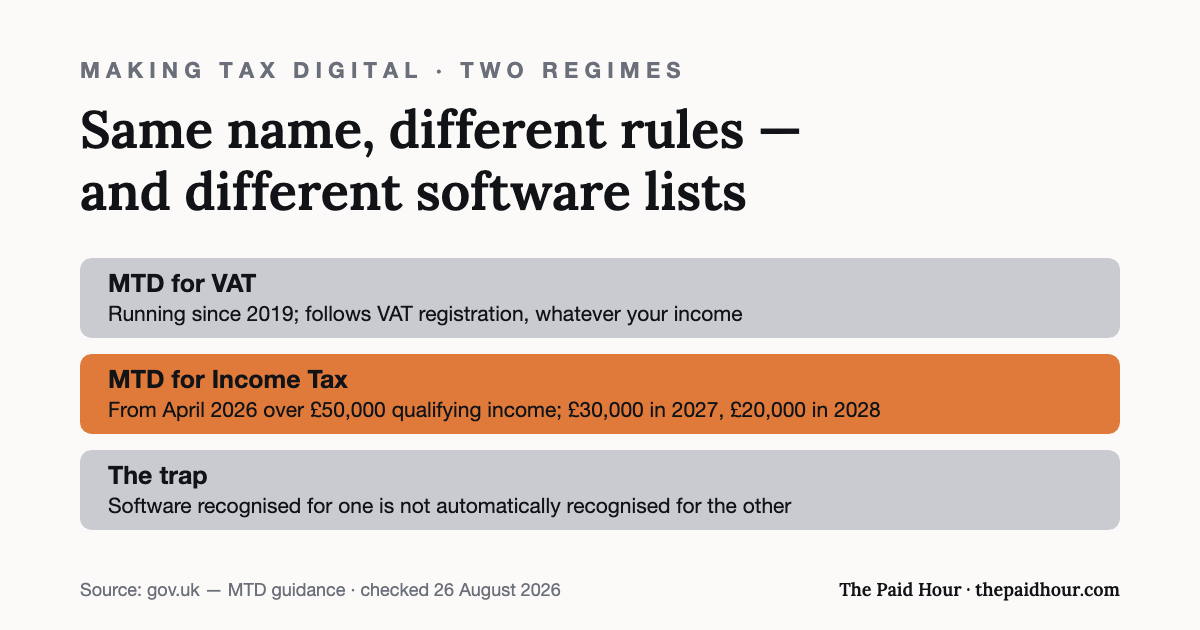
Who does it apply to, right now? All of them. HMRC’s own announcement confirms: “In July 2020, it was announced that all VAT-registered businesses must file digitally through Making Tax Digital from April 2022, regardless of turnover” (gov.uk). Larger businesses (turnover above the VAT threshold) were brought in first, from April 2019; smaller and voluntarily-registered businesses below the threshold followed from their first VAT period starting on or after 1 April 2022 (gov.uk). Today, gov.uk simply states: “All VAT-registered businesses should now be signed up for Making Tax Digital for VAT. You no longer need to sign up yourself” (gov.uk).
In practice this means: if you’re VAT-registered (whether that’s because you crossed the £90,000 VAT registration threshold or you registered voluntarily below it), MTD for VAT already applies to you. There’s no turnover exemption left.
What does MTD for VAT require?
Per HMRC’s VAT Notice 700/22, you need to:
- Keep your VAT records digitally, in what HMRC calls “functional compatible software” (gov.uk).
- Use software capable of recording and preserving the specified digital records, and of sending VAT Return data to HMRC through their API, and receiving information back the same way (gov.uk).
- Maintain digital links wherever data moves between different pieces of software forming your VAT records. HMRC is explicit that “manually transferring data within or between software programs…is not acceptable” once that data has entered your digital records, so copy-typing figures from one spreadsheet into another, for example, can fall foul of the rules (gov.uk).
A narrow exemption exists if you can’t go digital (for reasons such as disability, remoteness of location, or religious belief), in which case “it will not be required” (gov.uk). For almost everyone else, compatible bookkeeping software (Xero, QuickBooks, FreeAgent and similar all support MTD for VAT) is simply part of running a VAT-registered business now.
What is Making Tax Digital for Income Tax (MTD ITSA)?
MTD for Income Tax, often shortened to MTD ITSA (Income Tax Self Assessment), is a separate scheme for sole traders and landlords, replacing the annual Self Assessment tax return with quarterly digital updates plus a final declaration, submitted through compatible software.
Unlike VAT, it is not yet universal: it’s being rolled out gradually based on your qualifying income rather than your VAT status (many sole traders below the VAT threshold will still be caught by MTD ITSA, and plenty of VAT-registered businesses trading as limited companies won’t be caught by it at all, because it applies to individuals instead of companies).
We’ve covered the full detail (exemptions, what counts as qualifying income, how the quarterly updates work), in our dedicated guide to Making Tax Digital for Income Tax for sole traders. The short version, verified directly against gov.uk’s current guidance:
- From 6 April 2026: mandatory for sole traders and landlords with qualifying income above £50,000 (based on the 2024–25 tax year) (gov.uk).
- From 6 April 2027: the threshold drops to £30,000 (based on the 2025–26 tax year) (gov.uk).
- From 6 April 2028: the threshold drops again to £20,000 (based on the 2026–27 tax year) (gov.uk).
Partnerships are expected to be brought into MTD ITSA at some point, but gov.uk doesn’t yet give a confirmed date for that, so if you trade as a partnership, don’t assume a start date until HMRC publishes one.
MTD for VAT vs MTD for Income Tax: the key differences
| MTD for VAT | MTD for Income Tax (ITSA) | |
|---|---|---|
| Who it applies to | Any VAT-registered business or individual, any structure | Sole traders and landlords (individuals), based on income |
| What triggers it | Being VAT-registered (compulsory or voluntary) | Qualifying self-employment/property income over the threshold |
| Current status | Fully mandatory since April 2022, regardless of turnover | Phasing in by threshold, from April 2026 |
| What you submit | VAT Returns (usually quarterly) via compatible software | Quarterly updates + a final declaration, via compatible software |
| Replaces | Manual entry on HMRC’s VAT online portal | The annual Self Assessment return (for those in scope) |
Could both apply to you at once?
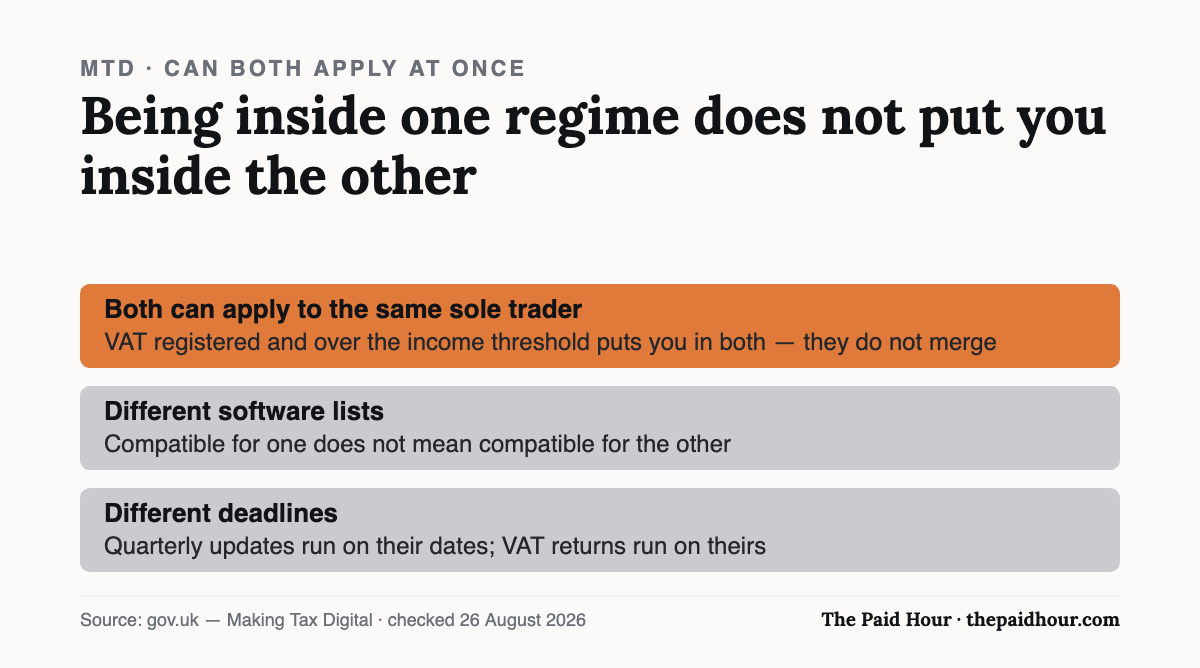
Yes, easily. A self-employed graphic designer who registered for VAT voluntarily at £40,000 turnover, and whose self-employment income is £55,000, is already inside MTD for VAT (since 2022) and now falls into the first wave of MTD ITSA (from April 2026) too. The two schemes run in parallel. Meeting one doesn’t exempt you from the other, and the software you use may need to handle both.
Where this leaves you
MTD for VAT is done and universal: if you’re VAT-registered, you’re already required to keep digital records, use compatible software, and maintain digital links between them, there’s no turnover carve-out left. MTD for Income Tax is still rolling out and depends entirely on your qualifying income, starting with the £50,000-plus group from April 2026, with lower thresholds following in 2027 and 2028. Check your own position against gov.uk’s current guidance rather than an older blog post, since these dates and thresholds have shifted before.
MTD quarters coming and the books are a shoebox?
Digital Bookkeeping System (MTD-ready) 2026/27. Seven modules and a seven-sheet toolkit, built around a category-to-tax-box mapping table that makes your quarterly updates fill themselves.
- A software decision sheet costed over three years, split by turnover, VAT status and phone-or-desktop
- The chart of categories mapped to the Self Assessment and MTD boxes, and the three categories never to auto-categorise
- Weekly and month-end cards, an MTD quarter-close checklist, and an export-and-archive index so their cloud is never your only copy
Software is priced monthly, excluding VAT, and you will hold the subscription for years. Pick on the wrong number and the difference over three years is more than every course on this site combined.
Buying more than one? All ten 2026/27 courses for £107, against £328 at full price.
Sources
- Making Tax Digital for VAT is coming, are you ready?, gov.uk
- Extension of Making Tax Digital for VAT: gov.uk
- VAT Notice 700/22: Making Tax Digital for VAT — gov.uk
- Check when you must start using Making Tax Digital for VAT / VAT record keeping, gov.uk
- Find out if and when you need to use Making Tax Digital for Income Tax. Gov.uk
- VAT registration threshold, gov.uk
The MTD for Income Tax start dates and thresholds were re-checked against gov.uk on 26 August 2026. This is general information about how the rules work, not tax advice. The links above go to the primary sources; for your own circumstances, speak to an accountant or contact HMRC directly.