
The short version: Most home-based freelancers never owe business rates: normal desk work in a spare room does not trigger them. They start when part of the home is used exclusively or commercially, a converted salon, a workshop, regular client visits, and the Valuation Office gives that part a rateable value.
Business rates are the wrong worry for most home workers, the right one is claiming the working-from-home tax relief you are owed. Still, this is one of those questions freelancers Google once, get a vague answer to, and then forget about, until a council letter turns up asking questions. The short version: most home-based freelancers never pay business rates at all. But there are specific situations where part of your home does get treated as business premises, and it’s worth knowing what triggers that before it happens to you.
The default: you just pay council tax
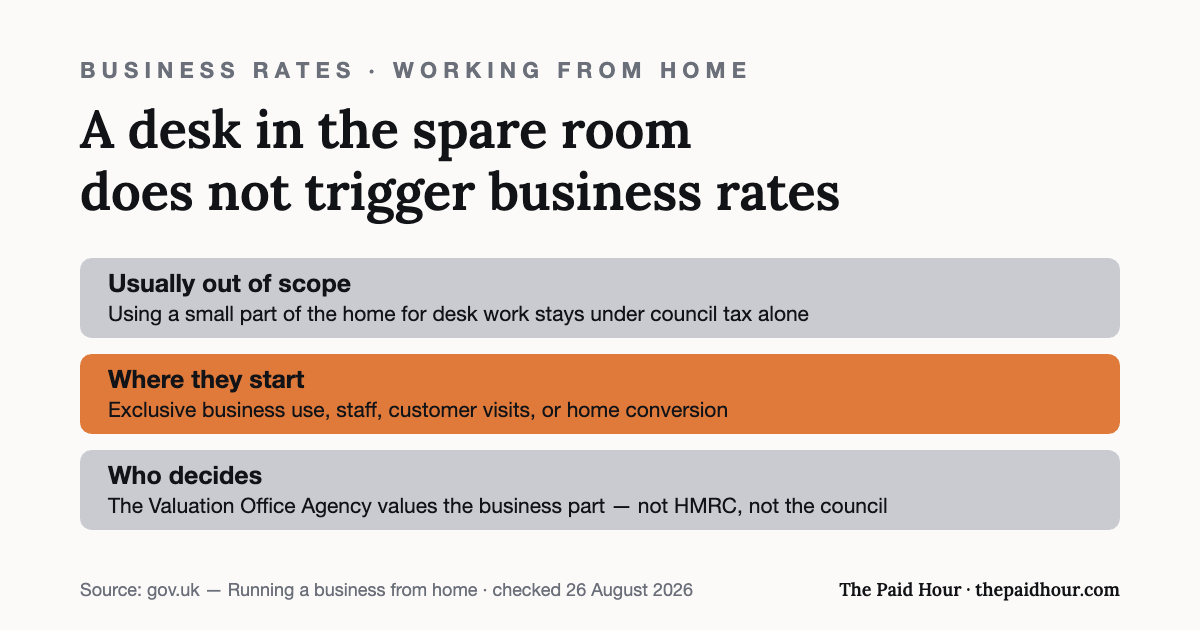
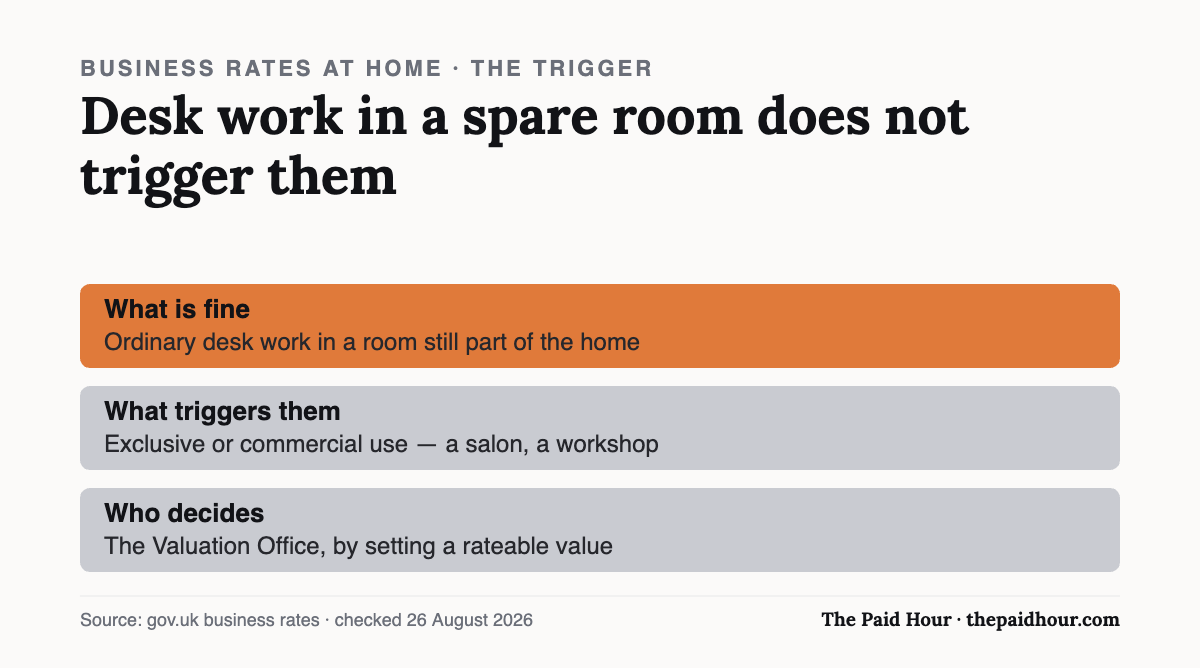
If you work from a spare room, kitchen table, or home office that’s still recognisably part of your home (used for both living and working rather than converted into something separate), you generally continue paying council tax as normal, with no business rates involved. This covers the overwhelming majority of freelancers: a laptop on a desk in the corner of a bedroom doesn’t turn your house into a rated business property.
What triggers business rates
According to gov.uk, whether you pay business rates instead of, or alongside, council tax depends on whether the Valuation Office Agency (VOA) has given part of your home a rateable value. That’s more likely to happen if:
- You’ve converted part of the property specifically for business use, a purpose-built garden studio or an extension used only for work, rather than a spare bedroom doing double duty.
- You employ staff who work from the property.
- You regularly have customers or clients visiting, or get frequent business deliveries.
- The part of your home used for work has features that make it look more like commercial space than domestic space.
If any of that sounds like your setup, the guidance is to contact the VOA directly (or the local assessor if you’re in Scotland) instead of guess: they’re the ones who make the call on whether part of your property gets a rateable value.
What it costs if you do get rated
If the VOA does assign a rateable value to your workspace, most freelancers land well within small business rate relief:
- Rateable value of £12,000 or less: 100% relief — effectively nothing to pay, as long as it’s your only business property.
- Rateable value between £12,001 and £15,000: relief tapers down gradually. A property valued at £13,500 gets roughly 50% relief; at £14,000, roughly 33%.
- Above £15,000: you generally fall outside small business rate relief and pay in full.
A home workspace’s rateable value is almost always small, so in practice most freelancers who do end up with a rated portion of their home still pay little or nothing thanks to this relief, the bigger practical issue is usually the planning permission question rather than the rates bill itself.
A worked example
Say you’re a freelance illustrator working from a converted garden studio you had built specifically as a workspace, separate from the main house. That’s exactly the kind of purpose-built, business-only space the VOA is more likely to look at. If they assess it and give it a rateable value of, say, £4,000, you’d fall well under the £12,000 threshold and get 100% small business rate relief. Meaning nothing to pay, but you’d still need to be registered and go through the process, rather than assuming no letter means no obligation.
Compare that to a freelance copywriter working from a desk in a spare bedroom that’s also used as a guest room. That’s still a domestic space doing double duty, not a converted or purpose-built business area, so it’s very unlikely to attract a rateable value at all.
Planning permission is the other thing to check
Separately from rates, if you’re making major structural alterations to accommodate your work, you may need permission from your local planning authority, and if you’ll have a lot of customers or deliveries, your council may want to know about that too. Neither of these is about rates specifically, but they tend to come up in the same conversation, so it’s worth checking both at once instead of assuming a clean rates position means everything else is automatically fine.
See our guide on simplified expenses and flat-rate working-from-home claims for the (separate) question of what you can deduct for tax purposes when you work from home.
Source: gov.uk (Running a business from home and gov.uk), Small business rate relief, checked 23 August 2026.
Other things a business-use declaration can trigger
Business rates aren’t the only knock-on effect of formally using part of your house for freelance work. Standard home insurance policies typically exclude business equipment and business-related liability, so running a design studio or a client-facing office from a spare room without telling your insurer can leave a claim unpaid exactly when you need it. A quick call to add business use, or a dedicated home business insurance policy, is usually inexpensive and worth doing regardless of whether business rates ever apply.
If you own with a mortgage, some lenders technically require notification of business use too, though enforcement in practice is inconsistent for a freelancer working quietly at a laptop. It becomes more relevant the moment clients, deliveries, or structural changes are involved.
Challenging a business rates decision
If the VOA does assign a rateable value to part of your home and you think it’s wrong (the room is smaller than assessed, or it’s mixed-use rather than dedicated business space), you can challenge the valuation through the VOA’s Check, Challenge, Appeal process rather than simply accepting the first figure. This is worth doing before assuming those rates are a fixed, unarguable cost; valuations are judgement calls, and mixed-use rooms in particular are often assessed generously if you push back with photos and a clear description of how the space is actually used day to day.
Common mistakes freelancers make with business rates at home
- Converting a garage or outbuilding into a dedicated, permanently-equipped office and assuming it’s treated the same as working at the kitchen table.
- Not telling home insurance about business use, then discovering a claim is void after the fact.
- Ignoring a VOA letter instead of checking small business rate relief eligibility straight away, for many home workers the relief brings the bill to zero rather than just reducing it.
- Assuming any client meetings at home automatically trigger business rates: occasional meetings in an otherwise domestic room rarely do; it’s dedicated, permanent business use that tends to matter.
For most freelancers working from a spare room or the kitchen table with no separate entrance, no employees on site, and no structural conversion, business rates when working from home simply won’t apply, council tax already covers it. The cases above are the genuine edge cases worth planning for rather than the default.
Frequently asked: business rates when working from home
Do I automatically owe business rates when working from home part-time? No, business rates when working from home are triggered by the VOA assessing part of your property, not by the fact you work there. Most part-time or occasional home workers never see a rateable value assigned.
Who decides whether they apply? The Valuation Office Agency in England and Wales, or your local assessor in Scotland instead of your local council directly, though the council bills you once a rateable value exists.
Can a business rates bill be backdated? Yes, in principle, if the VOA determines business use had already started. Another reason to notify them proactively rather than waiting to be found, and to register for small business rate relief the moment a rateable value is confirmed.
Filing it yourself this year?
HMRC Tax & Expense Mastery 2026/27. Nine modules and eleven working templates that take a UK freelancer from “do I even need to register” to a correct return, with MTD quarters built in.
- Fifteen expense categories, with the trap inside each one (training, clothing, meals, the seven-year pre-trading rule)
- Home and vehicle: flat rate against actual cost, with the £312 break-even worked out and the mileage lock-in rule
- The year-one payments-on-account cash shock, and the routine that stops it landing twice
HMRC does not send a list of what you forgot to claim. Most freelancers leave several hundred pounds of legitimate expenses on the table every single year, and the return still gets filed.
Buying more than one? The Complete Freelancer System, all five for £87, against £215 at full price.
Sources
The trigger conditions were re-checked against gov.uk on 26 August 2026.
This is general information about how the rules work, not tax advice. The links above go to the primary sources; for your own circumstances, speak to an accountant or contact HMRC directly.