
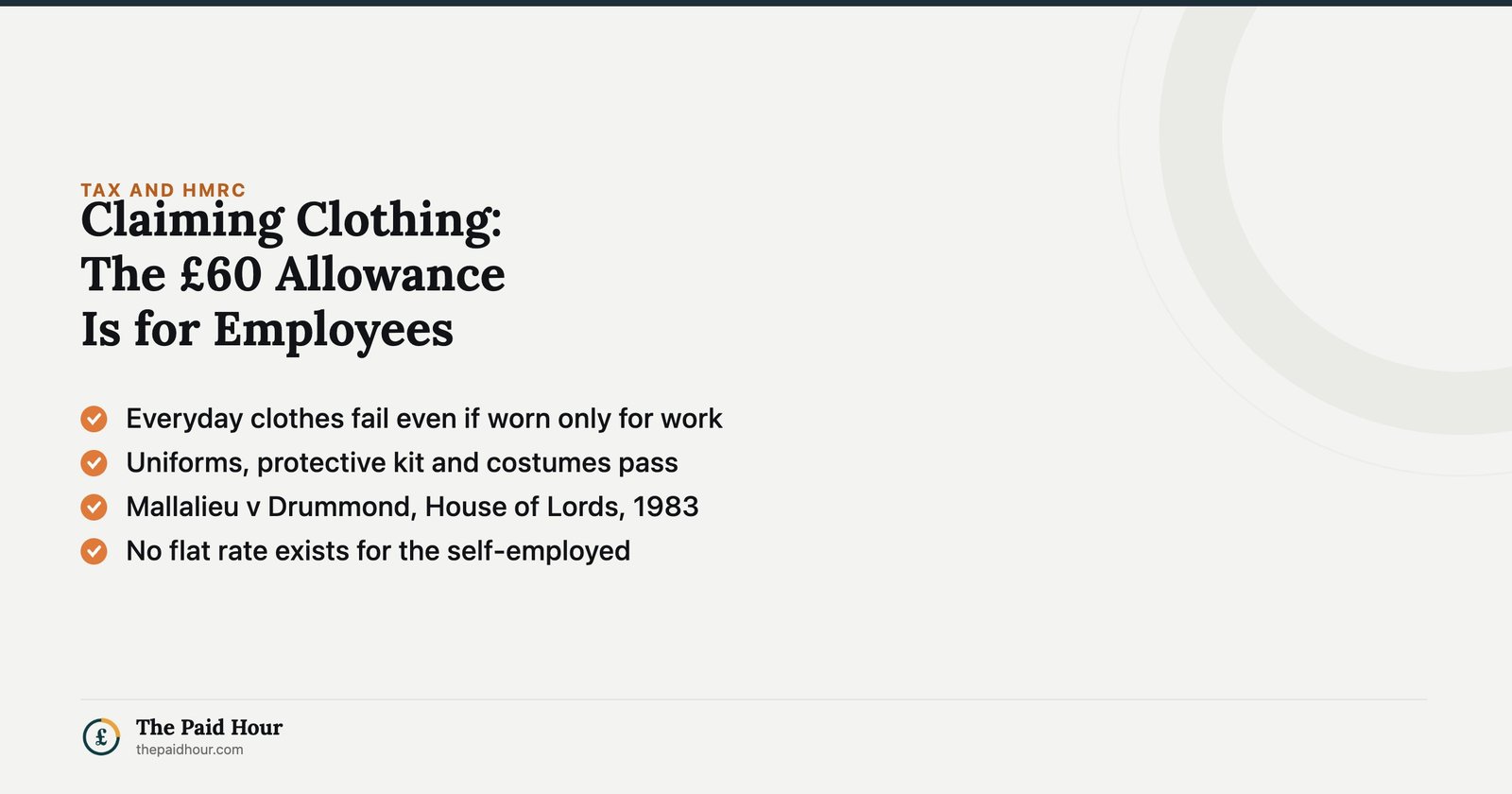
In short: HMRC allows three kinds of clothing against a sole trader’s profits — a uniform, protective clothing the work genuinely requires, and a costume for a performance. Everything else fails, and it fails even when you only ever wear it for work. The reason is not that HMRC suspects you. It is that clothes keep you warm and decent whether you intended that or not, and there is no way in law to strip that second purpose out. The £60 flat rate you will read about belongs to employees. There is no equivalent for the self-employed.
Table of Contents
Can you claim clothing when you are self-employed? Almost never. The rule itself is one sentence long. The reasoning behind it is not, and the reasoning is what stops you getting the next item wrong.
Search the question and within a few results you will meet a £60 allowance. That figure is real. It is not yours. It sits on an HMRC page written for employees, and that same page says, in as many words, that there are different rules if you are self-employed. A good deal of what is published about claiming clothing is an employee page with the word freelancer pasted over the top.
What clothing can a self-employed person claim?
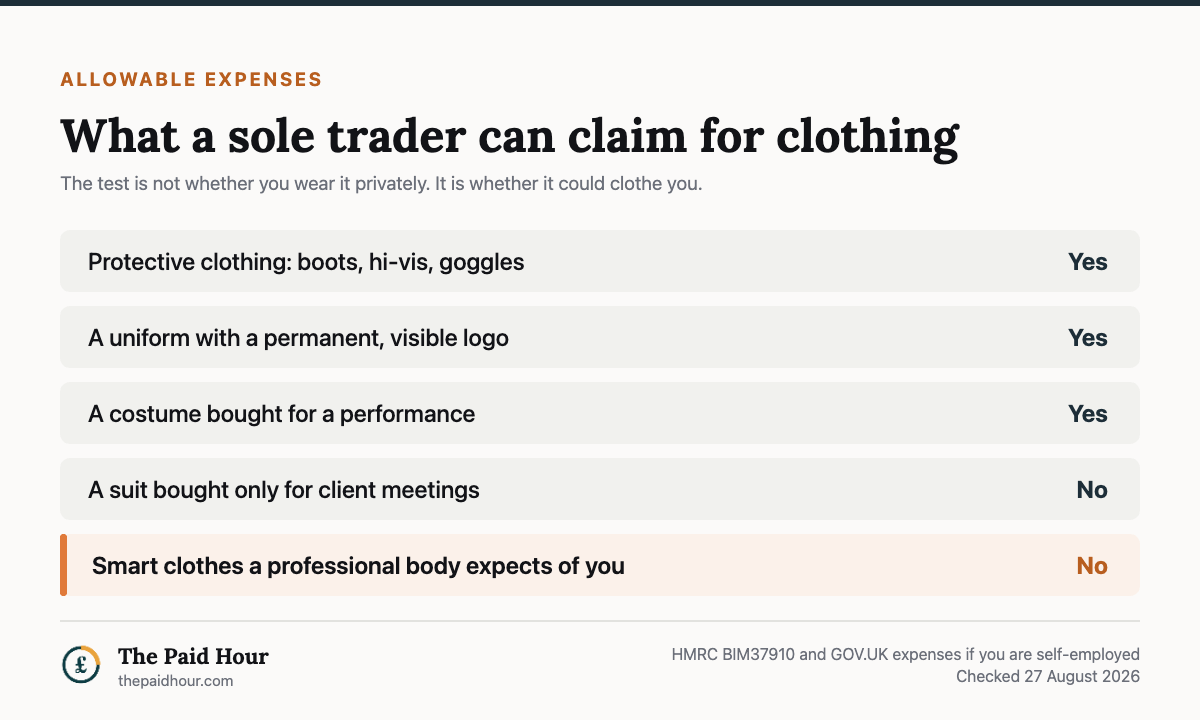
GOV.UK gives three categories: uniforms, protective clothing needed for your work, and costumes for actors or entertainers. Then one line closes the door on the rest — you cannot claim for everyday clothing (even if you wear it for work).
The bracket is doing the heavy lifting. Most people assume the test is private use: if the jacket never leaves the studio, surely it is a business cost. It is not, and that assumption is where almost every wrong claim starts.
Why a barrister lost the case over her court clothes
The authority is Mallalieu v Drummond, decided by the House of Lords in 1983. A female barrister claimed the cost of buying and cleaning the dark, sober clothes the Bar required her to wear in court. She did not wear them anywhere else. Her own taste, on her own time, ran to something rather more adventurous.
The lower courts agreed with her. The House of Lords, by four to one, did not.
The reason was never about whether she liked the clothes. It was that a human being wearing clothes is being kept warm and decently covered, and that is a purpose of the spending whether she thought about it or not. Lord Brightman drew the line between the object of an expense — what it is actually for, and its effect. An incidental private advantage does not sink a business expense. Warmth and decency are not incidental.
HMRC applies that in its Business Income Manual with no softening at all: ordinary clothing is disallowed even where particular standards of dress are required by, for example, the rules of a professional body. So the accountant who buys a suit because clients expect one, the consultant who would never otherwise own a blazer, the photographer in black at every wedding — all of them are buying everyday clothes, and none of them can claim.
Why you cannot just claim a business percentage
This is the part worth understanding, because it explains why some mixed costs split and clothing never does.
Section 34 of the Income Tax (Trading and Other Income) Act 2005 blocks a deduction unless the spending was wholly and exclusively for the trade. HMRC is blunt about what follows: there is no provision that allows a business proportion where an expense has a non-business purpose running through it.
There is one escape, and it is narrower than it sounds. Where a definite part or proportion of the spending was itself laid out wholly and exclusively for the trade, that part is allowable. A phone bill splits because the business calls are a definite part. A room in the house splits because the floor area and the hours are measurable. A coat does not split, because there is no identifiable slice of a coat that is doing business and not keeping you warm.
That distinction is why working from home tax relief exists and a clothing allowance does not.
The £60 uniform allowance is for employees
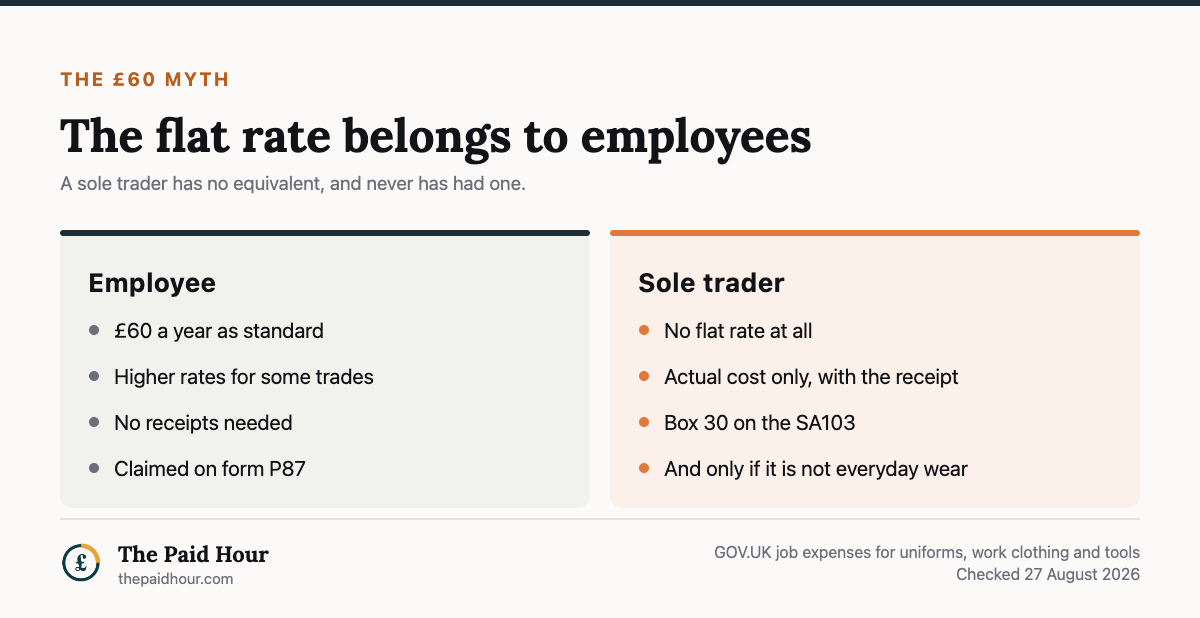
Employees who have to buy or launder their own uniform or specialist kit can claim a flat rate — £60 a year as the default, more for certain trades, without producing a single receipt. It is claimed on form P87 or through their tax return.
Nothing like it exists for a sole trader. Not a smaller version, not a pro-rated version. If you are employed and self-employed at the same time, you may be able to claim the flat rate against the employment and still get nothing against the self-employment, for the same shirt.
The simplified expenses flat rates do not fill the gap either. They cover vehicles, working from home and living in your business premises. Clothing is not on the list and never has been.
What actually counts as a uniform
HMRC allows uniforms, and then declines to define one. Lord Brightman called it a question of fact and degree, which is judicial for: you will know it when you see it, and so will we. The manual offers a nurse’s uniform and a waiter’s tails — clothes designed for the job in a way that makes them faintly ridiculous anywhere else.
The clearest statement HMRC publishes sits in the employment manual rather than the business one, so treat it as a guide to the thinking and not as your rule. It works through an airline uniform: the jacket, the skirt or trousers and the scarf all carry the airline’s name sewn prominently into the material, and all three qualify. The shirts, socks and shoes do not.
Read across to a sole trader and the practical test is the one an inspector will reach for anyway. Is the branding permanent and visible? Would you wear the item to a friend’s wedding? A polo shirt with your business name embroidered on the chest is a uniform. Five plain black polo shirts you happen to wear to jobs are five polo shirts.
Protective clothing is the easy one
Steel toe-capped boots, hi-vis, hard hats, goggles, gloves, overalls, chemical-resistant aprons. Where the work creates the hazard and the clothing answers it, the claim is straightforward, and this is where most trades will find their genuine clothing costs. If you work under the Construction Industry Scheme, protective kit is likely to be the only clothing line in your accounts.
Buy the boots because the site requires them and you have an allowable expense. Buy a heavy jacket because January is cold and you do not, whatever it says on the receipt.
Costumes, and the odd rule for performers
Actors and entertainers can claim costume bought for a performance. HMRC keeps a separate manual page for people in the public eye, and it repeats the Mallalieu line first: a self-employed person cannot claim a wardrobe of everyday clothes. A costume is different because it is not clothing you could plausibly live in.
The same page goes somewhere most guides never mention. Surgery for health reasons is not deductible, which HMRC traces back to a 1944 case. But a non-health cosmetic procedure can be, in the narrow case where the performer can show the spending had no private aesthetic motive at all. The manual gives cosmetic dentistry for a television performer who had never been troubled by their teeth until the work required it.
That is an extremely thin door, and it is only open to performers. It is worth knowing about because it shows what HMRC means by sole purpose, not mostly for work, but nothing else in it.
Cleaning and repairing work clothes
Upkeep follows the item. Mallalieu was a claim for buying and maintaining the clothes, and the Lords dealt with both the same way. So if the item passes — the branded uniform, the overalls, the costume, laundering and repairing it passes with it. If the item fails, dry-cleaning your suit fails too.
Where clothing goes on your tax return
On the full self-employment pages, allowable clothing sits in box 30, other business expenses, alongside subscriptions and sundry running costs. HMRC’s own notes to that box name the cost of ordinary clothing among the things that are not allowable — the warning is printed on the form you are filling in.
If your bookkeeping puts everything through and sorts it later, the disallowable half has to come back out before the profit figure is right. That is the same discipline as the rest of your disallowable expenses.
What to keep
The receipt, and one line saying why the item is not everyday wear. Embroidered with the business name. Site-mandated safety footwear. Stage costume for a named production.
Clothing is a small number that draws attention out of proportion to its size, because it is one of the categories an inspector expects to find mistakes in. A line of reasoning written at the time is worth more than an argument reconstructed three years later, and you need to keep the records for at least five years after the filing deadline anyway. More on what else HMRC looks at in what triggers a tax return enquiry.
If you are working through the wider list, start with allowable expenses for UK freelancers and treat clothing as the exception it is.
Claiming everything you are owed?
HMRC Tax & Expense Mastery 2026/27. Nine modules and eleven working templates that take a UK freelancer from “do I even need to register” to a correct return, with MTD quarters built in.
- Fifteen expense categories, with the trap inside each one (training, clothing, meals, the seven-year pre-trading rule)
- Home and vehicle: flat rate against actual cost, with the £312 break-even worked out and the mileage lock-in rule
- The year-one payments-on-account cash shock, and the routine that stops it landing twice
HMRC does not send a list of what you forgot to claim. Most freelancers leave several hundred pounds of legitimate expenses on the table every single year, and the return still gets filed.
Buying more than one? The Complete Freelancer System, all five for £87, against £215 at full price.
Sources
- Expenses if you are self-employed: clothing — GOV.UK
- BIM37910: intrinsic duality of purpose — clothing — HMRC Business Income Manual
- BIM37007: wholly and exclusively, overview — HMRC Business Income Manual
- BIM50160: performers in the public eye — HMRC Business Income Manual
- Claim tax relief for your job expenses: uniforms, work clothing and tools — GOV.UK
- EIM32476: clothing, the airline uniform example — HMRC Employment Income Manual
- Simplified expenses if you are self-employed — GOV.UK
Mallalieu v Drummond is reported at [1983] 57 TC 330 and is quoted here from HMRC’s Business Income Manual at BIM37910; Norman v Golder at [1944] 26 TC 293 from BIM50160. The three allowable categories and the everyday-clothing exclusion are GOV.UK’s wording. The £60 flat rate and the statement that different rules apply to the self-employed are from GOV.UK’s job expenses guidance. The box 30 treatment is from HMRC’s notes to the SA103F self-employment pages. All pages read on 27 August 2026. This is general information about how the rules work, not tax advice — check your own position with HMRC or an accountant before you file.