
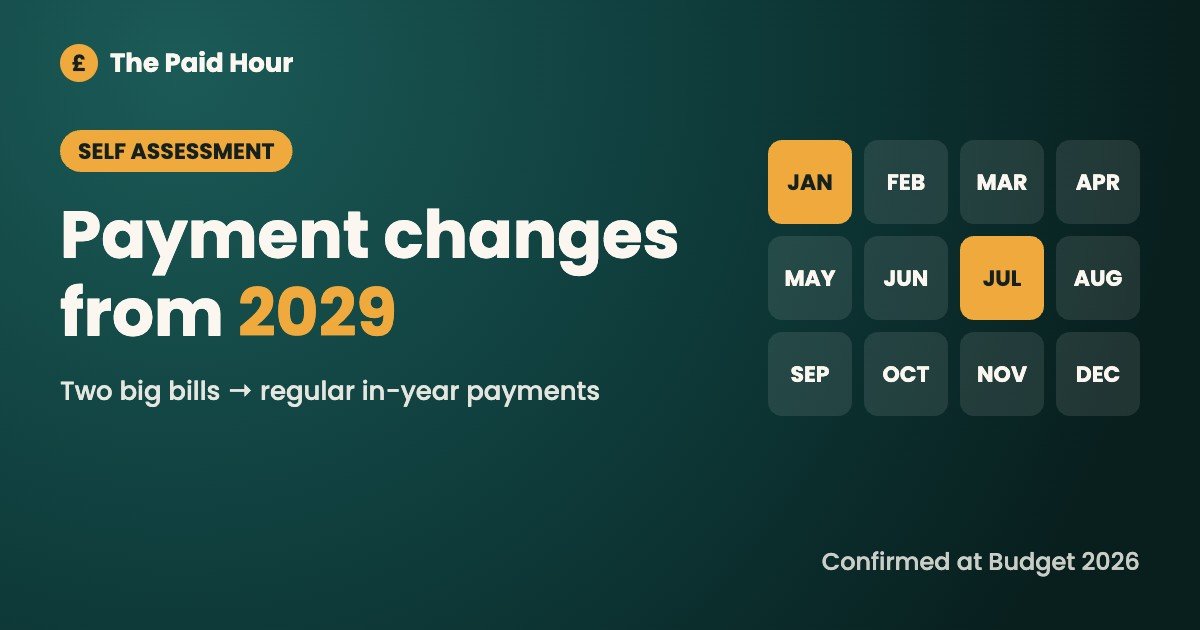
Confirmed at Budget 2026: from April 2029, Self Assessment taxpayers who make payments on account will make more regular payments during the year. HMRC says they will be automated, and people with enough PAYE income can choose to pay through PAYE. How often (monthly or quarterly) is still being designed. Nothing changes for 2026/27, 2027/28 or 2028/29. Checked 29 October 2026.
The Self Assessment payment changes 2029 are the biggest shift in how the self-employed pay tax since payments on account began. Instead of two large bills on 31 January and 31 July, you will pay towards the current year’s tax as you earn. The Budget on 28 October 2026 confirmed the plan. The detail, including how often you pay, is still being built.
Here is what is confirmed, what is still a proposal, what it could look like for a typical sole trader. And the switch-year cash squeeze to plan for now.
Table of Contents
Self Assessment payment changes 2029: what is confirmed
| Point | Status | Detail |
|---|---|---|
| Start date | Confirmed | April 2029 |
| Who | Confirmed | Self Assessment taxpayers who make payments on account |
| What | Confirmed | More regular payments during the tax year the income is earned |
| How | Confirmed | Automated payments; people with enough PAYE income can opt to pay through PAYE |
| How often | Not decided | Monthly or quarterly were both put forward in HMRC’s consultation |
| Transition rules | Not decided | Options include spreading the old July payment and voluntary prepayments |
Earlier plans suggested that people with a job or pension would have their Self Assessment tax collected automatically through PAYE. The Budget softened that: under the Self Assessment payment changes 2029, paying through PAYE is an option you can choose, not the default.
Self Assessment payment changes 2029: the timeline
| Date | What happens |
|---|---|
| June to August 2026 | HMRC consultation on timely payments |
| 28 October 2026 | Budget confirms in-year payments from April 2029, automated, with a PAYE opt-in |
| 2026/27 to 2028/29 | Payments on account stay on 31 January and 31 July |
| Before April 2029 | Detailed rules, frequency and transition support to be published |
| April 2029 | New in-year payments begin for the 2029/30 tax year |
Before the Self Assessment payment changes 2029: how payments on account work now
You make payments on account if your last Self Assessment bill was over £1,000 and less than 80% of your tax was taken at source, for example through PAYE. Each payment is half of last year’s bill:
| Date | What you pay |
|---|---|
| 31 January | Balance for the last tax year, plus the first payment on account for the current year |
| 31 July | Second payment on account |
That creates the famous first-year shock. In your first full year of self-employment, the January bill can be 150% of a year’s tax. The whole of last year plus half of this year in advance. Our payments on account guide walks through it. And you can reduce payments on account with SA303 if your income falls.
Why the Self Assessment payment changes 2029 are happening
- Around one in five Self Assessment bills is paid late.
- HMRC can receive tax up to 22 months after you earned the income.
- About 12 million people file Self Assessment, and around 30% make payments on account.
- Around 2.5 million people who cannot pay through PAYE make payments on account directly.
Those numbers are the whole case for the Self Assessment payment changes 2029. The long gap means money gets spent before the bill arrives. Paying closer to the time you earn should mean fewer tax debts and fewer January panics.
Who the Self Assessment payment changes 2029 affect
| You | Affected? |
|---|---|
| Self-employed and make payments on account | Yes: more regular automated payments |
| Job or pension plus Self Assessment income, with payments on account | Yes: can choose to pay through PAYE |
| Pay one lump sum each January (bill under £1,000, or 80%+ taxed at source) | Not expected to change |
| Only file to claim employment expenses | From April 2028 you can claim through PAYE instead |
What monthly or quarterly tax could look like
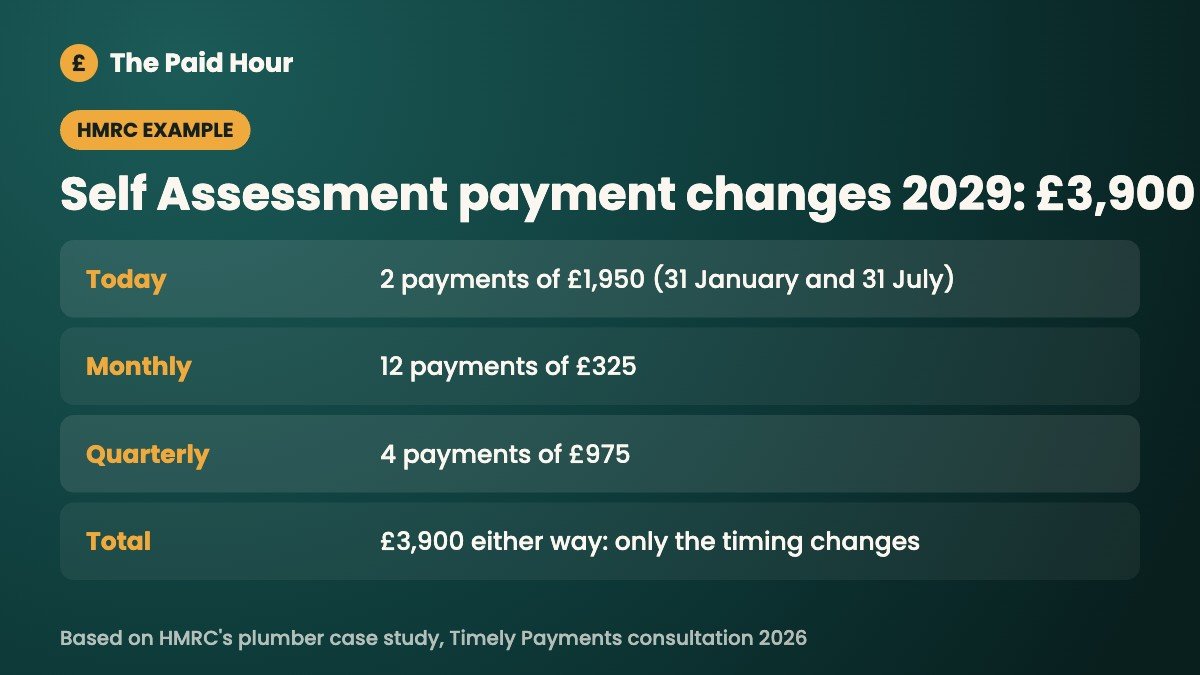
HMRC’s consultation used the example of a self-employed plumber with £25,000 of profit and an estimated tax and National Insurance bill of £3,900 for 2029/30. Spread through the year, that is:
| Frequency | Each payment | Payments a year |
|---|---|---|
| Monthly | £325 | 12 |
| Quarterly | £975 | 4 |
| Today (payments on account) | £1,950 | 2 |
Worked example: a freelancer with a job
Sam works part-time on PAYE and runs a design business on the side. His Self Assessment bill on the business is about £2,400 a year. So he makes payments on account of £1,200 in January and July. From April 2029, he can choose to have his estimated Self Assessment tax collected through his PAYE tax code, about £200 a month, or pay HMRC directly on the new automated schedule. Either way, the total is the same. The difference is when the money leaves his account.
For Sam, PAYE might feel easiest, because the tax is gone before his wages land. But if his design income drops, he needs to update his forecast quickly so his tax code does not over-collect. HMRC says forecasts will start from your latest return and you will be able to update them when your circumstances change.
The switch-year squeeze
The total tax does not change under the Self Assessment payment changes 2029. The timing does. In the switch year you are likely to pay what is left of the old year alongside the first new in-year payments. Some advisers have warned this could mean paying the equivalent of up to 200% of a year’s tax within 12 months, unless HMRC spreads it.
| When | Old system only | With new in-year payments (illustration) |
|---|---|---|
| 31 January 2029 | Balance 2027/28 + 1st payment on account 2028/29 | Same |
| 31 July 2029 | 2nd payment on account 2028/29 | Same, or spread over months |
| April 2029 – March 2030 | Nothing | Monthly or quarterly payments for 2029/30 |
| 31 January 2030 | Balance 2028/29 + 1st payment on account 2029/30 | Balance 2028/29 only |
HMRC has floated ways to soften this. Using Budget Payment Plans, spreading the July 2029 payment over 4, 6 or 12 months, and letting people make voluntary prepayments before the change. HMRC has not confirmed any of them yet.
If your income goes up and down
HMRC’s consultation flagged seasonal and irregular earners as a group that needs care. A wedding photographer who earns most of her money between May and September could find equal monthly payments hard in winter. Until the rules are final, the safest plan is a tax pot that you fill in good months and draw from in quiet ones. Expect to be able to adjust your estimate during the year, but do not rely on it.
If you are new to self-employment
New taxpayers do not usually make payments on account in their first year, because there is no previous bill to base them on. That is why the first January can be so painful. HMRC has said it wants a workable first-year model under the new system. If you start trading before 2029, the current rules apply, so plan for the 150% January bill.
How this fits with Making Tax Digital
Making Tax Digital for Income Tax already asks many sole traders and landlords to send quarterly updates, and each update shows a tax estimate. Paying during the year is the natural next step: HMRC will see your income sooner and can ask for tax sooner. If you are in MTD, use your quarterly estimates as a practice run for in-year payments. If you join MTD at £30,000 in April 2027 or £20,000 in April 2028, you will have a year or two of estimates before the payment change arrives. See how MTD works for sole traders.
What it means if you employ staff
HMRC’s consultation flagged employers as a group to watch, because collecting more Self Assessment tax through PAYE can raise the amount an employer pays over to HMRC each month. With PAYE now an opt-in, the effect should be smaller than first feared. If you run payroll for a small business, keep an eye on HMRC’s employer bulletins while HMRC finalises the rules.
Self Assessment payment changes 2029: switch-year cash estimator
Illustration only, assuming the same bill each year. Final rules are not published yet.
How to prepare for the Self Assessment payment changes 2029
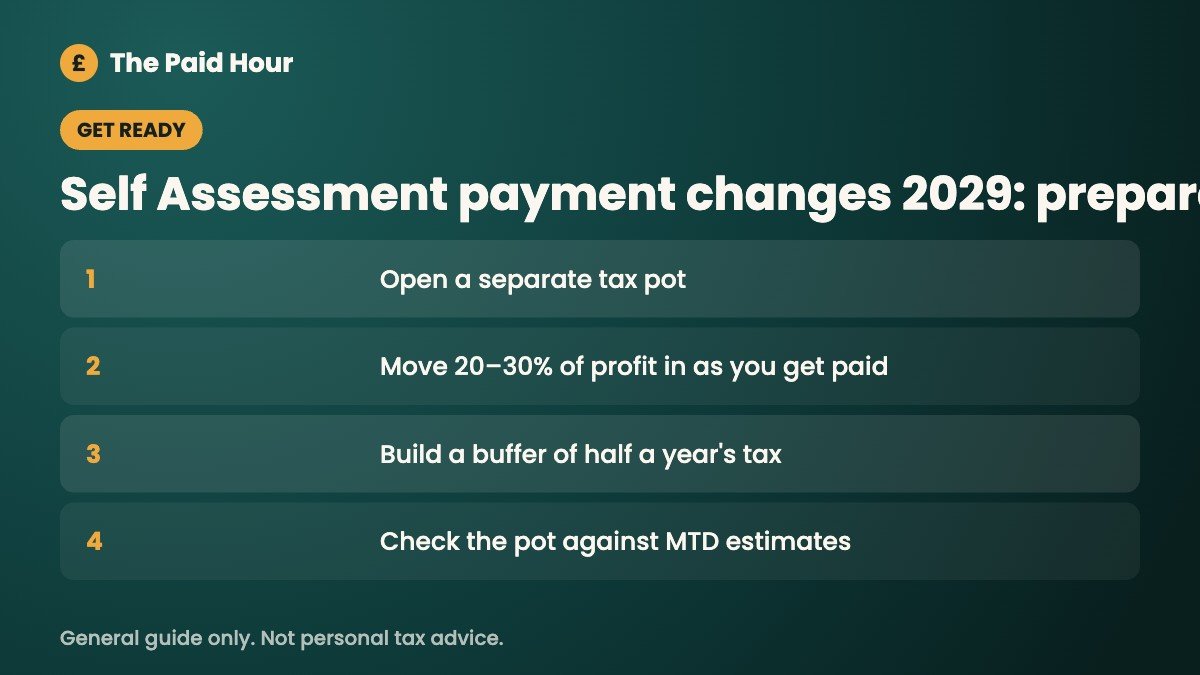
- Open a separate tax pot. Move a fixed share of every payment you receive into it the day it arrives.
- Use the right percentage. Many basic-rate sole traders need 20% to 30% of profit. Work yours out with how much to save for tax.
- Build a buffer of half a year’s tax before April 2029 to absorb the switch year.
- Use MTD estimates. If you are in Making Tax Digital, each quarterly update shows your tax so far. Use it to check the pot.
- Smooth irregular income. If your income swings, see budgeting with irregular income.
A business account with built-in tax pots makes step one automatic. Tide lets sole traders set aside money in separate pots. Affiliate link: we may earn a commission at no cost to you.
What is still not decided
- Whether direct payments will be monthly, quarterly or your choice.
- How the July 2029 payment on account will be spread, if at all.
- How forecasts will work for people whose income rises or falls sharply.
- How new self-employed people will be brought in during their first year.
- Whether HMRC will require Direct Debit.
We will update this guide as soon as HMRC publishes the detailed design of the Self Assessment payment changes 2029. The date at the top of the page shows the last check.
What does not change yet
- 2026/27, 2027/28 and 2028/29: 31 January and 31 July payment dates as now.
- You can still ask HMRC for a Time to Pay arrangement if you cannot pay in full.
- The Self Assessment return deadline stays 31 January.
What happens next
HMRC said it would publish a summary of responses to its Timely Payments consultation in autumn 2026. And the Budget has now set the direction. The next steps are detailed design work with taxpayers, agents and software providers, followed by legislation in a future Finance Bill. Expect the payment frequency, the forecasting rules and the transition support to be announced well before April 2029, because payroll and accounting software will need time to build them.
In the meantime, the best protection is a habit, not a rule. If you already move a share of every invoice into a separate tax pot, the Self Assessment payment changes 2029 will feel like a small shift in timing. If you rely on finding the money each January, start building that habit now, while you still have two or three years of the current system to practise on.
We will add the confirmed details to this page as soon as HMRC publishes them, including worked examples for monthly and quarterly payments and what to do if your income changes partway through the year.
Frequently asked questions
What are the Self Assessment payment changes in 2029?
From April 2029, people who make payments on account will make more regular, automated payments during the tax year instead of two payments in January and July. People with enough PAYE income can choose to pay through PAYE.
Will I pay Self Assessment tax monthly from 2029?
Possibly. HMRC’s consultation put forward monthly or quarterly payments. The frequency has not been confirmed yet.
Will my Self Assessment tax be taken through my PAYE tax code?
Only if you choose. Budget 2026 confirmed that paying through PAYE will be an option for people with enough PAYE income, not automatic.
Will I pay double tax in the switch year?
Your total tax does not change, but you may pay the last old-style payment alongside new in-year payments. HMRC is considering spreading the July 2029 payment to ease this.
Does anything change before 2029?
No. Payments on account stay on 31 January and 31 July for 2026/27, 2027/28 and 2028/29.
Sources
- HMRC, Budget 2026 overview of tax legislation and rates (section 2.31)
- HMRC, Timely payments in Income Tax Self Assessment (consultation)
- HMRC, Timely payments in Income Tax Self Assessment factsheet
- HM Treasury, Budget 2026
Filing it yourself this year?
HMRC Tax & Expense Mastery 2026/27. Nine modules and eleven working templates that take a UK freelancer from “do I even need to register” to a correct return, with MTD quarters built in.
- Fifteen expense categories, with the trap inside each one (training, clothing, meals, the seven-year pre-trading rule)
- Home and vehicle: flat rate against actual cost, with the £312 break-even worked out and the mileage lock-in rule
- The year-one payments-on-account cash shock, and the routine that stops it landing twice
HMRC does not send a list of what you forgot to claim. Most freelancers leave several hundred pounds of legitimate expenses on the table every single year, and the return still gets filed.
Buying more than one? The Complete Freelancer System, all five for £87, against £193 bought separately.