

You can take £1,000 of trading income a year tax free, and that £1,000 is what goes in the till, not what you keep. A stall trading in December 2026 sits in the 2026/27 tax year: tell HMRC by 5 October 2027, file and pay by 31 January 2028. GOV.UK trading allowance guidance, checked 11 September 2026.
Most advice on Christmas market stall tax opens with profit. HMRC’s threshold does not look at profit at all. It looks at gross takings, and three busy weekends will clear £1,000 without you noticing. Cross that line and you have to register, even if the stall lost money once the pitch fees and the wax and the parking are counted.
The £1,000 is turnover, not profit
The trading allowance is £1,000 of gross trading income in a tax year. Gross means before anything comes off. GOV.UK is blunt about what follows: if your trading income is more than £1,000 you have to register for Self Assessment, and you register by 5 October in the following tax year.
One detail catches people every year. The allowance is per person, across everything you trade, not per stall and not per market. Candles at a church hall fair, a bit of weekend dog walking and £40 from a car boot all count towards the same £1,000. Under it, you do not need to tell HMRC, though you still have to keep records of the income.
Then there is the swap. You can have the £1,000 allowance, or you can deduct your real costs. Not both. GOV.UK puts it in one line: “You cannot claim expenses if you use your £1,000 tax-free trading allowance.” For a stall carrying actual stock, that choice is usually worth more than people assume, and the arithmetic is further down. If what you are selling is stuff you already owned rather than things you bought or made to sell, that is a different question, and our guide to the badges of trade is where the line sits.
HMRC pushes this out most Novembers. The 2025 release, dated 12 November, named the activities by hand: handmade Christmas decorations, upcycled furniture, a seasonal market stall. I rechecked the allowance page on 11 September 2026 and the wording has not moved.
Which tax year a December stall lands in
A stall trading in November and December 2026 falls in the 2026/27 tax year, which runs 6 April 2026 to 5 April 2027. Nothing at all is due in December.
The run of dates goes like this. You have to tell HMRC by 5 October 2027. A paper return has to reach them by 31 October 2027. The online return is due by 11:59pm on 31 January 2028 and the tax is due the same night. If you want the bill collected through a PAYE tax code instead, the return has to be in by 30 December 2027. Register late and HMRC gives you a separate filing deadline of three months from the notice, but the tax is still due on 31 January.
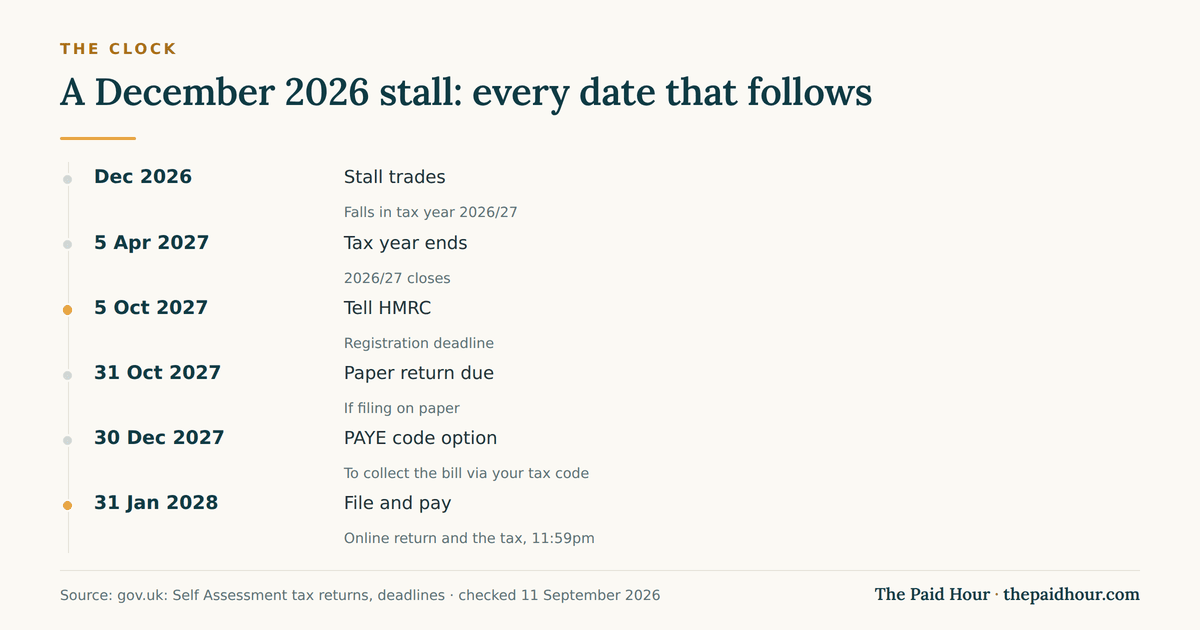
Fourteen months between the market and the registration deadline is the actual risk. Registering takes minutes. Remembering to, ten months after you packed the gazebo away, does not. Our guide to registering as a sole trader with HMRC covers the form.
What a Christmas market stall costs you in tax
Nadia pours candles at home and books four events: three weekend markets and one late-night shopping evening. Across the four she takes £2,850, most of it on card. Her costs, all inside the GOV.UK list of allowable expenses:
- pitch fees, four events at £45 = £180
- wax, wicks, jars and labels = £940
- gazebo, folding table and a weighted base, bought in November = £210
- card reader fees as billed on her statements = £48
- 240 business miles at the 55p flat rate = £132
That is £1,510 of costs. Her profit is £2,850 minus £1,510, which is £1,340. Now the two routes, side by side.
| Same stall, two routes | Trading allowance | Actual costs |
|---|---|---|
| Takings | £2,850 | £2,850 |
| What you deduct | £1,000 | £1,510 |
| Taxable profit | £1,850 | £1,340 |
| Income tax at 20% | £370 | £268 |
| Difference over the year | – | £102 less tax |
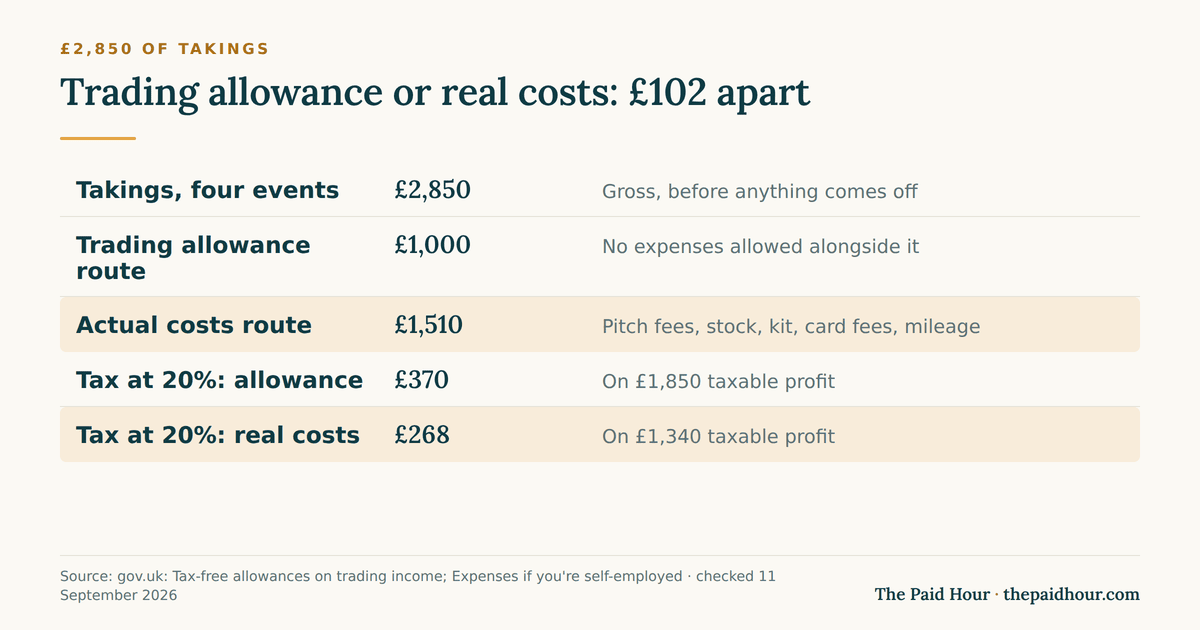
£510 lower taxable profit, £102 less tax. Not life changing. It is also four minutes of typing, and the gap widens fast as stock costs rise.
Two things follow. Her £1,340 profit is below the £7,105 small profits threshold, so Class 2 National Insurance is not treated as paid that year, and she can pay it voluntarily at £3.65 a week (£189.80 for the year) to keep the year on her State Pension record. Class 4 starts at £12,570 of profit, so it does not reach her. If she has a day job, the £1,340 stacks on her salary and is taxed at her existing top rate, which our free UK tax calculator shows in seconds. Doing both at once is common enough to have its own guide on being employed and self-employed at the same time.
Licences, food registration and the clock you did not know was running
HMRC is not the only body with a deadline. To trade from a stall at a market you need a licence from the local council, and the licence carries restrictions on when you can trade, where the stall must stand and what size it can be. Trading without one can mean prosecution, seized goods and a fine. Some organisers hold a blanket licence covering all pitches, some do not, and the only way to know is to ask the organiser in writing.
If you sell anything edible, and mulled wine, brownies and a bag of fudge all count, you must also register the food business with the council at least 28 days before you trade. Different body, different clock, no connection to your HMRC registration. Book a 6 December market on 20 November and you are already too late.
The licence fee, the pitch fee, the public liability cover the organiser insists on and the printing are all deductible if you go the actual-costs route. Keep the organiser’s invoice. It is the most commonly lost piece of paper in the whole exercise, because it arrives as a booking confirmation email rather than anything that looks like a receipt. Our list of allowable expenses covers the rest.
Cash, cards and records that have to survive to 2033
Self-employed records have to be kept for at least five years after the 31 January submission deadline for that tax year. For a December 2026 stall, filed by 31 January 2028, you are holding that paperwork until at least 31 January 2033. Our guide on how long to keep business records has the exceptions.
Cash is where this falls apart. A card reader hands you a statement. A cash tin hands you nothing, and “roughly two hundred” is not a record. Count the float out before you open, count it back in when you pack down, and write the difference down that evening while you still remember what the £20 went on.
If you also sell online, the platform reporting rules run in parallel. A platform reports a seller to HMRC once they pass 30 sales of goods in a calendar year or receive more than 2,000 euros (about £1,700). GOV.UK is careful to say that being reported does not automatically mean you owe tax. It does mean HMRC has a figure to hold against your return. The platform reporting rules guide covers what gets sent. If this is your first year with any self-employed income at all, the Side Hustle Tax Starter course takes the registration and the first return in order, which is the part most people get out of sequence.
Questions stallholders ask
Do I pay tax on a one-off Christmas market stall?
Only if your gross trading income for the whole tax year, every trading activity added together, comes to more than £1,000. Under that, nothing to register and nothing to pay, though you still keep records.
Can I use the £1,000 allowance and still claim my pitch fees?
No. GOV.UK is explicit that you cannot claim expenses if you use the trading allowance. Add your costs up first, then take whichever figure is bigger.
When do I have to register if my stall was in December 2026?
By 5 October 2027, because December 2026 sits in the 2026/27 tax year. The return and the payment are then both due by 31 January 2028.
The plan, in order
- Add up gross takings from every trading activity this tax year, not just the stall, and see whether the total clears £1,000.
- Total your real costs. If they beat £1,000, keep every receipt and forget the allowance.
- Ask the market organiser in writing whether their licence covers your pitch or whether you need your own from the council.
- If you are selling anything edible, register the food business with the council at least 28 days before your first event.
- Write cash takings down the same evening, every event, before the float gets mixed with your own money.
- Put “register with HMRC” in your calendar for September 2027, a month ahead of the 5 October deadline.
Sources
- GOV.UK: Tax-free allowances on property and trading income
- GOV.UK: Set up as a sole trader
- GOV.UK: Self Assessment tax returns, deadlines
- GOV.UK: Expenses if you’re self-employed
- GOV.UK: Simplified expenses, vehicles
- GOV.UK: Self-employed National Insurance rates
- GOV.UK: Income Tax rates and Personal Allowances
- GOV.UK: Business records if you’re self-employed, how long to keep your records
- GOV.UK: Market stall licence
- GOV.UK: Register a food business
- GOV.UK: Selling goods or services on a digital platform
- GOV.UK: Christmas crafters urged to check tax rules (12 November 2025)
Figures checked against GOV.UK and HMRC guidance on 11 September 2026. This is general information, not financial or tax advice.
Do you actually owe HMRC anything yet?
Side Hustle Tax Starter 2026/27. A six-module starter course and six working templates that tell you, in an evening, whether you owe anything at all, and set up the twenty-minute monthly routine that keeps it that way.
- The nine badges of trade as questions you can answer about your own income
- What the platforms send HMRC, the small-seller exemption, and three reply letters for when a letter arrives
- A sales log with a running £1,000 alert, an allowance-versus-expenses sheet, and a tax set-aside calculator at 2026/27 rates
Selling platforms now hand your sales data to HMRC once a year. Selling your own old possessions is never taxable. Buying to resell, making things, or freelancing is. Knowing which side you are on is the whole question.
Buying more than one? All ten 2026/27 courses for £107, against £293 bought separately.